Questions

M.C.Q (1 Marks)

Take a timed test

17 questions · auto-graded multiple-choice test.

MCQ 11 Mark
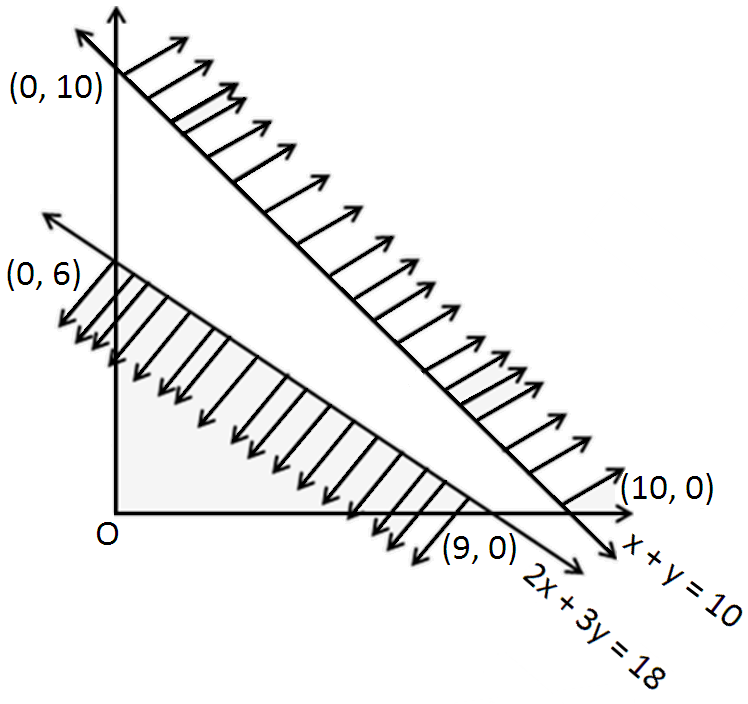
The maximum value of Z = 4x + 2y Subjected to the constraints $2\text{x}+3\text{y}\leq18,\text{x}+\text{y}\geq10,\text{x},\text{y}\geq0$ is:
  • A
    36
  • B
    40
  • C
    20
  • none of these
Answer
Correct option: D.
none of these
Consider, 2x + 3y = 18
x
y
(x, y)
0
6
(0, 6)
9
0
(9, 0)
Consider, x + y = 10
x
y
(x, y)
0
10
(0, 10)
10
0
(10, 0)
From the graph we conclude that no feasible region exist.
View full question & answer
MCQ 21 Mark
Objective function of a LPP is:
  • A
    a constraint
  • a function to be optimized
  • C
    a relation between the variables
  • D
    none of these
Answer
Correct option: B.
a function to be optimized
The objective function of a linear programming problem is either to be maximized or minimized i.e. objective function is to be optimized.
View full question & answer
MCQ 31 Mark
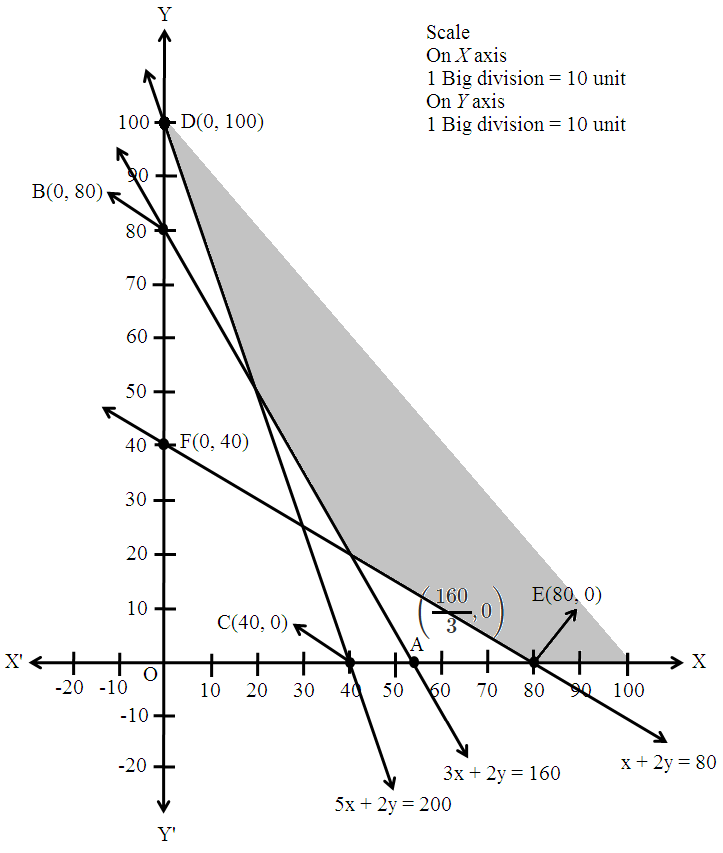
The maximum value of Z = 4x + 3y subjected to the constraints 3x + 2y ≥ 160, 5x + 2y ≥ 200, x + 2y ≥ 80, x, y ≥ 0 is:
  • A
    320
  • B
    300
  • C
    230
  • none of these
Answer
Correct option: D.
none of these
We need to maximize the function Z = 4x + 3y

Converting the given inequations into equations, we obtain

3x + 2y = 160, 5x + 2y = 200, x + 2y = 80, x = 0 and y = 0

Region represented by 3x + 2y ≥ 160:

The line 3x + 2y = 160 meets the coordinate axes at A1603,0 and B(0, 80) respectively.

By joining these points we obtain the line 3x + 2y = 160.

Clearly (0, 0) does not satisfies the inequation 3x + 2y ≥ 160.

So, the region in xy plane which does not contain the origin represents the solution set of the inequation 3x + 2y ≥ 160.

Region represented by 5x +2y ≥ 200:

The line 5x + 2y = 200 meets the coordinate axes at C(40, 0) and D(0, 100) respectively.

By joining these points we obtain the line 5x + 2y = 200.

Clearly (0, 0) does not satisfies the inequation 5x +2y ≥ 200.

So, the region which does not contain the origin represents the solution set of the inequation 5x +2y ≥ 200.

Region represented by x +2y ≥ 80:

The line x + 2y = 80 meets the coordinate axes at E(80, 0) and F(0, 40) respectively.

By joining these points we obtain the line x + 2y = 80.

Clearly (0, 0) does not satisfies the inequation x + 2y ≥ 80.

So, the region which does not contain the origin represents the solution set of the inequation x + 2y ≥ 80.

Region represented by x ≥ 0 and y ≥ 0:

Since, every point in the first quadrant satisfies these inequations.

So, the first quadrant is the region represented by the inequations x ≥ 0, and y ≥ 0.

The feasible region determined by the system of constraints 3x + 2y ≥ 160,5x+2y ≥ 200, x +2y ≥ 80, x ≥ 0, and y ≥ 0 are as follows.


Here, we see that the feasible region is unbounded.

Therefore,maximum value is infinity.
View full question & answer
MCQ 41 Mark
The corner points of the feasible region determined by the following system of linear inequalities:

2x + y ≤ 10, x + 3y ≤ 15, x, y ≥ 0 are (0, 0), (5, 0), (3, 4) and (0, 5).

Let Z = px + qy, where p.q > 0.

Condition on p and q so that the maximum of Z occurs at both (3, 4) and (0, 5) is:
  • A
    P = q
  • B
    p = 2q
  • C
    p = 3q
  • q = 3q
Answer
Correct option: D.
q = 3q
The maximum value of Z is unique.

It is given that the maximum value of Z occurs at two points (3, 4) and (0,5).

Value of Z at (3, 4) = Value of Z at (0,5)

= p(3) + q(4) = p(0) + 7(5)

= 3p + 4q = 5q

= q = 3p
View full question & answer
MCQ 51 Mark
The objective function Z = 4x + 3y can be maximised subjected to the constraints 3x + 4y ≤ 24, 8x + 6y ≤ 48, x ≤ 5, y ≤ 6, x, y ≥ 0
  • A
    at only one point
  • B
    at two points only
  • at an infinite number of points
  • D
    none of these
Answer
Correct option: C.
at an infinite number of points
We need to maximize Z = 4x + 3y

First, we will convert the given inequations into equations, we obtain the following equations: 3x + 4y = 24, 8x + 6y = 48, x = 5, y = 6, x = 0 and y = 0.

The line 3x + 4y = 24 meets the coordinate axis at A(8, 0) and B(0, 6).

Join these points to obtain the line 3x + 4y = 24.

Clearly, (0, 0) satisfies the inequation 3x + 4y ≤ 24.

So, the region in xy-plane that contains the origin represents the solution set of the given equation.

The line 8x + 6y = 48 meets the coordinate axis at C(6, 0) and D(0, 8).

Join these points to obtain the line 8x + 6y = 48.

Clearly, (0, 0) satisfies the inequation 8x + 6y ≤ 48.

So, the region in xy plane that contains the origin represents the solution set of the given equation.

x = 5 is the line passing through x = 5 parallel to the Y axis.

y = 6 is the line passing through y = 6 parallel to the X axis.

Region represented by x ≥ 0 and y ≥ 0:

Since, every point in the first quadrant satisfies these inequations.

So, the first quadrant is the region represented by the inequations.

These lines are drawn using a suitable scale.

and B (0,6).

The corner points of the feasible region are O(0, 0), G(5, 0), $\text{F}\Big(5,\frac{4}{3}\Big),\text{E}\Big(\frac{24}{7},\frac{24}{7}\Big)$and B(0, 6).

The values of Z at these corner points are as follows.
$\text{Corner point}$ $\text{Z} = 4\text{x} + 3\text{y}$
$\text{O}(0, 0)$ $4 \times 0 + 3 \times 0= 0$
$\text{G}(5, 0)$ $4 \times 5 + 3 \times 0 = 20$
$\text{F}\Big(5,\frac{4}{3}\Big)$ $4\times5+3\times\frac{4}{3}=24$
$\text{E}\Big(\frac{24}{7},\frac{24}{7}\Big)$ $4\times\frac{24}{7}+3\times\frac{24}{7}=\frac{196}{7}=24$
$\text{B}(0, 6)$ $4\times0+3\times6=18$
We see that the maximum value of the objective function Z is 24 which is at F(5, 4) and $\text{E}\Big(\frac{24}{7},\frac{24}{7}\Big).$

Thus, the optimal value of Z is 24.

As, we know that if a LPP has two optimal solution, then there are an infinite number of optimal solutions.

Therefore, the given objective function can be subjected at an infinite number of points.
View full question & answer
MCQ 61 Mark
The solution set of the inequation 2x + y > 5 is:
  • A
    half plane that contains the origin
  • open half plane not containing the origin
  • C
    whole xy-plane except the points lying on the line 2x + y = 5
  • D
    none of these
Answer
Correct option: B.
open half plane not containing the origin
On putting x = 0, y = 0 in the given inequality, we get 0 > 5, which is absurd.

Therefore, the solution set of the given inequality does not include the origin.

Thus, the solution set of the given inequality consists of the open half plane not containing the origin.
View full question & answer
MCQ 71 Mark
If the constraints in a linear programming problem are changed
  • the problem is to be re-evaluated
  • B
    solution is not defined
  • C
    the objective function has to be modified
  • D
    the change in constraints is ignored
Answer
Correct option: A.
the problem is to be re-evaluated

The optimisation of the objective function of a LPP is governed by the constraints.

Therefore, if the constraints in a linear programming problem are changed, then the problem needs to be re-evaluated.
View full question & answer
MCQ 81 Mark
Which of the following statements is correct?
  • A
    Every $\text{LPP}$ admits an optimal solution
  • B
    A $\text{ LPP}$ admits unique optimal solution
  • If a $\text{LPP}$ admits two optimal solution it has an infinite number of optimal solutions
  • D
    The set of all feasible solutions of a $\text{LPP}$ is not a converse set
Answer
Correct option: C.
If a $\text{LPP}$ admits two optimal solution it has an infinite number of optimal solutions
Optimal solution of $\text{LPP}$ has three types.
  1. Unique
  2. Infinite
  3. Does not exist.
Hence, it has infinite solution if it admits two optimal solution.
View full question & answer
MCQ 91 Mark
The optimal value of the objective function is attained at the points
  • A
    given by intersection of inequations with the axes only
  • B
    given by intersection of inequations with x-axis only
  • given by corner points of the feasible region
  • D
    none of these
Answer
Correct option: C.
given by corner points of the feasible region

It is known that the optimal value of the objective function is attained at any of the corner point.

Thus, the potimal value of the objective function is attined at the points given by corner points of the feasible region.
View full question & answer
MCQ 101 Mark
Consider a LPP given by
Minimum Z = 6x + 10y
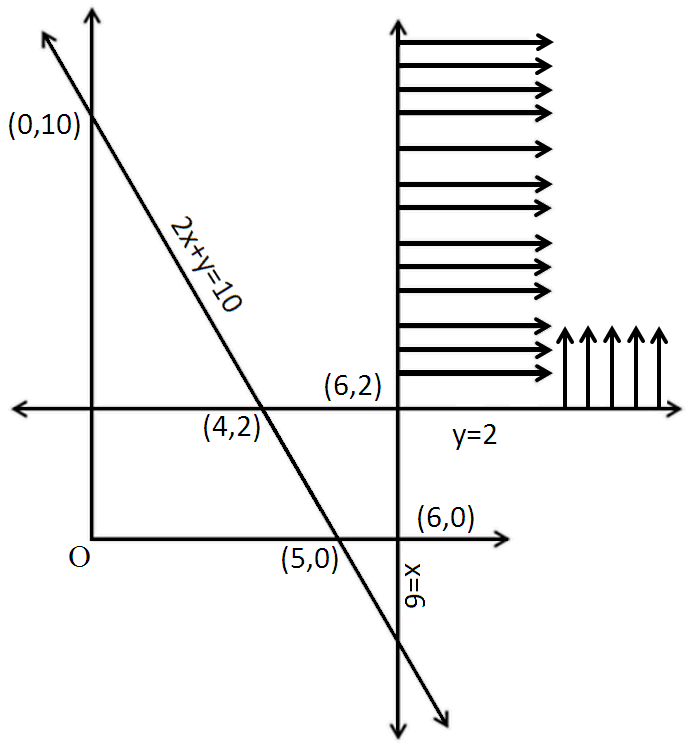
Subjected to x ≥ 6, y ≥ 2, 2x + y ≥ 10, x ≥ 0, y ≥ 0
Redundant constraints in this LPP are
  • A
    x ≥ 0, y ≥ 0
  • B
    x ≥ 6
  • 2x + y ≥ 10
  • D
    none of these
Answer
Correct option: C.
2x + y ≥ 10
Consider, x = 6

and y = 2

Now 2x + y = 10
x
y
(x, y)
0
10
(0, 10)
5
0
(5, 0)


Minimum Z will be at 2x + y ≥ 10.
View full question & answer
MCQ 111 Mark
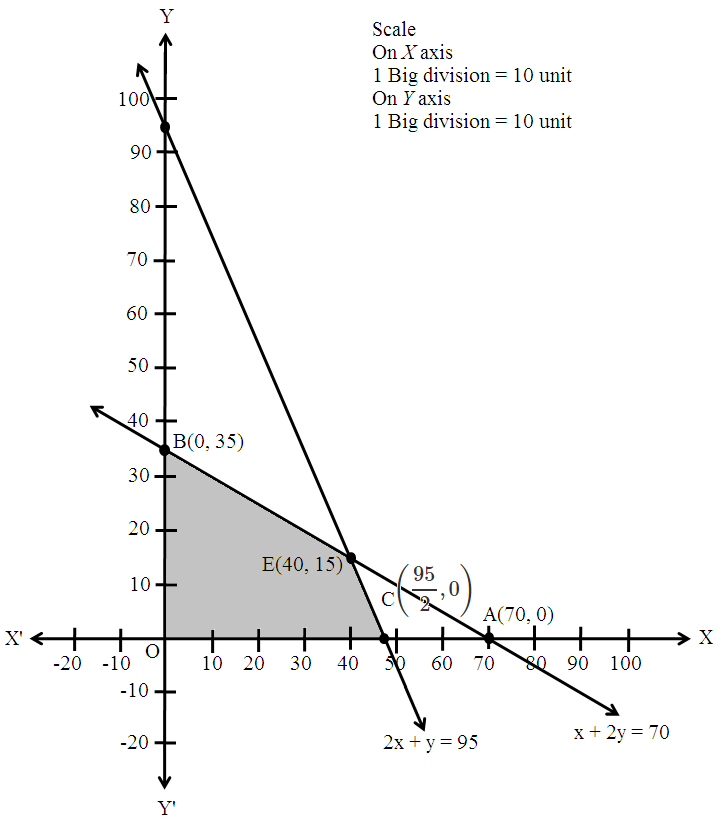
The point at which the maximum value of x + y, subject to the constraints x + 2y ≤ 70, 2x + y ≤ 95, x, y ≥ 0 isobtained, is:
  • A
    (30, 25)
  • B
    (20, 35)
  • C
    (35, 20)
  • (40, 15)
Answer
Correct option: D.
(40, 15)
We need to maximize the function

Z = x + y

Converting the given inequations into equations, we obtain x + 2y = 70, 2x + y = 95, x = 0 and y = 0

Region represented by x + 2y ≤ 70:

The line x + 2y = 70 meets the coordinate axes at A(70, 0) and B(0, 35) respectively.

By joining these points we obtain the line x + 2y = 70.

Clearly (0, 0) satisfies the inequation x + 2y ≤ 70.

So, the region containing the origin represents the solution set of the inequation x + 2y ≤ 70.

Region represented by 2x + y ≤ 95:

The line 2x + y = 95 meets the coordinate axes at $\text{C}\Big(\frac{95}{2},0\Big)$ and D(0, 95) respectively.

By joining these points we obtain the line 2x + y = 95.

Clearly (0, 0) satisfies the inequation 2x + y ≤ 95.

So, the region containing the origin represents the solution set of the inequation 2x + y ≤ 95.

Region represented by x ≥ 0 and y ≥ 0:

Since, every point in the first quadrant satisfies these inequations.

So, the first quadrant is the region represented by the inequations x ≥ 0, and y ≥ 0.

The feasible region determined by the system of constraints x + 2y ≤ 70, 2x + y ≤ 95, x ≥ 0, and y ≥ 0, are as follows.


The corner points of the feasible region are O(0, 0), $\text{C}\Big(\frac{95}{2},0\Big)$, E(40, 15) and B(0, 35).

The values of Z at these corner points are as follows.
$\text{Corner point}$ $\text{Z} = \text{x} + \text{y}$
$\text{O}(0, 0)$ $0 + 0 = 0$
$\text{C}\Big(\frac{95}{2},0\Big)$ $\frac{95}{2}+0,2=\frac{95}{2}$
$\text{E}(40, 1)$ $40 + 15 = 55$
$\text{B}(0, 35)$ $0 + 35 = 35$
We see that the maximum value of the objective function Z is 55 which is at (40, 15).
View full question & answer
MCQ 121 Mark
The value of objective function is maximum under linear constraints
  • A
    at the centre of feasible region
  • B
    at (0, 0)
  • at any vertex of feasible region
  • D
    the vertex which is maximum distance from (0, 0)
Answer
Correct option: C.
at any vertex of feasible region
In linear programming problem we substitute the coordinates of vertices of feasible region in the objective function and then we obtain the maximum or minimum value.

Therefore, the value of objective function is maximum under linear constraints at any vertex of feasible region.
View full question & answer
MCQ 131 Mark
Let $ X_1$ and $X_2$ are optimal solutions of a $\text{LPP},$ then:
  • A
    $\text{X}=\lambda\ \text{X}_1+(1-\lambda)\text{X}_2,\lambda\in R$ is also an optimal solution
     
  • $\text{X}=\lambda\ \text{X}_1+(1-\lambda)\text{X}_2,0\leq\lambda\leq1$ given an optimal solution
     
  • C
    $\text{X}=\lambda\ \text{X}_1+(1+\lambda)\text{X}_2,0\leq\lambda\leq1$ given an optimal solution
     
  • D
    $\text{X}=\lambda\ \text{X}_1+(1+\lambda)\text{X}_2,\lambda\in$ R given an optimal solution
Answer
Correct option: B.
$\text{X}=\lambda\ \text{X}_1+(1-\lambda)\text{X}_2,0\leq\lambda\leq1$ given an optimal solution
 
set $A$ is convex if, for any two points $X_1, X_2 \in\text{A}$ and $\lambda\in0,1$ imply that $\lambda\times1+1-\lambda\times2\in\text{A}$.
Since, here $X_1$ and $X_2$ are optimal solution
Therefore, their convex combination will also be an optimal solution
Thus, $\text{X}=\lambda\ \text{X}_1+(1-\lambda)\text{X}_2,0\leq\lambda\leq1$ gives an optimal solution.
View full question & answer
MCQ 141 Mark
Which of the following is not a convex set?
  • $\{(x, y) ; 2x + 5y \leq 7\}$
     
  • B
    $\{(x, y) : x^{_2} + y^2 \leq 4\}$
     
  • C
    $\{x : |x| = 5\}$
     
  • D
    $\{(x, y) : 3x^2 + 2y^2 \leq 6\}$
Answer
Correct option: A.
$\{(x, y) ; 2x + 5y \leq 7\}$
 
$|x| = 5$ is not a convex set as any two points from negative and positive $x-$ axis if are joined will not lie in set.
View full question & answer
MCQ 151 Mark
Which of the following sets are convex?
  • A
    $\{(\text{x},\text{y}):\text{x}^2+\text{y}^2\geq1\}$
  • B
    $\{(\text{x},\text{y}):\text{y}^2\geq\text{x}\}$
  • C
    $\{(\text{x},\text{y}):3\text{x}^2+4\text{y}^2\geq5\}$
  • $\{(\text{x},\text{y}):\text{y}\geq2,\text{y}\leq4\}$
Answer
Correct option: D.
$\{(\text{x},\text{y}):\text{y}\geq2,\text{y}\leq4\}$
is the region between two parallel lines, so any line segment joining any two points in it lies in it.

Hence, it is a convex set.
View full question & answer
MCQ 161 Mark
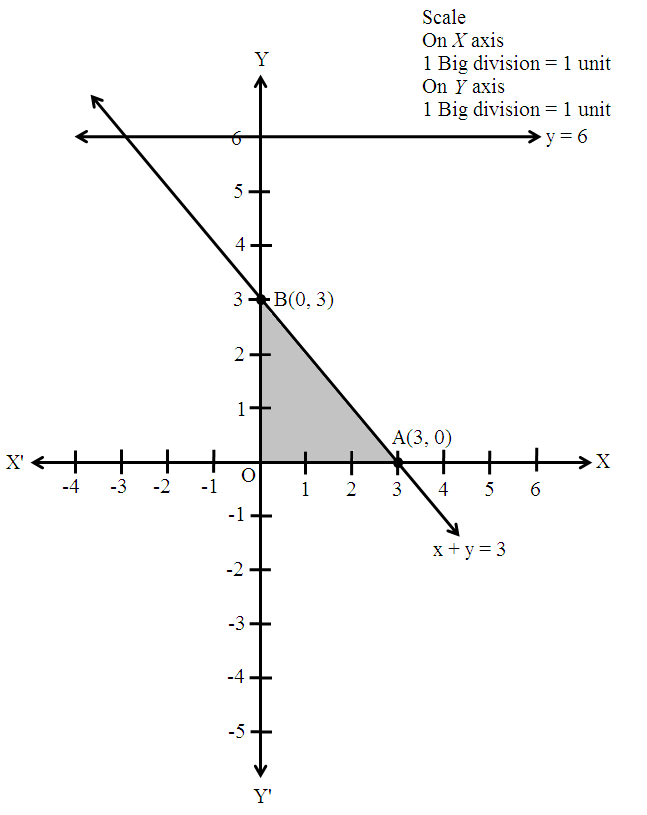
The region represented by the inequation system x, y ≥ 0, y ≤ 6, x + y ≤ 3 is:
  • A
    unbounded in first quadrant
  • B
    unbounded in first and second quadrants
  • bounded in first quadrant
  • D
    none of these
Answer
Correct option: C.
bounded in first quadrant
Converting the given inequations into equations, we obtain
y = 6, x + y = 3, x = 0 and y = 0

y = 6 is the line passing through (0, 6) and parallel to the X axis.

The region below the line y = 6 will satisfy the given inequation.

The line x + y = 3 meets the coordinate axis at A(3, 0) and B(0, 3).

Join these points to obtain the line x + y = 3

Clearly, (0, 0) satisfies the inequation x + y ≤ 3.

So, the region in xy-plane that contains the origin represents the solution set of the given equation.

Region represented by x ≥ 0 and y ≥ 0:

Since, every point in the first quadrant satisfies these inequations.

So, the first quadrant is the region represented by the inequations.

These lines are drawn using a suitable scale.


The shaded region represents the feasible region of the given LPP, which is bounded in the first quadrant.
View full question & answer
MCQ 171 Mark
By graphical method, the solution of linear programming problem Maximize $Z = 3x_1 + 5x_2$ Subject to $3x_1 + 2x_2 \leq 18 , x_1 \leq 4 , x_2 \leq 6 x , 1 \geq 0, x2 \geq 0,$ is:
  • A
    $x_1 = 2, x_2 = 0, Z = 6$
  • $x_1 = 2, x_2 = 6, Z = 36$
  • C
    $x_1 = 4, x_2 = 3, Z = 27$
  • D
    $x_1 = 4, x_2 = 6, Z = 42$
Answer
Correct option: B.
$x_1 = 2, x_2 = 6, Z = 36$
We need to maximize the function $Z = 3x_4 + 5x_2$
First, we will convert the given inequations into equations, we obtain the following equations:
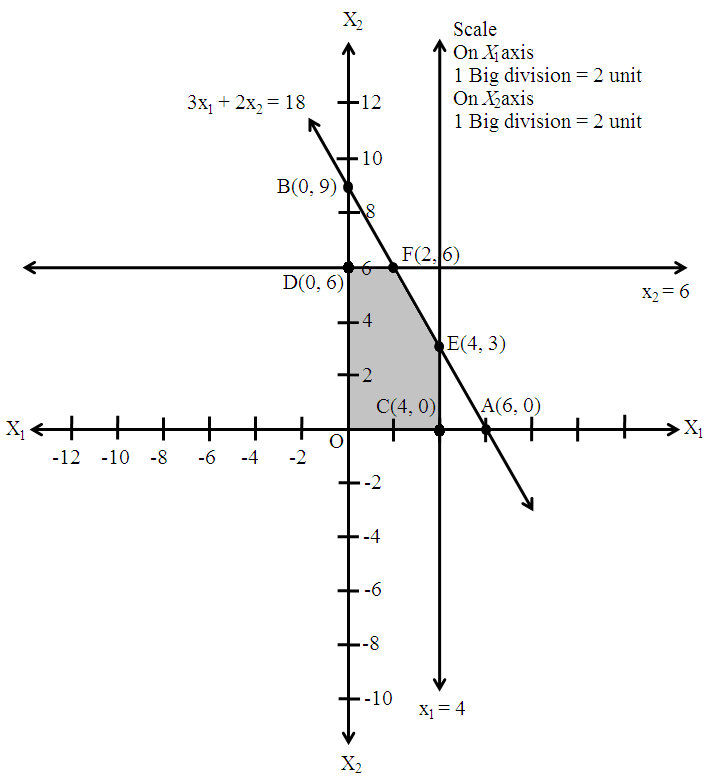
$3x_1 + 2x_2 = 18, x_1 = 4, x_2 = 6, x_1 = 0$ and $x_2 = 0$
Region represented by $3x_1 + 2x_2 \leq 18:$
The line $3x_1 + 2x_2 = 18$ meets the coordinate axes at $A(6, 0)$ and $B(0, 9)$ respectively.
By joining these points we obtain the line $3x1 + 2x2 = 18.$
Clearly $(0, 0)$ satisfies the inequation $3x_1 + 2x_2 = 18.$
So the region in the plane which contain the origin represents the solution set of the inequation $3x_1 + 2x_2 \leq 18.$
Region represented by $x_1 \leq 4:$
The line $x_1 = 4$ is the line that passes through $C(4, 0)$ and is parallel to the Y axis.
The region to the left of the line $x_1 = 4$ will satisfy the inequation $x_1 \leq 4.$
Region represented by $x_2 \leq 6:$
The line $x_2 = 6$ is the line that passes through $D(0, 6)$ and is parallel to the $X$ axis.
The region below the line $x_2 = 6$ will satisfy the inequation $X_2 \leq 6.$
Region represented by $x_1 \geq 0$ and $x_2 \geq 0:$
Since, every point in the first quadrant satisfies these inequations.
So, the first quadrant is the region represented by the inequations $x_1 \geq 0$ and $x_2 \geq 0.$
The feasible region determined by the system of constraints, $3x_1 + 2x_2 \leq 18, x_1 \leq 4, x_2 \leq 6, x_1 \geq 0$ and $x_2 \geq $0 are as follows

Corner points are $O(0, 0), D(0, 6), F(2, 6), E(4, 3)$ and $C(4, 0).$
The values of the objective function at these points are given in the following table.
Points
Value of $Z$
$O(0, 0)$
$3(0) + 5(0) = 0$
$D(0, 6)$
$3(0) + 5(6) = 30$
$F(2, 6)$
$3(2) + 5(6) = 36$
$E(4, 3)$
$3(4) + 5(3) = 27$
$C(4, 0)$
$3(4) + 5(0) = 12$
We see that the maximum value of the objective function $Z$ is $36$ which is at $F(2, 6).$
View full question & answer