Question 13 Marks
Find the matrix $X$ so that $X\left[\begin{array}{lll}1 & 2 & 3 \\ 4 & 5 & 6\end{array}\right]=\left[\begin{array}{ccc}-7 & -8 & -9 \\ 2 & 4 & 6\end{array}\right]$
AnswerLet $X = \left[ {\begin{array}{*{20}{c}} a&b \\ c&d \end{array}} \right]$
$\therefore \;\left[ {\begin{array}{*{20}{c}} a&b \\ c&d \end{array}} \right]\left[ {\begin{array}{*{20}{c}} 1 \\ 4 \end{array}\;\;\begin{array}{*{20}{c}} 2 \\ 5 \end{array}\;\;\begin{array}{*{20}{c}} 3 \\ 6 \end{array}} \right] = \left[ {\begin{array}{*{20}{c}} { - 7} \\ 2 \end{array}\;\;\begin{array}{*{20}{c}} { - 8} \\ 4 \end{array}\;\;\begin{array}{*{20}{c}} { - 9} \\ 6 \end{array}} \right]$
$\left[ {\begin{array}{*{20}{c}} {a + 4b} \\ {c + 4d} \end{array}\;\;\begin{array}{*{20}{c}} {2a + 5b} \\ {2c + 5d} \end{array}\;\;\begin{array}{*{20}{c}} {3a + 6b} \\ {3c + 6d} \end{array}} \right] = \left[ {\begin{array}{*{20}{c}} { - 7} \\ 2 \end{array}\;\;\begin{array}{*{20}{c}} { - 8} \\ 4 \end{array}\;\;\begin{array}{*{20}{c}} { - 9} \\ 6 \end{array}} \right]$
On solving a + 4b = -7 and 2a + 5b = -8 & c + 4d = 2 and 2c + 5d = 4
we get a = 1, b = -2, c = 2, d = 0
$X = \left[ {\begin{array}{*{20}{c}} 1&{ - 2} \\ 2&0 \end{array}} \right]$
View full question & answer→Question 23 Marks
A manufacturer produces three products, x, y, z which he sells in two markets. Annual sales are indicated below:
| Market | Products |
| I | 10000 | 2,000 | 18,000 |
| II | 6000 | 20,000 | 8,000 |
- If unit sale prices of x, y and z are Rs 2.50, Rs 1.50 and Rs 1.00 respectively, find the total revenue in each market with the help of matrix algebra.
- If the unit costs of the above three commodities are Rs 2.00, Rs 1.00 and 50 paise respectively. Find the gross profit.
AnswerAccording to question, the matrix $A = \left[ \begin{gathered} \begin{array}{*{20}{c}} {\mathop {10,000}\limits^x }&{\mathop {2,000}\limits^y }&{\mathop {18,000}\limits^z } \end{array} \hfill \\ \begin{array}{*{20}{c}} {6,000}&{20,000}&{8,000} \end{array} \hfill \\ \end{gathered} \right]$
- Let B be the column matrix representing sale price of each unit of products x, y, z.
Then, $B = {\left[ {\begin{array}{*{20}{c}} {2.5} \\ {1.5} \\ 1 \end{array}} \right]_{3 \times 1}}$
Now Revenue = Sale price * Number of items sold
$\Rightarrow \left[ \begin{gathered} \begin{array}{*{20}{c}} {10,000}&{2,000}&{18,000} \end{array} \hfill \\ \begin{array}{*{20}{c}} {6,000}&{20,000}&{8,000} \end{array} \hfill \\ \end{gathered} \right]\left[ {\begin{array}{*{20}{c}} {2.5} \\ {1.5} \\ 1 \end{array}} \right]$$= \left[ {\begin{array}{*{20}{c}} {25,000 + 3,000 + 18,000} \\ {15,000 + 30,000 + 8,000} \end{array}} \right] = \left[ {\begin{array}{*{20}{c}} {46,000} \\ {53,000} \end{array}} \right]$
Therefore, the revenue collected by sale of all items in Market I = Rsb 46,000 and the revenue collected by sale of all items in Market II = Rs 53,000. - Let C be the column matrix representing cost price of each unit of products x, y, z.
Then $C = {\left[ {\begin{array}{*{20}{c}} 2 \\ 1 \\ {0.5} \end{array}} \right]_{3 \times 1}}$
$\therefore$ Total cost = AC = $\left[ \begin{gathered} \begin{array}{*{20}{c}} {10,000}&{2,000}&{18,000} \end{array} \hfill \\ \begin{array}{*{20}{c}} {6,000}&{20,000}&{8,000} \end{array} \hfill \\ \end{gathered} \right]\left[ {\begin{array}{*{20}{c}} 2 \\ 1 \\ {0.5} \end{array}} \right]$
$ = \left[ {\begin{array}{*{20}{c}} {20,000 + 2,000 + 9,000} \\ {12,000 + 20,000 + 4,000} \end{array}} \right] = \left[ {\begin{array}{*{20}{c}} {31,000} \\ {36,000} \end{array}} \right]$
$\therefore$The profit collected in two markets is given in matrix form as
Profit matrix = Revenue matrix – Cost matrix
$ \Rightarrow \left[ {\begin{array}{*{20}{c}} {46,000} \\ {53,000} \end{array}} \right] - \left[ {\begin{array}{*{20}{c}} {31,000} \\ {36,000} \end{array}} \right] = \left[ {\begin{array}{*{20}{c}} {15,000} \\ {17,000} \end{array}} \right]$
Therefore, the gross profit in both the markets = Rs 15000 + Rs 17000 = Rs 32,000
View full question & answer→Question 33 Marks
Find $x$, if $\left[\begin{array}{lll}x & -5 & -1\end{array}\right]\left[\begin{array}{lll}1 & 0 & 2 \\ 0 & 2 & 1 \\ 2 & 0 & 3\end{array}\right]\left[\begin{array}{l}x \\ 4 \\ 1\end{array}\right]=0$
AnswerGiven: $\left[ {\begin{array}{*{20}{c}} x&{ - 5}&{ - 1} \end{array}} \right]\left[ {\begin{array}{*{20}{c}} 1&0&2 \\ 0&2&1 \\ 2&0&3 \end{array}} \right]\left[ {\begin{array}{*{20}{c}} x \\ 4 \\ 1 \end{array}} \right] = 0$
$\Rightarrow \left[ {\begin{array}{*{20}{c}} {x - 0 - 2}&{0 - 10 - 0}&{2x - 5 - 3} \end{array}} \right]\left[ {\begin{array}{*{20}{c}} x \\ 4 \\ 1 \end{array}} \right] = 0$
$\Rightarrow \left[ {\begin{array}{*{20}{c}} {x - 2}&{ - 10}&{2x - 8} \end{array}} \right]\left[ {\begin{array}{*{20}{c}} x \\ 4 \\ 1 \end{array}} \right] = 0$
$\Rightarrow [(x - 2)x - 10(4) + (2x - 8)1] = 0$
$\Rightarrow [x^2 - 2x - 40 + 2x - 8] = 0$
$\Rightarrow {\left[ {{x^2} - 48} \right]_{1 \times 1}} = {\left[ 0 \right]_{1 \times 1}}$
Equating corresponding entries, we have
$x^2 - 48 = 0$
$\Rightarrow x^2 = 48$
$\Rightarrow x = \pm 4\sqrt 3$
View full question & answer→Question 43 Marks
If $A=\left[\begin{array}{cc}3 & 1 \\ -1 & 2\end{array}\right]$ show that $\mathrm{A}^2-5 \mathrm{~A}+7 \mathrm{I}=0$
AnswerGiven: $A = \left[ {\begin{array}{*{20}{c}} 3&1 \\ { - 1}&2 \end{array}} \right]$
$\therefore A^2 – 5A + 7I = \left[ {\begin{array}{*{20}{c}} 3&1 \\ { - 1}&2 \end{array}} \right]\left[ {\begin{array}{*{20}{c}} 3&1 \\ { - 1}&2 \end{array}} \right] - 5\left[ {\begin{array}{*{20}{c}} 3&1 \\ { - 1}&2 \end{array}} \right] + 7\left[ {\begin{array}{*{20}{c}} 1&0 \\ 0&1 \end{array}} \right]$
$ = \left[ {\begin{array}{*{20}{c}} {9 - 1}&{3 + 2} \\ { - 3 - 2}&{ - 1 + 4} \end{array}} \right] - \left[ {\begin{array}{*{20}{c}} {15}&5 \\ { - 5}&{10} \end{array}} \right] + \left[ {\begin{array}{*{20}{c}} 7&0 \\ 0&7 \end{array}} \right]$ $ = \left[ {\begin{array}{*{20}{c}} 8&5 \\ { - 5}&3 \end{array}} \right] - \left[ {\begin{array}{*{20}{c}} {15}&5 \\ { - 5}&{10} \end{array}} \right] + \left[ {\begin{array}{*{20}{c}} 7&0 \\ 0&7 \end{array}} \right]$
$ = \left[ {\begin{array}{*{20}{c}} {8 - 15}&{5 - 5} \\ { - 5 + 5}&{3 - 10} \end{array}} \right] + \left[ {\begin{array}{*{20}{c}} 7&0 \\ 0&7 \end{array}} \right]$ $ = \left[ {\begin{array}{*{20}{c}} { - 7}&0 \\ 0&{ - 7} \end{array}} \right] + \left[ {\begin{array}{*{20}{c}} 7&0 \\ 0&7 \end{array}} \right]$ $ = \left[ {\begin{array}{*{20}{c}} { - 7 + 7}&{0 + 7} \\ {0 + 7}&{ - 7 + 7} \end{array}} \right]$
$ = \left[ {\begin{array}{*{20}{c}} 0&0 \\ 0&0 \end{array}} \right]$
$\therefore $ L.H.S= R.H.S. Hence Proved.
View full question & answer→Question 53 Marks
Find the values of $\mathrm{x}, \mathrm{y}, \mathrm{z}$ if the matrix $A=\left[\begin{array}{ccc}0 & 2 y & z \\ x & y & -z \\ x & -y & z\end{array}\right]$ satisfy the equation $\mathrm{A}^{\prime} \mathrm{A}=\mathrm{I}$.
AnswerIt is given that: $A = \left[ {\begin{array}{*{20}{c}} 0&{2y}&z \\ x&y&{ - z} \\ x&{ - y}&z \end{array}} \right]$
$ \Rightarrow A' = \left[ {\begin{array}{*{20}{c}} 0&x&x \\ {2y}&y&{ - y} \\ z&{ - z}&z \end{array}} \right]$
From the given question, $A'.A = I \Rightarrow \left[ {\begin{array}{*{20}{c}} 0&x&x \\ {2y}&y&{ - y} \\ z&{ - z}&z \end{array}} \right]\left[ {\begin{array}{*{20}{c}} 0&x&x \\ {2y}&y&{ - y} \\ z&{ - z}&z \end{array}} \right]$
$ = \left[ {\begin{array}{*{20}{c}} 1&0&0 \\ 0&1&0 \\ 0&0&1 \end{array}} \right]$
$ \Rightarrow \left[ {\begin{array}{*{20}{c}} {0 + {x^2} + {x^2}}&{0 + xy - xy}&{0 - xy + xz} \\ {0 + xy - xy}&{4{y^2} + {y^2} + {y^2}}&{2yz - yz - yz} \\ {0 - zx + zx}&{2yz - yz - yz}&{{z^2} + {z^2} + {z^2}} \end{array}} \right]$
$ = \left[ {\begin{array}{*{20}{c}} 1&0&0 \\ 0&1&0 \\ 0&0&1 \end{array}} \right]$
$ \Rightarrow \left[ {\begin{array}{*{20}{c}} {2{x^2}}&0&0 \\ 0&{6{y^2}}&0 \\ 0&0&{3{z^2}} \end{array}} \right] = \left[ {\begin{array}{*{20}{c}} 1&0&0 \\ 0&1&0 \\ 0&0&1 \end{array}} \right]$
Equating corresponding entries,we obtain
$2x^2 = 1 \Rightarrow {x^2} = \frac{1}{2} \Rightarrow x = \pm \frac{1}{{\sqrt 2 }}$
And $6y^2 = 1 \Rightarrow {y^2} = \frac{1}{6} \Rightarrow y = \pm \frac{1}{{\sqrt 6 }}$
And $3z^2 = 1 \Rightarrow {z^2} = \frac{1}{3} \Rightarrow z = \pm \frac{1}{{\sqrt 3 }}$
$\therefore x = \pm \frac{1}{{\sqrt 2 }},\;y = \pm \frac{1}{{\sqrt 6 }},\;Z = \pm \frac{1}{{\sqrt 3 }}$
View full question & answer→Question 63 Marks
Matrices $A$ and $B$ will be inverse of each other only if
AnswerHere it is given that $A\ \&\ B$ are inverse of each other.
$\therefore A^{-1} = B ...(i)$
Also $B^{-1} = A ...(ii)$
From definition of inverse matrix, we know that-
$AA^{-1} = I$
$\therefore A^{-1} = B ...$from eq $(i)$
$\Rightarrow AB = AA^{-1} = I...(iii)$
Similarly, $BB^{-1} = I$
$\therefore B^{-1} = A ...($from eq$(ii))$
$\Rightarrow BA = BB^{−1} = I ...(iv)$
So, from (iii) and (iv), we get
$AB = BA = I$
View full question & answer→Question 73 Marks
Find $\frac{1}{2}\left(\mathrm{~A}+\mathrm{A}^{\prime}\right)$ and $\frac{1}{2}\left(\mathrm{~A}-\mathrm{A}^{\prime}\right)$ when $A=\left[\begin{array}{ccc}0 & a & b \\ -a & 0 & c \\ -b & -c & 0\end{array}\right]$.
AnswerGiven: $A = \left[ {\begin{array}{*{20}{c}} 0&a&b \\ { - a}&0&c \\ { - b}&{ - c}&0 \end{array}} \right]$
$\therefore A' = \left[ {\begin{array}{*{20}{c}} 0&{ - a}&{ - b} \\ a&0&{ - c} \\ b&c&0 \end{array}} \right]$
Now, $A + A' = \left[ {\begin{array}{*{20}{c}} 0&a&b \\ { - a}&0&c \\ { - b}&{ - c}&0 \end{array}} \right] + \left[ {\begin{array}{*{20}{c}} 0&{ - a}&{ - b} \\ a&0&{ - c} \\ b&c&0 \end{array}} \right]$
$ = \left[ {\begin{array}{*{20}{c}} {0 + 0}&{a - a}&{b - b} \\ { - a + a}&{0 + 0}&{c - c} \\ { - b + b}&{ - c + c}&{0 + 0} \end{array}} \right]$
$ = \left[ {\begin{array}{*{20}{c}} 0&0&0 \\ 0&0&0 \\ 0&0&0 \end{array}} \right]$
$\therefore \frac{1}{2}(A + A') = \frac{1}{2}\left[ {\begin{array}{*{20}{c}} 0&0&0 \\ 0&0&0 \\ 0&0&0 \end{array}} \right] = \left[ {\begin{array}{*{20}{c}} 0&0&0 \\ 0&0&0 \\ 0&0&0 \end{array}} \right]$
Now, $A - A' = \left[ {\begin{array}{*{20}{c}} 0&a&b \\ { - a}&0&c \\ { - b}&{ - c}&0 \end{array}} \right] - \left[ {\begin{array}{*{20}{c}} 0&{ - a}&{ - b} \\ a&0&{ - c} \\ b&c&0 \end{array}} \right]$
$ = \left[ {\begin{array}{*{20}{c}} {0 - 0}&{a + a}&{b + b} \\ { - a - a}&{0 - 0}&{c + c} \\ { - b - b}&{ - c - c}&{0 - 0} \end{array}} \right]$
$ = \left[ {\begin{array}{*{20}{c}} 0&{2a}&{2b} \\ { - 2a}&0&{2c} \\ { - 2b}&{ - 2c}&0 \end{array}} \right]$
$\therefore \frac{1}{2}(A - A') = \frac{1}{2}\left[ {\begin{array}{*{20}{c}} 0&{2a}&{2b} \\ { - 2a}&0&{2c} \\ { - 2b}&{ - 2c}&0 \end{array}} \right]$
$ = \left[ {\begin{array}{*{20}{c}} 0&a&b \\ { - a}&0&c \\ { - b}&{ - c}&0 \end{array}} \right]$
View full question & answer→Question 83 Marks
If $A=\left[\begin{array}{ccc}1 & 2 & -3 \\ 5 & 0 & 2 \\ 1 & -1 & 1\end{array}\right], B=\left[\begin{array}{ccc}3 & -1 & 2 \\ 4 & 2 & 5 \\ 2 & 0 & 3\end{array}\right]$ and $C=\left[\begin{array}{ccc}4 & 1 & 2 \\ 0 & 3 & 2 \\ 1 & -2 & 3\end{array}\right]$,
then compute $(A+B)$ and $(B-$ C).
Also, verify that $A+(B-C)=(A+B)-C$.
Answer$A + B = \left[ {\begin{array}{*{20}{c}} 1&2&{ - 3} \\ 5&0&2 \\ 1&{ - 1}&1 \end{array}} \right] + \left[ {\begin{array}{*{20}{c}} 3&{ - 1}&2 \\ 4&2&5 \\ 2&0&3 \end{array}} \right]$ $ = \left[ {\begin{array}{*{20}{c}} {1 + 3}&{2 - 1}&{ - 3 + 2} \\ {5 + 4}&{0 + 2}&{2 + 5} \\ {1 + 2}&{ - 1 + 0}&{1 + 3} \end{array}} \right] = \left[ {\begin{array}{*{20}{c}} 4&1&{ - 1} \\ 9&2&7 \\ 3&{ - 1}&4 \end{array}} \right]$
$B - C = \left[ {\begin{array}{*{20}{c}} 3&{ - 1}&2 \\ 4&2&5 \\ 2&0&3 \end{array}} \right] - \left[ {\begin{array}{*{20}{c}} 4&1&2 \\ 0&3&2 \\ 1&{ - 2}&3 \end{array}} \right]$ $ = \left[ {\begin{array}{*{20}{c}} {3 - 4}&{ - 1 - 1}&{2 - 2} \\ {4 - 0}&{2 - 3}&{5 - 2} \\ {2 - 1}&{0 + 2}&{3 - 3} \end{array}} \right] = \left[ {\begin{array}{*{20}{c}} { - 1}&{ - 2}&0 \\ 4&{ - 1}&3 \\ 1&2&0 \end{array}} \right]$
Now, we show; A + (B – C) = (A + B) – C
$ \Rightarrow \left[ {\begin{array}{*{20}{c}} 1&2&{ - 3} \\ 5&0&2 \\ 1&{ - 1}&1 \end{array}} \right] + \left[ {\begin{array}{*{20}{c}} { - 1}&{ - 2}&0 \\ 4&{ - 1}&3 \\ 1&2&0 \end{array}} \right]$$ = \left[ {\begin{array}{*{20}{c}} 4&1&{ - 1} \\ 9&2&7 \\ 3&{ - 1}&4 \end{array}} \right] - \left[ {\begin{array}{*{20}{c}} 4&1&2 \\ 0&3&2 \\ 1&{ - 2}&3 \end{array}} \right]$
$ \Rightarrow \left[ {\begin{array}{*{20}{c}} {1 - 1}&{2 - 2}&{ - 3 + 0} \\ {5 + 4}&{0 - 1}&{2 + 3} \\ {1 + 1}&{ - 1 + 2}&{1 + 0} \end{array}} \right]$$ = \left[ {\begin{array}{*{20}{c}} {4 - 4}&{1 - 1}&{ - 1 - 2} \\ {9 - 0}&{2 - 3}&{7 - 2} \\ {3 - 1}&{ - 1 + 2}&{4 - 3} \end{array}} \right]$
$ \Rightarrow \left[ {\begin{array}{*{20}{c}} 0&0&{ - 3} \\ 9&{ - 1}&5 \\ 2&1&1 \end{array}} \right] = \left[ {\begin{array}{*{20}{c}} 0&0&{ - 3} \\ 9&{ - 1}&5 \\ 2&1&1 \end{array}} \right]$
$\Rightarrow$ L.H.S. = R.H.S. Hence Proved.
View full question & answer→Question 93 Marks
The bookshop of a particular school has 10 dozen chemistry books, 8 dozen physics books, 10 dozen economics books. Their selling prices are Rs 80, Rs 60 and Rs 40 each respectively. Find the total amount the bookshop will receive from selling all the books using matrix algebra.
AnswerLet the number of books as a 1 $\times$ 3 matrix= $B = \left[ \begin{gathered} \;\begin{array}{*{20}{c}} {\;\;\;10\;dozen}&{\;\;\;\;8\;dozen}&{\;\;\;\;10\;dozen} \end{array} \hfill \\ \begin{array}{*{20}{c}} {10 \times 12 = 120}&{8 \times 12 = 96}&{10 \times 12 \times 120} \end{array} \hfill \\ \end{gathered} \right]$
Let the selling prices of each book as a 3 $\times$ 1 matrix $S = \left[ {\begin{array}{*{20}{c}} {80} \\ {60} \\ {40} \end{array}} \right]$
$\therefore$ Total amount received by selling all books = $BS = \left[ {\begin{array}{*{20}{c}} {120}&{96}&{120} \end{array}} \right]\left[ {\begin{array}{*{20}{c}} {80} \\ {60} \\ {40} \end{array}} \right]$
= [120(80) + 96(60) + 120(40)] = [9,600 + 5,760 + 4,800] = [20,160]
Therefore, Total amount received by selling all the books = Rs 20,160
View full question & answer→Question 103 Marks
If $A=\left[\begin{array}{ll}3 & -2 \\ 4 & -2\end{array}\right] \& I=\left[\begin{array}{ll}1 & 0 \\ 0 & 1\end{array}\right] ;$ Find k, So that $\mathrm{A}^2=\mathrm{kA}$ - 2l.
Answer$A^2 = A.A$
$ = \left[ {\begin{array}{*{20}{c}} 3&{ - 2} \\ 4&{ - 2} \end{array}} \right]\left[ {\begin{array}{*{20}{c}} 3&{ - 2} \\ 4&{ - 2} \end{array}} \right]$
$ = \left[ {\begin{array}{*{20}{c}} {9 - 8}&{ - 6 + 4} \\ {12 - 8}&{ - 8 + 4} \end{array}} \right]$
$ = \left[ {\begin{array}{*{20}{c}} 1&{ - 2} \\ 4&{ - 4} \end{array}} \right]$
$A^2 = kA - 2I.$
$\Rightarrow$$\left[ {\begin{array}{*{20}{c}} 1&{ - 2} \\ 4&{ - 4} \end{array}} \right] = k\left[ {\begin{array}{*{20}{c}} 3&{ - 2} \\ 4&{ - 2} \end{array}} \right] - 2\left[ {\begin{array}{*{20}{c}} 1&0 \\ 0&1 \end{array}} \right]$
$\Rightarrow$$\left[ {\begin{array}{*{20}{c}} 1&{ - 2} \\ 4&{ - 4} \end{array}} \right] = \left[ {\begin{array}{*{20}{c}} {3k}&{ - 2k} \\ {4k}&{ - 2k} \end{array}} \right] - \left[ {\begin{array}{*{20}{c}} 2&0 \\ 0&2 \end{array}} \right]$
$\Rightarrow$$\left[ {\begin{array}{*{20}{c}} 3&{ - 2} \\ 4&{ - 2} \end{array}} \right] = \left[ {\begin{array}{*{20}{c}} {3k}&{ - 2k} \\ {4k}&{ - 2k} \end{array}} \right]$$\Rightarrow 3k = 3$
$\Rightarrow k = 1$
View full question & answer→Question 113 Marks
Find $A^2-5 A+61$ if $A=\left[\begin{array}{ccc}2 & 0 & 1 \\ 2 & 1 & 3 \\ 1 & -1 & 0\end{array}\right]$.
Answer$A^2 - 5A + 6I =\left[ {\begin{array}{*{20}{c}} 2&0&1 \\ 2&1&3 \\ 1&{ - 1}&0 \end{array}} \right]\left[ {\begin{array}{*{20}{c}} 2&0&1 \\ 2&1&3 \\ 1&{ - 1}&0 \end{array}} \right]$$ - 5\left[ {\begin{array}{*{20}{c}} 2&0&1 \\ 2&1&3 \\ 1&{ - 1}&0 \end{array}} \right] + 6\left[ {\begin{array}{*{20}{c}} 1&0&0 \\ 0&1&0 \\ 0&0&1 \end{array}} \right]$
$ = \left[ {\begin{array}{*{20}{c}} {4 + 0 + 1}&{0 + 0 - 1}&{2 + 0 + 0} \\ {4 + 2 + 3}&{0 + 1 - 3}&{2 + 3 + 0} \\ {2 - 2 + 0}&{0 - 1 - 0}&{1 - 3 + 0} \end{array}} \right]$ $ - \left[ {\begin{array}{*{20}{c}} {10}&0&5 \\ {10}&5&{15} \\ 5&{ - 5}&0 \end{array}} \right] + \left[ {\begin{array}{*{20}{c}} 6&0&0 \\ 0&6&0 \\ 0&0&6 \end{array}} \right]$
$ = \left[ {\begin{array}{*{20}{c}} 5&{ - 1}&2 \\ 9&{ - 2}&5 \\ 0&{ - 1}&{ - 2} \end{array}} \right] - \left[ {\begin{array}{*{20}{c}} {10}&0&5 \\ {10}&5&{15} \\ 5&{ - 5}&0 \end{array}} \right]$$ + \left[ {\begin{array}{*{20}{c}} 6&0&0 \\ 0&6&0 \\ 0&0&6 \end{array}} \right]$$ = \left[ {\begin{array}{*{20}{c}} {5 - 10 + 6}&{ - 1 - 0 + 0}&{2 - 5 + 0} \\ {9 - 10 + 0}&{ - 2 - 5 + 6}&{5 - 15 + 0} \\ {0 - 5 + 0}&{ - 1 + 5 + 0}&{ - 2 + 0 + 6} \end{array}} \right]$
$ = \left[ {\begin{array}{*{20}{c}} 1&{ - 1}&{ - 3} \\ { - 1}&{ - 1}&{ - 10} \\ { - 5}&4&4 \end{array}} \right]$
View full question & answer→Question 123 Marks
Let $A=\left[\begin{array}{cc}2 & -1 \\ 3 & 4\end{array}\right], B=\left[\begin{array}{ll}5 & 2 \\ 7 & 4\end{array}\right], C=\left[\begin{array}{ll}2 & 5 \\ 3 & 8\end{array}\right]$. Find a matrix D such that $\mathrm{CD}-\mathrm{AB}=0$
AnswerLet $D = \left[ {\begin{array}{*{20}{c}} a&b \\ c&d \end{array}} \right]$
Given that CD - AB = O
$\left[ {\begin{array}{*{20}{c}} 2&5 \\ 3&8 \end{array}} \right]\left[ {\begin{array}{*{20}{c}} a&b \\ c&d \end{array}} \right] - \left[ {\begin{array}{*{20}{c}} 2&{ - 1} \\ 3&4 \end{array}} \right]\left[ {\begin{array}{*{20}{c}} 5&2 \\ 7&4 \end{array}} \right] = 0$
$\left[ {\begin{array}{*{20}{c}} {2a + 5c}&{2b + 5d} \\ {3a + 8c}&{3b + 8d} \end{array}} \right] - \left[ {\begin{array}{*{20}{c}} 3&0 \\ {43}&{22} \end{array}} \right] = 0$
$\left[ {\begin{array}{*{20}{c}} {2a + 5c - 3}&{2b + 5d} \\ {3a + 8c - 43}&{3b + 8d - 22} \end{array}} \right] = \left[ {\begin{array}{*{20}{c}} 0&0 \\ 0&0 \end{array}} \right]$
2a + 5c – 3 = 0........(1)
2b + 5d = 0.........(2)
3a + 8c – 43 = 0..........(3)
3b + 8d – 22 = 0..........(4)
Solving (1) and (3), we get, a = -191, c = 77.
Solving (2) and (4), we get, b = -110, d = 44
$D = \left[ {\begin{array}{*{20}{c}} { - 191}&{ - 110} \\ {77}&{44} \end{array}} \right]$
View full question & answer→Question 133 Marks
If A and B are symmetric matrices of the same order, then show that AB is symmetric if and only if A and B commute, that is AB = BA.
AnswerSince A and B are both symmetric matrices, therefore A′ = A and B′ = B.
Let AB be symmetric, then (AB)′ = AB
But (AB)′ = B′A′ = BA
Therefore BA = AB
Conversely, if AB = BA, then we shall show that AB is symmetric.
Now (AB)′ = B′A′
= B A ...(as A and B are symmetric)
= AB
Hence AB is symmetric if and only if A and B commute, that is AB = BA
View full question & answer→Question 143 Marks
If $A=\left[\begin{array}{cc}\cos \theta & \sin \theta \\ -\sin \theta & \cos \theta\end{array}\right]$ then prove that $A^n=\left[\begin{array}{cc}\cos n \theta & \sin n \theta \\ -\sin n \theta & \cos n \theta\end{array}\right], n \in N$.
View full question & answer→Question 153 Marks
Express the matrix $B=\left[\begin{array}{ccc}2 & -2 & -4 \\ -1 & 3 & 4 \\ 1 & -2 & -3\end{array}\right]$ as the sum of a symmetric and a skew-symmetric matrix.
Answer$B' = \left[ {\begin{array}{*{20}{c}} 2&{ - 1}&1 \\ { - 2}&3&{ - 2} \\ { - 4}&4&{ - 3} \end{array}} \right]$
Let $P = \frac{1}{2}(B + B') = \left[ {\begin{array}{*{20}{c}} 2&{\frac{{ - 3}}{2}}&{\frac{{ - 3}}{2}} \\ {\frac{{ - 3}}{2}}&3&1 \\ {\frac{{ - 3}}{2}}&1&{ - 3} \end{array}} \right]$
$P' = \left[ {\begin{array}{*{20}{c}} 2&{\frac{{ - 3}}{2}}&{\frac{{ - 3}}{2}} \\ {\frac{{ - 3}}{2}}&3&1 \\ {\frac{{ - 3}}{2}}&1&{ - 3} \end{array}} \right] = P$
Thus $P = \frac{1}{2}(B + B')$ is a symmetric matrix
Let $Q = \frac{1}{3}(B - B') = \left[ {\begin{array}{*{20}{c}} 0&{\frac{{ - 1}}{2}}&{\frac{{ - 5}}{2}} \\ {\frac{1}{2}}&0&3 \\ {\frac{5}{2}}&{ - 3}&0 \end{array}} \right]$
$Q' = \left[ {\begin{array}{*{20}{c}} 0&{\frac{{ - 1}}{2}}&{\frac{5}{2}} \\ {\frac{{ - 1}}{2}}&0&{ - 3} \\ {\frac{{ - 5}}{2}}&3&0 \end{array}} \right]$
$Q' = \left[ {\begin{array}{*{20}{c}} 0&{\frac{{ - 1}}{2}}&{\frac{{ - 5}}{2}} \\ {\frac{1}{2}}&0&3 \\ {\frac{5}{2}}&{ - 3}&0 \end{array}} \right]$
Q' = -Q
Thus $Q = \frac{1}{2}(B - B')$ is a skew symmetric matrix 
$P + Q = \left[ {\begin{array}{*{20}{c}} 2&{\frac{{ - 3}}{2}}&{\frac{{ - 3}}{2}} \\ {\frac{{ - 3}}{2}}&3&1 \\ {\frac{{ - 3}}{2}}&1&{ - 3} \end{array}} \right] + \left[ {\begin{array}{*{20}{c}} 0&{\frac{{ - 1}}{2}}&{\frac{{ - 5}}{2}} \\ {\frac{1}{2}}&0&3 \\ {\frac{5}{2}}&{ - 3}&0 \end{array}} \right]$
View full question & answer→Question 163 Marks
If $A=\left[\begin{array}{c}-2 \\ 4 \\ 5\end{array}\right], B=\left[\begin{array}{lll}1 & 3 & -6\end{array}\right]$; Verify that (AB)' = $B^{\prime} A^{\prime}$
Answer$AB = \left[ {\begin{array}{*{20}{c}} { - 2}&{ - 6}&{12} \\ 4&{12}&{ - 24} \\ 5&{15}&{ - 30} \end{array}} \right]$
$\left( {AB} \right)' = \left[ {\begin{array}{*{20}{c}} { - 2}&4&5 \\ { - 6}&{12}&{15} \\ {12}&{ - 24}&{ - 30} \end{array}} \right]$
$A' = \left[ {\begin{array}{*{20}{c}} { - 2}&4&5 \end{array}} \right]$
$B' = \left[ {\begin{array}{*{20}{c}} 1 \\ 3 \\ { - 6} \end{array}} \right]$
$B'A' = \left[ {\begin{array}{*{20}{c}} 1 \\ 3 \\ { - 6} \end{array}} \right]\left[ {\begin{array}{*{20}{c}} { - 2}&4&5 \end{array}} \right]$$ = \left[ {\begin{array}{*{20}{c}} { - 2}&4&5 \\ { - 6}&{12}&{15} \\ {12}&{ - 24}&{ - 30} \end{array}} \right]$
Hence (AB)' = B'. A'
View full question & answer→Question 173 Marks
In a legislative assembly election, a political group hired a public relations firm to promote its candidate in three ways: telephone, house calls, and letters. The cost per contact (in paise) is given in matrix A as
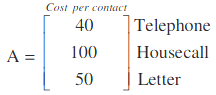
The number of contacts of each type made in two cities X and Y is given by
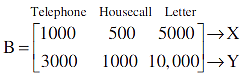
Find the total amount spent by the group in the two cities X and Y.
AnswerWe have
${\text{BA}} = \left[ {\begin{array}{*{20}{l}} {40,000 + 50,000 + 250,000} \\ {120,000 + 100,000 + 500,000} \end{array}} \right]\mathop {}\nolimits_{ \to {\text{Y}}}^{ \to {\text{X}}} $
$ = \left[ {\begin{array}{*{20}{l}} {340,000} \\ {720,000} \end{array}} \right]\mathop {}\nolimits_{ \to {\text{Y}}}^{ \to {\text{X}}} $
So the total amount spent by the group in the two cities is 340,000 paise and 720,000 paise, i.e., ₹3400 and ₹7200, respectively.
View full question & answer→Question 183 Marks
If $A=\left[\begin{array}{ccc}1 & 2 & 3 \\ 3 & -2 & 1 \\ 4 & 2 & 1\end{array}\right]$, then show that $\mathrm{A}^3-23 \mathrm{~A}-40 \mathrm{I}=0$
AnswerWe have $A^2 = A.A = \left[ {\begin{array}{*{20}{c}} 1&2&3 \\ 3&{ - 2}&1 \\ 4&2&1 \end{array}} \right]\left[ {\begin{array}{*{20}{c}} 1&2&3 \\ 3&{ - 2}&1 \\ 4&2&1 \end{array}} \right] = \left[ {\begin{array}{*{20}{c}} {19}&4&8 \\ 1&{12}&8 \\ {14}&6&{15} \end{array}} \right]$
So $A^3 = A.A^2 \left[ {\begin{array}{*{20}{c}} 1&2&3 \\ 3&{ - 2}&1 \\ 4&2&1 \end{array}} \right]\left[ {\begin{array}{*{20}{c}} {19}&4&8 \\ 1&{12}&8 \\ {14}&6&{15} \end{array}} \right] = \left[ {\begin{array}{*{20}{c}} {63}&{46}&{69} \\ {69}&{ - 6}&{23} \\ {92}&{46}&{63} \end{array}} \right]$
Now
$A^3 - 23A - 40I = \left[ {\begin{array}{*{20}{c}} {63}&{46}&{69} \\ {69}&{ - 6}&{23} \\ {92}&{46}&{63} \end{array}} \right] - 23\left[ {\begin{array}{*{20}{c}} 1&2&3 \\ 3&{ - 2}&1 \\ 4&2&1 \end{array}} \right]$ $- 40\left[ {\begin{array}{*{20}{c}} 1&0&0 \\ 0&1&0 \\ 0&0&1 \end{array}} \right]$
$= \left[ {\begin{array}{*{20}{c}} {63}&{46}&{69} \\ {69}&{ - 6}&{23} \\ {92}&{46}&{63} \end{array}} \right] + \left[ {\begin{array}{*{20}{c}} { - 23}&{ - 46}&{ - 69} \\ { - 69}&{46}&{ - 23} \\ { - 92}&{ - 46}&{ - 23} \end{array}} \right]$$ + \left[ {\begin{array}{*{20}{c}} { - 40}&0&0 \\ 0&{ - 40}&0 \\ 0&0&{ - 40} \end{array}} \right]$
$ = \left[ {\begin{array}{*{20}{c}} {63 - 23 - 40}&{46 - 46 + 0}&{69 - 69 + 0} \\ {69 - 69 + 0}&{ - 6 + 46 - 40}&{23 - 23 + 0} \\ {92 - 92 + 0}&{46 - 46 + 0}&{63 - 23 - 40} \end{array}} \right]$
$= \left[ {\begin{array}{*{20}{c}} 0&0&0 \\ 0&0&0 \\ 0&0&0 \end{array}} \right] = 0$
View full question & answer→Question 193 Marks
If $A = \left[\begin{array}{ccc} {0} & {6} & {7} \\ {-6} & {0} & {8} \\ {7} & {-8} & {0} \end{array}\right], B=\left[\begin{array}{lll} {0} & {1} & {1} \\ {1} & {0} & {2} \\ {1} & {2} & {0} \end{array}\right], C=\left[\begin{array}{c} {2} \\ {-2} \\ {3} \end{array}\right]$ Calculate $AC, BC$ and $(A + B)C$. Also, verify that $(A + B)C = AC + BC$
AnswerWe have $, A + B = \left[\begin{array}{ccc} {0} & {6} & {7} \\ {-6} & {0} & {8} \\ {7} & {-8} & {0} \end{array}\right] +\left[\begin{array}{lll} {0} & {1} & {1} \\ {1} & {0} & {2} \\ {1} & {2} & {0} \end{array}\right]$
$= \left[\begin{array}{ccc} {0} & {7} & {8} \\ {-5} & {0} & {10} \\ {8} & {-6} & {0} \end{array}\right]$
So $(A + B) C = \left[\begin{array}{ccc} {0} & {7} & {8} \\ {-5} & {0} & {10} \\ {8} & {-6} & {0} \end{array}\right]\left[\begin{array}{c} {2} \\ {-2} \\ {3} \end{array}\right]=\left[\begin{array}{c} {0-14+24} \\ {-10+0+30} \\ {16+12+0} \end{array}\right]=\left[\begin{array}{c} {10} \\ {20} \\ {28} \end{array}\right] .......(i)$
Further $AC = \left[\begin{array}{ccc} {0} & {6} & {7} \\ {-6} & {0} & {8} \\ {7} & {-8} & {0} \end{array}\right]\left[\begin{array}{c} {2} \\ {-2} \\ {3} \end{array}\right]=\left[\begin{array}{c} {0-12+21} \\ {-12+0+24} \\ {14+16+0} \end{array}\right]=\left[\begin{array}{c} {9} \\ {12} \\ {30} \end{array}\right]$
and $BC = \left[\begin{array}{lll} {0} & {1} & {1} \\ {1} & {0} & {2} \\ {1} & {2} & {0} \end{array}\right]\left[\begin{array}{l} {2} \\ {-2} \\ {3} \end{array}\right]=\left[\begin{array}{l} {0-2+3} \\ {2+0+6} \\ {2-4+0} \end{array}\right]=\left[\begin{array}{c} {1} \\ {8} \\ {-2} \end{array}\right]$
So $AC + BC = \left[\begin{array}{c} {9} \\ {12} \\ {30} \end{array}\right]+\left[\begin{array}{c} {1} \\ {8} \\ {-2} \end{array}\right]=\left[\begin{array}{c} {10} \\ {20} \\ {28} \end{array}\right] .........(ii)$
Clearly, from $(i)$ and $(ii),$ it follows that
$(A + B) C = AC + BC$
View full question & answer→Question 203 Marks
Two farmers Ramkishan and Gurcharan Singh cultivates only three varieties of rice namely Basmati, Permal and Naura. The sale (in Rupees) of these varieties of rice by both the farmers in the month of September and October are given by the following matrices A and B.
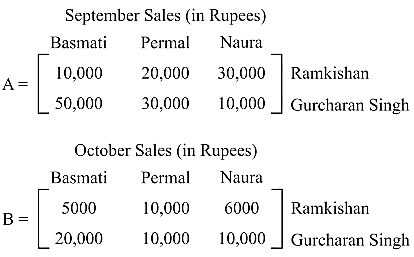
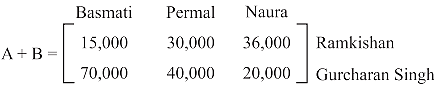
- Find the combined sales in September and October for each farmer in each variety.
- Find the decrease in sales from September to October.
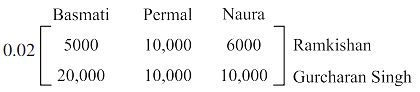
- If both farmers receive 2% profit on gross sales, compute the profit for each farmer and for each variety sold in October.
Answer - Combined sales in September and October for each farmer in each variety is given by
- Change in sales from September to October is given by

- 2% of B = $\frac{2}{100} \times B=0.02\times B$
= 
= 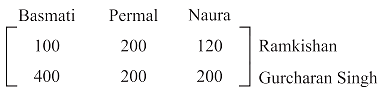
Thus, in October Ramkishan receives ₹ 100, ₹ 200 and ₹ 120 as profit in the sale of each variety of rice, respectively, and Grucharan Singh receives profit of ₹ 400, ₹ 200 and ₹ 200 in the sale of each variety of rice, respectively
View full question & answer→