Questions

1 Marks Question

Take a timed test

36 questions · self-marked practice — reveal the answer and mark yourself.

Question 11 Mark
Let $A = \{1, 2, 3\}$. Then number of equivalence relations containing $(1, 2)$ is
Answer
It is given that $A = \{1, 2, 3\}.$
An equivalence relation is reflexive, symmetric and transitive.
The smallest equivalence relations containing $(1, 2)$ is equal to
$R_1 = {(1, 1), (2, 2), (3, 3), (1, 2), (2, 1)}$
Now, only four pairs are left $(2, 3), (3, 2), (1, 3)$ and $(3, 1).$
So, if we add the pair $(2, 3)$ to R, then for symmetry we must add $(3, 2).$
Also, for transitivity we required to add $(1, 3)$ and $(3, 1).$
Thus, the only equivalence relation is the universal relation.
Therefore, the total number of equivalence relations containing $(1, 2)$ is $2.$
View full question & answer
Question 21 Mark
Let A = {1, 2, 3}. Then number of relations containing (1, 2) and (1, 3) which are reflexive and symmetric but not transitive is
Answer
This is because relation R is reflexive as (1, 1), (2, 2), (3, 3) $\in$ R.
Relation R is symmetric as (1, 2), (2, 1) $\in$ R and (1, 3), (3, 1) $\in$ R.
But relation R is not transitive as (3, 1), (1, 2) $\in$ R but (3, 2) R.
Now, if we add any one of the two pairs (3, 2) and (2, 3) (or both) to relation R,
Then, the relation R will become transitive.
Therefore, the total number of desired relations is one.
View full question & answer
Question 31 Mark
Find the number of all onto functions from the set $\{1, 2, 3, ...., n\}$ to itself.
Answer
The number of onto functions that can be defined from a finite set $A$ containing n elements onto a finite set $B$ containing $n$ elements $= 2^n - n.$
View full question & answer
Question 41 Mark
Show that the function $f : R \rightarrow R$ given by $f(x) = x^3$ is injective.
Answer
Let $x_1, x_2 \in\ R$ be such that $f(x_1) = f(x_2)$
$ \Rightarrow x_1^3 = x_2^3$
$\Rightarrow x_1 = x_2$
Therefore, f is one-one function, hence $f(x) = x^3$ is injective.
View full question & answer
Question 51 Mark
Let $\;f{\text{ }}:{\text{ }}R{\text{ }} \to {\text{ }}R$ be defined as f (x) = 3x. Choose the correct answer.
Answer
Injectivity: Let ${x_1},{x_2} \in R\;$ such that $f\left( {{x_1}} \right) = f\left( {{x_2}} \right).$ Then, $f\left( {{x_1}} \right) = f\left( {{x_2}} \right)$$ \Rightarrow $3${x_1} = 3{x_2}$$ \Rightarrow $${x_1} = {x_2}\;.$ So, f : R $\rightarrow$ R is one –one.
Surjectivity: Let y$\; \in $ R, Then $f(x) = y \Rightarrow 3x = y \Rightarrow x = \frac{y}{3}$, Clearly, $\frac{y}{3} \in R\;for\;any\;y \in R$ such that $f\;\left( {\frac{y}{3}} \right) = 3\left( {\frac{y}{3}} \right) = y\;.$ So, Let f : ${\text{ }}R{\text{ }} \to {\text{ }}R$ is onto.
View full question & answer
Question 61 Mark
Let f: R $\rightarrow$ R be defined as$f\left( x \right){\text{ }} = {\text{ }}{x^4}$. Choose the correct answer.
Answer
Since f (-1) = 1, f (1) = 1, f(-2) =16 , f(2) = 16. Thus, 1 and -1 have the same image. Similarly, 2 and -2 also have the same image. So, f is many-one function. Also, for all $y \in R,{y^{\frac{1}{4}}}$ is a real number. Thus, for all y $\in$ R.There exists x = ${y^{\frac{1}{4}}}$ in R such that f(x) = ${x^4} = y.$ Therefore, f is onto.
So, f is many one and onto.
View full question & answer
Question 71 Mark
Show the relation R in the set A = {x $\in$ Z : 0 $\leq$ x $\leq$12}, given by R = {(a, b) : a = b}, is an equivalence relation. Find the set of all elements related to 1 in each case.
Answer
We have, $A=\{x \in Z : 0 \leq x \leq 12\}$be a set and
R = {(a, b) : a = b} be a relation on A
Now,
Reflexivity: Let a $\in$ A
$\Rightarrow$ a = a
$\Rightarrow$ (a, a) $\in$ R
$\Rightarrow$ R is reflexive
Symmetric: Let a, b, $\in$ A and (a, b) $\in$ R
$\Rightarrow$ a = b
$\Rightarrow$ b = a
$\Rightarrow$ (b, a) $\in$ R
$\Rightarrow$ R is symmetric
Transitive: Let a, b & c $\in$ A
and let (a, b) $\in$ R and (b, c) $\in$ R
$\Rightarrow$ a = b and b = c
$\Rightarrow$ a = c
$\Rightarrow$ (a, c) $\in$ R
$\Rightarrow$ R is transitive
Since R is being reflexive, symmetric and transitive, so R is an equivalence relation.
Also we need to find the set of all elements related to 1.
Since the relation is given by, R = {(a, b): a = b}, and 1 is an element of A.
R = {(1, 1): 1 = 1}
Thus, the set of all elements related to 1 is {1}.
View full question & answer
Question 81 Mark
Show the relation R in the set A = {x $\in$ Z : 0 $\leq$ x $\leq$ 12}, given by
R = {(a, b) : |a – b| is a multiple of 4} is an equivalence relation.
Find the set of all elements related to 1 in each case.
Answer
The relation R on the set A = {x $\in$ Z : 0 $\leq$ x $\leq$ 12}, is given by
R = {(a, b) : |a – b| is a multiple of 4}
For any element a $\in$ A, we have (a,a) $\in$ R as |a-a|=0 is a multiple of 4.
Therefore, R is reflexive.
Now, Let (a,b) $\in$ R
$\Rightarrow$ |a – b| is a multiple of 4
$\Rightarrow$ |b – a| = |a – b| is a multiple of 4
$\Rightarrow$ (b,a) $\in$ R
Therefore, R is symmetric.
Finally, Let (a,b), (b,c) $\in$ R
$\Rightarrow$ |a – b| is a multiple of 4 and |b - c| is a multiple of 4
$\Rightarrow$ $a-b $ is a multiple of 4 and $b-c$ is a multiple of 4
$\Rightarrow$ $a-c=a-b+b-c$, is a multiple of 4
$\Rightarrow$ $|a-c|$ is a multiple of 4
$\Rightarrow$ (a,c) $\in$ R
Therefore, R is transitive.
Hence, R is an equivalence relation.
The set of elements related to 1 is {1,5,9}
|1-1| = 0 is multiple of 4
|5-1| = 4 is multiple of 4
|9-1| = 8 is multiple of 4.
View full question & answer
Question 91 Mark
Let R be the relation in the set N given by R = {(a, b) : a = b – 2, b > 6}.
Answer
(6, 8) $\in$ R

as b - 2 = 8 - 2 = 6 and b>6 .

View full question & answer
Question 101 Mark
Let R be the relation in the set {1, 2, 3, 4} given by R = {(1, 2), (2, 2), (1, 1), (4, 4), (1, 3), (3, 3), (3, 2)}. Choose the correct answer.
Answer
R is reflexive and transitive but not symmetric.
View full question & answer
Question 111 Mark
Prove that the function f: $R \rightarrow R,$ given by $f(x) = 2x$, is one-one and onto.
Answer
$x_1 ,x_2$ are two different elements of $R$
Let $f(x_1) = f (x_{​​​​​​2})$
$2x_1= 2x_2$
$x_1 = x_{2,}$ hence f is one-one.
View full question & answer
Question 121 Mark
Show that the function $f: N \to N,$ given by $f (x) = 2x,$ is one-one but not onto.
Answer
We observe the following properties of $f.$
Injectivity:: Let $x_1, x_2 \in  N$ such that $f(x_1) = f(x_2).$ Then,
$f(x_1) = f(x_2) $
$\Rightarrow  2x_1= 2x_2 $
$ \Rightarrow x_1 = x_2$
So, $f$ is one-one.
Surjectivity: Clearly, it takes even values. Therefore, no odd natural number in N (co-domain) has its pre-image in domain. So, f is not onto.
View full question & answer
Question 131 Mark
Let A be the set of all 50 students of Class X in a school. Let f : $A \rightarrow N$ be function defined by f(x) = roll number of the student x. Show that f is one-one but not onto.
Answer
No two different students of the class can have the same roll number.
Therefore, f must be one-one.
We can assume without any loss of generality that roll numbers of students are from 1 to 50.
This implies that 51 and higher natural numbers in N cannot be the roll numbers of any student in the class.
So, 51 and higher natural numbers can not be the images of any element of A under f. Hence, f is not onto.
View full question & answer
Question 141 Mark
Let R be the relation defined on the set A = {1, 2, 3, 4, 5, 6, 7} by R = {(a, b ): both a and b are either odd or even}. Show that R is an equivalence relation. Further, show that all the elements of the subset {1, 3, 5, 7 } are related to each other and all the elements of the subset {2, 4, 6} are related to each other, but no element of the subset {1, 3, 5, 7} is related to any element of the subset {2, 4, 6}.
Answer
Given A ={1, 2, 3, 4 , 5, 6, 7} and R = {(a, b): both a and b are either odd or even number}
Therefore,
R = {(1, 1), (1, 3), (1, 5), (3, 3), (3, 5), (3, 7), (5, 5), (5, 7), (7, 7), (7, 5), (7, 3), (5, 3), (5, 1), (3, 1)
(2, 2), (2, 4), (2, 6), (4, 4), (4, 6), (6, 6), (6, 4), (6, 2), (4, 2)}
From the relation R it is seen that R is symmetric, reflexive and transitive as well. Therefore, R is an equivalent relation.
From the relation R it is seen that {1, 3, 5, 7} are related with each other only and {2, 4, 6} are related with each other.
View full question & answer
Question 151 Mark
Show that the relation R in the set Z of integers given by R = {(a, b) : 2 divides a-b} is an equivalence relation.
Answer
R is reflexive , as 2 divide a - a = 0
Let ((a,b) $\in$ R then(a-b) is divided by 2
$\Rightarrow$ (b-a) is divided by 2. Therefore (b,a) $\in$ R and hence R is symmetric.
Let a,b,c $\in$ Z such that(a,b) $\in$ R and (b,c) $\in$ R
Then, a - b and b - c is divided by 2
$\Rightarrow$ (a - b) is even and ( b-c) is even
$\Rightarrow$ a - b +b - c is even, as sum of two even numbers is even
$\Rightarrow$ (a - c) is even
$\Rightarrow$ a - c is divided by 2
$\Rightarrow$ (a , c) $\in$ R
Hence, R is transitive.

Therefore, R is an equivalence relation.

View full question & answer
Question 161 Mark
Show that the relation R in the set {1, 2 ,3} given by R = {(1, 1), (2, 2), (3, 3), (1, 2), (2, 3)} is reflexive but neither symmetric nor transitive.
Answer
Since 1, 2, 3 $\in$ A and (1, 1), (2, 2), (3, 3) $\in$ R i.e. for each a $\in$ A, (a, a) $\in$ R. So, R is reflexive.
We observe that (1, 2) $\in$ R but (2,1) $\in$ R. So, R is not symmetric.
Also, (1,2) $\in$ R and (2, 3) $\in$ R but (1, 3) $\in$ R. So, R is not transitive.
View full question & answer
Question 171 Mark
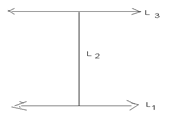
Let L be the set of all lines in a plane and $R$ be the relation in $L$ defined as $R = \{(L_1, L_2 ) : L_1$ is perpendicular to $L_2\}.$ Show that R is symmetric but neither reflexive nor transitive.
Answer
$R$ is not reflexive, as a line $L_1$  cannot be $ \bot$ to itself i.e $(L_1, L_1 ) \notin R$

Let $(L_1,L_2)$ $\in R$
$\Rightarrow$ $L_1$ $ \bot$ $L_2$
$\Rightarrow$$ L_2$ $\bot$ $L_1$
$\Rightarrow$ $(L_2, L_1)$ $\in$ $R$
$\Rightarrow$ $R$ is symmetric
Let $(L_1,L_2) \in R$ and $(L_2,L_3)\in R$,then
$L_1$ $ \bot$ $L_2$ and $L_2$ $ \bot$ $L_3$​​​​​​​
Then $L_1$ can never be $ \bot$ to $L_3$ in fact $L_1 || L_3​​​​​​​$​​​​​​​
i.e $(L_1, L_2)$ $\in$ $R,\ (L_2,L_3)$ $\in$ $R.$
But $(L_1, L_3)$ $\notin$ $R$
$R$ is not transitive.
View full question & answer
Question 181 Mark
Consider the function $f : [0, \frac{\pi}{2}  ] \rightarrow R$ given by $f (x) = \sin x$ and $g : [0, \frac{\pi}{2}  ] \rightarrow R$ given by $g (x) = \cos x$. Show that $f$ and $g$ are one-one, but $f + g$ is not one-one.
Answer
We observe that for any two distinct elements $x_1$ and $x_2$ in $[0, \frac{\pi}{2} $]
$\sin x_1  \neq  \sin x_2$ and $\cos x_1  \neq  \cos x_2$
$\Rightarrow f (x_1)  \neq f (x_2)$ and $g (x_1)  \neq  g (x_2)$
$\Rightarrow$ f and g are one-one.
We have,
$(f + S) (x) = f (x) + g (x) = \sin x + \cos x$
$\Rightarrow (f + g) (0) = \sin 0 + \cos 0° = 1$ and $(f + g)  \left(\frac{\pi}{2}\right)=\sin \frac{\pi}{2}+\cos \frac{\pi}{2}=1$
Thus, $0 \neq \frac{\pi}{2}$ but, $(f + g) (0) = (f + g)$ $\left(\frac{\pi}{2}\right)$ So, $f + g$ is not one-one.
View full question & answer
Question 191 Mark
Consider the identity function $I_N: N \rightarrow N$ defined as, $ I_N (x) = x  \forall  x  \in  N.$
Show that although $I_N$ is onto but $I_N + I_N : N  \rightarrow  N$ defined as
$(I_N + I_N) (x) = I_N (x) + I_N (x) = x + x = 2x$ is not onto.
Answer
We know that the identity function on a given set is always a bijection.
Therefore,$ I_N: N \rightarrow N $ is onto. We have,
$(I_N + I_N) (x) = 2x$ for all $x \in N$
This means that under $I_N + I_N$, images of natural numbers are even natural numbers.
So, odd natural numbers in $N$  (co-domain) do not have their pre-images in domain $N.$
For example, $1, 3, 5$ etc. do not have their pre-images.
So, $ I_N + I_N : N \rightarrow$ $N$ is not onto.
View full question & answer
Question 201 Mark
Show that the number of equivalence relations on the set $\{1, 2, 3\}$ containing $(1, 2)$ and $(2, 1)$ is two.
Answer
The smallest equivalence relation $R_1$ containing $(1, 2)$ and $(2, 1)$ is $\{(1, 1), (2, 2), (3, 3), (1, 2), (2, 1)\}.$
Now we are left with only $4$ pairs namely $(2, 3), (3, 2), (1, 3)$ and $(3, 1).$
If we add anyone, say $(2, 3)$ to $R_1,$ then for symmetry, we must add $(3, 2)$ this loses transitivity.
To maintain transitivity along with symmetry, we are forced to add $(1, 3)$ and $(3, 1).$
Thus, the only equivalence relation bigger than $R_1$ is the universal relation.
This shows that the total number of equivalence relations containing $(1, 2)$ and $(2, 1)$ is two.
View full question & answer
Question 211 Mark
Let $A = \{1, 2, 3\}.$ Then show that the number of relations containing $(1, 2)$ and $(2, 3)$ which are reflexive and transitive but not symmetric is three.
Answer
The smallest relation $R_1$ containing $(1, 2)$ and $(2, 3)$ which is reflexive and transitive but not symmetric is $\{(1, 1), (2, 2), (3, 3), (1, 2), (2, 3), (1, 3)\}.$
Now, if we add the pair $(2, 1)$ to $R_1$ to get $R_2$, then the relation $R_2$ will be reflexive, transitive but not symmetric.
Similarly, we can obtain $R_3$ by adding $(3, 2)$ to $R_1$ to get the desired relation.
However, we can not add the pairs $(2, 1), (3, 2)$ and $(3, 1)$ to $R_1$ at a time, as by doing so the relation will become symmetric, which is not required. At a time, we can only add two pairs out of the remaining three viz. $(2,1), (3,2)$ and $(3,1).$ This can be done in three ways
adding $(2,1)$ and $(3,2)$
or $(2,1)$ and $(3,1)$
or $(3,2)$ and $(3,1)$
Thus, the total number of desired relations is three.
View full question & answer
Question 221 Mark
Find the number of all one-one functions from set A = {1, 2, 3} to itself.
Answer
One-one function from {1, 2, 3} to itself is simply a permutation on three symbols 1, 2, 3.
Therefore, a total number of one-one maps from {1, 2, 3} to itself is the same as the total number of permutations on three symbols 1, 2, 3 which is 3! = 6
View full question & answer
Question 231 Mark
Let f: X $\to$ Y is a function. Define a relation R in X given by R = {(a, b): f(a) = f(b)}. Examine whether R is an equivalence relation or not.
Answer
The given function is f : X $\to$ Y and relation on X is R = {(a, b) : f (a) = f (b)}
Reflexive Since, for every x$\in$X, we have
$f(x) = f(x)$
$\Rightarrow$ $(x, x)$$\in$R $\forall$ x$\in$X
$\therefore$ R is reflexive.

Symmetric Let (x, y)$\in$R
Then, $f(x)=f(y)$
$\Rightarrow f(y) = f(x) $
$\Rightarrow (y, x)$$\in$R
$\therefore$ R is symmetric.

Transitive Let x, y, z$\in$X such that (x, y)$\in$Rand (y, z)$\in$R
Then $f(x) = f(y)$........(i)
and $f (y) = f (z)$.......(ii)
From Equation (i) and (ii), we get
$\Rightarrow$$f(x) = f(z)$
$\Rightarrow$ (x, z) $\in$ R
Thus, (x, y)$\in$R and (y, z)$\in$R
$\Rightarrow$ (x, z) $\in$ R $\forall$ x, y, z$\in$X
$\therefore$ R is transitive.
Therefore, R is transitive. Since, R is reflexive, symmetric and transitive, so it is an equivalence relation.
View full question & answer
Question 241 Mark
Let $X = \{1, 2, 3, 4, 5, 6, 7, 8, 9\}$. Let $R_1$ be a relation on $X$ given by $R_1= \{(x, y ): x - y$ is divisible by $3\}$ and $R_2$ be another relation on $X$ given by $R_2 = \{(x, y) : (x, y)$ $\subset$ $\{1, 4, 7\}$ or $\{x, y\}$ $\subset$ $\{2, 5, 8\}$ or $\{x, y\}$ $\subset$ $\{3, 6, 9\}\}$. Show that $R_1= R_2.$
Answer
Clearly, $R_1$ and $R_2$ are subsets of X $\times$ X. In order to prove that $R_1= R_2$, it is sufficient to show that $R_1$ $\subset$ $R_2$ and $R_2$ $\subset$ $R_1.$
We observe that the difference between any two elements of each of the sets {1, 4, 7}, {2, 5, 8} and {3, 6, 9} is a multiple of 3.
Let $(x, y)$ be an arbitrary element of $R_1$. Then,
$(x, y)  \in R_1$
$\Rightarrow x - y$ is divisible by $3.$
$\Rightarrow x - y$ is a multiple of $3$
$\Rightarrow$ $\{x, y)$ $\subset$ $\{1, 4, 7\}$ or $\{x, y\}$ $\subset$ $\{2, 5, 8)$ or $(x, y)$ $\subset$ $\{3, 6, 9\}$
$\Rightarrow$ $(x, y$) $\in$ $R_2$​​​​​​​
Thus, $(x, y)$ $\in$ $R_1$ $\Rightarrow$ $(x, y)$ $\in$ $R_2.$
So, $R_1$ $\subset$ $R_2...(i)$
Now, let $(a, b)$ be an arbitrary element of $R_2$. Then,
$(a, b)$ $\in$ $R_2$​​​​​​​
$\Rightarrow$ $\{a, b\}$ $\subset$ $\{1, 4, 7\}$ or $\{a, b\}$ $\subset$ $\{2, 5, 8\}$ or $\{a, b\}$ $\subset$ $\{3, 6 , 9\}$
$\Rightarrow$ $a - b$ is divisible by $3$
$\Rightarrow$ $(a, b)$ $\in$ $R_1$​​​​​​​
Thus, $(a, b) \in  R_2  \Rightarrow (a, b)  \in R_1$​​​​​​​
So, $R_2 \subset$ $R_1...(ii)$
From $(i)$ and $(ii)$, we get: $R_1 = R_2.$
View full question & answer
Question 251 Mark
Let $T$ be the set of all triangles in a plane with $R$ a relation in $T$ given by
$R = \{(T_1, T_2) : T_1$ is congruent to $T_2\}.$
Show that R is an equivalence relation.
Answer
R is reflexive, since every $\Delta$ is congruent to itself.
Let $(T_1,T_2) \in$ $R,$ then, $T_1$ is congruent to $T_2.T$. This implies $T_2$ is congruent to $T_1$, therefore $(T_2 , T _1 )  \in R$. Thus,$R$ is transitive.
Let $(T_1,T_2)  \in R$, and $(T_2,T_3) \in R$. Then, $T_1$​​​​​​​ is congruent to $T_2$ and $T_2$ is congruent to $T_3$. This implies $T_1$ is congruent to $T_3.$
Therefore,$(T_1,T_3)\in R$.
Hence, $R$ is transitive.
Therefore, $R$ is an equivalence relation
View full question & answer
Question 261 Mark
Let R be a relation on the set A of ordered pairs of positive integers defined by
(x, y) R (u, v) if and only if xv = yu.
Show that R is an equivalence relation.
Answer
Clearly, (x, y) R (x, y), $\forall$ (x, y) $\in$ A, since xy = yx.
This shows that R is reflexive.
Further, (x, y) R (u, v)
$\Rightarrow$ xv = yu
$\Rightarrow$ uy = vx
$\Rightarrow$ (u, v) R (x, y).
This shows that R is symmetric.
Similarly, (x, y) R (u, v) and (u, v) R (a, b) $\Rightarrow$ xv = yu and ub = va
$\Rightarrow$ $x v \frac{a}{u}=y u \frac{a}{u} \Rightarrow x v \frac{b}{v}=y u \frac{a}{u} \Rightarrow$xb = ya
$\Rightarrow$ (x, y) R (a, b).
Thus, R is transitive. Thus, R is an equivalence relation.
View full question & answer
Question 271 Mark
If $R_1$ and $R_2$ are equivalence relations in a set A, show that $R_1$ $\cap$ $R_2$ is also an equivalence relation.
Answer
Given that, $R_1$ and $R_2$ are equivalence relations,
Therefore, $(a, a) \in R_1$, and $(a, a) \in R_2 \forall a \in A$.
$\Rightarrow(a, a) \in R_1 \cap R_2, \forall a \in A$, showing $R_1 \cap R_2$ is reflexive.
Now, $(a, b) \in R_1 \cap R_2$
$\Rightarrow(a, b) \in R_1$ and $(a, b) \in R_2$
$\Rightarrow(b, a) \in R_1$ and $(b, a) \in R_2$
$\Rightarrow(b, a) \in R_1 \cap R_2$,
Hence, $R_1 \cap R_2$ is symmetric.
Finally, $(a, b) \in R_1 \cap R_2$ and $(b, c) \in R_1 \cap R_2$
$\Rightarrow(a, c) \in R_1$ and $(a, c) \in R_2$
$\Rightarrow(a, c) \in R_1 \cap R_2$.
This shows that $R_1 \cap R_2$ is transitive.
Thus, $R_1 \cap R_2$ is an equivalence relation.
View full question & answer
Question 281 Mark
Let $f : N \rightarrow Y$ be a function defined as $f (x) = 4x + 3$, where $Y = \{y  \in  N : y = 4x + 3$ for some $x \in N\}.$ Show that $f$ is invertible. Find its inverse.
Answer
In order to prove that $f$ is invertible, it is sufficient to show that it is a bisection.
$f$ is one-one: For any $x, y \in N$, we find that
$f(x)=f(y) \Rightarrow 4 x+3=4 y+3 \Rightarrow x=y$
So, $f: N \rightarrow Y$ is one-one.
$f$ is onto: Let $y$ be an arbitrary element of Y . Then, there exists $x \in N$ such that
$y=4 x+3$ [By definition of $Y$ ]
$\Rightarrow y=f(x)$
Thus, for each $y \in N$ there exists $x \in N$ such that $f(x)=y$. So, $f: N \rightarrow Y$ is onto.
Thus, $f: N \rightarrow Y$ is both one and onto. Consequently, it is invertible. Let $f^{-1}$ be the inverse of $f$.
Then,
fof ${ }^{-1}(x)=x$ for all $x \in Y$
$\Rightarrow \mathrm{f}\left(\mathrm{f}^{-1}(\mathrm{x})\right)=\mathrm{x}$ for all $\mathrm{x} \in \mathrm{Y}$
$\Rightarrow 4 \mathrm{f}^{-1}(\mathrm{x})+3=\mathrm{x}$ for all $\mathrm{x} \in \mathrm{Y}$ [Using definition of $f ]$
$\Rightarrow \quad f^{-1}(x)=\frac{x-3}{4}$ for all $\mathrm{x} \in \mathrm{Y}$
Hence, $\mathrm{f}^{-1}: \mathrm{Y} \rightarrow \mathrm{N}$ is given by $f^{-1}(x)=\frac{x-3}{4}$ for all $\mathrm{x} \in \mathrm{Y}$.
View full question & answer
Question 291 Mark
Find gof and fog, if $f: R \rightarrow R$ and $g: R \rightarrow R$ are given by $f(x)=\cos x$ and $g(x)=3 x^2$. Show that $gof \neq fog.$
Answer
$ \text { We have } gof(x)=g(f(x)) $
$ =g(\cos x)=3(\cos x)^2 $
$ =3 \cos ^2 x$
$ \text { Similarly, fog }(x)=f(g(x)) $
$ =f\left(3 x^2\right) $
$ =\cos \left(3 x^2\right) $
$ \text { But, } 3 \cos ^2 x \neq \cos 3 x^2, \text { for } x=0$
$\text { Hence, gof } \neq \text { fog. }$
View full question & answer
Question 301 Mark
Let f: {2, 3, 4, 5) $\rightarrow$ {3, 4 ,5, 9} and g : {3, 4, 5, 9) $\rightarrow$ {7, 11, 15) be functions defined as f (2) = 3 , f (3) = 4 , f (4) = f (5) = 5 and, g (3) = g (4) = 7 and g (5) = g (9) = 11. Find gof.
Answer
We have, Range of f = {3, 4, 5}
Clearly, it is a subset of domain of g. So, gof exists and gof : {2, 3, 4, 5} $\rightarrow${7,11,15} such that
gof (2) = g (f(2)) = g (3) = 7; gof (3) = g (f(3)) = g (4) =7
gof (4) = g (f(4)) = g (5) =11 and gof (5) = g (f(5)) =11
Hence, gof: (2, 3, 4, 5) $\rightarrow$ {7,11,15) such that gof = {(2, 7), (3, 7), (4, 11), (5, 11)}
View full question & answer
Question 311 Mark
Show that a one – one function f : {1, 2, 3} $\to$ {1, 2, 3} must be onto.
Answer
Since f is one – one three element of {1, 2, 3} must be taken to 3 different element of the co – domain {1, 2, 3} under f. Hence, f has to be onto.

{by definition ONTO FUNCTION- every element of co-domain have a pre-image in domain}

View full question & answer
Question 321 Mark
Show that an onto function f : {1, 2, 3} $\rightarrow$ {1, 2, 3} is always one-one.
Answer
Suppose f is not one-one.
Then there exists two elements, say 1 and 2 in the domain whose image in the co-domain is the same.
Also, the image of 3 under f can be only one element.
Therefore, the range set can have at the most two elements of the co-domain {1, 2, 3}, showing that f is not onto, a contradiction. Hence, f must be one-one.
View full question & answer
Question 331 Mark
Show that $f : N \to N$, given by $ f ( x ) = \left\{ \begin{array} { l l } { x + 1 , } & { \text { if } x \text { is odd } } \\ { x - 1 , } & { \text { if } x \text { is even } } \end{array} \right.$is both one-one and onto.
Answer
Given function is $f: N \to$ N such that
$ f ( x ) = \left\{ \begin{array} { l l } { x + 1 , } & { \text { if } x \text { is odd } } \\ { x - 1 , } & { \text { if } x \text { is even } } \end{array} \right.$
One-One function
Case I:
When $x_1$ and $x_2$ are odd.
Then, $f(x1) = f(x2)$
$ \Rightarrow$ $x_1 -1 = x_2 -1$
$ \Rightarrow$ $x_1 = x_2$
Case II: When $x_1$ and $x_2$ are even.
Then, $f(x_1) = f(x_2)$
$ \Rightarrow$ $x_1 + 1 = x_2 + 1$
$ \Rightarrow$ $x_1 = x_2$
Thus, in both cases,
$f(x_1)= f(x_2)$ $ \Rightarrow$$x_1 = x_2$
Case III: When $ x_1$ is odd and $x_2$ is even.
Then, $x_1 \ne x_2$
Also, $f(x_1)$ is even and $f(x_2)$ is odd.
So, $f(x_1) \ne f(x_2)$
Thus, $x_1$ $ \ne$ $x_2$ $ \Rightarrow$ $f(x_1)$ $ \ne$ $f(x_2)$
Case IV: When $x_1$ is even and $x_2$ is odd.
Then, $x_1 \neq x_2$
Also, $f\left(x_1\right)$ is odd and $f\left(x_2\right)$ is even.
So, $f\left(x_1\right) \neq f\left(x_2\right)$
Thus, $x_1 \neq x_2 \Rightarrow f\left(x_1\right) \neq f\left(x_2\right)$
Hence, from cases $I,\ II,\ III$ and $IV$ we can obsere that, $f(x)$ is a one-one function.
Onto function
Let $y\in N$ ( co-domain) be any arbitrary number.
If $y$ is odd, then there exists an even number $y+ 1$ $ \in$ $N$ (domain) such that $f(y+ 1) = (y+ 1 ) - 1 = y.$
If $y$ is even, then there exists an odd number $y - 1$ $ \in$ $N$ (domain) such that $f(y-1) = (y-1) + 1 = y$
Thus, every element in $N$ ( codomain) has a pre-image in $N$ (domain).
Therefore, $f(x)$ is an onto function. Hence, the function $f(x)$ is bijective.
View full question & answer
Question 341 Mark
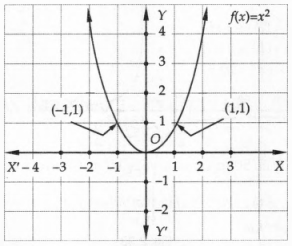
Show that the function $f: R \to R$, defined as $f(x) = x^2$ , is neither one-one nor onto.
Answer
We observe that 1 and $-1 \in R$ such that $f (-1) = f (1)$ i.e. there are two distinct elements in $R$ which have the same image. So, $f$ is not one-one.
Since $f (x)$ assumes only non-negative values. So, no negative real number in $R$ (co-domain) has its pre-image in domain of f i.e. $R$. Consequently $f$ is not onto.
These facts are evident from the graph of $f (x)$ as shown in Fig.
View full question & answer
Question 351 Mark
Show that the function f: N $ \to $ N given by f (1) = f (2) = 1 and f (x) = x - 1, for every x > 2, is onto but not one-one.
Answer
It is given that
$f(x) = \left\{ {\begin{array}{*{20}{c}} {1,x = 1,2}\\ {x - 1,x \ge 2} \end{array}} \right.$
Clearly, f (1) = f (2) = 1 i.e. 1 and 2 have the same image.
So, f: N $\to $N is a many-one function.
Let y be an arbitrary element in N (Co-domain). Then,
f(x) = y $ \Rightarrow $ x - 1 = y $ \Rightarrow $x = y + 1
Clearly, y + 1 $\in$N (domain) for all y e N (Co-domain). Thus, for each y $\in$ N (co-domain) there exists y + 1 $\in$ N (domain) such that f(y + 1 ) = y + 1 - 1 = y.
So, f: N $\to $N is an onto function.
View full question & answer
Question 361 Mark
Let A be the set of all students of a boys school. Show that the relation R in A given by R = {(a, b) : a is a sister of b} is the empty relation and R′ = {(a, b) : the difference between heights of a and b is less than 3 meters} is the universal relation.
Answer
Since the school is a boys school, no student of the school can be the sister of any student of the school. Hence, R = $\phi$, showing that R is the empty relation.
It is also obvious that the difference between the heights of any two students of the school has to be less than 3 meters. This shows that R′ = A $\times$ A is the universal relation.
View full question & answer