Questions

1 Marks Question

Take a timed test

36 questions · self-marked practice — reveal the answer and mark yourself.

Question 11 Mark
If $\theta $ is the angle between any two vectors $\vec a$ and $\vec b$, then $\left| {\vec a.\vec b} \right| = \left| {\vec a \times \vec b} \right|$ when θ is equal to
Answer
We have:
$|\vec a.\vec b|=|\vec a \times \vec b|$
$\Rightarrow |\vec a||\vec b|cos\theta =|\vec a||\vec b|sin\theta$
$\Rightarrow cos\theta=\sin\theta$
$\Rightarrow tan\theta =1\Rightarrow \theta=\frac{\pi}{4}$
View full question & answer
Question 21 Mark
The value of $\hat{i} \cdot(\hat{j} \times \hat{k})+\hat{j} \cdot(\hat{i} \times \hat{k})+\hat{k} \cdot(\hat{i} \times \hat{j})$ is
Answer
Given: $(\hat{ {j}} \times \hat{ {k}})+\hat{ {j}} \cdot(\hat{ {i}} \times \hat{ {k}})+\hat{ {k}}(\hat{ {i}} \times \hat{ {j}})$
$\text { i. }(\hat{j} \times \hat{k})+\hat{j} \cdot(\hat{i} \times \hat{k})+\hat{k} \cdot(\hat{i} \times \hat{j})$ = $\hat{\mathrm{i}} . \hat{\mathrm{I}}+\hat{\mathrm{j}} \cdot(-\hat{\mathrm{j}})+\hat{\mathrm{k}} \hat{\mathrm{k}}$
= $1-\hat{\jmath} . \hat{\jmath}+1$
=1 - 1 + 1
=1
View full question & answer
Question 31 Mark
Let $\vec a$ and $\vec b$ be two unit vectors and θ is the angle between them. Then $\vec a + \vec b$ is a unit vector if
Answer
It is given that $|\vec a|=|\vec b|=1$
$\therefore |\vec a+\vec b|^2=(\vec a+\vec b).(\vec a+\vec b)=|\vec a|^2+|\vec b|^2+2\vec a.\vec b$
$\Rightarrow |\vec a+\vec b|^2=1+1+2|\vec a||\vec b|cos\theta=2+2cos\theta$
It is given that $(\vec a+\vec b)$ is a unit vector.
Therefore, 2 + 2$cos\theta$ = 1
Therefore, $\theta=\frac{2\pi}{3}$
View full question & answer
Question 41 Mark
If $\theta $ is the angle between two vectors$\;\vec a\;$and $\vec b$, then $\vec a.\vec b \geq 0$ only when
Answer
$\vec a.\vec b=|\vec a||\vec b|cos\theta$,
Also, $\vec a .\vec b \geq 0$
$\Rightarrow |\vec a||\vec b|cos\theta \Rightarrow cos\theta\leq 0\Rightarrow 0\leq\theta\leq\frac{\pi}{2}$
View full question & answer
Question 51 Mark
Area of a rectangle having vertices A, B, C and D with position vectors $ - \hat i + \frac{1}{2}\hat j + 4\hat k$, $\hat i + \frac{1}{2}\hat j + 4\hat k$, $\hat i - \frac{1}{2}\hat j + 4\hat k$ and $- \hat i - \frac{1}{2}\hat j + 4\hat k$, respectively is
Answer
We have:
$​​\overrightarrow {OA} = - \hat i + {1 \over 2}\hat j + 4\hat k$ (position vector of A) similarly , $\overrightarrow {OB} = \hat i + {1 \over 2}\hat j + 4\hat k$ , $\overrightarrow {OC} = \hat i - {1 \over 2}\hat j + 4\hat k$,$\overrightarrow {OD} = - \hat i - {1 \over 2}\hat j + 4\hat k$:
,where $\overrightarrow {AB} = \overrightarrow {OB} - \overrightarrow {OA} = \left( {\hat i + {1 \over 2}\hat j + 4\hat k} \right) - \left( { - \hat i + {1 \over 2}\hat j + 4\hat k} \right) = 2\hat i + 0\hat j + 0\hat k$(by triangle law of vector
addition),similarly $\overrightarrow {AD} = 0\hat i - \hat j + 0\hat k$, Therefore , area of rectangle ABCD is given by $\left| {\overrightarrow {AB} X} \right.\left. {\overrightarrow {AD} } \right|$,where$\overrightarrow {AB} X\overrightarrow {AD} = $$\left| {\matrix{ {\hat i} & {\hat j} & {\hat k} \cr 2 & 0 & 0 \cr 0 & { - 1} & 0 \cr } } \right| = \hat i\left( {0 - 0} \right) - \hat j\left( {0 - 0} \right) + \hat k\left( { - 2 - 0} \right)$=$ - 2\hat k$,$\left| {\overrightarrow {AB} X} \right.\left. {\overrightarrow {AD} } \right|$=$\sqrt {{0^2} + {0^2} + {{\left( { - 2} \right)}^2}} = $ 2 sq. units.
View full question & answer
Question 61 Mark
Let the vectors $\vec a\;$ and $\vec b$ be such that $\left| {\vec a} \right| = 3\;$ and $\;\left| b \right| = \frac{{\sqrt 2 }}{3},\;$ then $\;\vec a \times \vec b$ is a unit vector if the angle between $\vec a\;$ and $\vec b\;$ is
Answer
It is given that $\overrightarrow{a}\times \overrightarrow{b}$ is a unit vector, then:
$\Rightarrow |\vec a\times \vec b|=1\Rightarrow |\vec a||\vec b|sin\theta =1$
$\Rightarrow 3.\frac{\sqrt2}{3}sin\theta=1\Rightarrow sin\theta =\frac{1}{\sqrt2}\Rightarrow \theta =\frac{\pi}{4}$
View full question & answer
Question 71 Mark
If $\vec a$ is a non zero vector of magnitude ‘a’ and $\lambda $ a non zero scalar, then $\lambda \vec a$ is a unit vector if
Answer
$\lambda \vec a$is a unit vector if and only if $\vec a$ is equal to $\frac{1}{{\left| \lambda \right|}}$.
View full question & answer
Question 81 Mark
If $\vec a$ and $\vec b$ are two collinear vectors, then which of the following are incorrect:
Answer
If $\vec a$ and $\vec b$ are two collinear vectors, then, they are parallel to the same line irrespective of their magnitudes and directions.
View full question & answer
Question 91 Mark
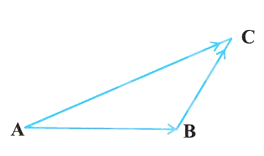
In triangle ABC, which of the following is not true:

Answer
$\vec {AB} + \vec {BC} = \vec {AC} $ (triangle law of vector addition) but $\vec {AC} = - \vec {CA} $
View full question & answer
Question 101 Mark
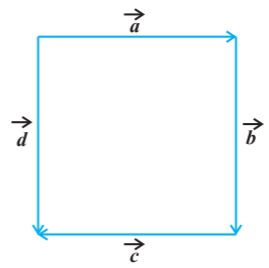
In the figure which are the Collinear but not equal vectors?

Answer
$\because$ $\overrightarrow{\mathrm{a}}$ and $\overrightarrow{\mathrm{c}}$ are parallel vectors, so, they are collinear. But they have opposite direction, so, they are not equal.
Hence, $\overrightarrow{\mathrm{a}}$ and $\overrightarrow{\mathrm{c}}$ are collinear but not equal.
View full question & answer
Question 111 Mark
In the figure which are the Equal vectors?

Answer
Equal vectors: Two or more vectors having same direction and same magnitude are called equal vectors.
So, in the above figure $\overrightarrow{{b}}$ and $\overrightarrow{{d}}$ are equal vectors as they have same magnitude and same direction.
$\therefore$ Equal vectors: $\overrightarrow{{b}}$ and $\overrightarrow{{d}}$
View full question & answer
Question 121 Mark
In the figure which are the Coinitial vectors?

Answer
Coinitial vectors: Two or more vectors having same initial point are called coinitial vectors.
So, in the above figure $\overrightarrow{{a}}$ and $\overrightarrow{{d}}$ are coinitial vectors as they have same initial point.
$\therefore$ Coinitial vectors: $\overrightarrow{{a}}$ and $\overrightarrow{{d}}$
View full question & answer
Question 131 Mark
Classify work done as scalar or vector quantity.
Answer
Work done: It is a scalar quantity as it has magnitude as well as direction.
View full question & answer
Question 141 Mark
Classify velocity as scalar or vector quantity.
Answer
Velocity: It is a vector quantity as it has magnitude as well as direction.
View full question & answer
Question 151 Mark
Classify force as scalar or vector quantities.
Answer
Force: It is a vector quantity as it has magnitude as well as direction.
View full question & answer
Question 161 Mark
Classify distance as scalar and vector quantity.
Answer
Distance: It is a scalar quantity as it has magnitude only and no direction.
View full question & answer
Question 171 Mark
Classify time period as scalar and vector quantities.
Answer
Time period: It is a scalar quantity as it has magnitude only and no direction.
View full question & answer
Question 181 Mark
Classify $20\ m/s^2$ measure as scalar and vector.
Answer
$20\ m/sec^2$ : It is a measure of acceleration. It is a vector quantity as it is a measure of rate of change of velocity.
View full question & answer
Question 191 Mark
Classify $10^{-19}$ coulomb measure as scalar and vector.
Answer
$10^{-19}$ coulomb: It is a measure of electric charge. It is a scalar quantity as it has magnitude only and no direction.
View full question & answer
Question 201 Mark
Classify the 40-watt measure as scalar and vector.
Answer
40 watt: It is a measure of power. It is a scalar quantity as it has magnitude only and no direction.
View full question & answer
Question 211 Mark
Classify the $40^\circ$ measure as scalar and vector.
Answer
$40^o:$ It is a measure of angle. It is a scalar quantity as it has magnitude only and no direction.
View full question & answer
Question 221 Mark
Classify 2 meters north-west measure as scalar and vector.
Answer
2 meters north-west: It is a measure of distance in a particular direction.
$\therefore$ It is a vector quantity as it has magnitude as well as direction.
View full question & answer
Question 231 Mark
Classify 10 kg quantity measures as scalar and vector.
Answer
10 kg: It is a measure of mass. It is a scalar quantity as it has magnitude only and no direction.
View full question & answer
Question 241 Mark
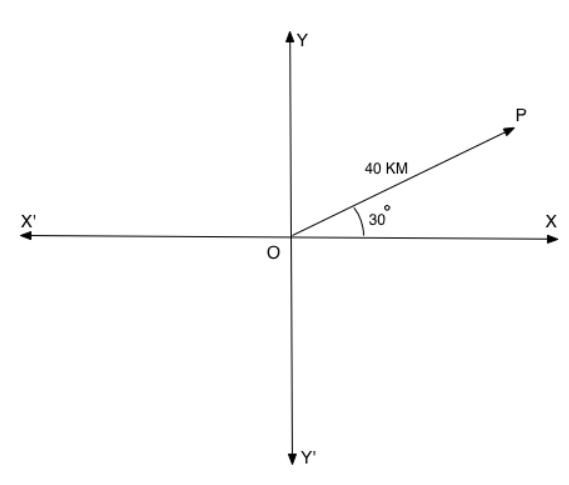
Represent graphically a displacement of 40 km, ${30^o}$ East of North.
Answer

Displacement 40 km, ${30^o}$ East of North
$\Rightarrow$ Displacement vector $\overrightarrow {OA} $ (say) such that $\left| {\overrightarrow {OA} } \right| = 40$ km (given) and vector $\overrightarrow {OA} $ makes an angle ${30^o}$ with North in East-North quadrant.

View full question & answer
Question 251 Mark
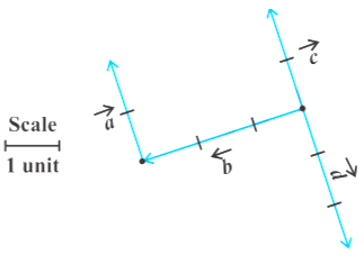
In the given Figure, which vectors are the Coinitial vectors?.

Answer
Coinitial vectors : $\vec{b}, \vec{c}$ and $\vec{d}$
View full question & answer
Question 271 Mark
In the Figure, which are the Collinear vector.

Answer
Collinear vectors : $\vec{a}, \vec{c}$ and $\vec d$
View full question & answer
Question 311 Mark
Is the measure of 10 Newton a scalar or vector?
Answer
Vector because Newton is a unit of force and force has both magnitude and direction.
View full question & answer
Question 331 Mark
Is the measure of 5 seconds vector or scalar?
Answer
5 Seconds is a time period, it has only magnitude i.e; 5 and has no direction, So it is Scalar.
View full question & answer
Question 341 Mark
Consider two points P and Q with position vectors $\vec{OP}=3 \vec{a}-2 \vec{b}$ and $\vec{OQ}=\vec{a}+\vec{b}$.
Find the position vector (externally) of a point R which divides the line joining P and Q in the ratio 2 : 1.
Answer
The position vector of the point R dividing the join of P and Q externally in the ratio 2 : 1 is
$\vec{OR}=\frac{2(\vec{a}+\vec{b})-(3 \vec{a}-2 \vec{b})}{2-1}=4 \vec{b}-\vec{a}$
View full question & answer
Question 351 Mark
Consider two points P and Q with position vectors $\vec{OP}=3 \vec{a}-2 \vec{b}$ and $\vec{OQ}=\vec{a}+\vec{b}$. Find the position vector (internally) of a point R which divides the line joining P and Q in the ratio 2 : 1.
Answer
The position vector of the point R dividing the join of P and Q internally in the ratio 2 : 1 is
$\vec{OR}=\frac{2(\vec{a}+\vec{b})+(3 \vec{a}-2 \vec{b})}{2+1}=\frac{5 \vec{a}}{3}$
View full question & answer
Question 361 Mark
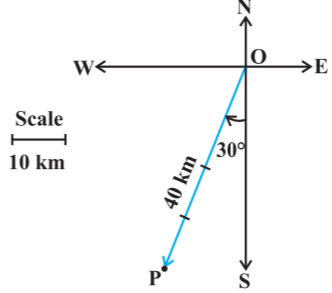
Represent graphically a displacement of 40 km, 30° west of south.
Answer
The vector $\vec {OP}$ represents the required displacement.

View full question & answer