Sample QuestionsVECTOR ALGEBRA questions
One sample from each question group in this chapter. Select any group above to see the full set with answer keys.
If the projection of $\vec{\text{a}}=\hat{\text{i}}-2\hat{\text{j}}+3\hat{\text{k}}$ on $\vec{\text{b}}=2\hat{\text{i}}+\lambda\hat{\text{k}}$ is zero, then the value of $\lambda$ is:
- A
$0$
- B
$1$
- ✓
$\frac{-2}{3}$
- D
$\frac{-3}{2}$
Answer: C.
View full solution →If the projection of $\vec{\text{a}}=\hat{\text{i}}-2\hat{\text{j}}+3\hat{\text{k}}$ on $\vec{\text{b}}=2\hat{\text{i}}+\lambda\hat{\text{k}}$ is zero, then the value of $\lambda$ is:
- A
$0$
- B
$1$
- ✓
$\frac{-2}{3}$
- D
$\frac{-3}{2}$
Answer: C.
View full solution →If the projection of $\vec{\text{a}}=\hat{\text{i}}-2\hat{\text{j}}+3\hat{\text{k}}$ on $\vec{\text{b}}=2\hat{\text{i}}+\lambda\hat{\text{k}}$ is zero, then the value of $\lambda$ is:
- A
$0$
- B
$1$
- ✓
$\frac{-2}{3}$
- D
$\frac{-3}{2}$
Answer: C.
View full solution →$\overrightarrow{\text{r}} = \overrightarrow{\text{x}}{\hat{\text{i}}}+ \overrightarrow{\text{y}}{\hat{\text{j}}}$ is the equation of:
Answer: D.
View full solution →A set of vectors taken in a given order gives a closed polygon. Then the resultant of these vectors is:
Answer: D.
View full solution →Directions : In these questions, a statement of Assertion is followed by a statement of Reason is given.Choose the correct answer out of the following choices :
Assertion : The magnitude of the resultant of vectors $\overline{\text{a}}=2\hat{\text{i}}+\hat{\text{j}}+\hat{\text{k}}$ and $\hat{\text{b}}=\hat{\text{i}}+2\hat{\text{j}}+3\hat{\text{k}}$
Reason : The magnitude of a vector can never be negative.
- A
Assertion and Reason both are correct statements and Reason is the correct explanation of Assertion.
- ✓
Assertion and Reason both are correct statements but Reason is not the correct explanation of Assertion.
- C
Assertion is correct statement but Reason is wrong statement.
- D
Assertion is wrong statement but Reason is correct statement.
Answer: B.
View full solution →Directions : In these questions, a statement of Assertion is followed by a statement of Reason is given. Choose the correct answer out of the following choices :
Assertion : The adjacent sides of a parallelogramarealong $\overline{\text{a}}=\hat{\text{i}}+2\hat{\text{j}}$ and $\overline{\text{b}}=2\hat{\text{i}}+\hat{\text{j}}$ The angle between the diagonals is $150^\circ$.
Reason : Two vectors are perpendicular to each other if their dot product is zero.
- ✓
Assertion and Reason both are correct statements and Reason is the correct explanation of Assertion.
- B
Assertion and Reason both are correct statements but Reason is not the correct explanation of Assertion.
- C
Assertion is correct statement but Reason is wrong statement.
- D
Assertion is wrong statement but Reason is correct statement.
Answer: A.
View full solution →Directions : In these questions, a statement of Assertion is followed by a statement of Reason is given. Choose the correct answer out of the following choices :
Let $\overline{\text{a}}=\hat{\text{i}}+\hat{\text{j}}=3\hat{\text{k}}$ and $\overline{\text{b}}=\hat{2\text{i}}+\hat{\text{j}}=\hat{\text{k}}$
Assertion : Vectors $\overline{\text{a}}$ and $\overline{\text{b}}$ are perpendicular to each other.
Reason : $\overline{\text{a}}.\overline{\text{b}}=0$
- ✓
Assertion and Reason both are correct statements and Reason is the correct explanation of Assertion.
- B
Assertion and Reason both are correct statements but Reason is not the correct explanation of Assertion.
- C
Assertion is correct statement but Reason is wrong statement.
- D
Assertion is wrong statement but Reason is correct statement.
Answer: A.
View full solution →Directions : In these questions, a statement of Assertion is followed by a statement of Reason is given. Choose the correct answer out of the following choices :
Assertion : If $ (\vec{\text{a}}\times\vec{\text{b}})+(\vec{\text{a}}.\vec{\text{b}})=400$ and $|\vec{\text{a}}|=4,$ then $|\vec{\text{b}}|=9.$
Reason : If $\vec{\text{a}}$ and $\vec{\text{b}}$ are any two vectors, then $(\vec{\text{a}}\times\vec{\text{b}})^2$ is equal to $(\vec{\text{a}})^2(\vec{\text{b}})^2-(\vec{\text{a}}.\vec{\text{b}})^2.$
- A
Assertion and Reason both are correct statements and Reason is the correct explanation of Assertion.
- B
Assertion and Reason both are correct statements but Reason is not the correct explanation of Assertion.
- C
Assertion is correct statement but Reason is wrong statement.
- ✓
Assertion is wrong statement but Reason is correct statement.
Answer: D.
View full solution →Directions : In the following questions, the Assertions $(A)$ and Reason $(s)\ (R)$ have been put forward. Read both the statements carefully and choose the correct alternative from the following:
Assertion : Three points with position vectors $\vec{\text{a}},\vec{\text{b}}$ and $\vec{\text{c}}$ are collinear if $\vec{\text{a}}\times\vec{\text{b}}+\vec{\text{b}}\times\vec{\text{c}}+\vec{\text{c}}\times\vec{\text{a}}=\vec{0}$
Reason : If $\overrightarrow{\text{AB}}.\overrightarrow{\text{AC}}.=0,$ then $\overrightarrow{\text{AB}}\bot\overrightarrow{\text{AC}}.$
- A
Assertion and Reason both are correct statements and Reason is the correct explanation of Assertion.
- ✓
Assertion and Reason both are correct statements but Reason is not the correct explanation of Assertion.
- C
Assertion is correct statement but Reason is wrong statement.
- D
Assertion is wrong statement but Reason is correct statement.
Answer: B.
View full solution →Write the position vector of the point which divides the join of points with position vectors $3\overrightarrow{\text{a}} - 2\overrightarrow{\text{b}} \text{and } 2\overrightarrow{\text{a}} + 3\overrightarrow{\text{b}}$ in the ratio $2:1.$
View full solution →Write the number of vectors of unit length perpendicular to both the vectors $\overrightarrow{\text{a}} = 2\hat{\text{i}} + \hat{j} + 2\hat{\text{k}} \text{ and} \overrightarrow{\text{b}} = \hat{\text{j}} + \hat{\text{k}}.$
View full solution →Find a vector of magnitude $\sqrt{171}$ which is perpendicular to both of the vectors $\overrightarrow{\text{a}} = \hat{\text{i}} + 2\hat{\text{j}} - 3\hat{\text{k}}$ $\text{and} \overrightarrow{\text{b}} = 3\hat{\text{i}} - \hat{\text{j}} + 2\hat{\text{k}}.$
View full solution →If $\overrightarrow{\text{a}}$and$\overrightarrow{\text{b}}$ are perpendicular vectors,|$\overrightarrow{\text{a}}$+$\overrightarrow{\text{b}}$|= 13 and |$\overrightarrow{\text{a}}$| = 5 find the value of|$\overrightarrow{\text{b}}$|.
View full solution →Write the position vector of the point which divides the join of points with position vectors $3\overrightarrow{\text{a}} - 2\overrightarrow{\text{b}} \text{and } 2\overrightarrow{\text{a}} + 3\overrightarrow{\text{b}}$ in the ratio $2:1.$
View full solution →If $\theta$ is the angle between two vectors $\hat{\text{i}}-2\hat{\text{j}}+3\hat{\text{k}}\ \text{and}\ 3\hat{\text{i}}-2\hat{\text{j}}+\hat{\text{k}},$ find $\sin\theta.$
View full solution →If $\theta$ is the angle between two vectors $\hat{\text{i}}-2\hat{\text{j}}+3\hat{\text{k}}\ \text{and}\ 3\hat{\text{i}}-2\hat{\text{j}}+\hat{\text{k}},$ find $\sin\theta.$
View full solution →If $\theta$ is the angle between two vectors $\hat{\text{i}}-2\hat{\text{j}}+3\hat{\text{k}}\ \text{and}\ 3\hat{\text{i}}-2\hat{\text{j}}+\hat{\text{k}},$ find $\sin\theta.$
View full solution →If $|\vec{\text{a}}|=2,\big|\vec{\text{b}}\big|=3$ and $\vec{\text{a}}.\vec{\text{b}}=3,$ find the projection of $\vec{\text{b}}$ on $\vec{\text{a}}.$
View full solution →Represent the following graphically:
- A displacement of 40km, 30º east of north.
- A displacement of 50km south-east.
- A displacement of 70km, 40º north of west.
Find the projection of $\vec{b}+\vec{c}$ on $\vec{a}$ where $\vec{a}=\hat{i}+2\hat{j}+\hat{k},\text{ }\vec{b}=\hat{i}+3\hat{j}+\hat{k}$ and $\vec{c}=\hat{i}+\hat{k}.$
View full solution →Find the value of $\lambda$ which makes the vectors $\vec{a},\vec{b},\vec{c}$ coplanar, where $\vec{a}=-4\hat{\text{i}}-6\hat{\text{j}}-2\hat{\text{k}},\text{ }\vec{b}=-\hat{\text{i}}+4\hat{\text{j}}+3\hat{\text{k}}$ and $\vec{c}=-8\hat{\text{i}}-\hat{\text{j}}+\lambda\hat{\text{k}.}$
View full solution →Using vectors, prove that in a $\Delta$ ABC,
$\frac{\text{a}}{\sin\text{A}}=\frac{\text{b}}{\sin\text{B}}=\frac{\text{c}}{\sin\text{C}}$
Where a, b and c are lengths of the sides opposite, respectively, to the angles A, B and C of $\Delta$ ABC.
View full solution →Find the angle between the vectors $\vec{\text{a}}+\vec{\text{b}}\text{ and }\vec{\text{a}}-\vec{\text{b}}\text{ if }\text{ }\vec{\text{a}}=2\hat{\text{i}}-\hat{\text{j}}+3\hat{\text{k}}\text{ and }\vec{\text{b}}\text{ }=3\hat{\text{i}}+\hat{\text{j}}-2\hat{\text{k}}.$
View full solution →Find the projection of $\overrightarrow{b} + \overrightarrow{c} $ on $\overrightarrow{a}$ where $\overrightarrow{a} = 2\hat{i} - 2\hat{j} + \hat{k}, \overrightarrow{b} = \hat{i} + 2\hat{j} - 2\hat{k} $ and $\overrightarrow{c} = 2\hat{i} - \hat{j} + 4\hat{k}.$
View full solution →If $ \vec{\text{a}}=2\hat{\text{i}}-\hat{\text{j}}-2\hat{\text{k}}\ \text{and}\ \vec{\text{b}}=7\hat{\text{i}}+2\hat{\text{j}}-3\hat{\text{k}}, $ then express $ \overrightarrow{\text{b}}$ in the form of $\overrightarrow{\text{b}}=\ \overrightarrow{\text{b}}_1+\overrightarrow{\text{b}}_2,$ where $ \overrightarrow{\text{b}}_1$ is parallel to $\overrightarrow{\text{a}}$ and $ \overrightarrow{\text{b}}_2$ is perpendicular to$\overrightarrow{\text{a}}$.
View full solution →A manufacturing company makes two types of teaching aids A and B of Mathematics for class XII. Each type of A requires 9 labour hours of fabricating and 1 labour hour for finishing. Each type of B requires 12 labour hours for fabricating and 3 labour hours for finishing. For fabricating and finishing, the maximum labour hours available per week are 180 and 30 respectively. The company makes a profit of A and ₹ 80 on each piece of type ₹ 120 on each piece of type B. How many pieces of type A and type B should be manufactured per week to get a maximum profit? Make it as an LPP and solve graphically. What is the maximum profit per week?
A manufacturing company makes two types of teaching aids A and B of Mathematics for class XII. Each type of A requires 9 labour hours of fabricating and 1 labour hour for finishing. Each type of B requires 12 labour hours for fabricating and 3 labour hours for finishing. For fabricating and finishing, the maximum labour hours available per week are 180 and 30 respectively. The company makes a profit of A and ₹ 80 on each piece of type ₹ 120 on each piece of type B. How many pieces of type A and type B should be manufactured per week to get a maximum profit? Make it as an LPP and solve graphically. What is the maximum profit per week?
Find the value of $\lambda,$ if four points with position vectors $3\hat{\text{i}} + 6\hat{\text{j}} + 9\hat{\text{k}}, \hat{\text{i}} + 2\hat{\text{j}} + 3\hat{\text{k}}, 2\hat{\text{i}} + 3\hat{\text{j}} + \hat{\text{k}} \text{ and } 4\hat{\text{i}} + 6\hat{\text{j}} + \lambda\hat{\text{k}}$are coplanar.
View full solution →Show that the points A, B, C with position vectors $2\hat{\text{i}} - \hat{\text{j}} + \hat{\text{k}}, \hat{\text{i}} - 3\hat{\text{j}} - 5\hat{\text{k}} \text{ and } 3\hat{\text{i}} - 4\hat{\text{j}} - 4\hat{\text{k}}$ respectively, are the vertices of a right-angled triangle. Hence find the area of the triangle.
View full solution →Ishaan left from his village on weekend. First, he travelled up to temple. After this, he left for the zoo. After this, he left for shopping in a mall. The positions of Jshaan at different places is given in the following graph.
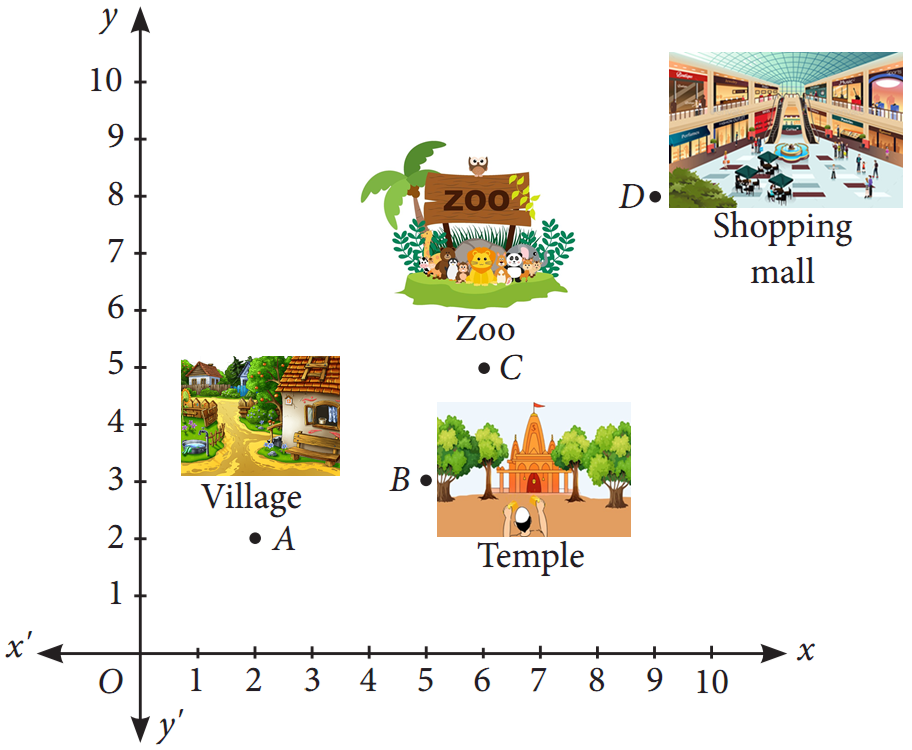
Based on the above information, answer the following questions.
- Position vector of B is:
- $3\hat{\text{i}}+5\hat{\text{j}}$
- $5\hat{\text{i}}+3\hat{\text{j}}$
- $-5\hat{\text{i}}-3\hat{\text{j}}$
- $-5\hat{\text{i}}+3\hat{\text{j}}$
- Position vector of D is:
- $5\hat{\text{i}}+3\hat{\text{j}}$
- $3\hat{\text{i}}+5\hat{\text{j}}$
- $8\hat{\text{i}}+9\hat{\text{j}}$
- $9\hat{\text{i}}+8\hat{\text{j}}$
- Find the vector $\overline{\text{BC}}$ in terms of $\hat{\text{i}},\hat{\text{j}}.$
- $\hat{\text{i}}-2\hat{\text{j}}$
- $\hat{\text{i}}+2\hat{\text{j}}$
- $2\hat{\text{i}}+\hat{\text{j}}$
- $2\hat{\text{i}}-\hat{\text{j}}$
- Length of vector $\overline{\text{AB}}$ is:
- $\sqrt{67}\text{ units}$
- $\sqrt{85}\text{ units}$
- 90 units
- 100 units
- If $\vec{\text{M}}=4\hat{\text{j}}+3\hat{\text{k}},$ then its unit vector is:
- $\frac{4}{5}\hat{\text{j}}+\frac{3}{5}\hat{\text{k}}$
- $\frac{4}{5}\hat{\text{j}}-\frac{3}{5}\hat{\text{k}}$
- $-\frac{4}{5}\hat{\text{j}}+\frac{3}{5}\hat{\text{k}}$
- $-\frac{4}{5}\hat{\text{j}}-\frac{3}{5}\hat{\text{k}}$
View full solution →Ritika starts walking from his house to shopping mall. Instead of going to the mall directly, she first goes to a ATM, from there to her daughter's school and then reaches the mall. ln the diagram, A, B, C, and D represent the coordinates of House, ATM, School and Mall respectively.
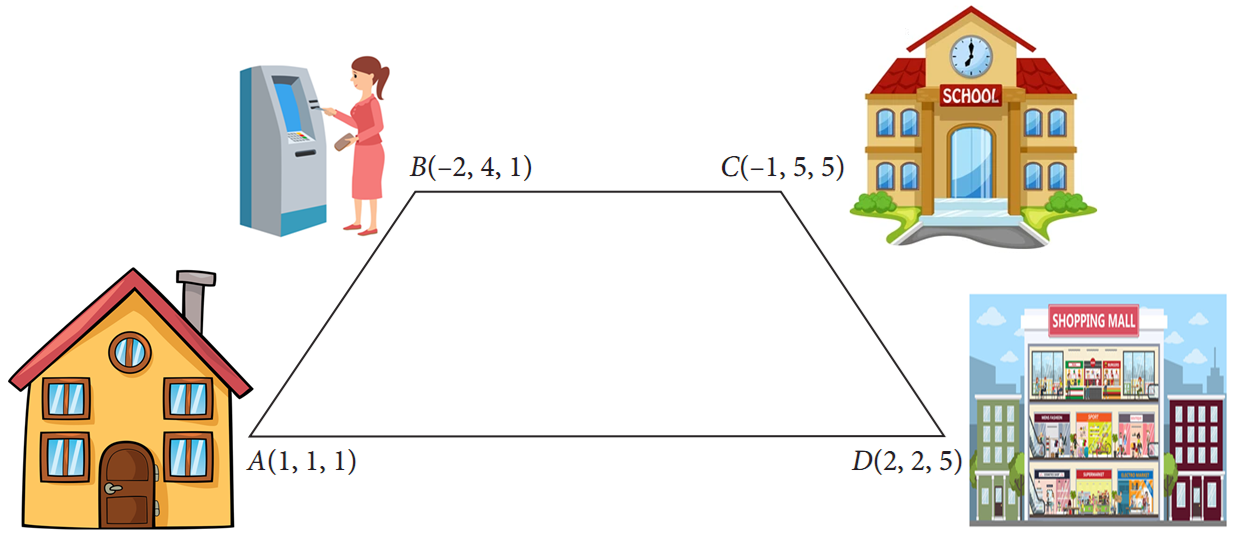
Based on the above information, answer the following questions.
- Distance between House (A) and ATM (B) is:
- $3\text{ units}$
- $3\sqrt{2}\text{ units}$
- $\sqrt{2}\text{ units}$
- $4\sqrt{2}\text{ units}$
- Distance between ATM (B) and School (C) is:
- $\sqrt{2}\text{ units}$
- $2\sqrt{2}\text{ units}$
- $3\sqrt{2}\text{ units}$
- $4\sqrt{2}\text{ units}$
- Distance between School (C) and Shopping mall (D) is:
- $3\sqrt{2}\text{ units}$
- $5\sqrt{2}\text{ units}$
- $7\sqrt{2}\text{ units}$
- $10\sqrt{2}\text{ units}$
- What is the total distance travelled by Ritika:
- $4\sqrt{2}\text{ units}$
- $6\sqrt{2}\text{ units}$
- $8\sqrt{2}\text{ units}$
- $9\sqrt{2}\text{ units}$
- What is the extra distance travelled by Ritika in reaching the shopping mall?
- $3\sqrt{2}\text{ units}$
- $5\sqrt{2}\text{ units}$
- $6\sqrt{2}\text{ units}$
- $7\sqrt{2}\text{ units}$
View full solution →Ginni purchased an air plant holder which is in the shape of a tetrahedron.
Let A, B, C, and Dare the coordinates of the air plant holder where $\text{A}\equiv(1,1,1),\text{B}\equiv(2,1,3),\text{C}\equiv(3,2,2)$ and $\text{D}\equiv(3,3,4).$
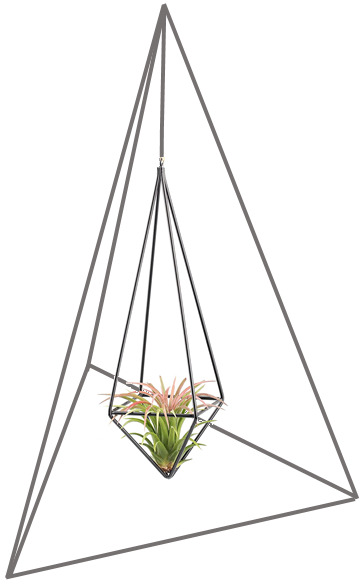
Based on the above information, answer the following questions.
- Find the position vector of $\overline{\text{AB}}.$
- $-\hat{\text{i}}-2\hat{\text{k}}$
- $2\hat{\text{i}}+\hat{\text{k}}$
- $\hat{\text{i}}+2\hat{\text{k}}$
- $-2\hat{\text{i}}-\hat{\text{k}}$
- Find the position vector of $\overline{\text{AC}}.$
- $2\hat{\text{i}}-\hat{\text{j}}-\hat{\text{k}}$
- $2\hat{\text{i}}+\hat{\text{j}}+\hat{\text{k}}$
- $-2\hat{\text{i}}-\hat{\text{j}}+\hat{\text{k}}$
- $\hat{\text{i}}+2\hat{\text{j}}+\hat{\text{k}}$
- Find the position vector of $\overline{\text{AD}}.$
- $2\hat{\text{i}}-2\hat{\text{j}}-3\hat{\text{k}}$
- $\hat{\text{i}}+\hat{\text{j}}-3\hat{\text{k}}$
- $3\hat{\text{i}}+2\hat{\text{j}}+2\hat{\text{k}}$
- $2\hat{\text{i}}+2\hat{\text{j}}+3\hat{\text{k}}$
- Area of $\triangle\text{ABC}=$
- $\frac{\sqrt{11}}{2}\text{sq}.\text{units}$
- $\frac{\sqrt{14}}{2}\text{sq}.\text{units}$
- $\frac{\sqrt{13}}{2}\text{sq}.\text{units}$
- $\frac{\sqrt{17}}{2}\text{sq}.\text{units}$
- Find the unit vector along $\overline{\text{AD}}.$
- $\frac{1}{\sqrt{17}}(2\hat{\text{i}}+2\hat{\text{j}}+3\hat{\text{k}})$
- $\frac{1}{\sqrt{17}}(3\hat{\text{i}}+3\hat{\text{j}}+2\hat{\text{k}})$
- $\frac{1}{\sqrt{11}}(2\hat{\text{i}}+2\hat{\text{j}}+3\hat{\text{k}})$
- $(2\hat{\text{i}}+2\hat{\text{j}}+3\hat{\text{k}})$
View full solution →A building is to be constructed in the form of a triangular pyramid, ABCD as shown in the figure.
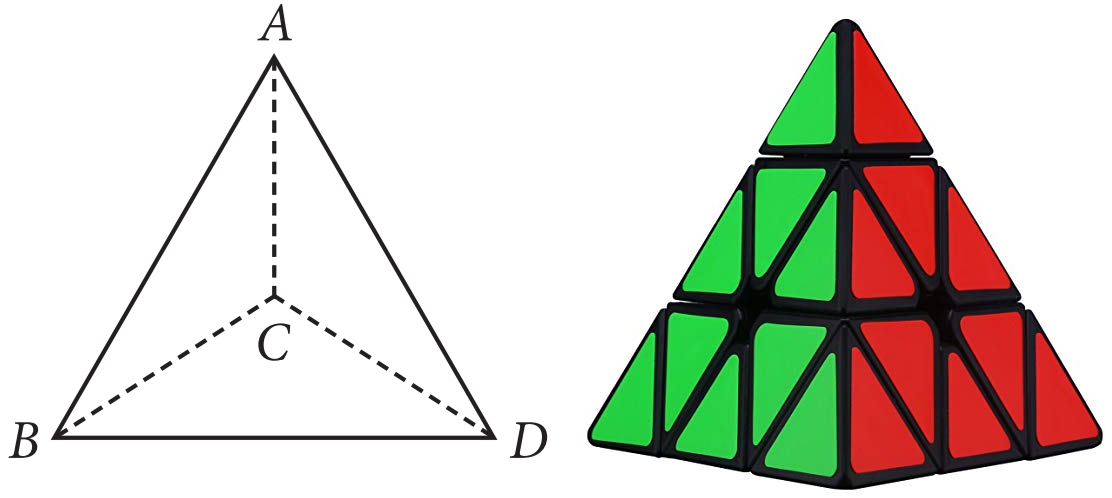
Let its angular points are A(0, 1, 2), B(3, 0, 1), C(4, 3, 6), and D(2, 3, 2), and G be the point of intersection of the medians of $\triangle\text{BCD}.$
Based on the above information, answer the following questions.
- The coordinates of point Gare:
- (2, 3, 3)
- (3, 3, 2)
- (3, 2, 3)
- (0, 2, 3)
- The length of vector $\overline{\text{AG}}$ is:
- $\sqrt{17}\text{ units}$
- $\sqrt{11}\text{ units}$
- $\sqrt{13}\text{ units}$
- $\sqrt{19}\text{ units}$
- Area of $\triangle\text{ABC}$ (in sq. units) is:
- $\sqrt{10}$
- $2\sqrt{10}$
- $3\sqrt{10}$
- $5\sqrt{10}$
- The sum of lengths of $\overline{\text{AB}}$ and $\overline{\text{AC}}$ is:
- 5 units
- 9.32 units
- 10 units
- 11 units
- The length of the perpendicular from the vertex D on the opposite face is:
- $\frac{6}{\sqrt{10}}\text{ units}$
- $\frac{2}{\sqrt{10}}\text{ units}$
- $\frac{3}{\sqrt{10}}\text{ units}$
- $8\sqrt{10}\text{ units}$
View full solution →Geetika's house is situated at Shalimar Bagh at point O, for going to Alok's house she first travels 8km by bus in the East. Here at point A, a hospital is situated. From Hospital, Geetika takes an auto and goes 6km in the North, here at point B school is situated. From school, she travels by bus to reach Alok's house which is at 30º East, 6km from point B.
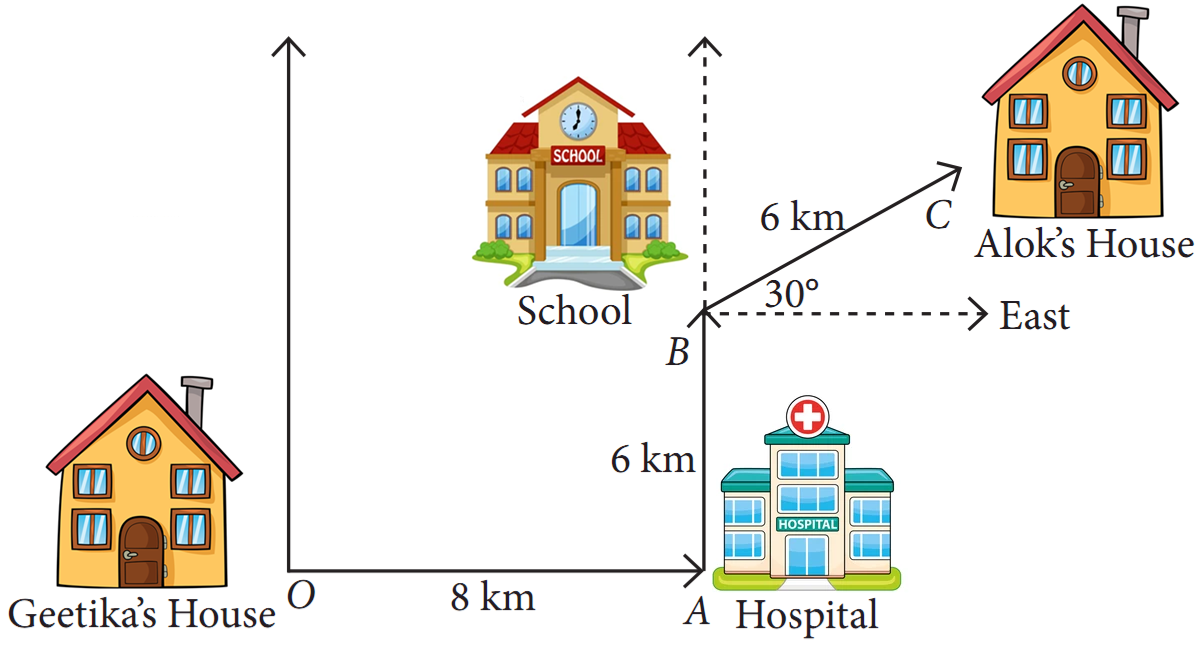
Based on the above information, answer the following questions.
- What is the vector distance between Geetika's house and school?
- $8\hat{\text{i}}-6\hat{\text{j}}$
- $8\hat{\text{i}}+6\hat{\text{j}}$
- $8\hat{\text{i}}$
- $6\hat{\text{j}}$
- How much distance Geetika travels to reach school?
- 14km
- 15km
- 16km
- 17km
- What is the vector distance from school to Alok's house?
- $\sqrt{3}\hat{\text{i}}+\hat{\text{j}}$
- $3\sqrt{3}\hat{\text{i}}+3\hat{\text{j}}$
- $6\hat{\text{i}}$
- $6\hat{\text{j}}$
- What is the vector distance from Geetika's house to Alok's house?
- $(8+3\sqrt{3})\hat{\text{i}}+9\hat{\text{j}}$
- $4\hat{\text{i}}+6\hat{\text{j}}$
- $15\hat{\text{i}}$
- $16\hat{\text{j}}$
- What is the total distance travelled by Geetika from her house to Alok's house?
- 19km
- 20km
- 21km
- 22km
View full solution →Fill in the blanks.
If $\vec{\text{r}}\cdot\vec{\text{a}}=0,\vec{\text{r}}\cdot\vec{\text{b}}=0,$ and $\vec{\text{r}}\cdot\vec{\text{c}}=0$ for some non-zero vector $\vec{\text{r}},$ then the value of $\vec{\text{a}}(\vec{\text{b}}\times\vec{\text{c}})$ is _______.
View full solution →Fill in the blanks.
The value of the expression $|\vec{\text{a}}\times\vec{\text{b}}|^2+(\vec{\text{a}}\cdot\vec{\text{b}})^2$ is ________.
View full solution →Fill in the blanks.
If $|\vec{\text{a}}\times\vec{\text{b}}|^2+|\vec{\text{a}}\cdot\vec{\text{b}}|^2=144$ and $|\vec{\text{a}}|=4,$ then $|\vec{\text{b}}|^2$ is equal to ________.
View full solution →Fill in the blanks.
If $\vec{\text{a}}$ is any non-zero vector, then $(\vec{\text{a}}\cdot\vec{\text{i}})\vec{\text{i}}+(\vec{\text{a}}\cdot\vec{\text{j}})\vec{\text{j}}+(\vec{\text{a}}\cdot\vec{\text{k}})\vec{\text{k}}$ equal ________.
View full solution →Fill in the blanks.
The values of k for which $|\text{k}\vec{\text{a}}|<|\vec{\text{a}}|$ and $\text{k}\vec{\text{a}}=\frac{1}{2}\vec{{\text{a}}}$ is a parallel to $\vec{\text{a}}$ holds true are _________.
View full solution →State True or False for the following:
Position vector of a point $\vec{\text{P}}$ is a vector whose initial point is origin.
View full solution →Answer the following as true or false.
Two collinear vectors are always equal in magnitude.
Two collinear vectors are always equal in magnitude.
State True or False for the following:
If $|\vec{\text{a}}|=|\vec{\text{b}}|,$ then necessarily it implies $\vec{\text{a}}=\pm\vec{\text{b}}.$
View full solution →View full solution →