Questions

1 Marks Question

Take a timed test

11 questions · self-marked practice — reveal the answer and mark yourself.
Question 11 Mark
When an AC source is connected to a capacitor there is a steady-state current in the circuit. Does it mean thatthe charges jump from one plate to the other to complete the circuit?
Answer
No.
View full question & answer
Question 21 Mark
An AC source is connected to a capacitor. Will the rms current increase, decrease or remain constant if a dielectric slab is inserted into the capacitor?
Answer
$\text{X}_\text{c}=\frac{1}{\omega\text{C}}$ as slab is introduced C increases and $X_C$ decreases so current increases.
View full question & answer
Question 31 Mark
Can a hot-wire ammeter be used to measure a direct current having a constant value? Do we have to change the graduations?
Answer
Yes, in this case $\mathrm{I}_{\mathrm{rms}}$ value will be same as the DC current.
View full question & answer
Question 41 Mark
What is the reactance of a capacitor connected to a constant DC source?
Answer
$\text{X}_\text{c}=\frac{1}{\omega\text{C}}$
As,
$\omega=0$
For,
$\text{DC},\text{X}_\text{c}=\infty.$
View full question & answer
Question 51 Mark
In a circuit containing a capacitor and an AC source the current is zero at the. stant the source voltage is maximum. Is it consistent with Ohm's law?
Answer
Ohm's law is valid for resistance.
View full question & answer
Question 61 Mark
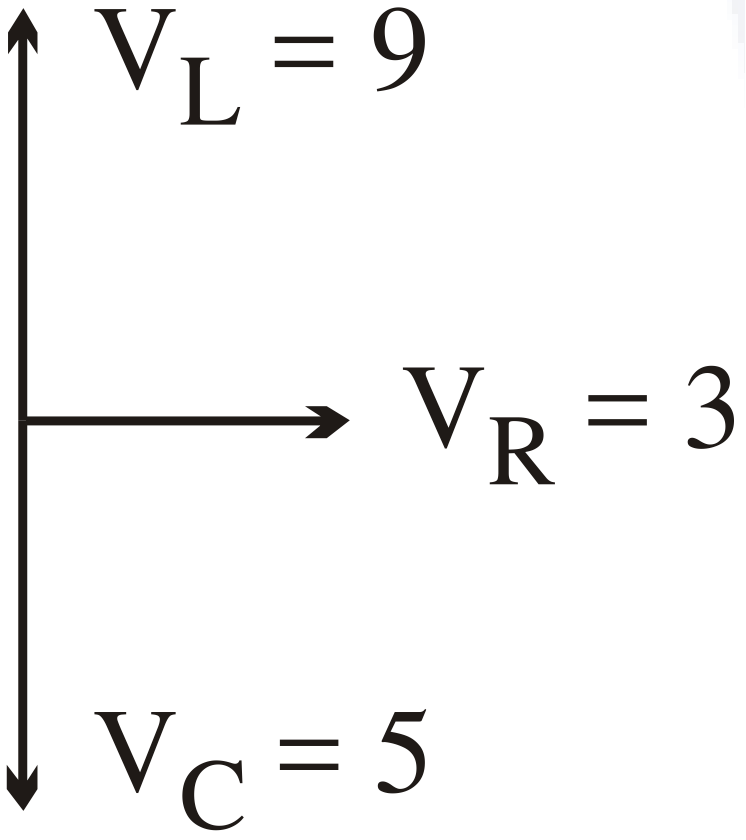
Can the peak voltage across the inductor be greater than the peak voltage of the source in an LCR circuit?
Answer
Yes,
Consider example below:
View full question & answer
Question 71 Mark
A current $\text{i}_1=\text{i}_0\sin\omega\text{t}$ passes through a resistor of resistance R. How much thermal energy is produced in one time period? A current $\text{i}_2=-\text{i}_0\sin\omega\text{t}$ passes through the resistor. How much thermal energy is produced in one time period? If $i_1$, and $i_2$ both pass through the resistor simultaneously, how much thermal energy is produced? Is the principle of superposition obeyed in this case?
Answer
$\text{I}_\text{rms}^{2}\times\text{R}\times\frac{2\pi}{\omega}$ from definition of rms current.
$i_1$, and $i_2$ both pass through the resistor simultaneously, and same thermal energy is produced.
Similary, the principle of superposition obeyed in this case zero.
View full question & answer
Question 81 Mark
Is energy produced when a transformer steps up the voltage?
Answer
No, as voltage increases current decreases. Hence, if efficiency is 100% power will be same.
View full question & answer
Question 91 Mark
When the frequency of the AC source in an LCR circuit equals the resonant frequency, the reactance of the circuit is zero. Does it mean that there is no current through the inductor or the capacitor?
Answer
There is current but the potential difference across inductor and capacitor cancel each other.
View full question & answer
Question 101 Mark
Can you, have an AG series circuit in which there is. a phase difference of 180° between the emf and the current? 120°?
Answer
No.
View full question & answer
Question 111 Mark
Two alternating currents are given by, $\text{i}_\text{i}=\text{i}_0\sin\omega\text{t}$ and $\text{i}_\text{i}=\text{i}_0\sin\Big(\omega\text{t}+\frac{\pi}{3}\Big)$ Will the rms values of the currents be equal or different?
Answer
$\mathrm{I}_{\mathrm{rms}}$ will be equal because in a complete cycle heat dissipated will be equal for both.
View full question & answer