Questions

2 Marks Questions

Take a timed test

5 questions · self-marked practice — reveal the answer and mark yourself.

Question 12 Marks
A transformer is designed to convert an AC voltage of 220V to an AC voltage of 12V. If the input terminals are connected to a DC voltage of 220V, the transformer usually burns. Explain.
Answer
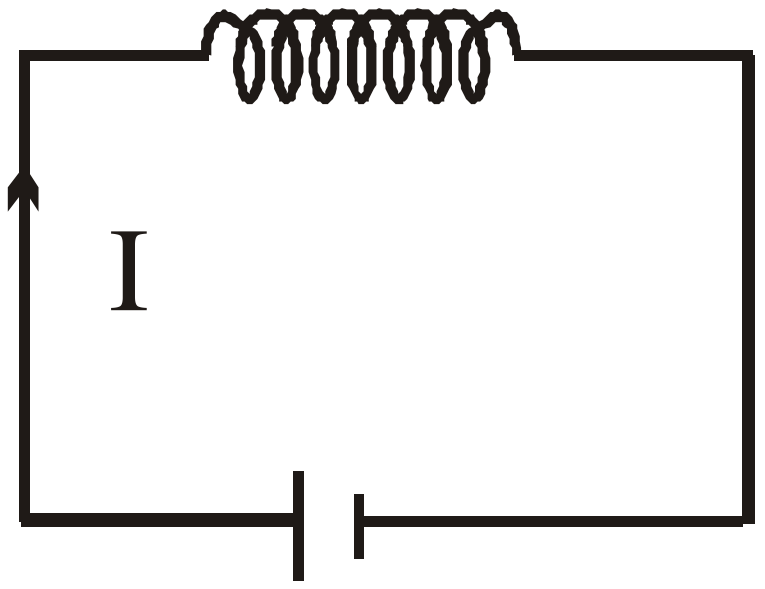
In case of inductor:
$\text{V}-\text{L}\frac{\text{dI}}{\text{dt}}=0$
$\text{V}=\text{L}\frac{\text{dI}}{\text{dt}}$
$\int\text{dI}=\frac{\text{V}}{\text{L}}\int\text{dt}$
$\text{I}=\frac{\text{Vt}}{\text{L}}$
If direct current is connected across inductor current increases with time and transformer is also inductor. So, current can increase to large value and transfer can burn.
View full question & answer
Question 22 Marks
The peak power consumed by a resistive coil, when connected to an AC source, is 80W. Find the energy consumed by the coil in 100 seconds, which is many times larger than the time period of the source.
Answer
$\text{P}_0=80\text{W}$ (Given)
$\text{P}_\text{rms}=\frac{\text{P}_0}{2}=40\text{W.}$
Energy consumed $=\text{P}\times\text{t}=40\times100$
$=4000\text{J}=4.0\text{KJ}$
View full question & answer
Question 32 Marks
The current in a discharging LR circuit is given by $\text{i}=\text{i}_0\text{e}^{\frac{-\text{t}}{\tau}}$ where $\tau$ is the time constant of the circuit. Calculate the rms current for the period $\text{t}=0$ to $\text{t}=\tau.$
Answer
$\text{i}=\text{i}_0\text{e}^{\frac{-\text{t}}{\tau}}$
$\text{i}^2=\frac{1}{\tau}\int\limits_0^\tau\text{i}_0{^2}\text{e}^{\frac{-2\text{t}}{\tau}}\text{dt}$
$=\frac{\text{i}_0{^2}}{\tau}\int\limits_0^\tau\text{e}^{\frac{-2\text{t}}{\tau}}\text{dt}$
$=\frac{\text{i}_0{^2}}{\tau}\times\Big[\frac{\tau}{2}\text{e}^{\frac{-2\text{t}}{\tau}}\Big]_0^\tau$
$=-\frac{\text{i}_0{^2}}{\tau}\times\frac{\tau}{2}\big[\text{e}^{-2}-1\big]$
$\sqrt{\text{i}^2}=\sqrt{-\frac{\text{i}_0^2}{2}\Big(\frac{1}{\text{e}^2}-1\Big)}$
$=\frac{\text{i}_0^2}{2}\sqrt{\Big(\frac{\text{e}^2-1}{2}\Big)}$
View full question & answer
Question 42 Marks
A resistance is connected to an AC source. If a capacitor is included in the series circuit, will the average power absorbed by the resistance increase or decrease? If an inductor of small inductance is also included in the series circuit, will the average power absorbed increase or decrease further?
Answer
If capacitor is included
$\text{Z}=\sqrt{\text{R}^2+\text{X}_\text{C}^2}$
Hence, impedence increases so $I_{rms}$ decreases. Hence, ${I_{rms}}^2$ R decreases. If the inductor of small inductance is also included then,
$\text{Z}=\sqrt{\text{R}^2+\big(\text{X}_\text{C}-\text{X}_\text{L}\big)^2}$
Now, impedance gets decreased hence $I_{rms}$ increases and ${I_{rms}}^2$ R increases.
View full question & answer
Question 52 Marks
The dielectric strength of air is $3.0 \times 10^6V/m.$ A parallel-plate air-capacitor has area $20cm^2$ and plate separation 0.10mm. Find the maximum rms voltage of an AC source that can be safely connected to this capacitor.
Answer
$E = 3 \times 10^6V/m, A = 20cm^2, d = 0.1mm.$
Potential difference across the capacitor$= Ed = 3 \times 10^6 \times 0.1 \times 10^{-3} = 300V$
Maximum rms Voltage $=\frac{\text{V}}{\sqrt{2}}=\frac{300}{\sqrt{2}}=212\text{V}.$
View full question & answer