Question types

Dispersion and Spectra question types

23 questions across 4 question groups — pick any mix to generate a Physics paper with step-by-step answer keys.

23
Questions
4
Question groups
5
Question types
Sample Questions

Dispersion and Spectra questions

One sample from each question group in this chapter. Select any group above to see the full set with answer keys.

prism can produce a minimum deviation $\delta$ in a light beam. If three such prisms are combined, the minimum deviation that can be produced in this beam is:
  • A
    $0$
  • $\delta$
  • C
    $2\delta$
  • D
    $3\delta$

Answer: B.

View full solution
If a glass prism is dipped in water, its dispersive power:
  • A
    Increases.
  • Decreases.
  • C
    Does not change.
  • D
    May increase or decrease depending on whether the angle of the prism is less than or greater than 60°.

Answer: B.

View full solution
In producing a pure spectrum, the incident light is passed through a narrow slit placed in the focal plane of an achromatic lens because a narrow slit:
  • A
    Produces less diffraction.
  • B
    Increases intensity.
  • C
    Allows only one colour at a time.
  • Allows a more parallel beam when it passes through the lens.

Answer: D.

View full solution
The angular dispersion produced by a prism:
  • Increases if the average refractive index increases.
  • B
    Increases if the average refractive index decreases.
  • C
    Remains constant whether the average refractive index increases or decreases.
  • D
    Has no relation with average refractive index.

Answer: A.

View full solution
Consider the following two statements:
  1. Line spectra contain information about atoms.
  2. Band spectra contain information about molecules.
  • A
    Both $A$ and $B$ are wrong
  • B
    $A$ is correct but $B$ is wrong.
  • C
    $B$ is correct but $A$ is wrong
  • Both $A$ and $B$ are correct.

Answer: D.

View full solution
The equation $\omega=\frac{\mu_\text{v}-\mu_\text{r}}{\mu-1}$ asderived for a prism having small refracting angle. Is it also valid for a prism of large refracting angle? Is it also valid for a glass slab or a glass sphere?
View full solution
The refractive index of a material changes by 0.014 as the colour of the light changes from red to violet. A rectangular slab of height 2.00cm made of this material is placed on a newspaper. When viewed normally in yellow light, the letters appear 1.32cm below the top surface of the slab. Calculate the dispersive power of the material.
View full solution
Can the dispersive power $\omega=\frac{\mu_\text{v}-\mu\text{r}}{\mu-1}$ be negative? What is the sign of co if a hollow prism is immersed into water?
View full solution
The minimum deviations suffered by red, yellow and violet beams passing through an equilateral transparent prism are 38.4°, 38.7° and 39.2° respectively. Calculate the dispersive power of the medium.
View full solution
Q 113 Marks Question3 Marks
A thin prism of crown glass $(\mu_\text{r}=1.515,\mu_\text{v}=1.525)$ and a thin prism of flint glass $(\mu_\text{r}=1.612,\mu_\text{v}=1.632)$ are placed in contact with each other. Their refracting angles are 5.0° each and are similarly directed. Calculate the angular dispersion produced by the combination.
View full solution
Q 123 Marks Question3 Marks
The focal lengths of a convex lens for red, yellow and violet rays are 100cm, 98cm and 96cm respectively. Find the dispersive power of the material of the lens.
View full solution
Q 143 Marks Question3 Marks
Two prisms of identical geometrical shape are combined with their refracting angles oppositely directed. The materials of the prisms have refractive indices 1.52 and 1.62 for violet light. A violet ray is deviated by 1.0° when passes symmetrically through this combination. What is the angle of the prisms?
View full solution
Q 153 Marks Question3 Marks
A thin prism is made of a material having refractive indices 1.61 and 1.65 for red and violet light. The dispersive power of the material is 0.07. It is found that a beam of yellow light passing through the prism suffers a minimum deviation of 4.0° in favourable conditions. Calculate the angle of the prism.
View full solution
The refractive index of a material $M_1$ changes by 0.014 and that of another material $M_2$ changes by 0.024 as the colour of the light is changed from red to violet. Two thin prisms one made of $M_1(A = 5.3^\circ)$ and other made of $M_2(A = 3.7^\circ)$ are combined with their refracting angles oppositely directed.
  1. Find the angular dispersion produced by the combination.
  2. The prisms are now combined with their refracting angles similarly directed. Find the angular dispersion produced by the combination.
View full solution
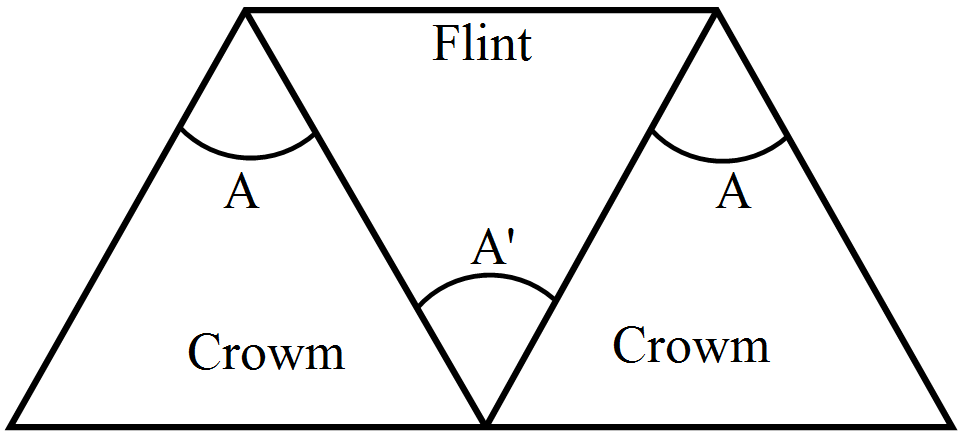
Three thin prisms are combined as shown in figure. The refractive indices of the crown glass for red, yellow and violet rays are $\mu_\text{r},\mu_\text{y}$ and $\mu_\text{v}$ respectively and those for the flint glass are $\mu'_\text{r},\mu'_\text{y}$ and $\mu'_\text{v}$ respectively. Find the ratio $\frac{\text{A}'}{\text{A}}$ for which.
  1. There is no net angular dispersion.
  2. There is no net deviation in the yellow ray.
View full solution
A thin prism of angle $6.0^\circ,\omega=0.07$ and $\mu_\text{y}=1.50$ is combined with another thin prism having $\omega=0.08$ and $\mu_\text{y}=1.60.$ The combination produces no deviation in the mean ray.
  1. Find the angle of the second prism.
  2. Find the net angular dispersion produced by the combination when a beam of white light passes through it.
  3. If the prisms are similarly directed, what will be the deviation in the mean ray
  4. Find the angular dispersion in the situation described in (c).
View full solution

Generate a Dispersion and Spectra paper free

Pick question groups from the list above, set marks and difficulty, and export a branded PDF with step-by-step answer keys. First 3 chapters free — no signup.

Download App