Questions

2 Marks Questions

Take a timed test

21 questions · self-marked practice — reveal the answer and mark yourself.

Question 12 Marks
An electron gun emits $2.0 × 10^{16}$ electrons per second. What electric current does this correspond to?
Answer
No. of electrons per second $= 2 × 10^{16}$ electrons/ sec.
Charge passing per second $=2\times10^{16}\times1.6\times10^{-9}\frac{\text{coulomb}}{\text{sec}}$
$=3.2\times10^{-9}$ Coulomb/ sec
Current $=3.2\times10^{-3}\text{A}.$
View full question & answer
Question 22 Marks
Can the potential difference across a battery be greater than its emf?
Answer
In general potential difference can be equal or less than the emf.
E.m.f can never exceed the potential difference.
If the emf of a battery is E Volt, the potential difference across a battery is given by,
V = E - I r where I is the current in the circuit and r is the internal resistance.
View full question & answer
Question 32 Marks
Consider a circuit containing an ideal battery connected to a resistor. Do "work done by the battery" and "the thermal energy developed" represent two names of the same physical quantity?
Answer
No as the work done by the battery is work done by the battery like ouput. and the thermal energy developed is due to lesser efficiency of battery. In case of ideal battery there would be no thermal energy developed.
View full question & answer
Question 42 Marks
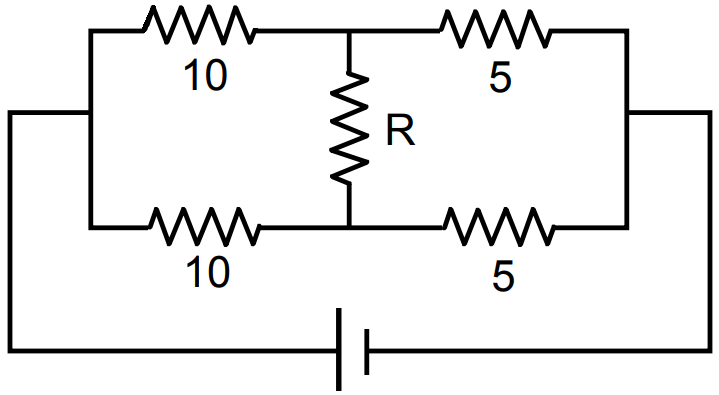
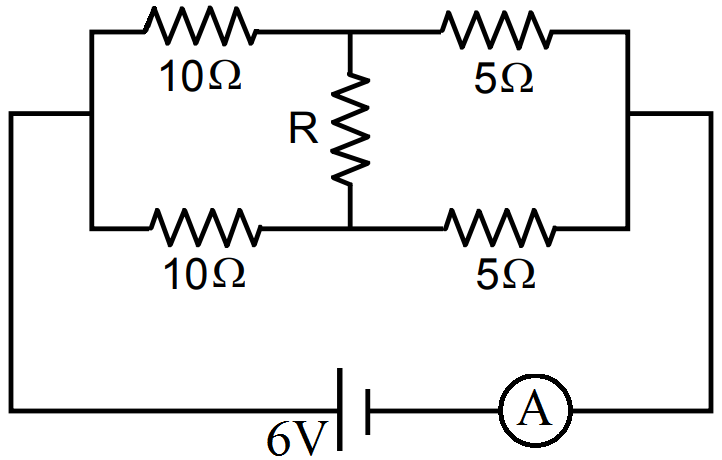
What should be the value of R in the figure. for which the current in it is zero?
Answer

For an value of R, the current in the branch is 0.
View full question & answer
Question 52 Marks
A parallel-plate capacitor is filled with a dielectric material of resistivity ρ and dielectric constant K. The capacitor is charged and disconnected from the charging source. The capacitor is slowly discharged through the dielectric. Show that the time constant of the discharge is independent of all geometrical parameters like the plate area or separation between the plates. Find this time constant.
Answer
Equation of discharging capacitor
$=\text{q}_0\text{e}^{\frac{-\text{t}}{\text{RC}}}=\frac{\text{K}\in_0\text{AV}}{\text{d}}\text{e}^{\frac{-1}{\frac{(\rho\text{dK}\in_0\text{A})}{\text{Ad}}}}=\frac{\text{K}\in_0\text{AV}}{\text{d}}\text{e}^{\frac{-\text{t}}{\rho\text{K}\in_0}}$
$\therefore\tau=\rho\text{K}\in_0$
$\therefore$ Time constant is $\rho\text{K}\in_0$ is independent of plate area or separation between the plate.
View full question & answer
Question 62 Marks
A wire has a length of 2.0m and a resistance of $5.0\Omega.$ Find the electric field existing inside the wire if it carries a current of 10A.
Answer
$\text{l}=2\text{m},\text{R}=5\Omega,\text{i}=10\text{A},\text{E}=?$
$\text{V}=\text{iR}=10\times5=50\text{V}$
$\text{E}=\frac{\text{V}}{\text{l}}=\frac{50}{2}=25\text{V}/\text{m}$
View full question & answer
Question 72 Marks
A non-ideal battery is connected to a resistor. Is work done by the battery equal to the thermal energy developed in the resistor? Will your answer change if the battery is ideal?
Answer
Yes, the answer will change if the battery is ideal. An ideal battery has no internal resistance. Hence, the work done by an ideal battery will be equal to the thermal energy developed in the resistor, assuming that the resistance of the wires used for connection is negligible.
View full question & answer
Question 82 Marks
The electric current existing in a discharge tube is $2.0\mu\text{A}.$ How much charge is transferred across a cross-section of the tube in 5 minutes?
Answer
$\text{i}'=2\mu\text{A},\text{t}=5\text{min}=5\times60\text{sec}$
$\text{q}=\text{i t}$
$=2\times10^{-6}\times5\times60$
$=10\times60\times10^{-6}\text{c}=6\times10^{-4}\text{c}$
View full question & answer
Question 92 Marks
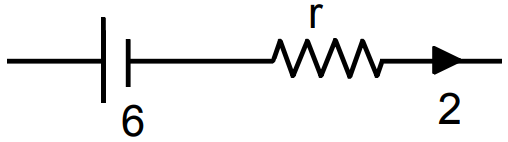
The potential difference between the terminals of a 6.0V battery is 7.2V when it is being charged by a current of 2.0A. What is the internal resistance of the battery?
Answer

$\text{V}=\in+\text{ir}$
$\Rightarrow7.2=6+2\times\text{r}$
$\Rightarrow1.2=2\text{r}\Rightarrow\text{r}=0.6\Omega.$
View full question & answer
Question 102 Marks
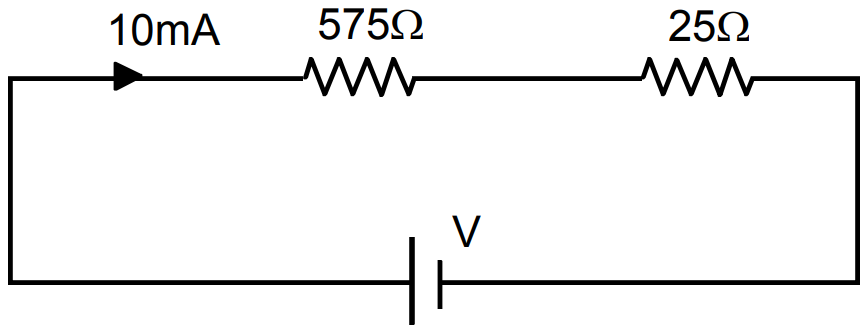
A voltmeter consists of a $25\Omega$ coil connected in series with a $575\Omega$ resistor. The coil takes 10mA for full scale deflection. What maximum potential difference can be measured by this voltmeter?
Answer

Full deflection current $=10\text{mA}=(10\times10^{-3})\text{A}$
$\text{R}_\text{eff}=(575+25)\Omega=600\Omega$
$\text{V}=\text{R}_\text{eff}\times\text{i}=600\times10\times10^{-3}=6\text{V}.$
View full question & answer
Question 112 Marks
A bulb is made using two filaments. A switch selects whether the filaments are used individually or in parallel. When used with a 15V battery, the bulb can be operated at 5W, 10W or 15W. What should be the resistances of the filaments?
Answer
The various resistances of the bulbs $=\frac{\text{V}^2}{\text{P}}$
Resistances are $\frac{(15)^2}{10},\frac{(15)^2}{10},\frac{(15)^2}{15},=45,22.5,15.$
Since two resistances when used in parallel have resistances less than both.
The resistances are 45 and 22.5.
View full question & answer
Question 122 Marks
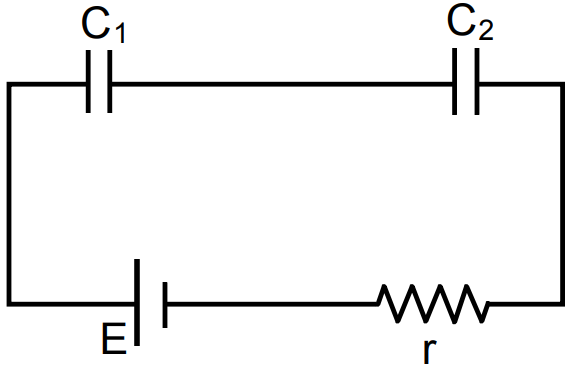
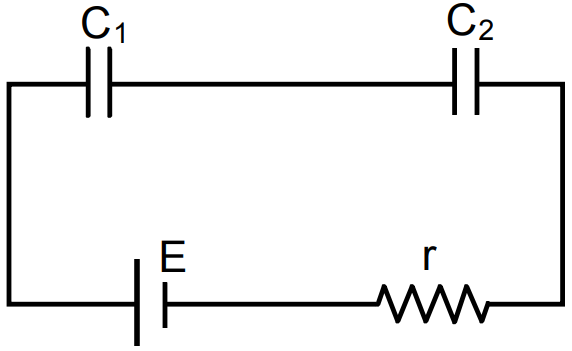
Consider the situation shown in figure. The switch is closed at t = 0 when the capacitors are uncharged. Find the charge on the capacitor $C_1$ as a function of time t.
Answer

$\text{C}_\text{eff}=\frac{\text{C}_1\text{C}_2}{\text{C}_1+\text{C}_2}$

$\text{Q}=\text{C}_\text{eff}\text{E}\Big(1-\text{e}^{\frac{-\text{t}}{\text{RC}}}\Big)=\frac{\text{C}_1\text{C}_2}{\text{C}_1+\text{C}_2}\text{E}\Big(1-\text{e}^\frac{-\text{t}}{\text{RC}}\Big)$
View full question & answer
Question 132 Marks
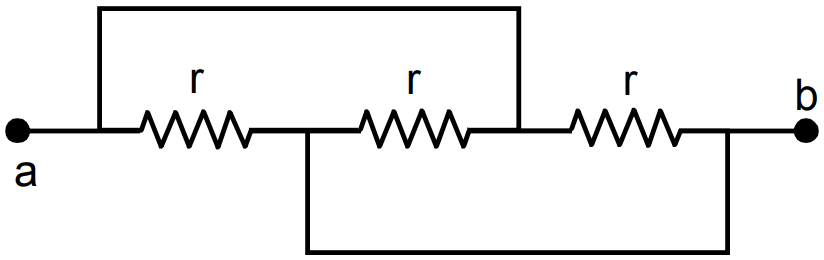
Find the equivalent resistance of the network shown in figure. between the points a and b.
Answer

Eq. Resistance $=\frac{\text{r}}{3}$
View full question & answer
Question 142 Marks
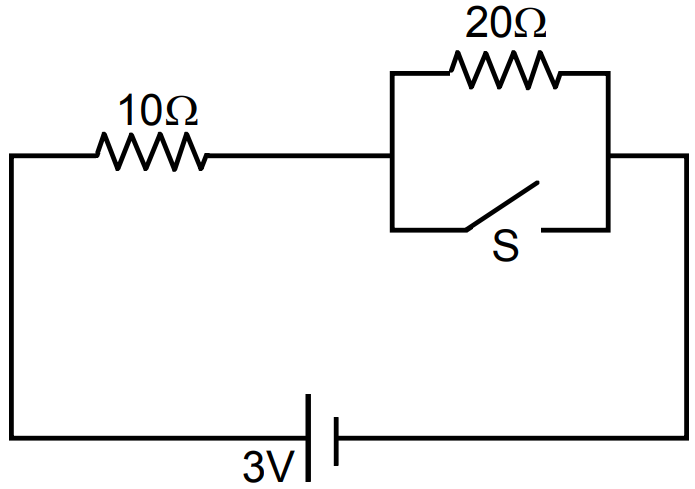
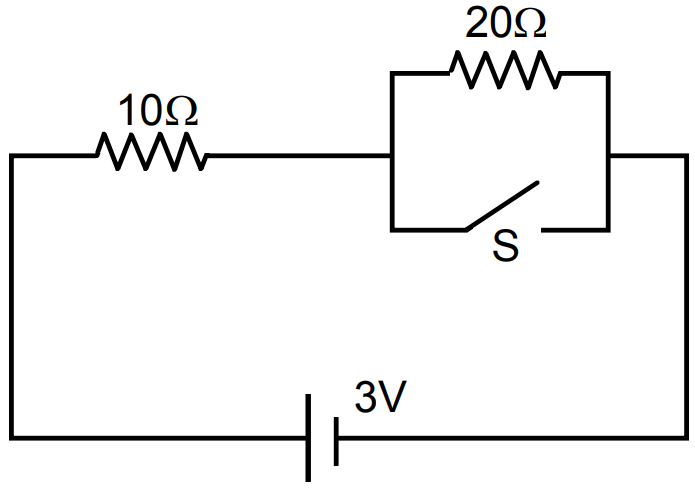
Consider the circuit shown in figure. Find the current through the $10\Omega$ resistor when the switch S is (a) Open (b) Closed.
Answer

  1. When S is open,
$\text{R}_\text{eq}=(10+20)\Omega=30\Omega$
  1. i = When S is closed,
$\text{R}_\text{eq}=10\Omega$

$\text{i}=\Big(\frac{3}{10}\Big)\Omega=0.3\Omega.$
View full question & answer
Question 152 Marks
In an electrolyte, the positive ions move from left to right and the negative ions from right to left. Is there a net current? If yes, in what direction?
Answer
As positive current moves from left to right and negative current moves from right to left in both cases as explained in previous question the current would be flowing from left to right.
View full question & answer
Question 162 Marks
A proton beam is going from east to west. Is there an electric current? If yes, in what direction?
Answer
A proton beam means positive charge moving in west direction that means current flowing from east to west. As electric current is in direction of positive charge flowing or opposite to negative charge flowing.
View full question & answer
Question 172 Marks
By evaluating $\int\text{i}^2\text{Rdt},$ show that when a capacitor is charged by connecting it to a battery through a resistor, the energy dissipated as heat equals the energy stored in the capacitor.
Answer
$\int\text{i}^2\text{Rdt}=\int\text{i}_0^2\text{Re}^{\frac{-2\text{t}}{\text{RC}}}\text{dt}=\text{i}_0^2\text{R}\int\text{e}^{\frac{-2\text{t}}{\text{RC}}}\text{dt}$
$=\text{i}^2_0\text{R}\Big(\frac{-\text{RC}}{2}\Big)\text{e}^{\frac{-2\text{t}}{\text{RC}}}=\frac{1}{2}\text{Ci}_0^2\text{R}^2\text{e}^{\frac{-2\text{t}}{\text{RC}}}=\frac{1}{2}\text{CV}^2$ (Proved).
View full question & answer
Question 182 Marks
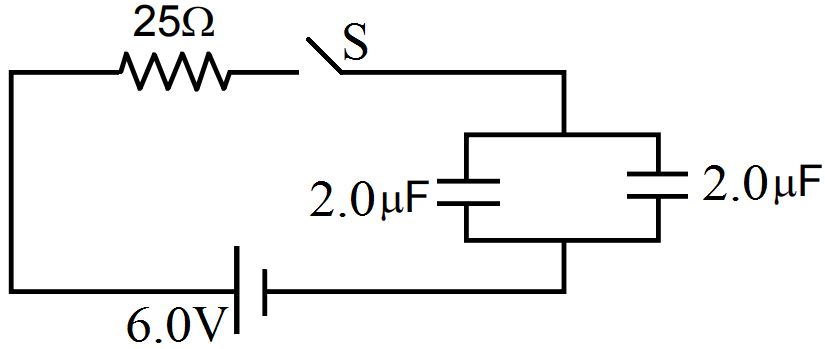
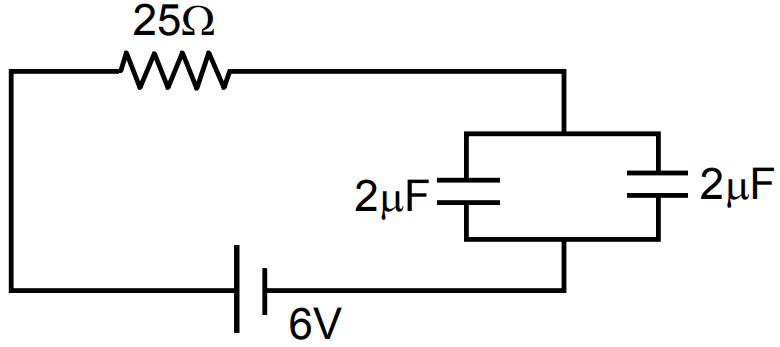
Find the charge on each of the capacitors 0.20ms after the switch S is closed in the figure.
Answer

$\text{q}=\text{q}_0\Big(1-\text{e}^{\frac{-\text{t}}{\text{RC}}}\Big)$
$=25(2+2)\times10^{-6}\bigg(1-\text{e}^\frac{-0.2\times10^{-3}}{25\times4\times10^{-6}}\bigg)$
$=24\times10^{-6}(1-\text{e}^2)=20.75$
Charge on each capacitor $=\frac{20.75}{2}=10.3$
View full question & answer
Question 192 Marks
Suppose you have three resistors of $20\Omega,50\Omega$ and $100\Omega.$ What minimum and maximum resistance can you obtain from these resistors?
Answer
$\text{R}_{\text{max}}=(20+50+100)\Omega=170\Omega$
$\text{R}_{\text{min}}=\frac{1}{\Big(\frac{1}{20}+\frac{1}{50}+\frac{1}{100}\Big)}=\frac{100}{8}=12.5\Omega.$
View full question & answer
Question 202 Marks
A capacitor of capacitance C is given a charge Q. At t = 0, it is connected to an ideal battery of emf $\in$ through a resistance R. Find the charge on the capacitor at time t.
Answer
The capacitor is given a charge Q. It will discharge and the capacitor will be charged up when connected with battery.
Net charge at time $\text{t}=\text{Qe}^\frac{-\text{t}}{\text{RC}}+\text{Q}\Big(1-\text{e}^\frac{-\text{t}}{\text{RC}}\Big).$
View full question & answer
Question 212 Marks
The internal resistance of an accumulator battery of emf 6V is $10\Omega$ when it is fully discharged. As the battery gets charged up, its internal resistance decreases to $1\Omega.$
The battery in its completely discharged state is connected to a charger that maintains a constant potential difference of 9V. Find the current through the battery (a) just after the connections are made and (b) after a long time when it is completely charged.
Answer
  1. Net emf while charging
$9-6=3\text{V}$

Current $=\frac{3}{10}=0.3\text{A}$
  1. When completely charged
Internal resistance $'\text{r}'=1\Omega$

Current $=\frac{3}{1}=3\text{A}$
View full question & answer