Questions

2 Marks Questions

Take a timed test

23 questions · self-marked practice — reveal the answer and mark yourself.

Question 12 Marks
A circular wire-loop of radius a carries a total charge Q distributed uniformly over its length. A small length dL of the wire is cut off. Find the electric field at the centre due to the remaining wire.
Answer
$\frac{\text{Charge}}{\text{Unit length}}=\frac{\text{Q}}{2\pi\text{a}}=\lambda;$ Charge of $\text{d}\ell=\frac{\text{Qd}\ell}{2\pi\text{a}}\text{C}$
Initially the electric field was ‘0’ at the centre. Since the element ‘dℓ’ is removed so, net electric field must $\frac{\text{K}\times\text{q}}{\text{a}^2}$
Where q = charge of element $\text{d}\ell$
$\text{E}=\frac{\text{Kq}}{\text{a}^2}$
$=\frac{1}{4\pi\in_0}\times\frac{\text{Q}\text{d}\ell}{2\pi\text{a}}\times\frac{1}{\text{a}^2}$
$=\frac{\text{Qd}\ell}{8\pi^2\in_0\text{a}^3}$
View full question & answer
Question 22 Marks
A hydrogen atom contains one proton and one electron. It may be assumed that the electron revolves in a circle of radius 0.53 angstrom (1 angstrom $= 10^{-10}m$ and is abbreviated as A) with the proton at the centre. The hydrogen atom is said to be in the ground state in this case. Find the magnitude of the electric force between the proton and the electron of a hydrogen atom in its ground state.
Answer
$\text{R}=0.53\text{A}^\circ=0.53\times10^{-10}\text{m}$
$\text{F}=\frac{\text{Kq}_1\text{q}_2}{\text{r}^2}$
$=\frac{9\times10^9\times1.6\times1.6\times10^{-38}}{0.53\times0.53\times10^{-10}\times10^{-10}}$
$=82.02\times10^{-9}\text{N}$
View full question & answer
Question 32 Marks
Why does a phonograph-record attract dust particles just after it is cleaned?
Answer
When a phonograph record is cleaned, it develops a charge on its surface due to rubbing. This charge attracts the neutral dust particles due to induction.
View full question & answer
Question 42 Marks
At what separation should two equal charges, 1.0C each, be placed so that the force between them equals the weight of a 50kg person?
Answer
Given:
Magnitude of charges, $\text{q}_1=\text{q}_2=1\text{C}$
Electrostatic force between them,
F = Weight of a 50kg person
$\text{mg}=50\times9.8=490\text{N}$
$\text{mg}=490\text{N}$
Let the required distance be r.
By Coulomb's Law, electrostatic force,
$\text{F}=\frac{1}{4\pi\in_0}\frac{\text{q}_1\text{q}_2}{\text{r}^2}$
$\Rightarrow490=\frac{9\times10^9\times1\times1}{\text{r}^2}$
$\Rightarrow\text{r}^2=\frac{9\times10^9}{490}$
$\Rightarrow\text{r}=\sqrt{\frac{9}{49}\times10^8}$
$=\frac{3}{7}\times10^4\text{m}$
$=4.3\times10^3\text{m}$
View full question & answer
Question 52 Marks
The electric force experienced by a charge of $1.0 \times 10^{-6} \mathrm{C}$ is $1.5 \times 10^{-3} \mathrm{~N}$. Find the magnitude of the electric field at the position of the charge.
Answer
$\text{F}_\text{e}=1.5\times10^{-3}\text{N},\ \text{q}=1\times10^{-6}\text{C},$
$\text{F}_\text{e}=\text{q}\times\text{E}$
$\Rightarrow\text{E}=\frac{\text{F}_\text{e}}{\text{q}}$
$=\frac{1.5\times10^{-3}}{1\times10^{-6}}$
$=1.5\times10^3\text{N/C}$
View full question & answer
Question 62 Marks
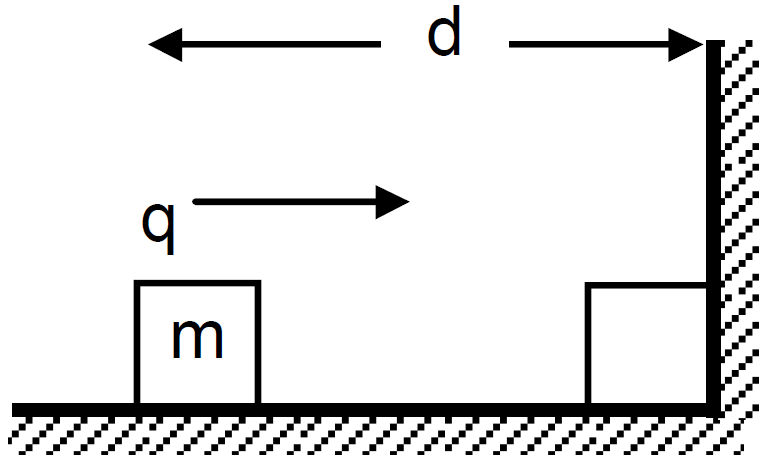
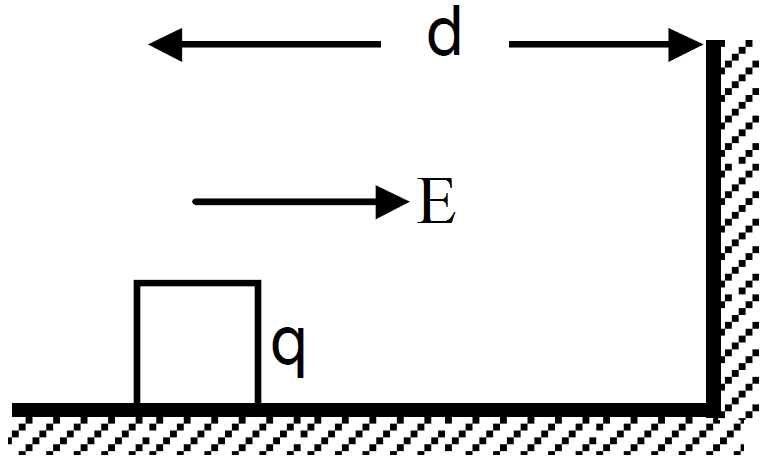
A block of mass m containing a net positive charge q is placed on a smooth horizontal table which terminates in a vertical wall as shown in figure. The distance of the block from the wall is d. A horizontal electric field E towards right is switched on. Assuming elastic collisions (if any) find the time period of the resulting oscillatory motion. Is it a simple harmonic motion?
Answer
The block does not undergo. SHM since here the acceleration is not proportional to displacement and not always opposite to displacement. When the block is going towards the wall the acceleration is along displacement and when going away from it the displacement is opposite to acceleration.
Time taken to go towards the wall is the time taken to goes away from it till velocity is:

$\text{d}=\text{ut}+\Big(\frac{1}{2}\Big)\text{at}^2$
$\Rightarrow\text{d}=\frac{1}{2}\times\frac{\text{qE}}{\text{m}}\times\text{t}^2$
$\Rightarrow\text{t}^2=\frac{2\text{dm}}{\text{qE}}$
$\Rightarrow\text{t}=\sqrt{\frac{2\text{md}}{\text{qE}}}$
$\therefore\ $Total time taken for to reach the wall and com back (Time period)
$=2\text{t}=2\sqrt{\frac{2\text{md}}{\text{qE}}}$
$=\sqrt{\frac{2\text{md}}{\text{qE}}}$
View full question & answer
Question 72 Marks
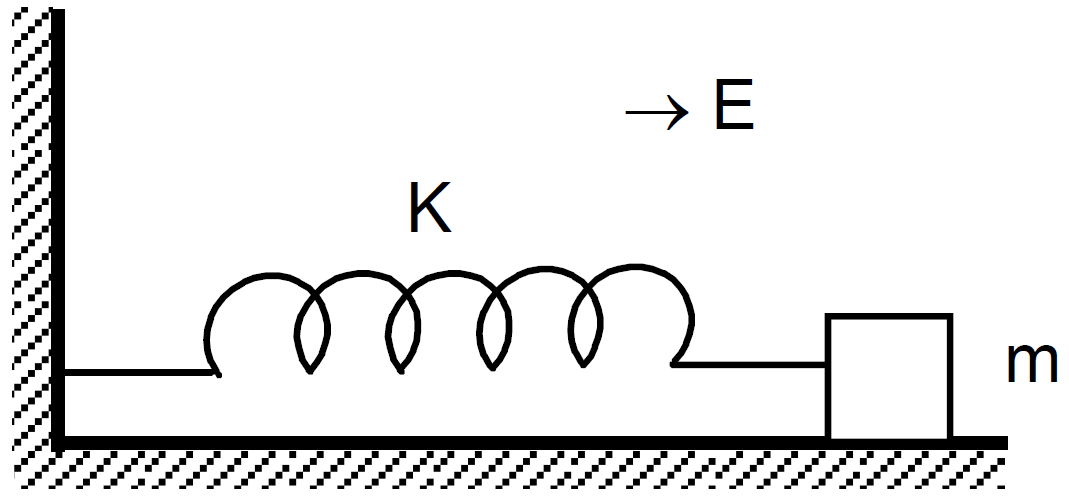
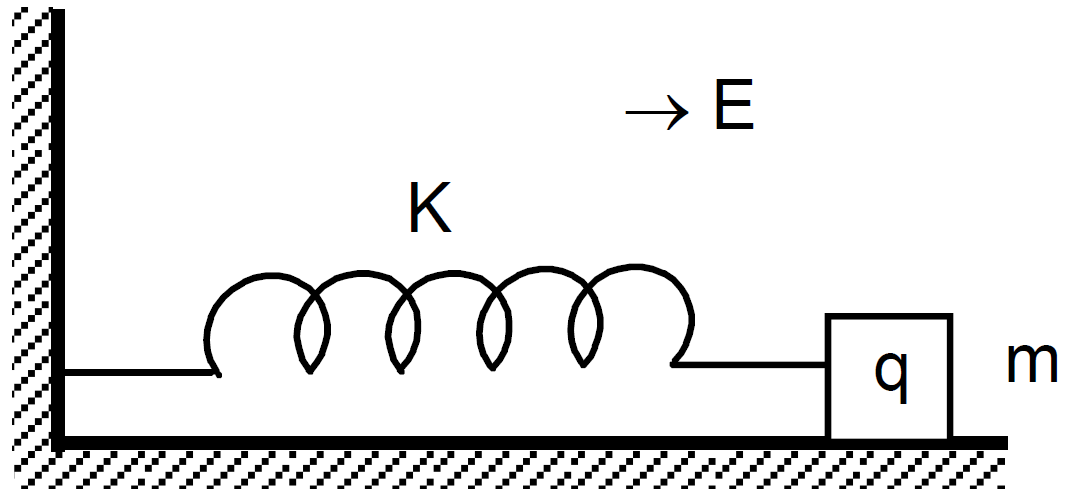
A block of mass m having a charge q is placed on a smooth horizontal table and is connected to a wall through an unstressed spring of spring constant k as shown in figure. A horizontal electric field E parallel to the spring is switched on. Find the amplitude of the resulting SHM of the block.
Answer

$\text{F}=\text{qE},\ \text{F}=-\text{Kx}$
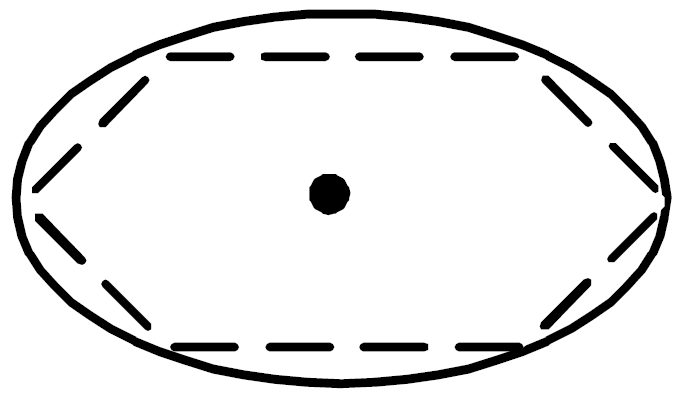
Where x = amplitude
$\text{x}=\frac{-\text{qE}}{\text{K}}$
View full question & answer
Question 82 Marks
Is there any lower limit to the electric force between two particles placed at a separation of 1cm ?
Answer
Yes, there's a lower limit to the electric force between two particles placed at a separation of 1cm, which is equal to the magnitude of force of repulsion between two electrons placed at a separation of 1cm.
View full question & answer
Question 92 Marks
A uniform electric field of $10NC^{-1}$ exists in the vertically downward direction. Find the increase in the electric potential as one goes up through a height of 50cm.
Answer
$\text{E}=10\text{n/c},\ \text{S}=50\text{cm}=0.1\text{m}$
$\text{E}=\frac{\text{dV}}{\text{dr}}$
Or,
$\text{V}=\text{E}\times\text{r}$
$\text{r}=10\times0.5$
$=5\text{cm}$
View full question & answer
Question 102 Marks
In some old texts it is mentioned that $4\pi$ lines of force originate from each unit positive charge. Comment on the statement in view of the fact that $4\pi$ is not an integer.
Answer
$4\pi$ is the total solid angle. "$4\pi$ lines of force" is just a way of stating that the field lines extend uniformly in all directions away from the charge.
View full question & answer
Question 112 Marks
12J of work has to be done against an existing electric field to take a charge of 0.01C from A to B. How much is the potential difference $V_B- V_A?$
Answer
Now, $V_B- V_A=$ Potential diff $= ?$
Charge $= 0.01C$
Work done $= 12J$
Now, Work done = Pot. Diff × Charge
$\Rightarrow\text{W} =\big(\text{V}_\text{B} -\text{V}_\text{A}\big)\times\text{q}$
$\Rightarrow\text{Pot. Diff}=\frac{12}{0.01}$
$=1200\text{ Volt}$
View full question & answer
Question 122 Marks
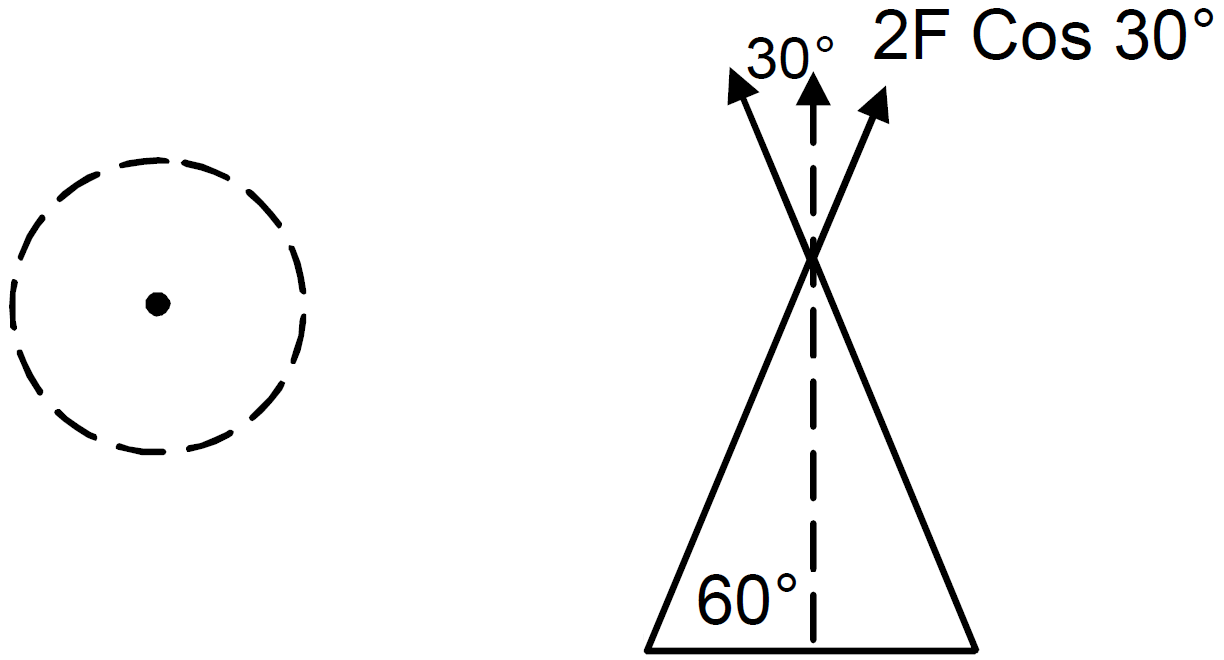
A wire is bent in the form of a regular hexagon and a total charge q is distributed uniformly on it. What is the electric field at the centre? You may answer this part without making any numerical calculations.
Answer

Since it is a regular hexagon. So, it forms an equipotential surface. Hence the charge at each point is equal. Hence the net entire field at the centre is Zero.
View full question & answer
Question 132 Marks
An electric field $\vec{\text{E}}=(\vec{\text{i}}20+\vec{\text{j}}30)\text{N}\text{C}^{-1}$ exists in the space. If the potential at the origin is taken to be zero, find the potential at (2m, 2m).
Answer
$\text{E}=\big(\hat{\text{i}}120+\hat{\text{j}}\big)\text{N/CV}$
$=\text{at}(2\text{m},2\text{m})\text{r}=(2\text{i}+2\text{j})$
So, $\text{V}=-\vec{\text{E}}\times\vec{\text{r}}$
$=-(\text{i}20+30\text{J})(2\hat{\text{i}}+2\text{j})$
$=-(2\times20+2\times30)$
$=-100\text{V}$
View full question & answer
Question 142 Marks
Find the electric force between two protons separated by a distance of 1 fermi (1 fermi $= 10^{-15}$m). The protons in a nucleus remain at a separation of this order.
Answer
We know:
Charge on a proton, $\mathrm{q}=1.6 \times 10^{-19} \mathrm{C}$
Given, separation between the charges, $r=10^{-15} \mathrm{~m}$
By Coulomb's Law, electrostatic force,
$\text{F}=\frac{1}{4\pi\in_0}\frac{\text{q}_1\text{q}_2}{\text{r}^2}$
$\Rightarrow\text{F}=96\times10^9\times\frac{(1.6\times10^{-19})^2}{(10^{-15})^2}$
$\Rightarrow\text{F}=230\text{N}$
View full question & answer
Question 152 Marks
Consider two particles A and B having equal charges and placed at some distance. The particle A is slightly displaced towards B. Does the force on B increase as soon as the particle A is displaced? Does the force on the particle A increase as soon as it is displaced?
Answer
Electrostatic force follows the inverse square law, $\text{F}=\frac{\text{k}}{\text{r}^2}.$ This means the the force on two particles carrying charges increases on decreasing the distance between them. Therefore, as particle A is slightly displaced towards B, the force on B as well as a A will increase.
View full question & answer
Question 162 Marks
The charge on a proton is $+1.6 \times 10^{-19} \mathrm{C}$ and that on an electron is $-1.6 \times 10^{-19} \mathrm{C}$. Does it mean that the electron has a charge 3.2 $\times 10^{-19} \mathrm{C}$ less than the charge of a proton?
Answer
An electron and a proton have equal and opposite charges of magnitude $1.6 \times 10^{-19} \mathrm{C}$. But it doesn't mean that the electron has $3.2 \times 10^{-19} \mathrm{C}$ less charge than the proton.
View full question & answer
Question 172 Marks
A point charge produces an electric field of magnitude $5.0NC^{-1}$ at a distance of 40cm from it. What is the magnitude of the charge?
Answer

$\text{E}=\frac{1}{4\pi\in_0}\frac{\text{q}}{\text{r}^2}$
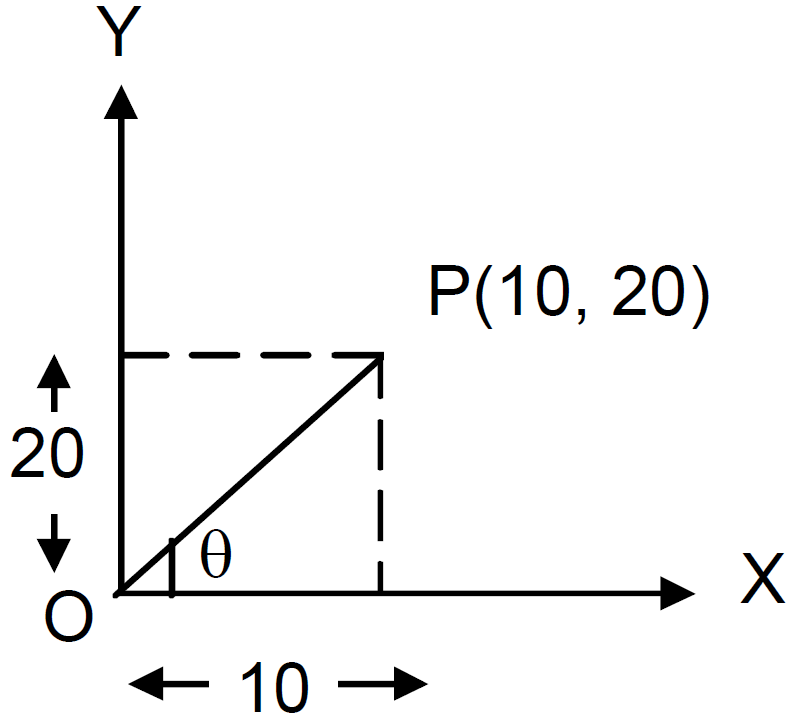
$\Rightarrow5.0=9\times10^9\times\frac{9}{(0.4)^2}$
$\Rightarrow\text{q}=8.9\times10^{-11}\text{C}$
View full question & answer
Question 182 Marks
An electric field $\vec{\text{E}}=\vec{\text{i}}\text{Ax}$ exists in the space, where $A= 10Vm^{-2}$. Take the potential at (10m, 20m) to be zero. Find the potential at the origin.
Answer

$\text{E}=\vec{\text{i}}\times\text{Ax}=100\vec{\text{i}}$
$\int\limits_\text{v}^0\text{dv}=-\int\limits\text{E}\times\text{d}\ell$
$\text{V}=-\int\limits_0^{10}10\text{x}\times\text{dx}$
$=-\int\limits^{10}_0\frac{1}{2}\times10\times\text{x}^2$
$0-\text{V}=-\Big[\frac{1}{2}\times1000\Big]$
$=-500$
$\Rightarrow\text{V}=500\text{ Volts}$
View full question & answer
Question 192 Marks
Can a gravitational field be added vectorially to an electric field to get a total field?
Answer
No, a gravitational field cannot be added vectorially to an electric field. This is because for electric influence, one or both the bodies should have some net charge and for gravitational influence both the bodies should have some mass. Also, gravitational field is a weak force, while electric field is a strong force.
View full question & answer
Question 202 Marks
A point charge is taken from a point A to a point B in an electric field. Does the work done by the electric field depend on the path of the charge?
Answer
Electrostatic field is a conservative field. Therefore, work done by the electric field does not depend on the path followed by the charge. It only depends on the position of the charge, from which and to which the charge has been moved.
View full question & answer
Question 212 Marks
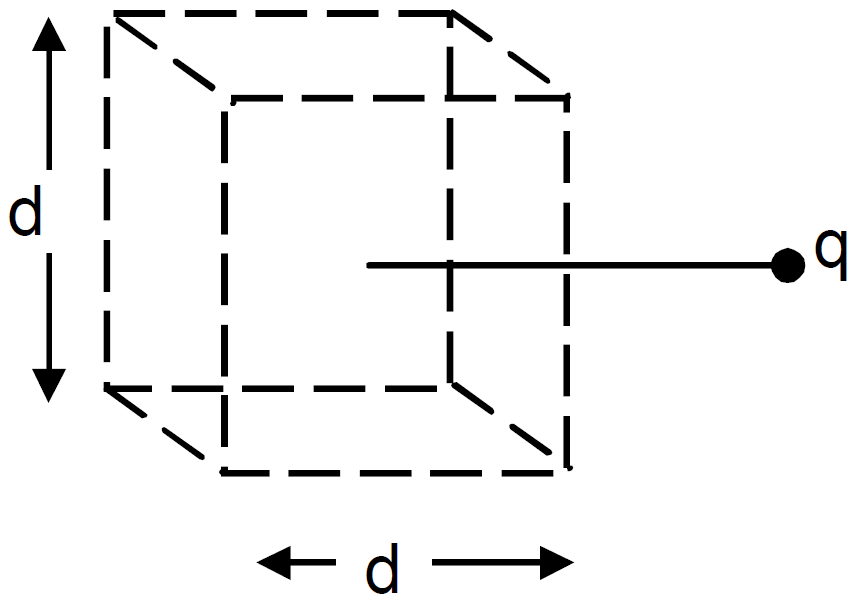
A positive charge q is placed in front of a conducting solid cube at a distance d from its centre. Find the electric field at the centre of the cube due to the charges appearing on its surface.
Answer

We know,
Electric field at a point due to a given charge
$'\text{E}'=\frac{\text{Kq}}{\text{r}^2}$ Where q = charge, r = Distance between the point and the charge
So, $'\text{E}'=\frac{1}{4\pi\in_0}\times\frac{\text{q}}{\text{d}^2}$ $[\therefore\text{r}=\text{‘d’}\text{here}]$
View full question & answer
Question 222 Marks
Consider a gold nucleus to be a sphere of radius 6.9 fermi in which protons and neutrons are distributed. Find the force of repulsion between two protons situated at largest separation. Why do these protons not fly apart under this repulsion?
Answer

Let two protons be at a distance be 13.8 femi,
$\text{F}=\frac{1}{4\pi\in_0}\frac{\text{q}_1\text{q}_2}{\text{r}^2}$
$\text{F}=\frac{9\times10^9\times1.6\times10^{-38}}{(14.8)^2\times10^{-30}}$
$\text{F}=1.2\text{N}$
View full question & answer
Question 232 Marks
It is said that the separation between the two charges forming an electric dipole should be small. Small compared to what?
Answer
The separation between the two charges forming an electric dipole should be small compared to the distance of a point from the centre of the dipole at which the influence of the dipole field is observed.
View full question & answer