Questions

3 Marks Question

Take a timed test

5 questions · self-marked practice — reveal the answer and mark yourself.

Question 13 Marks
A cube of ice of edge 4cm is placed in an empty cylindrical glass of inner diameter 6cm. Assume that the ice melts uniformly from each side so that it always retains its cubical shape. Remembering that ice is lighter than water, find the length of the edge of the ice cube at the instant it just leaves contact with the bottom of the glass.
Answer
Let x → edge of ice block When it just leaves contact with the bottom of the glass. h → height of water melted from ice W = U$\Rightarrow\text{x}^3\times\rho_{\text{ice}}\times\text{g}=\text{x}^2\times\rho_\text{w}\times\text{g}$
Again, volume of water formed, from melting of ice is given by,$4^3=\text{x}^3=\pi\times\text{r}^2\times\text{h}-\text{x}^2\text{h}$$\big($because amount of water $=(\pi\text{r}^2-\text{x}^2)\text{h}\big)$
$\Rightarrow4^3-\text{x}^3=\pi\times3^2\times\text{h}-\text{x}^2\text{h}$
Putting $\text{h}=0.9\text{x}$$\Rightarrow\text{x}=2.26\text{cm}.$
View full question & answer
Question 23 Marks
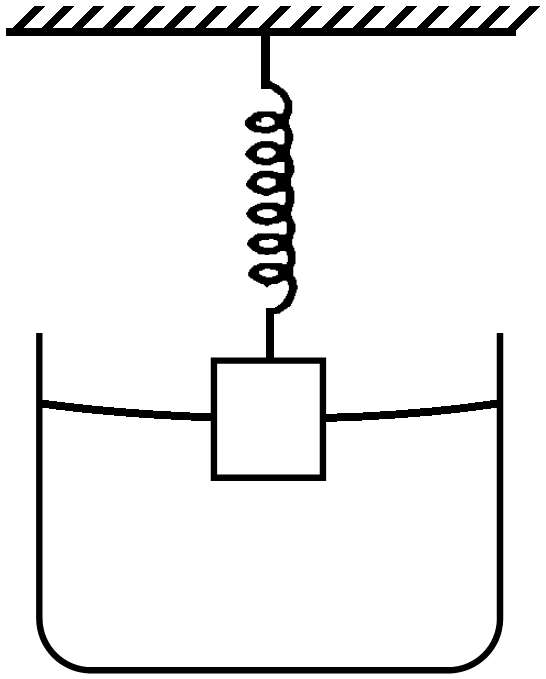
A cylindrical object of outer diameter 10cm, height 20cm and density $8000kg/m^3$ is supported by a vertical spring and is half dipped in water as shown in.
  1. Find the elongation of the spring in equilibrium condition.
  2. If the object is slightly depressed and released, find the time period of resulting oscillations of the object. The spring constant = 500N/m.
Answer
The volume of the object$=\pi\times5^2\times20\text{cm}^3=500\pi\text{cm}^3$
The mass of the object $=500\pi\times\frac{8000}{10^6}\text{Kg}$
$=4\pi\text{Kg}$
Since the object is half dipped, the volume of the water displaced
$=\frac{500\pi}{2}=250\pi\text{cm}^3$
The mass of the water displaced $=\frac{250\pi\times1000}{10^6}\text{Kg}$
$=0.25\pi\text{Kg}$
The force of buoyancy $=0.25\pi\text{g}\ \text{N}$
Hence the apparent weight of the object $=(4\pi-0.25\pi)\text{g}\ \text{N}$
$=3.75\pi\text{g}\ \text{N}$
The spring constant $\text{K}=500\text{N}/\text{m}$
  1. Hence the elongation of the spring
$=\frac{3.75\pi\text{g}}{500}\text{m}=3.75\times3.14\times\frac{10}{500}\text{m}$ $\big\{$Taking $g = 10 m/s^2\big\}$
$=0.235\text{m}$
$=23.5\text{cm}$
  1. Let the object be dipped to a distance X m. Assuming the axis of the cylindrical object vertical, the extra volume displaced$=\frac{\pi\times5^2\times\text{x}}{10000}\text{m}^3$
The buoyancy force $=\Big(\frac{\pi\times5^2\times\text{x}}{10000}\text{m}^3\Big)\times1000\text{g}\ \text{N}$
$=2.5\pi\text{g}\text{x}\ \text{N}$
The spring force $=\text{KxN}$
Hence the total upward force $=2.5\pi\text{g}\text{x}+500\text{X}\ \text{N}$
Hence the vertical acceleration at the moment $=\frac{\text{Force}}{\text{Mass}}$
$=\frac{\big(2.5\pi\text{x}+500\text{X}\big)}{4\pi}\text{m}/\text{s}^2$
$=\frac{\big(2.5\pi\text{g}+500\big)\text{X}}{4\pi}\text{m}/\text{s}^2$
But also this acceleration $=\omega^2\text{X}\text{m}/\text{s}^2$
Equating, $\omega^2\text{x}=\frac{​​\big(​​​2.5\pi\text{g}+500\big)\text{X}}{4\pi}$
$=46.04\text{X}$
$\rightarrow\omega=\sqrt{(46.04)}=6.785\text{s}^{-1}$
So, the time period
$=\frac{2\pi}{\omega}$
$=\frac{2\pi}{6.785}\text{s}$
$=0.93\text{s}$
View full question & answer
Question 33 Marks
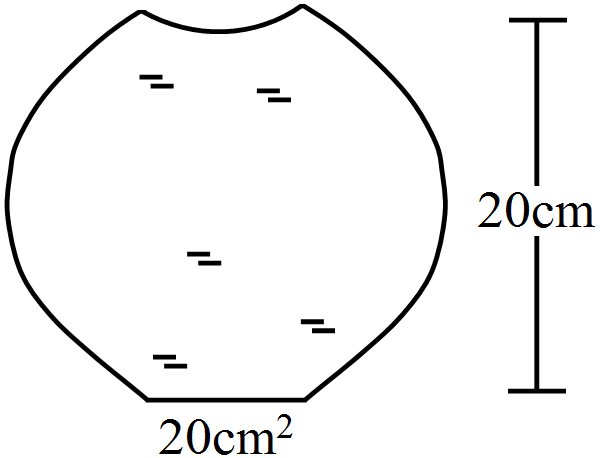
A glass full of water has a bottom of area $ 20cm^2,$ top of area $20cm^2$, height 20cm and volume half a litre.
  1. Find the force exerted by the water on the bottom.
  2. Considering the equilibrium of the water, find the.
Resultant force exerted by the sides of the glass on the water. Atmospheric pressure $= 1.0 \times 10^5N/m^2$. Density of water $= 1000kg/m^3$ and $g = 10m/s^2$. Take all numbers to be exact.
Answer
  1. We know that the Pressure at the bottom will be given by the relation,
The pressure of water at the bottom $=\rho\text{gh}$ + Atmospheric Pressure
$= 1000 \times 10 \times 0.20 + 1.013m \times 10^5$
$= 1.02 \times 10^5Pa.$
Hence the force by the water on the bottom.
$= 1.02 \times 10^5 \times 20 \times 10^{-4}$
$= 204N$​​​​​​​
  1. Now, The Resultant force from the sides to the water will be given by,
$= mg + P × A$
$= 0.5 × 10 + 20 \times 10^{-4} \times 1.0 \times 10^5N$
$= 5 + 200N$
$= 205N$
Now, Force by the bottom of the glass on the water is equal but opposite to that of the force by the water on the bottom = 204N
Hence the force by the sides of the glass on the water $= F - P$
$= 205 - 204$
$= 1N$
View full question & answer
Question 43 Marks
Suppose the glass of the previous problem is covered by a jar and the air inside the jar is completely pumped out.
  1. What will be the answers to the problem?
  2. Show that the answers do not change if a glass of different shape is used provided the height, the bottom area and the volume are unchanged.
Answer
When the glass is covered by a jar and the air is pumped out of the jar, atmospheric pressure has no effect on the glass.
  1. Force exerted on the bottom:
$(hp_wg) \times A$
$= (20 \times 10^{-2}\times 10^3 \times 10)20 \times 10^{-4}$​​​​​​​
$= 4N$​​​​​​​
  1. $mg = h \times p_w \times g \times A + F_s​​​​​​​$​​​​​​​
$⇒ Fs = 5 - 4 = 1N$
View full question & answer
Question 53 Marks
Water is filled in a rectangular tank of size 3m × 2m × 1m.
  1. Find the total force exerted by the water on the bottom surface of the tank.
  2. Consider a vertical side of area 2m × 1m. Take a horizontal strip of width ox metre in this side, situated at a depth of x metre from the surface of water. Find the force by the water on this strip.
  3. Find the torque of the force calculated in part.(b) about the bottom edge of this side.
  4. Find the total force by the water on this side.
  5. Find the total torque by the water on the side about.
The bottom edge. Neglect the atmospheric pressure and take $g = 10m/s^2.$
Answer
  1. The dimensions of the tank are,
Length (L) = 3m, Breadth (B) = 2m, Height (H) = 1m.
Since the tank is filled, the height of water in the tank = H = 1m.
The pressure of water at the bottom $= \rho \text{gH}$
$= 1000 × 10 × 1$
$= 10000N/m^2$
Area of the bottom of the tank $= L × B$
$= 3m × 2m = 6m^2$
So the force on the bottom = Pressure × Area
$= 10000 × 6$
$= 60000N.$
  1. The pressure at × m below the surface of the water $= \rho\text{gx}$
Area of a horizontal strip = 2 × x
The force on this strip F = Area pressure
$=2\times \text{x}^2\rho\text{gx}$
$= 2\times \text{x}^2×1000×10$
$= 20000 \text{x}^2\text{N}$
  1. The perpendicular distance of this force from the bottom of edge of this side
$= H - x = 1 - xm$
Hence the torque of the force = Force x perpendicular distance
$= 20000x × x × (1 - x)Nm$
$= 20000 × x(1- x) × xNm.$​​​​​​​
  1. The total force of the water on this side $=\int\text{Fda},$ (from x = 0 to x = 1m,
where F is the pressure at the depth xm and da = area of the strip}
$= spg × x (2 × dx)$ {dx is the width of the strip}
$×=2\text{pg}\int\text{x}\cdot\text{dx}$
$=2\text{pg}\times\Big[\frac{\text{x}^2}{2}\Big]$
$= pgH^2$
$= 1000 \times 10 \times 1^2$
$= 1000N.​​​​​​​$​​​​​​​
  1. Total Force $=\frac{1}{2}\times\text{pg}\times\text{H}\times2$
= 10000N
The height of this resultant force from the bottom of edge of the side
will be one- third of H(height of the C.G. from the bottom) $=\frac{\text{H}}{3}$
Hence the torque $=10000\times\frac{1}{2}$
$=10000\times\frac{1}{2}$
$=\frac{10000}{3}\text{Nm}$
View full question & answer