Questions

1 Marks Question

Take a timed test

4 questions · self-marked practice — reveal the answer and mark yourself.

Question 11 Mark
A circular loop of radius 4.0cm is placed in a horizontal plane and carries an electric current of 5.0A in the clockwise direction as seen from above. Find the magnetic field:
  1. At a point 3.0cm above the centre of the loop.
  2. At a point 3.0cm below the centre of the loop.
Answer
At O P the $\overrightarrow{\text{B}}$ must be directed downwards
We Know,
B at the axial line at O & P
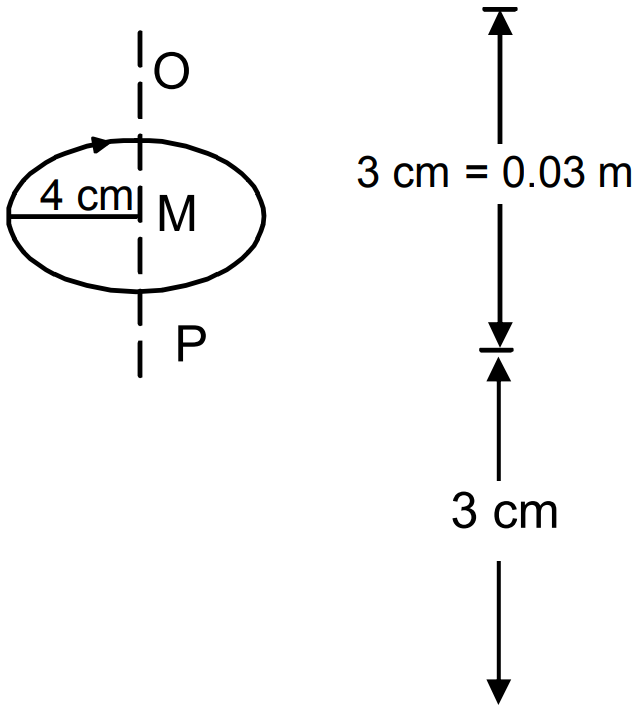
$=\frac{\mu_0\text{ia}^2}{2(\text{a}^2+\text{d}^2)^\frac{3}{2}}$ a = 4cm = 0.04m
$=\frac{4\pi\times10^{-7}\times5\times0.0016}{2(0.0025)^\frac{3}{2}}$ d = 3cm = 0.0m
$=40\times10^{-6}=\times10^{-5}\text{T}$ downwards in both the cases.
View full question & answer
Question 21 Mark
Two proton beams going in the same direction repel each other whereas two wires carrying currents in the same direction attract each other. Explain.
Answer
Two proton beams going in the same direction repel each other, as they are like charges and we know that like charges repel each other.
When a charge is in motion then a magnetic field is associated with it. Two wires carrying currents in the same direction produce their fields (acting on each other) in opposite directions so the resulting magnetic force acting on them is attractive. Due to the magnetic force, these two wires attract each other.
But when a charge is at rest then only an electric field is associated with it and no magnetic fiels is produced by it. So at rest, it repels a like charge by exerting a electric force on it. Charge in motion can produce both electric field and magnetic field.
The attractive force between two current carrying wires is due to the magnetic field and repulsive force is due to the electric field.
View full question & answer
Question 31 Mark
A long solenoid is fabricated by closely winding a wire of radius 0.5mm over a cylindrical nonmagnetic frame so that the successive turns nearly touch each other. What would be the magnetic field B at the centre of the solenoid if it carries a current of 5A?
Answer

$r = 0.5mm,$
$i = 5A,$
$\text{B}=\mu_0\text{ni}$ (for a solenoid)
Width of each turn $= 1 mm = 10^{-3}m$
No. of turns $\text{n}=\frac{1}{10^{-3}}=10^3$
So, $\text{B}=4\pi\times10^{-7}\times10^3\times5=2\pi\times10^{-3}\text{T}$
View full question & answer
Question 41 Mark
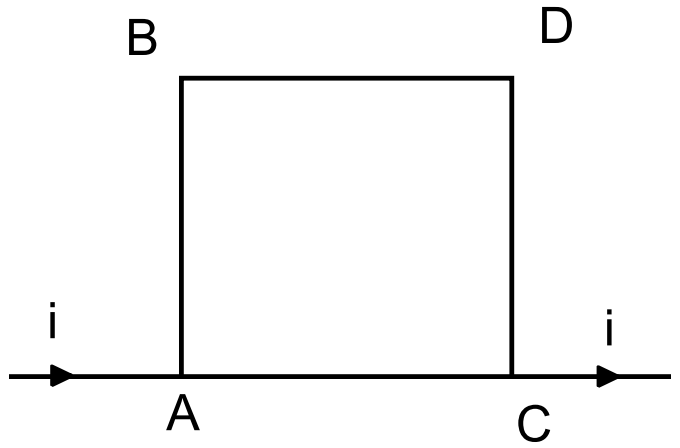
Consider the situation described in the previous problem. Suppose the current i enters the loop at the point A and leaves it at the point B. Find the magnetic field at the centre of the loop.
Answer

$\overrightarrow{\text{B}}$ due t BC
$\overrightarrow{\text{B}}$ due to AD at Pt ‘P’ are equal ore Opposite
Hence net $\overrightarrow{\text{B}}=0$
Similarly, due to AB & CD at P = 0 \
$\therefore$ The net B r at the Centre of the square loop = zero
View full question & answer