Questions

3 Marks Question

Take a timed test

19 questions · self-marked practice — reveal the answer and mark yourself.

Question 13 Marks
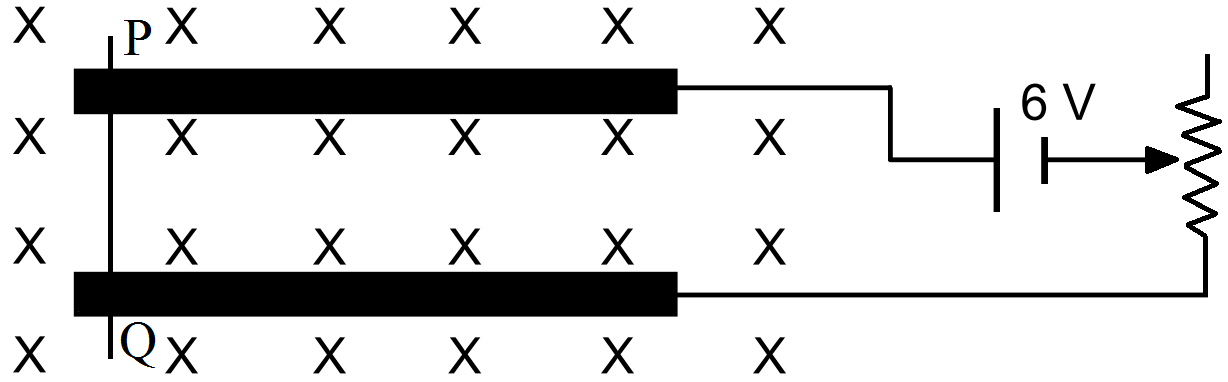
A metal wire PQ of mass 10g lies at rest on two horizontal metal rails separated by 4.90cm A vertically-downward magnetic field of magnitude 0.800T exists in the space. The resistance of the circuit is slowly decreased and it is found that when the resistance goes below 20.0Ω, the wire PQ starts sliding on the rails. Find the coefficient of friction.
Answer
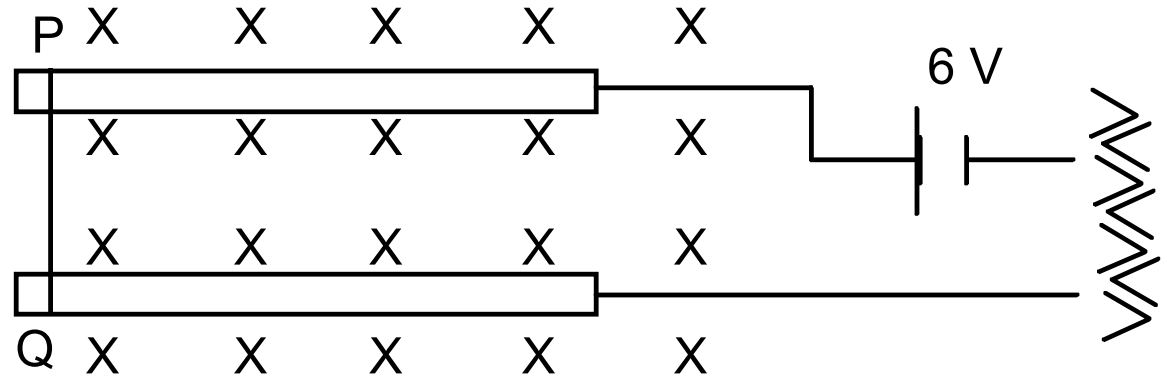
$\mu\text{R}=\text{F}$
$\Rightarrow\mu\times\text{m}\times\text{g}=\text{ilB}$
$\Rightarrow\mu\times10\times10^{-3}\times9.8$
$=\frac{6}{20}\times4.9\times10^{-2}\times0.8$
$\Rightarrow\mu=\frac{0.3\times0.8\times10^{-2}}{2\times10^{-2}}=0.12$
View full question & answer
Question 23 Marks
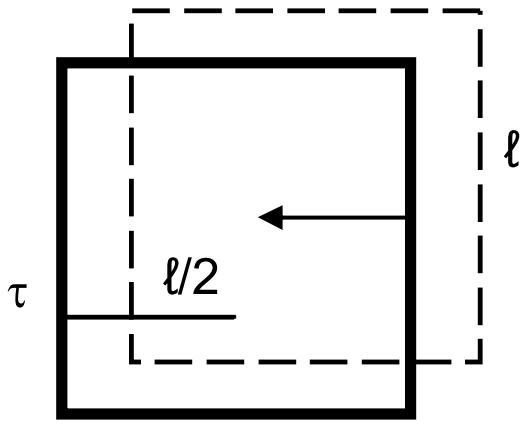
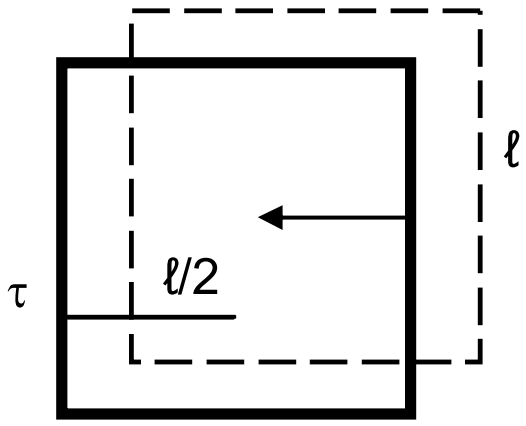
A square coil of edge l and with n turns carries a current i. It is kept on a smooth horizontal plate. A uniform magnetic field B exists parallel to an edge. The total mass of the coil is M. What should be the minimum value of B for which the coil will start tipping over?
Answer

Edge = l
Current = i
Turns= n
mass = M
Magnetic filed = B
Min Torque produced must be able to balance the torque produced due to weight Now, $\tau\text{B}=\tau$ Weight.
$\mu\text{B}=\mu\text{g}\Big(\frac{1}{2}\Big)$
$\Rightarrow\text{n}\times\text{i}\times\text{l}^2\text{B}=\mu\text{g}\Big(\frac{1}{2}\Big)$
$\Rightarrow\text{B}=\frac{\mu}{2\text{nil}}$
View full question & answer
Question 33 Marks
Consider a non-conducting ring of radius r and mass m that has a total charge q distributed uniformly on it. The ring is rotated about its axis with an angular speed $\omega.$
  1. Find the equivalent electric current in the ring.
  2. Find the magnetic moment $\mu$ of the ring.
  3. Show that $\mu=\frac{\text{q}}{2\text{m}}\text{l}$ where l is the angular momentum of the ring about its axis of rotation.
Answer
  1. $\text{i}=\frac{\text{q}}{\text{t}}=\frac{\text{q}}{\text{t}}=\frac{\text{q}}{\Big(\frac{2\pi}{\omega}\Big)}=\frac{\text{q}\omega}{2\pi}$
  2. $\mu=\text{n}\text{ ia}=\text{i A}[\because\text{n}=1]$
$=\frac{\text{q}\omega\pi\text{r}^2}{2\pi}$
  1. $\mu=\frac{\text{q}\omega\text{r}^2}{2}$
$\text{L}=\text{I}\omega=\text{mr}^2\omega,\ \frac{\mu}{\text{L}}$
$=\frac{\text{q}\omega\text{r}^2}{2\text{mr}^2\omega}=\frac{\text{q}}{2\text{m}}$
$\Rightarrow\mu=\Big(\frac{\text{q}}{2\text{m}}\Big)\text{L}$
View full question & answer
Question 43 Marks
A particle moves in a circle of diameter 1.0cm under the action of a magnetic field of 0.40T. An electric field of $200\ Vm^{-1}$ makes the path straight. Find the charge/ mass ratio of the particle.
Answer
$r = 0.5cm = 0.5 \times 10^{-2}m$
$B = 0.4T,$
$\text{E}=200\frac{\text{V}}{\text{m}}$
The path will straighten, if $\text{qE}=\text{quB}$
$\Rightarrow\text{E}=\frac{\text{rqB}\times\text{B}}{\text{m}}$
$\Rightarrow\text{E}=\frac{\text{rqB}^2}{\text{m}}$
$\Rightarrow\frac{\text{q}}{\text{m}}=\frac{\text{E}}{\text{B}^2\text{r}}=\frac{200}{0.4\times0.4\times0.5\times10^{-2}}$
$=2.5\times10^5\text{c/kg}$
View full question & answer
Question 53 Marks
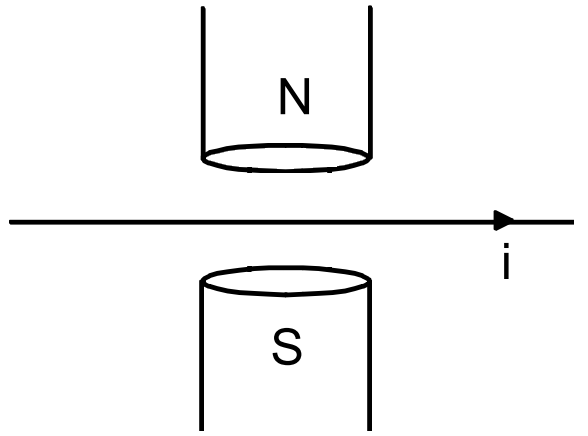
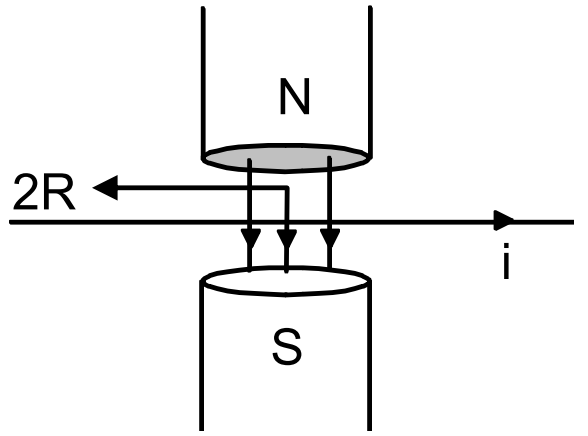
A magnetic field of strength 1.0T is produced by a strong electromagnet in a cylindrical region of radius 4.0cm, as shown in the figure. A wire, carrying a current of 2.0A, is placed perpendicular to and intersecting the axis of the cylindrical region. Find the magnitude of the force acting on the wire.
Answer

$\text{F}=\text{ilB}\sin\theta$
$=\text{ilB}\sin90^\circ$
$=\text{i}\ 2\text{RB}$
$=2\times(8\times10^{-2})\times1$
$=16\times10^{-2}$
$=0.16\text{N}.$
View full question & answer
Question 63 Marks
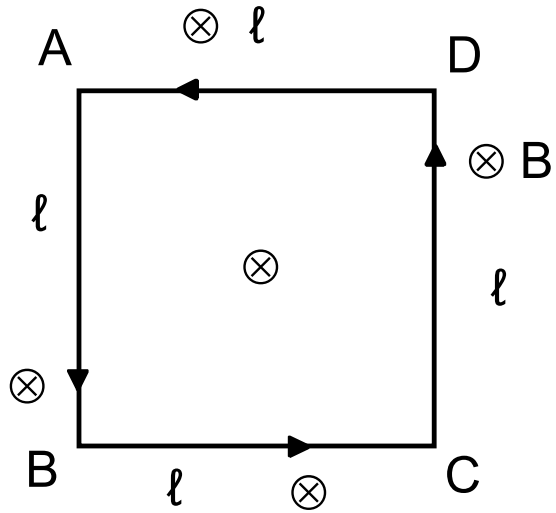
A current loop of arbitrary shape lies in a uniform magnetic field B. Show that the net magnetic force acting on the loop is zero.
Answer


$\mathrm{F}_1=$ Force on $\mathrm{AD}=\mathrm{i} \ell \mathrm{B}$ inwards
$\mathrm{F}_2=$ Force on $\mathrm{BC}=\mathrm{i} \ell \mathrm{B}$ inwards
They cancel each other
$\mathrm{F}_3=$ Force on $\mathrm{CD}=\mathrm{i} \ell \mathrm{B}$ inwards
$\mathrm{F}_4=$ Force on $\mathrm{AB}=\mathrm{i} \ell \mathrm{B}$ inwards
They also cancel each other.
So the net force on the body is 0.
View full question & answer
Question 73 Marks
A proton describes a circle of radius 1cm in a magnetic field of strength 0.10T. What would be the radius of the circle described by an α-particle moving with the same speed in the same magnetic field?
Answer
$\text{r}=\frac{\text{mv}}{\text{qB}}$
$0.01=\frac{\text{mv}}{\text{e}0.1}\ ...(1)$
$\text{r}=\frac{\text{4}\text{m}\times\text{V}}{2\text{e}\times0.1}\ ...(2)$
$(2)\div(1)$
$\Rightarrow\frac{\text{r}}{0.01}=\frac{4\text{mVe}\times0.1}{2\text{e}\times0.1\times\text{mv}}=\frac{4}{2}=2$
$\Rightarrow\text{r}=0.02\text{m}=2\text{cm}$
View full question & answer
Question 83 Marks
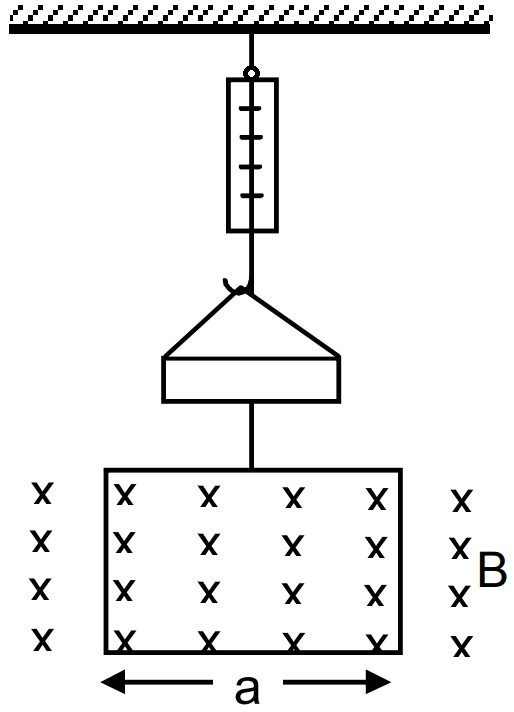
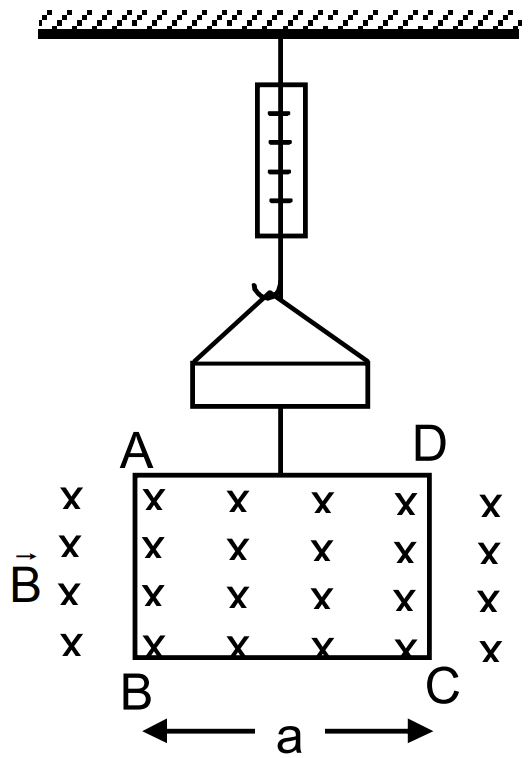
A rectangular wire loop of width a is suspended from the insulated pan of a spring balance, as shown in A current i exists in the anti-clockwise direction in the loop. A magnetic field Bexists in the lower region. Find the change in the tension of the spring if the current in the loop is reversed.
Answer

Current anticlockwise
Since the horizontal Forces have no effect.
Let us check the forces for current along AD & BC [Since there is no $\overrightarrow{\text{B}}$ ]
In AD, F = 0
For BC
F = iaB upward
Current clockwise
Similarly, F = - iaB downwards
Hence change in force = change in tension
= iaB - (-iaB) = 2 iaB
View full question & answer
Question 93 Marks
A proton is projected with a velocity of $3 \times 10^6 ms^{-1}$ perpendicular to a uniform magnetic field of 0.6T. Find the acceleration of the proton.
Answer
$\text{v}=3\times10^6\text{m/s},$
$\text{B}=0.6\text{T},$
$\text{m}=1.67\times10^{-27}\text{kg}$
$\text{F}=\text{qvB}$
$\text{q}_\text{p}=1.6\times10^{-19}\text{C}$
$\overrightarrow{\text{a}}=\frac{\text{F}}{\text{m}}=\frac{\text{quB}}{\text{m}}$
$=\frac{1.6\times10^{-19}\times3\times10^6\times10^{-1}}{1.67\times10^{27}}$
$=17.245\times10^{13}=1.724\times10^4\text{m/s}^2$
View full question & answer
Question 103 Marks
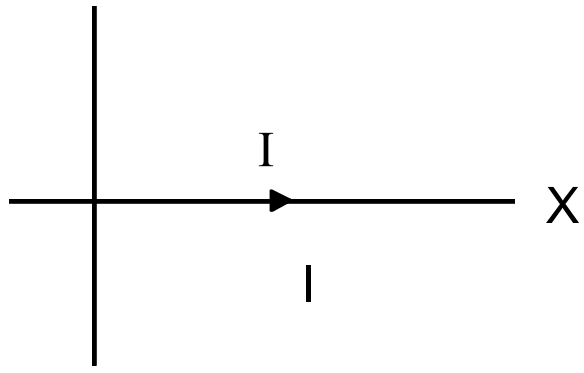
A wire of length l carries a current i long the x-axis. A magnetic field exists, which is given $\overrightarrow{\text{B}}=\text{B}_0(\overrightarrow{\text{i}}+\overrightarrow{\text{j}}+\overrightarrow{\text{k}})\text{T}.$ Find the magnitude of the magnetic force acting on the wire.
Answer

Length = l, Current $=\text{l}\hat{\text{i}}$
$\overrightarrow{\text{B}}=\text{B}_0(\hat{\text{i}}+\hat{\text{j}}+\hat{\text{k}})\text{T}$
$\text{B}_0\hat{\text{i}}+\text{B}_0\hat{\text{j}}+\text{B}_0\hat{\text{k}}\text{T}$
$\text{F}=\text{Il}\times\overrightarrow{\text{B}}=\text{Il}\hat{\text{i}}\times\text{B}_0\hat{\text{i}}+\text{B}_0\hat{\text{j}}+\text{B}_0\hat{\text{k}}$
$=\text{Il}\text{B}_0\hat{\text{i}}\times\hat{\text{i}}+\text{lB}_0\hat{\text{i}}\times\hat{\text{j}}+\text{lB}0\hat{\text{i}}\times\hat{\text{k}}=\text{Il}\text{B}_0\hat{\text{k}}-\text{IlB}\hat{\text{j}}$
or, $|\overrightarrow{\text{F}}|=\sqrt{2\text{I}^2\text{l}^2\text{B}_0^2}=\sqrt{2}\text{Il}\text{B}_0$
View full question & answer
Question 113 Marks
A uniform magnetic field of magnitude 0.20T exists in space from east to west. With what speed should a particle of mass 0.010g and with charge $1.0 \times 10^{-5}C$ be projected from south to north so that it moves with uniform velocity?
Answer
$B = 0.20T,$
$u = ?$
$m = 0.010g = 10^{-5}kg,$
$q = 1 \times 10^{-5}C$
Force due to magnetic field = Gravitational force of attraction
So, $quB = mg$
$\Rightarrow 1 \times 10^{-5} \times u \times 2 \times 10^{-1} = 1 \times 10–5 \times 9.8$
$\Rightarrow\text{v}=\frac{9.8\times10^{-5}}{2\times10^{-6}}=49\text{m/s}.$
View full question & answer
Question 123 Marks
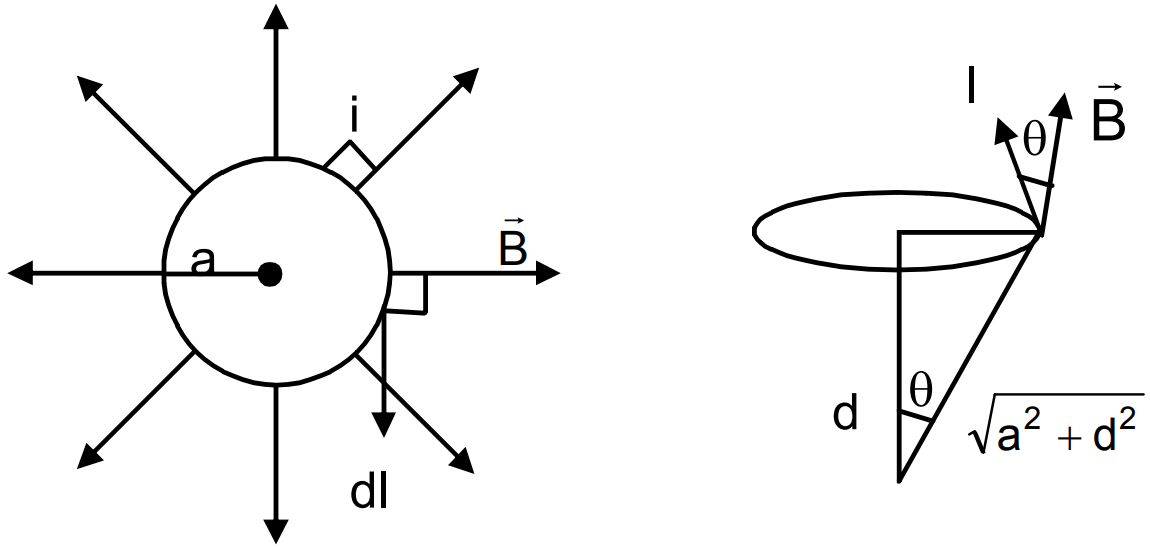
A hypothetical magnetic field existing in a region is given by $\overrightarrow{\text{B}}=\text{B}_0\overrightarrow{\text{e}}_\text{r},$ where $\overrightarrow{\text{e}}_\text{r}$ denotes the unit vector along the radial direction. A circular loop of radius a, carrying a current i, is placed with its plane parallel to the x-y plane and the centre at (0, 0, d). Find the magnitude of the magnetic force acting on the loop.
Answer

$\overrightarrow{\text{B}}=\text{B}_0\overrightarrow{\text{e}}_\text{r}$
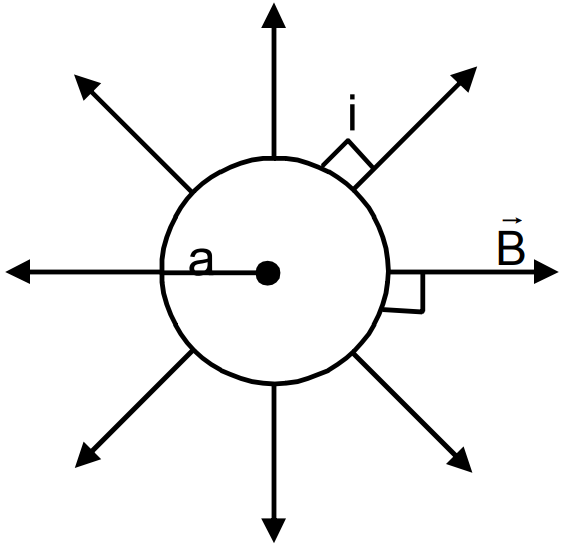
$\overrightarrow{\text{e}}_\text{r}=$ Unit vector along radial direction
$\text{F}=\text{i}(\overrightarrow{\text{l}}\times\overrightarrow{\text{B}})=\text{ilB}\sin\theta$
$=\frac{\text{i}(2\pi\text{a})\text{B}_0\text{a}}{\sqrt{\text{a}^2}+\text{d}^2}=\frac{\text{i}2\pi\text{a}^2\text{B}_0}{\sqrt{\text{a}^2+\text{d}^2}}$
View full question & answer
Question 133 Marks
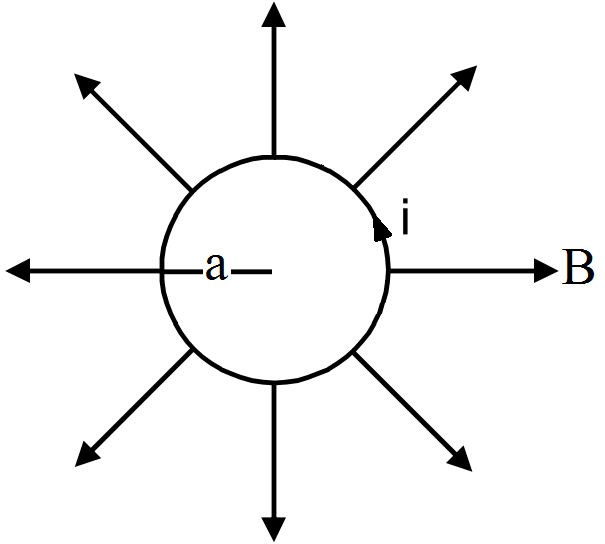
A circular loop of radius a, carrying a current i, is placed in a two-dimensional magnetic field. The centre of the loop coincides with the centre of the field The strength of the magnetic field at the periphery of the loop is B. Find the magnetic force on the wire.
Answer

$\text{l}=2\pi\text{a}$
Magnetic field $=\overrightarrow{\text{B}}$ radially outwards
Current ⇒ 'i'
$\text{F}=\text{i l}\times\text{B}$
$=\text{i}\times(2\pi\text{a}\times\overrightarrow{\text{B}})$
$=2\pi\text{ai B}$ perpendicular to the plane of the figure going inside.
View full question & answer
Question 143 Marks
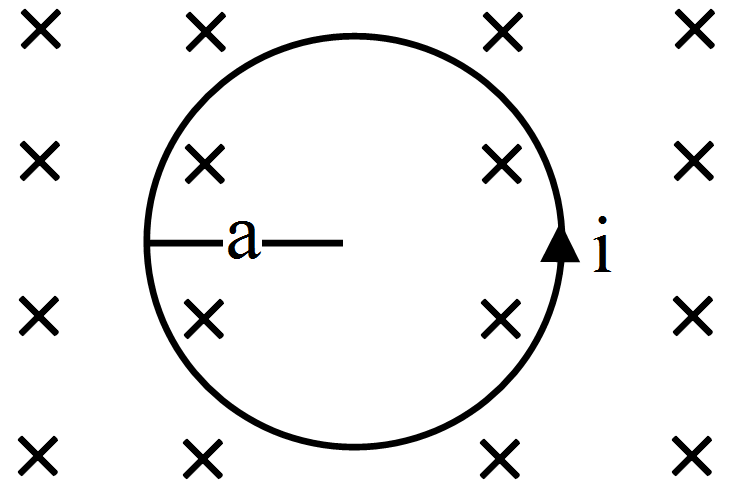
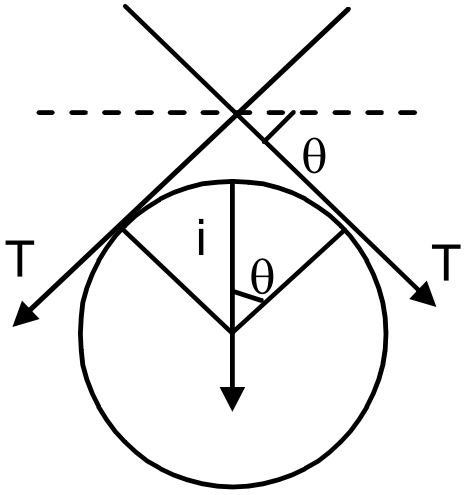
The shows a circular wire loop of radius a and carrying a current i, which is placed in a perpendicular magnetic field B.
  1. Consider a small part dl of the wire. Find the force on this part of the wire exerted by the magnetic field.
  2. Find the force of compression in the wire.
Answer

  1. Fdl = i × dl × B towards centre. (By cross product rule)
  2. Let the length of subtends an small angle of 20 at the centre.
Here, $2\text{T}\sin\theta=\text{i}\times\text{dl}\times\text{B}$

$\Rightarrow2\text{T}\theta=\text{i}\times\text{a}\times2\theta\times\text{B}$ $[\text{As}\theta\rightarrow0,\ \theta\approx0]$

$\Rightarrow\text{T}=\text{i}\times\text{a}\times\text{B}$

$\text{dl}=\text{a}\times2\theta$

Force of compression on the wire $=\text{i}\text{aB}$
View full question & answer
Question 153 Marks
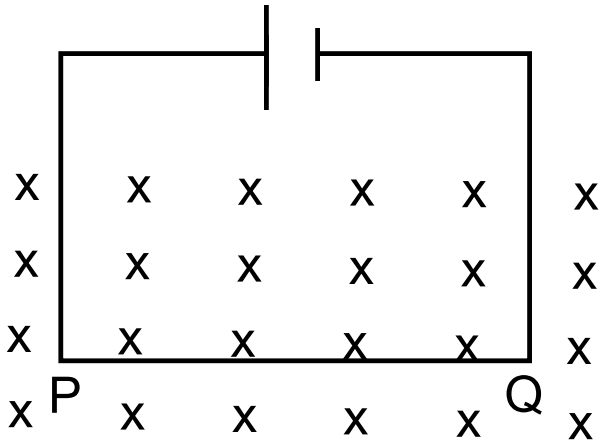
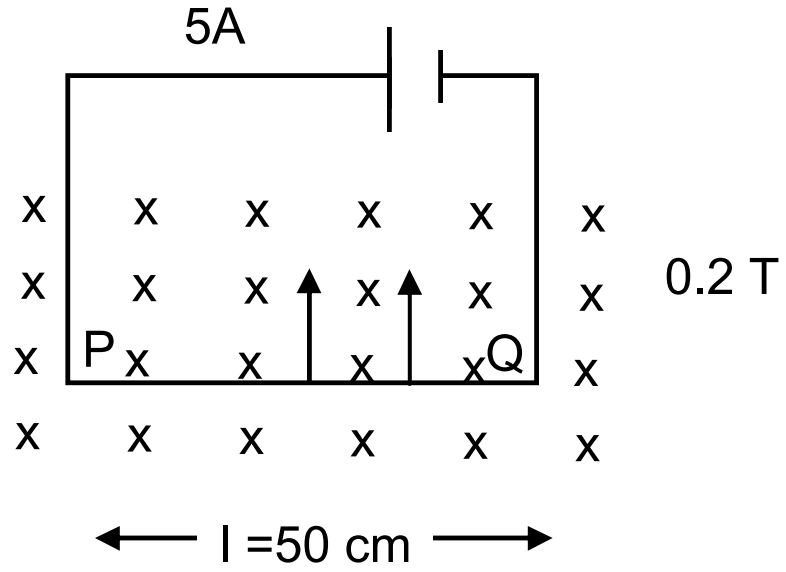
A current of 5.0A exists in the circuit shown in the figure. The wire PQ has a length of 50cm and the magnetic field in which it is immersed has a magnitude of 0.20T. Find the magnetic force acting on the wire PQ.
Answer

$\text{i}=5\text{A},\ \text{l}=50\text{cm}=0.5\text{m}$
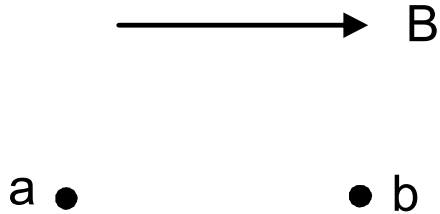
$\text{B}=0.2\text{T},$
$\text{F}=\text{ilB}\sin\theta=\text{ilB}\sin90^\circ$
$=5\times0.5\times0.2$
$=0.05\text{N}$
View full question & answer
Question 163 Marks
An experimenter's diary reads as follows: "A charged particle is projected in a magnetic field of $(7.0\vec{\text{i}}-3.0\vec{\text{j}})\times10^{-3}\text{T}.$ The acceleration of the particle is found to be $(\vec{\text{i}}+7.0\vec{\text{j}})\times10\text{m/s}^{2\text{n}}.$ The number to the left of $\vec{\text{i}}$ in the last expression was not readable. What can this number be?
Answer
$\vec{\text{B}}=(7.0\hat{\text{i}}+3.0 \ \vec{\text{j}})\times10^{-3}\text{T}$
$\vec{\text{a}}=$ acceleration $=(\text{i}+7\text{j})\times10^{-6}\text{m/s}^2$
Let the gap be x.
Since $\vec{\text{B}}$ and $\vec{\text{a}}$ are always perpendicular
$\vec{\text{B}}\times\vec{\text{a}}=0$
$\Rightarrow(7\text{x}\times10^{-3}\times10^{-6}-3\times10^{-3}7\times10^{-6})=0$
$\Rightarrow7\text{x}-21=0$
$\Rightarrow\text{x}=3$
View full question & answer
Question 173 Marks
Prove that the force acting on a current-carrying wire, joining two fixed points a and b in a uniform magnetic field, is independent of the shape of the wire.
Answer

For force on a current carrying wire in an uniform magnetic field
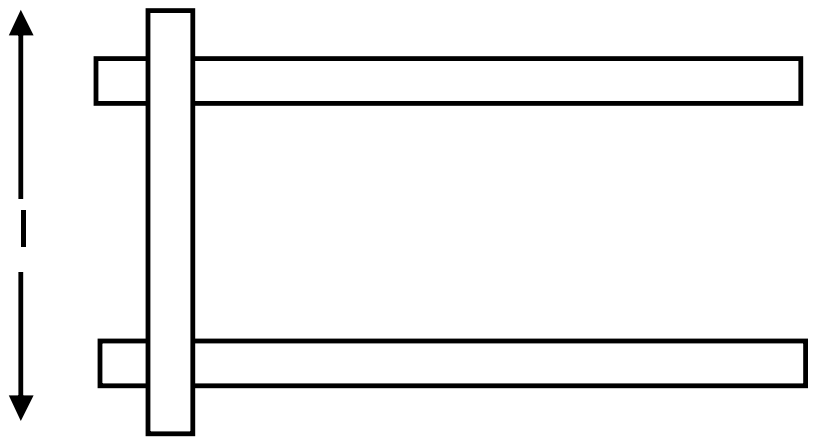
We need, l → length of wire
i → Current
B → Magnitude of magnetic field
Since $\overrightarrow{\text{F}}=\text{i}\ell\text{B}$
Now, since the length of the wire is fixed from A to B, so force is independent of the shape of the wire.
View full question & answer
Question 183 Marks
A straight wire of length l can slide on two parallel plastic rails kept in a horizontal plane with a separation d. The coefficient of friction between the wire and the rails is $\mu.$ If the wire carries a current i, what minimum magnetic field should exist in the space in order to slide the wire on the rails?
Answer

Mass = m
length = l
Current = i
Magnetic field = B = ?
$\text{iBl}=\mu\text{mg}$
$\Rightarrow\text{B}=\frac{\mu\text{gm}}{\text{il}}$
View full question & answer
Question 193 Marks
A straight horizontal wire of mass 10mg and length 1.0m carries a current of 2.0A. What minimum magnetic field B should be applied in the region, so that the magnetic force on the wire may balance its weight?
Answer
Mass $=10\text{mg}=10^{-5}\text{kg}$
Lenght $=1\text{m}$
$\text{I}=2\text{A}$
Now, $\text{Mg}=\text{ilB}$
$\Rightarrow\text{B}=\frac{\text{mg}}{\text{il}}=\frac{10^{-5}\times9.8}{2\times1}$
$=4.9\times10^{-5}\text{T}$
View full question & answer