Questions

1 Marks Question

Take a timed test

12 questions · self-marked practice — reveal the answer and mark yourself.

Question 11 Mark
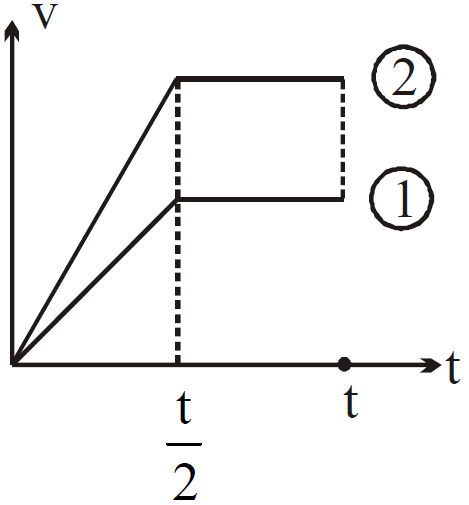
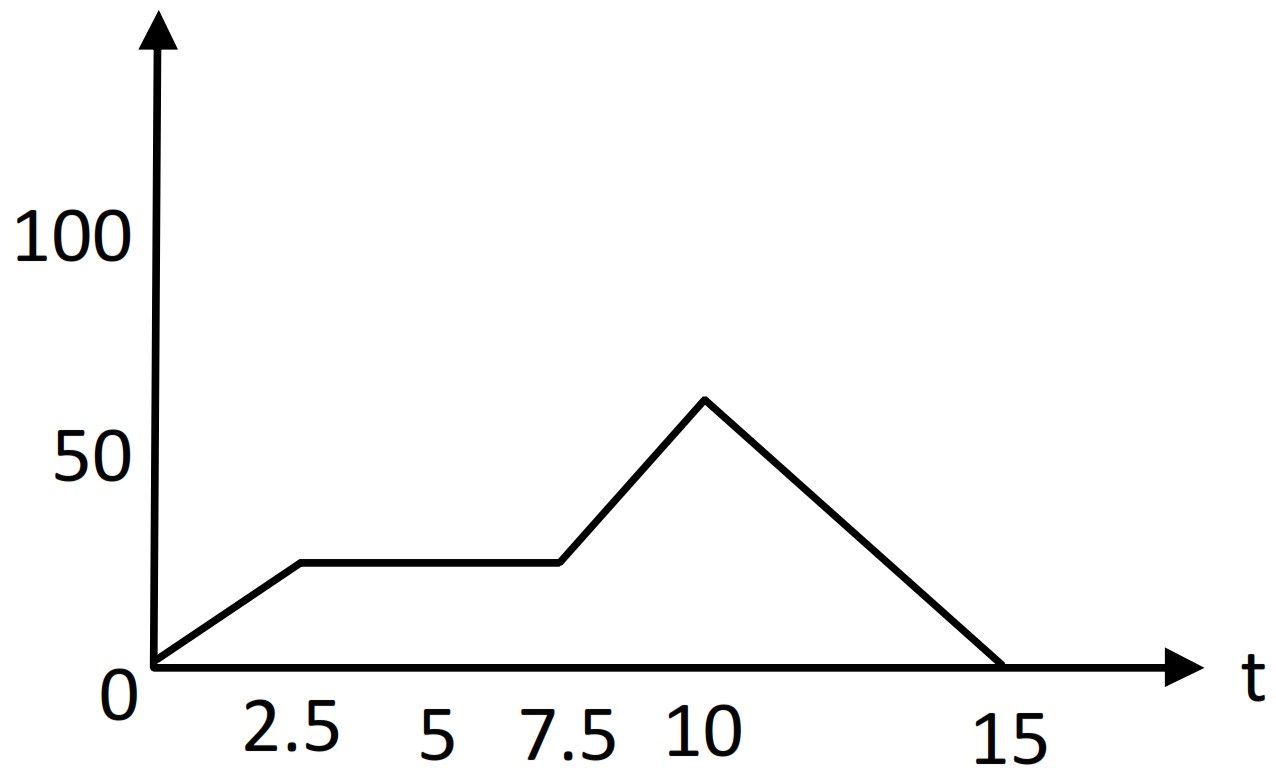
Two particles A and B start from rest and move for equal time on a straight line. The particle A has an acceleration a for the first half of the total time and 2a for the second half. The particle B has an acceleration 2a for the first half and a for the second half. Which particle has covered larger distance?
Answer
Second particle

Area under (v, t) graph gives displacement. For graph (2) area is more.
View full question & answer
Question 21 Mark
The increase in the speed of a car is proportional to the additional petrol put into the engine. Is it possible to accelerate a car without putting more petrol or less petrol into the engine?
Answer
Move in circular path with constant speed.
View full question & answer
Question 31 Mark
A person travelling at 43.2km/h applies the brake giving a deceleration of $6.0m/s^2$ to his scooter. How far will it travel before stopping?
Answer
Initial velocity u = 43.2km/hr = 12m/s
$u = 12m/s, v = 0$
$a = -6m/s^2$(deceleration)
Distance $\text{s}=\frac{\text{v}^2-\text{u}^2}{2(-6)}=12\text{m}$
View full question & answer
Question 51 Mark
When a particle moves with constant velocity, its average velocity, its instantaneous velocity and its speed are all equal. Comment on this statement.
Answer
Its average velocity and instantaneous velocity will be equal but we cannot compare these with average speed as one is vector and other is scalar.
View full question & answer
Question 61 Mark
The velocity of a particle is towards west at an instant. Its acceleration is not towards west, not towards east, not towards north and not towards south. Give an example of this type of motion.
Answer
Projectile at highest point because at the highest point vertical velocity become zero.
View full question & answer
Question 71 Mark
An object having a velocity 4.0m/s is accelerated at the rate of $1.2m/s^2$ for 5.0s. Find the distance travelled during the period of acceleration.
Answer
$u = 4m/s, a = 1.2m/s^2, t = 5 $ sec Distance $=\text{s}=\text{ut}+\frac{1}2{}\text{at}^2$$=4(5)+\frac{1}{2}(1.2)5^2=35\text{m}.$
View full question & answer
Question 81 Mark
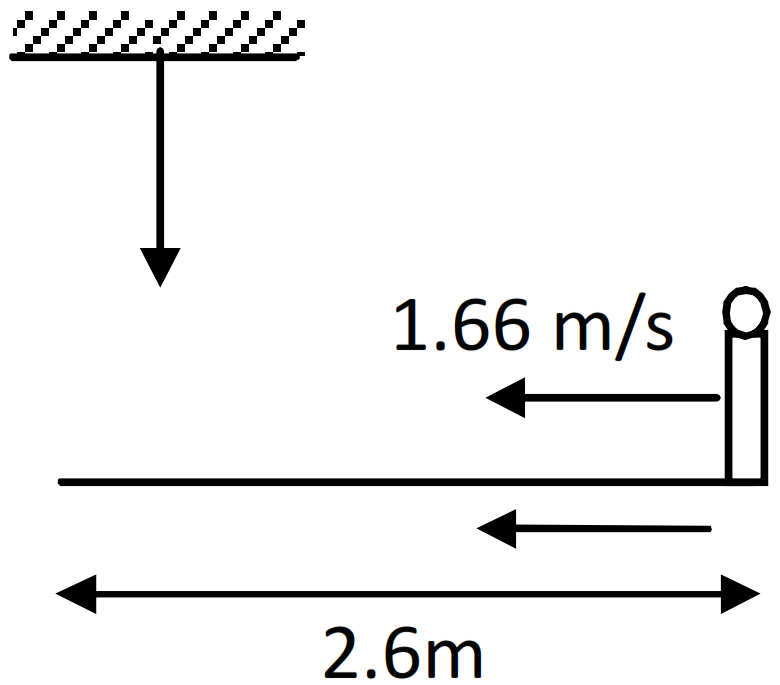
An NCC parade is going at a uniform speed of 6km/h through a place under a berry tree on which a bird is sitting at a height of 12.1m. At a particular instant the bird drops a berry. Which cadet (give the distance from the tree at the instant) will receive the berry on his uniform?
Answer
Let the true of fall be ‘t’ initial velocity u = 0 Acceleration $a = 9.8m/s^2$ Distance $\text{S}=\frac{12}{1}\text{m}$$\therefore\text{S = ut}+\frac{1}{2}\text{at}^2$
$\Rightarrow12.1=0+\frac{1}{2}(9.8)\times\text{t}^2$
$\Rightarrow\text{t}^2=\frac{12.1}{4.9}=2.46$
$\Rightarrow\text{t}=1.57\text{sec}$
For cadet velocity = 6km/hr = 1.66m/sec Distance $= vt = 1.57 × 1.66 = 2.6m. $ The cadet, 2.6m away from tree will receive the berry on his uniform.
View full question & answer
Question 91 Mark
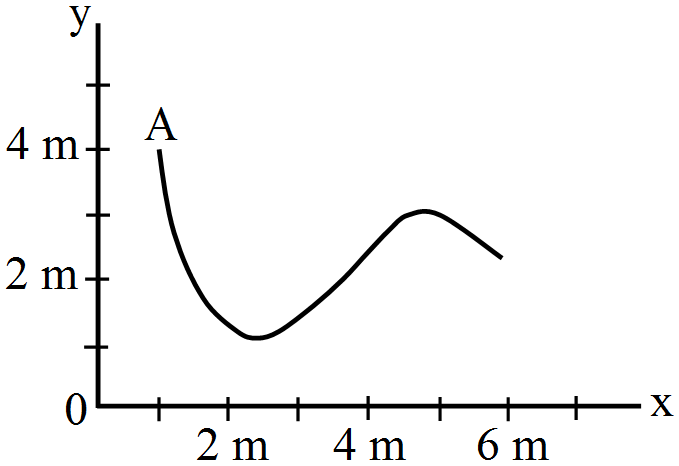
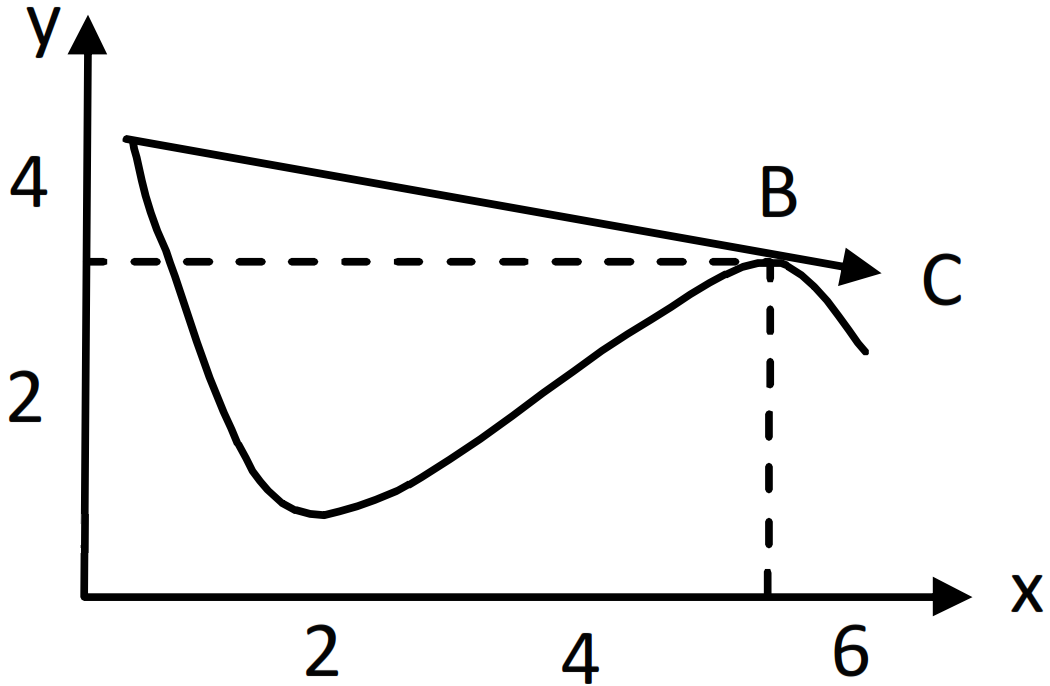
A particle starts from a point A and travels along the solid curve shown in figure. Find approximately the position B of the particle such that the average velocity between the positions A and B has the same direction as the instantaneous velocity at B.
Answer
At position B instantaneous velocity has direction along $\overrightarrow{\text{BC}}.$ For average velocity between A and B.$\text{V}_{\text{ave}}=\frac{\text{displacement}}{\text{times}}=\Big(\frac{\overrightarrow{\text{AB}}}{\text{t}}\Big)$
t = time We can see that $\overrightarrow{\text{AB}}$ is along $\overrightarrow{\text{BC}}$ i.e. they are in same direction. The point is B(5m, 3m).
View full question & answer
Question 101 Mark
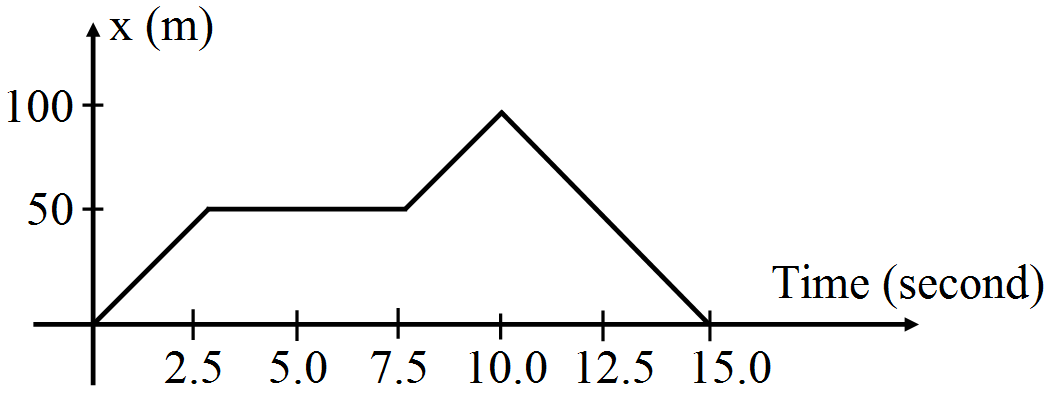
Figure shows the graph of the x-coordinate of a particle going along the X-axis as a function of time. Find:
  1. The average velocity during 0 to 10s.
  2. Instantaneous velocity at 2, 5, 8 and 12s.
Answer
  1. Displacement in 0 to 10 sec is 1000m.
time = 10 sec.
$\text{V}_{\text{ave}}=\frac{\text{s}}{\text{t}}=\frac{100}{10}=10\text{m/s}.$
  1. At 2 sec it is moving with uniform velocity $\frac{50}{2.5}=20\text{m/s}.$
at 2 sec. $V_{inst}= 20m/s.$
At 5 sec it is at rest.
$V_{inst}= zero.$
At 8 sec it is moving with uniform velocity 20m/s
$V_{inst}= 20m/s$
At 12 sec velocity is negative as it move towards initial position. Vinst = -20m/s.
View full question & answer
Question 111 Mark
Galileo was punished by the Church for teaching that the sun is stationary and the earth moves around it. His opponents held the view that the earth is stationary and the sun moves around it. If the absolute motion has no meaning, are the two, viewpoints not equally correct or equally wrong?
Answer
Yes, from relative motion we can this.
View full question & answer
Question 121 Mark
A car travels at a speed of 60km/hr due north and the other at a speed of 60km/hr due east. Are the velocities equal? If no, which one is greater? If you find any of the questions irrelevant, explain.
Answer
There are equal because they have different directions. There magnitude can be compared.
View full question & answer