Questions

M.C.Q (1 Marks)

Take a timed test

18 questions · auto-graded multiple-choice test.

MCQ 11 Mark
Consider the following statements about sound passing through a gas.
  1. The pressure of the gas at a point oscillates in time.
  2. The position of a small layer of the gas oscillates in time.
  • Both A and B are correct.
     
  • B
    A is correct but B is wrong.
     
  • C
    B is correct but A is wrong.
     
  • D
    Both A and B are wrong.
Answer
Correct option: A.
Both A and B are correct.
 
Explanation:
Sound is a longitudinal wave produced by the oscillation of pressure at a point, thus, forming compressions and rarefactions. That portion of gas itself does not move but the pressure variation causes a disturbance.
View full question & answer
MCQ 21 Mark
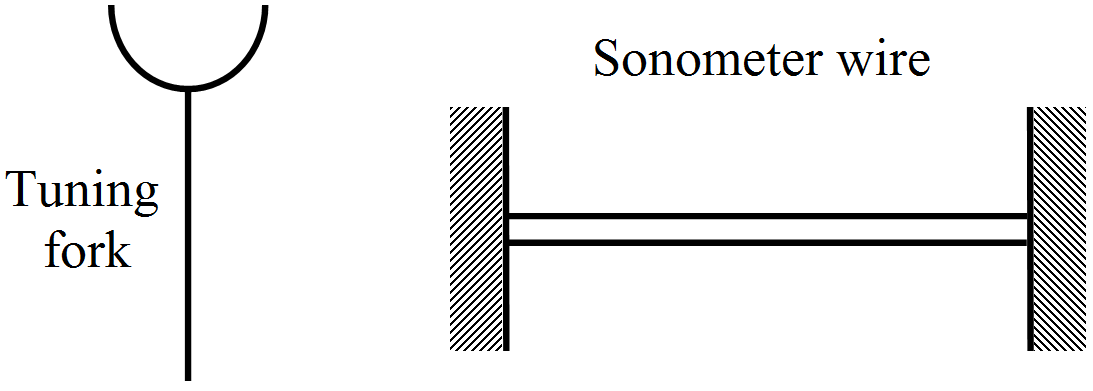
A tuning fork of frequency 512Hz is vibrated with a sonometer wire and 6 beats per second are heard. The beat frequency reduces if the tension in the string is slightly increased. The original frequency of vibration of the string is:
  • 506Hz
  • B
    512Hz
  • C
    518Hz
  • D
    524Hz.
Answer
Correct option: A.
506Hz
Explanation:

The frequency of the sonometer may be $512\pm6\text{Hz},$ i.e., $506\text{Hz}$ or $518\text{Hz}.$
On increasing the tension in a sonometer wire, the velocity of the wave (v) increases proportionately as the number of beats decreases. Therefore, the frequency of the sonometer wire is 506Hz.
View full question & answer
MCQ 31 Mark
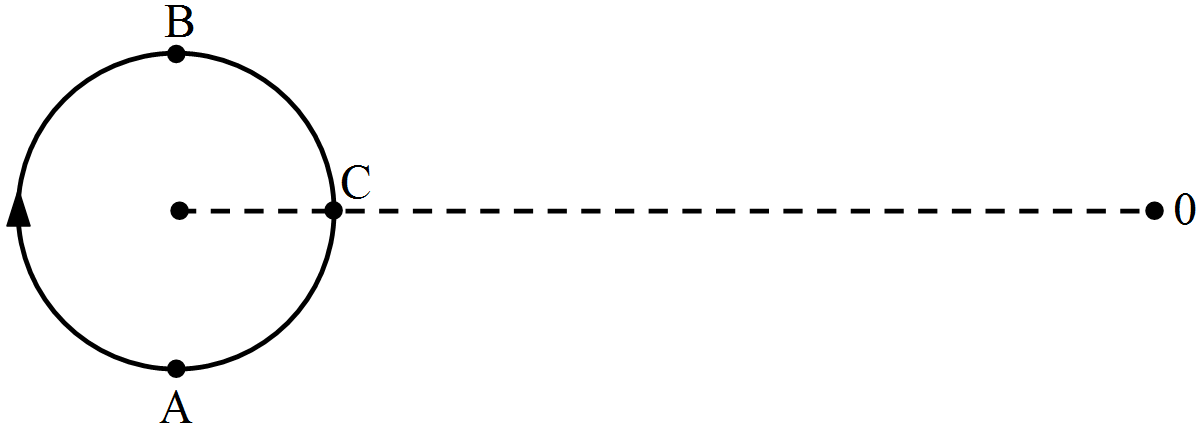
A small source of sound moves on a circle as shown$-$in figure and an observer is sitting at $0$. Let $v_1, v_2, v_3$ be the frequencies heard when the source is at $A, B$ and $C$ respectively.
  • A
    $v_1 > v_2 > v_3$
  • B
    $v_1=v_2 > v_3$
  • $v_2 > v_3 > v_1$
  • D
    $v_1 > v_2 > v_2$.
Answer
Correct option: C.
$v_2 > v_3 > v_1$

At $B,$ the velocity of the source is along the line joining the source and the observer.
Therefore, at $B$, the source is approaching with the highest velocity as compared to $A$ and $C$.
Hence, the frequency heard is maximum when the source is at $B.$
View full question & answer
MCQ 41 Mark
The speed of sound in a medium depends on:
  • A
    The elastic property but not on the inertia property.
  • B
    The inertia property but not on the elastic property.
  • The elastic property as well as the inertia property.
  • D
    Neither the elastic property nor the inertia property.
Answer
Correct option: C.
The elastic property as well as the inertia property.
Explanation:
Propagation of any wave through a medium depends on whether it is elastic and possesses inertia. A wave needs to oscillate (elastic property) for it to be propagated and if it does not have inertia, the oscillations wont keep on moving to and fro about the mean position.
View full question & answer
MCQ 51 Mark
Two sound waves move in the same direction in the same medium. The pressure amplitudes of the waves are equal but the wavelength of the first wave is double the second. Let the average power transmitted across a cross $-$ section by the first wave be $P_1$ and that by the $1$ second wave be $P_2$. Then,
  • $P_1=P_2$
  • B
    $P_1=4 P_2$
  • C
    $P_2=2 P_1$
  • D
    $\mathrm{P}_2=4 \mathrm{P}_1$
Answer
Correct option: A.
$P_1=P_2$
Since the average power transmitted by a wave is independent of the wavelength, we have $P_1=P_2$.
View full question & answer
MCQ 61 Mark
An organ pipe, open at both ends, contains
  • Longitudinal stationary waves.
  • B
    Longitudinal travelling waves.
  • C
    Transverse stationary waves.
  • D
    Transverse travelling waves.
Answer
Correct option: A.
Longitudinal stationary waves.
Explanation:
An open organ pipe has sound waves that are longitudinal. These waves undergo repeated till resonance to form standing waves.
View full question & answer
MCQ 71 Mark
The change in frequency due to Doppler effect does not depend on:
  • A
    The speed of the source.
  • B
    The speed of the observer.
  • C
    The frequency of the source.
  • Separation between the source and the observer.
Answer
Correct option: D.
Separation between the source and the observer.
Explanation:
$\text{v}_0=\Big(\frac{\text{v}\pm\mu_0}{\text{v}\pm\mu_\text{s}}\Big)\text{v}_\text{B}$
It is clear from the equation that the chage in frequency due to Doppler effect depends only on the relative and not on the distance between the source and the observer.
View full question & answer
MCQ 81 Mark
An open organ pipe of length L vibrates in its fundamental mode. The pressure variation is maximum.
  • A
    At the two ends.
  • At the middle of the pipe.
  • C
    At distances $\frac{\text{L}}{4}$ inside the ends.
  • D
    At distances $\frac{\text{L}}{8}$ inside the ends.
Answer
Correct option: B.
At the middle of the pipe.
Explanation:

For an open pipe in fundamental mode, anti-node is formed at the middle, where the amplitude of the wave is maximum. Hence, the pressure variation is also maximum at the middle.
View full question & answer
MCQ 91 Mark
The phenomenon of beats can take place:
  • A
    For longitudinal waves only.
  • B
    For transverse waves only.
  • For both longitudinal and transverse waves.
  • D
    For sound waves only.
Answer
Correct option: C.
For both longitudinal and transverse waves.
When two or more waves of slightly different frequencies $(v_1- v_2 > 10)$ travel with the same speed in the same direction, they superimpose to give beats. Thus, the waves may be longitudinal or transverse.
View full question & answer
MCQ 101 Mark
When we clap our hands, the sound produced is best described by-
  • A
    $\text{p}=\text{p}_0\sin(\text{kx}-\omega\text{t})$
  • B
    $\text{p}=\text{p}_0\sin\text{kx}\cos\omega\text{t}$
  • C
    $\text{p}=\text{p}_0\cos\text{kx}\sin\omega\text{t}$
  • $\text{p}=\sum\text{p}_{0\text{n}}\sin(\text{k}_\text{n}\text{x}-\omega_\text{n}\text{t}).$
Answer
Correct option: D.
$\text{p}=\sum\text{p}_{0\text{n}}\sin(\text{k}_\text{n}\text{x}-\omega_\text{n}\text{t}).$
Explanation:
When we clap, there is a change in pressure, which sets a disturbance and forms a wave. However, this variation is not uniform every time we clap (unlike in the case of a sound wave). Hence, we sum up all the disturbances.
View full question & answer
MCQ 111 Mark
A source of sound moves towards an observer.
  • A
    The frequency of the source is increased.
  • B
    The velocity of sound in the medium is increased.
  • The wavelength of sound in the medium towards the observer is decreased.
  • D
    The amplitude of vibration of the particles is increased.
Answer
Correct option: C.
The wavelength of sound in the medium towards the observer is decreased.
Explanation:
Due to Doppler effect, the frequency or wavelength of the sound changes towards the observer only.
The actual frequency and wavelength of the source does not change.
View full question & answer
MCQ 121 Mark
When sound wave is refracted from air to water, which of the following will remain unchanged?
  • A
    Wave number.
  • B
    Wavelength.
  • C
    Wave velocity.
  • Frequency.
Answer
Correct option: D.
Frequency.
Explanation:
When a sound or light wave undergoes refraction, its frequency remains constant because there is no change in its phase.
View full question & answer
MCQ 131 Mark
When two waves with same frequency and constant phase difference interfere,
  • A
    There is a gain of energy.
  • B
    There is a loss of energy
  • C
    The energy is redistributed and the distribution changes with time.
  • The energy is redistributed and the distribution remains constant in time.
Answer
Correct option: D.
The energy is redistributed and the distribution remains constant in time.
Explanation:
The energy is redistributed due to the presence of interference. However, as the frequency and phase remain constant. the distribution also remains constant With time.
View full question & answer
MCQ 141 Mark
When you speak to your friend, which of the following parameters have a unique value in the sound produced?
  • A
    Frequency.
  • B
    Wavelength.
  • C
    Amplitude.
  • Wave velocity.
Answer
Correct option: D.
Wave velocity.
Explanation:
The frequency, wavelength and amplitude do not have a unique value in the sound produced. The frequency (and wavelength) changes as the pitch of the sound varies, while the amplitude is different as the loudness varies. However, the speed of sound in the air at a particular temperature is constant, i.e., it has a unique value.
View full question & answer
MCQ 151 Mark
A tuning fork sends sound waves in air. If the temperature of the air increases, which of the following parameters will change?
  • A
    Displacement amplitude.
  • B
    Frequency.
  • Wavelength.
  • D
    Time period.
Answer
Correct option: C.
Wavelength.
Explanation:
The velocity of a sound wave varies with temperature as follows:
$\text{v}\propto\sqrt{\text{T}}$
As the temperature increases, the speed also increases. However, since the frequency remains the same, its wavelength changes.
View full question & answer
MCQ 161 Mark
The engine of a train sounds a whistle at frequency v. The frequency heard by a passenger is:
  • A
    $>\text{v}$
  • B
    $<\text{v}$
  • C
    $=\frac{1}{\text{v}}$
  • $=\text{v}$
Answer
Correct option: D.
$=\text{v}$
Explanation:
For the Doppler effect to occur, there must be relative motion between the source and the observer.
However, this is not the case here. Hence, the frequency heard by the passenger is v.
View full question & answer
MCQ 171 Mark
The bulk modulus and tbe density of water are greater than those of air. With this much of information, we can say that velocity of sound in air:
  • A
    Is larger than its value in water.
  • B
    Is smaller than its value in water.
  • C
    Is equal to its value in water.
  • Cannot be compared with its value in water.
Answer
Correct option: D.
Cannot be compared with its value in water.
Explanation:
If B is the bulk modulus and pis the density, then the velocity of sound is given by:
Velocity $=\sqrt{\frac{\text{B}}{\rho}}$
If both Band p are greater, then we cannot compare $\frac{2\text{B}}{2\rho}=\frac{3\text{B}}{3\rho}=\frac{\text{B}}{\rho}.$
For proper comparison, we need numerical values.
View full question & answer
MCQ 181 Mark
A cylindrical tube, open at both ends, has a fundamental frequency v. The tube is dipped vertically in water so that half of its length is inside the water. The new fundamental frequency is:
  • A
    $\frac{\text{v}}{4}$
  • B
    $\frac{\text{v}}{2}$
  • $\text{v}$
  • D
    $2\text{v}$
Answer
Correct option: C.
$\text{v}$
Explanation:
If v is the velocity of the wave and L is the length of the pipe. then the fundamental frequency for an open pipe is:
$\text{v}=\frac{\text{v}}{2\text{L}}$
For a closed organ pipe of length of lenth $\text{L}'=\frac{\text{L}}{2},$ the fundamental frequency is:
$\text{v}=\frac{\text{v}}{4\text{L}'}=\frac{\text{v}\times2}{4\times\text{L}}=\frac{\text{v}}{2\text{L}}=\text{v}$
(When the pipe is dipped in water, it behaves like a closed pipe that is half the lenth)
View full question & answer