Questions

5 Marks Questions

Take a timed test

25 questions · self-marked practice — reveal the answer and mark yourself.

Question 15 Marks
A 250g block slides on a rough horizontal table. Find the work done by the frictional force in bringing the block to rest if it is initially moving at a speed of 40cm/s. If the friction coefficient between the table and the block is 0.1, how far does the block move before coming to rest?
Answer
Given, m = 250g = 0.250kg, u = 40cm/sec = 0.4m/sec$\mu=0.1,\ \text{v}=0$
Here, $\mu\text{R}=\text{ma}$ {where, a = deceleration}$\text{a}=\frac{\mu\text{R}}{\text{m}}=\frac{\mu\text{mg}}{\text{m}}=\mu\text{g}$
$=0.1\times9.8=0.98\text{m}/\text{sec}^2$
$\text{S}=\frac{\text{v}^2-\text{u}^2}{2\text{a}}$
$=0.082\text{m}=8.2\text{cm}$
Again, work done against friction is given by,$\text{w}=\mu\text{RS}\cos\theta$
$=0.1\times2.5\times0.082\times1(\theta=0^\circ)=0.02\text{J}$
$\Rightarrow\text{W}=-0.02\text{J}$
View full question & answer
Question 25 Marks
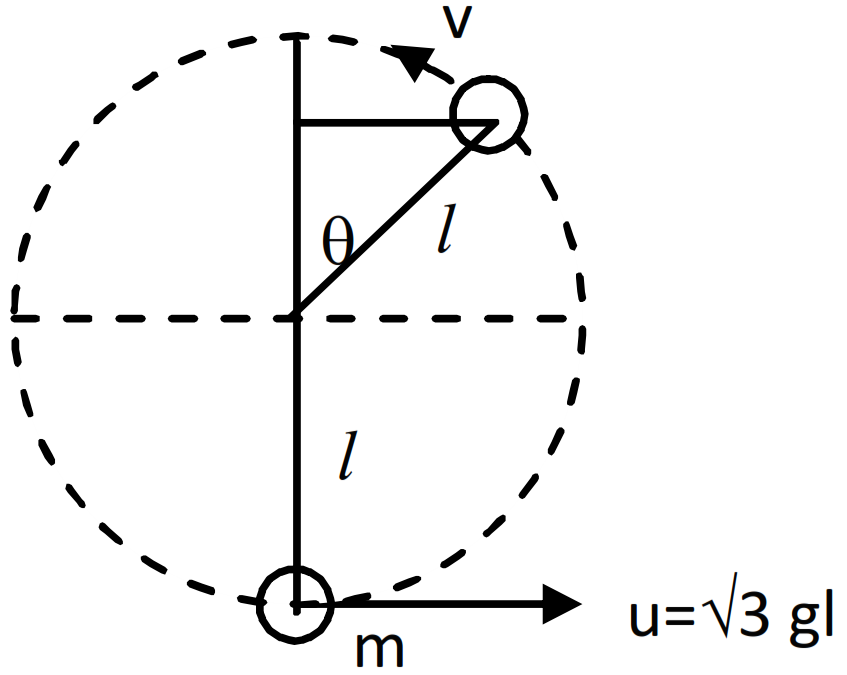
The bob of a stationary pendulum is given a sharp hit to impart it a horizontal speed of $\sqrt{3\text{gl}}.$ Find the angle rotated by the string before it becomes slack.
Answer


$\text{v}=\sqrt{3\text{gl}}$
$\frac{1}{2}\text{m}\text{v}^2-\frac{1}{2}\text{m}\text{v}_2^2=-\text{mgh}$
$\text{v}^2=\text{u}^2-2\text{g}(\text{l}+\cos\theta)$
$\text{v}^2=3\text{gl}-2\text{gl}(\text{l}+\cos\theta)\ \dots(1)$
Again,
$\frac{\text{mv}^2}{\text{l}}=\text{mg}\cos\theta$
$\text{v}^2=\text{lg}\cos\theta\ \dots(2)$
From equation (1) and (2), we get
$3\text{gl}-2\text{gl}-2\text{gl}\cos\theta=\text{gl}\cos\theta$
$3\cos\theta=1$
$\cos\theta=\frac{1}{3}$
$\theta=\cos^{-1}\Big(\frac{1}{3}\Big)$
So, angle rotated before the string becomes slack,
$\Rightarrow180^\circ-\cos^{-1}\Big(\frac{1}{3}\Big)=\cos^{-1}\Big(\frac{-1}{3}\Big)$
View full question & answer
Question 35 Marks
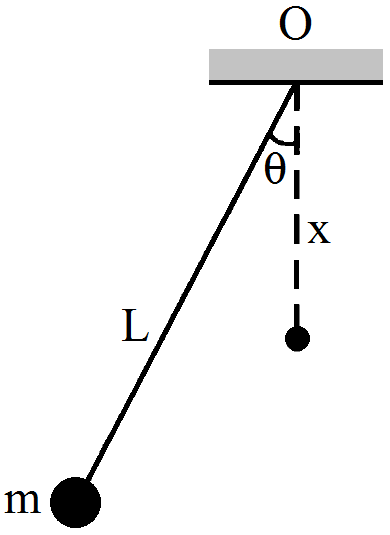
A simple pendulum of length L having a bob of mass m is deflected from its rest position by an angle $\theta$ and released (figure). The string hits a peg which is fixed at a distance x below the point of suspension and the bob starts going in a circle centred at the peg.
  1. Assuming that initially the bob has a height less than the peg, show that the maximum height reached by the bob equals its initial height.
  2. If the pendulum is released with $\theta=90^\circ$ and $\text{x}=\frac{\text{L}}{2}$ find the maximum height reached by the bob above its lowest position before the string becomes slack.
  3. Find the minimum value of $\frac{\text{x}}{\text{L}}$ for which the bob goes in a complete circle about the peg when the pendulum is released from $\theta=90^\circ.$
Answer

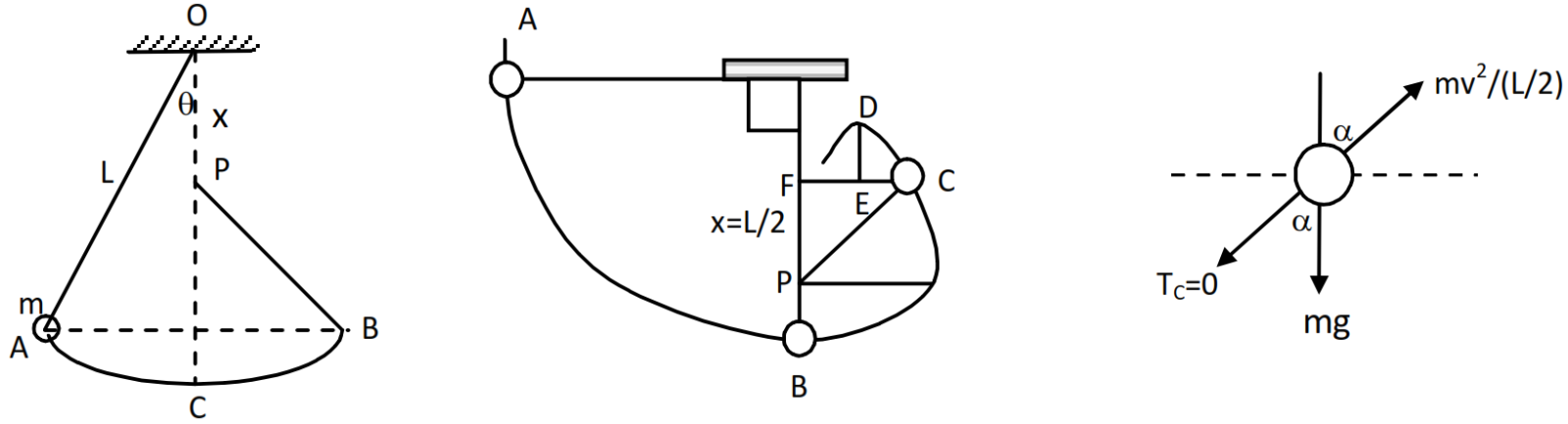
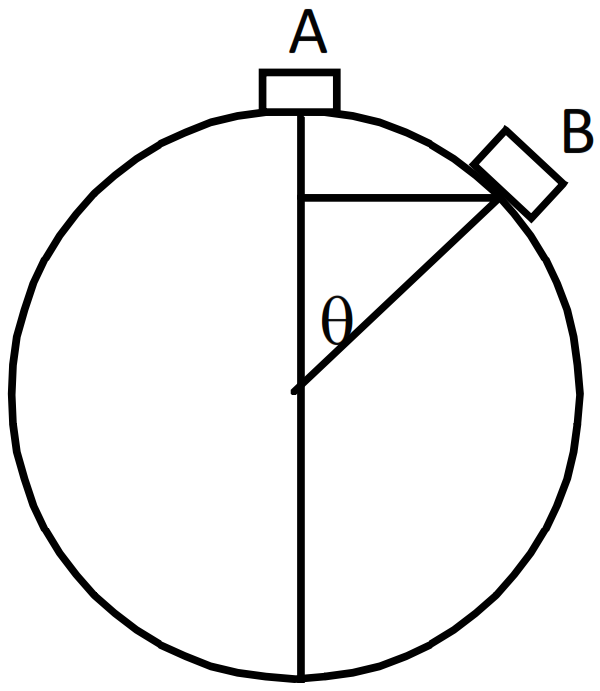
  1. When the bob has an initial height less than the peg and then released from rest (figure), let body travels from A to B.
Since, Total energy at A = Total energy at B
$\therefore (K.E)_A = (PE)_A = (KE)_B + (PE)_B$
$\Rightarrow (PE)_A = (PE)_B [$because, $(KE)_A = (KE)_B = 0]$
So, the maximum height reached by the bob is equal to initial height.
  1. When the pendulum is released with $\theta=90^\circ$ and $\text{x}=\frac{\text{L}}{2},$ (figure) the path of the particle is shown in the figure.
At point C, the string will become slack and so the particle will start making projectile motion.
$\Rightarrow\Big(\frac{1}{2}\Big)\text{mv}_\text{c}^2-0=\text{mg}\Big(\frac{\text{L}}{2}\Big)(1-\cos\alpha)$
Because, distance between A nd C in the vertical direction is $\frac{\text{L}}{2}(1-\cos\alpha)$
$\Rightarrow\text{v}_\text{c}^2=\text{gl}(1-\cos\alpha)\ \dots(1)$
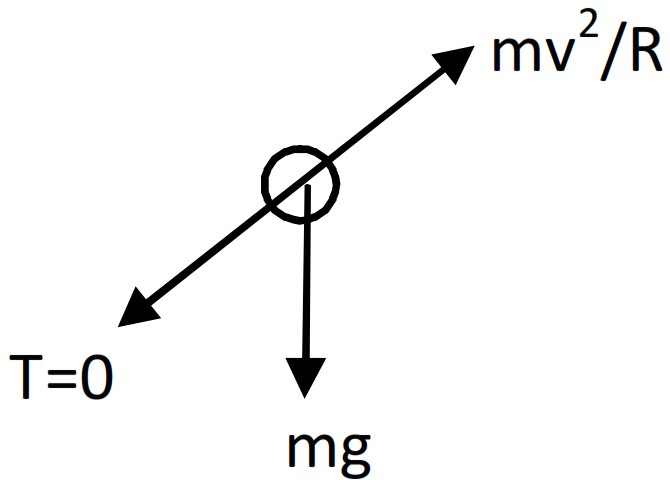
Again, form the freebody diagram,
$\frac{\text{mv}_\text{c}^2}{\frac{\text{L}}{2}}=\text{mg}\cos\alpha$ [because $T_c = 0$]
So, $\Rightarrow\text{v}_\text{c}^2=\frac{\text{gl}}{2}\cos\alpha\ \dots(2)$
From Eqn.(1) and equn (2),
$\text{gl}(1-\cos\alpha)=\frac{9\text{L}}{2}\cos\alpha$
$\Rightarrow(1-\cos\alpha)=\frac{1}{2}\cos\alpha$
$\Rightarrow\frac{3}{2}\cos\alpha=1$
$\Rightarrow\cos\alpha=\frac{2}{3}\ \dots(3)$
To find highest position C, before the string becomes slack.
$\text{BF}=\frac{\text{L}}{2}+\frac{\text{L}}{2}\cos\theta$
$\text{BF}=\frac{\text{L}}{2}+\frac{\text{L}}{2}\times\frac{2}{3}=\text{L}\Big(\frac{1}{2}+\frac{1}{3}\Big)$
So, $\text{BF}=\frac{5\text{L}}{6}$
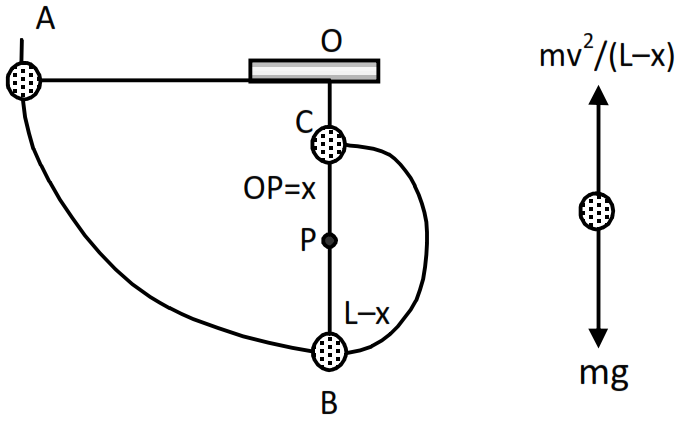
  1. If the particle has to complete a vertical circle, at the point C.

$\frac{\text{mv}_\text{c}^2}{(\text{L}-\text{x})}=\text{mg}$
$\Rightarrow\text{v}_\text{c}^2=\text{g}(\text{L}-\text{x})\ \dots(4)$
Again, applying energy principle between A and C,
$\frac{1}{2}\text{mv}_\text{c}^2-0=\text{mg}(\text{OC})$
$\Rightarrow\frac{1}{2}\text{v}_\text{c}^2-0=\text{mg}[\text{L}-2(\text{L}-\text{x})]$
$\Rightarrow\text{mg}(2\text{x}-\text{L})$
$\Rightarrow\text{v}_\text{c}^2=2\text{g}(2\text{x}-\text{L})\ \dots(5)$
From equn. (4) and equn (5),
$\text{g}(\text{L}-\text{x})=2\text{g}(2\text{x}-\text{L})$
$\Rightarrow\text{L}-\text{x}=4\text{x}-2\text{L}$
$\Rightarrow5\text{x}=3\text{L}$
$\therefore\ \frac{​​​​\text{x}}{\text{L}}=\frac{3}{5}=0.6$
So, the rates $\Big(\frac{\text{x}}{\text{L}}\Big)$ should be 0.6
View full question & answer
MCQ 45 Marks
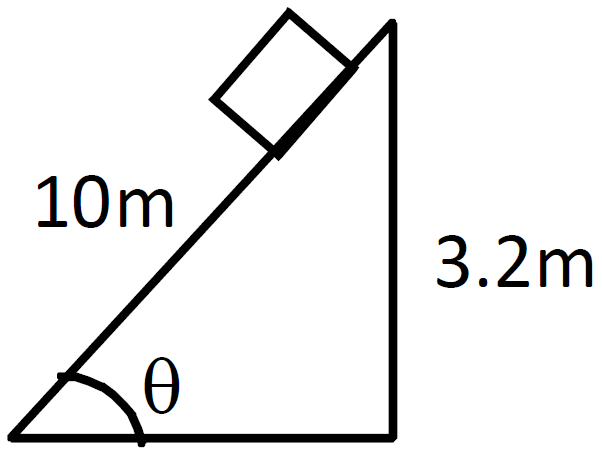
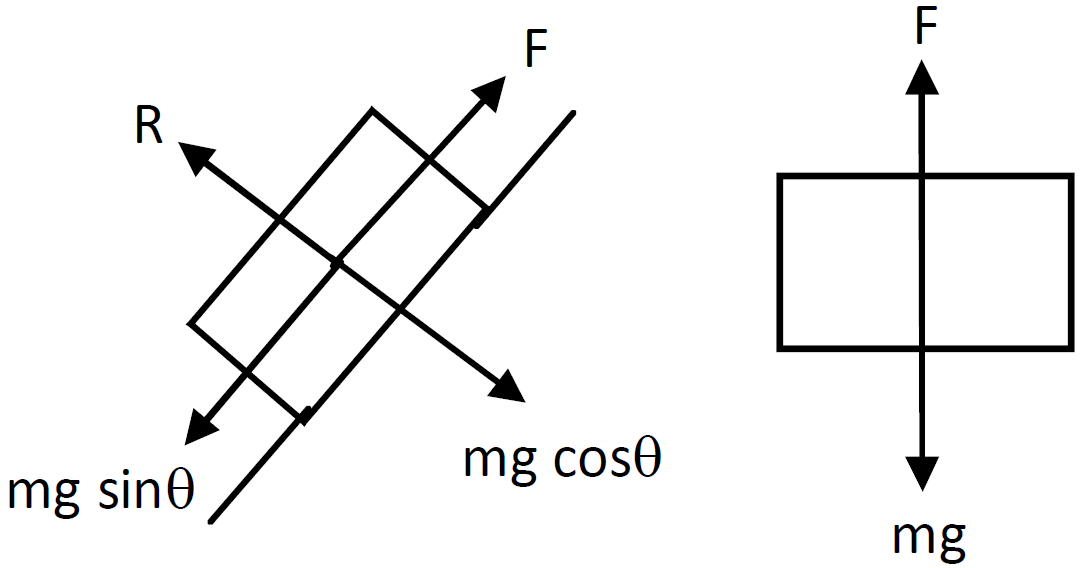
A small block of mass 200g is kept at the top of a frictionless incline which is 10m long and 3.2m high. How much work was required.
  • A
    To lift the block from the ground and put it at the top.
     
  • B
    To slide the block up the incline? What will be the speed of the block when it reaches the ground.
     
  • C
    It falls off the incline and drops vertically on the ground.
     
  • D
    It slides down the incline? Take $g = 10m/s^2.$
Answer
$m = 200g = 0.2kg, s = 10m, h = 3.2m, g = 10m/sec^2$
  1. Work done $W = mgh = 0.2 × 10 × 3.2 = 6.4J$
  2. Work done to slide the block up the incline,

$\text{w}=(\text{mg}\sin\theta)\times\text{s}$
$=(0.2)\times10\times\frac{3.2}{10}\times10=6.4\text{J}$
  1. Let, the velocity be v when falls on the ground vertically,
$=\frac{1}{2}\text{mv} -0=6.4\text{J}$
$\Rightarrow\text{v}=8\text{m}/\text{s}$
  1. Let V be the velocity when reaches the ground by liding,
$=\frac{1}{2}\text{mV}^2-0=6.4\text{J}$
$\Rightarrow\text{v}=8\text{m}/\text{s}$
View full question & answer
Question 55 Marks
Can static friction do nonzero work on an object? If yes, give an example. If no, give reason.
Answer
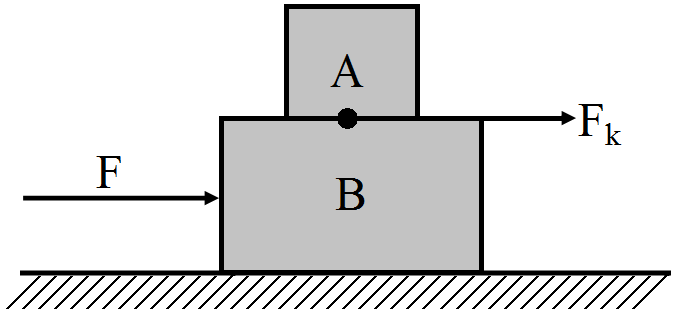
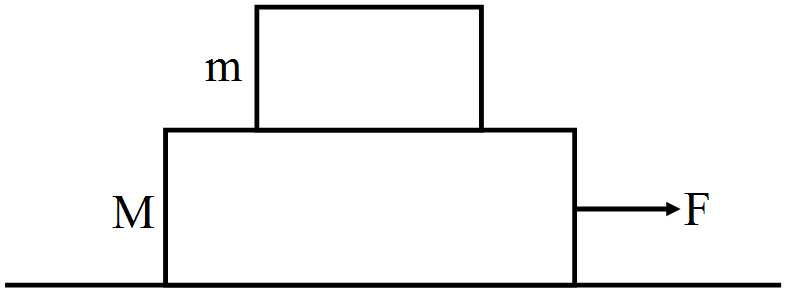
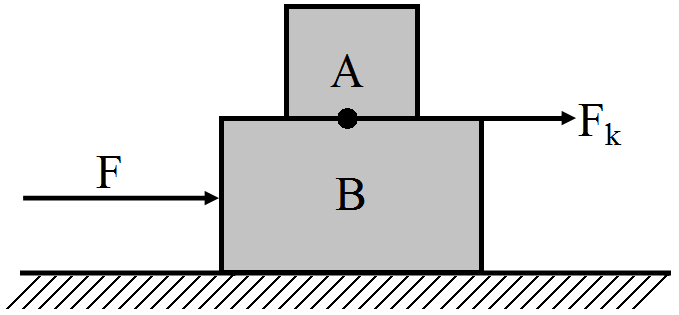
Yes. Let us consider a block A which is resting on another block B. Block B is resting on a smooth horizontal surface. Let the coefficient of kinetic friction between the blocks be $\mu\text{k}.$
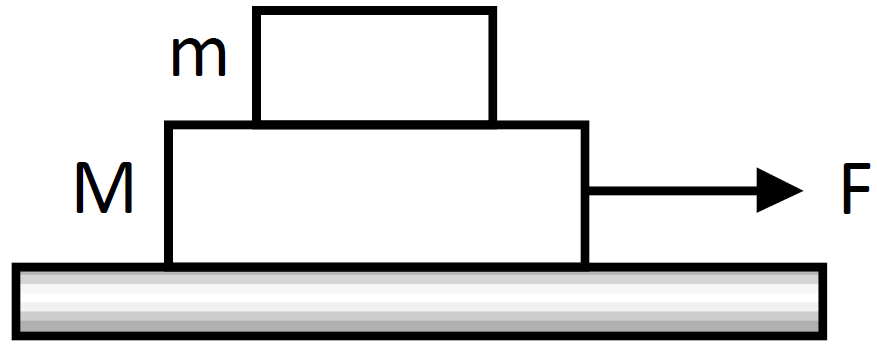
When a force F is applied on block B in the forward direction as shown in the above figure, block A moves with block B in the direction of the applied force. The friction force on block A and the displacement will be in the forward direction. Therefore, work done by the friction force is positive. In this case, block A will remain in contact with block B. This shows that static friction is doing a nonzero work on an object.
View full question & answer
Question 65 Marks
The heavier block in an Atwood machine has a mass twice that of the lighter one. The tension in the string is 16.0N when the system is set into motion. Find the decrease in the gravitational potential energy during the first second after the system is released from rest.
Answer
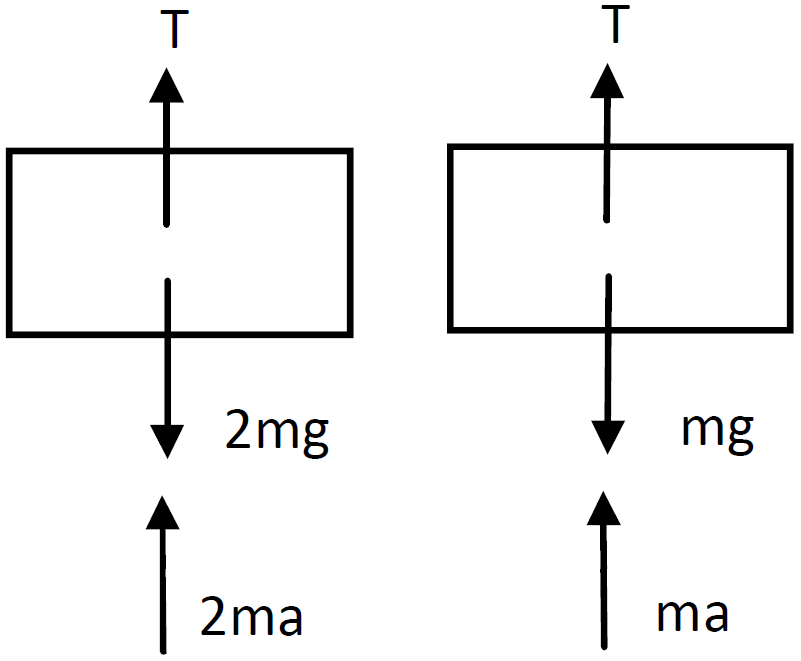
Given, T = 16N From the freebody diagrams,
T - 2mg + 2ma = 0 …(i) T - mg - ma = 0 …(ii) From, Equation (i) & (ii) T = 4ma $\Rightarrow\text{a}=\frac{\text{T}}{4\text{m}}$
$\Rightarrow\text{A}=\frac{16}{4\text{m}}=\frac{4}{\text{m}}\text{m}/\text{s}^2$
Now, $\text{s}=\text{ut}+\frac{1}{2}\text{at}^2$$\Rightarrow\text{S}=\frac{1}{2}\times\frac{4}{\text{m}}\times1$
$\Rightarrow\text{S}=\frac{2}{\text{m}}$ [because u=0]
Net mass = 2m - m = m Decrease in P.E. = mgh$\Rightarrow\text{P.E.}=\text{m}\times\text{g}\times\frac{2}{\text{m}}​​$
$\Rightarrow\text{P.E.}=9.8\times2$
$\Rightarrow\text{P.E.}=19.6\text{J}$
View full question & answer
Question 75 Marks
A block of mass m is kept over another block of mass M and the system rests on a horizontal surface figure. A constant horizontal force F acting on the lower block produces an acceleration $\frac{\text{F}}{2(\text{m+M})}$ in the system, the two blocks always move together.
  1. Find the coefficient of kinetic friction between the bigger block and the horizontal surface.
  2. Find the frictional force acting on the smaller block.
  3. Find the work done by the force of friction on the smaller block by the bigger block during a displacement d of the system.
Answer
Given,$\text{a}=\frac{\text{F}}{2(\text{M}+\text{m})}$
  1.  

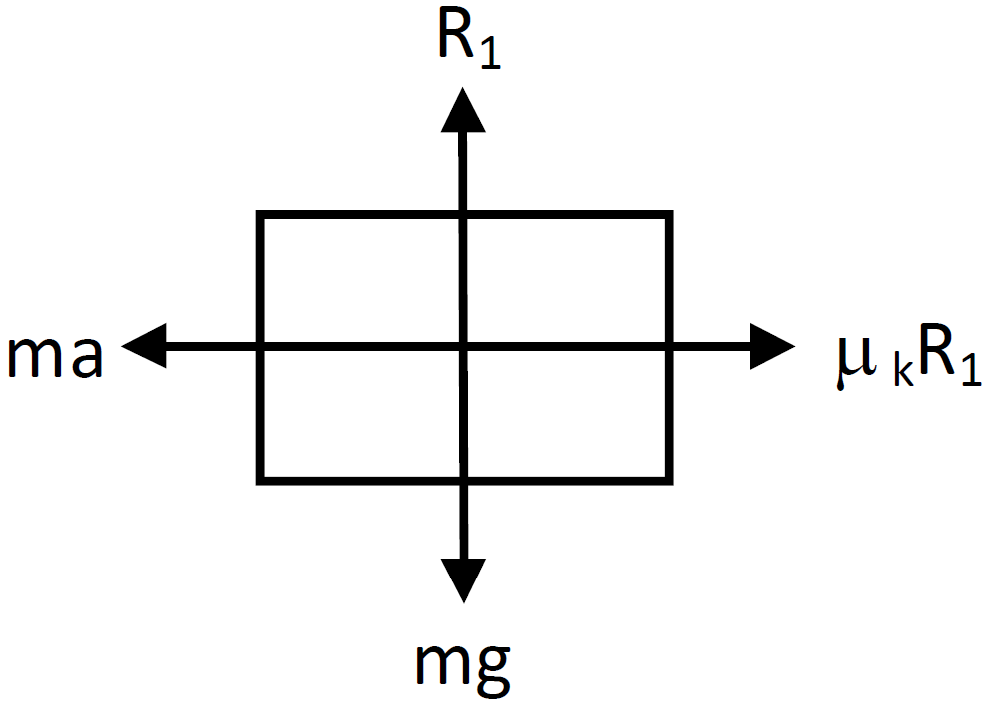
$\text{ma}=\mu_\text{k }\text{R}_1\text{and }\text{R}_1=\text{mg}$
$\Rightarrow\mu=\frac{\text{ma}}{\text{R}_1}=\frac{\text{F}}{2(\text{M}+\text{m})\text{g}}$
  1.  

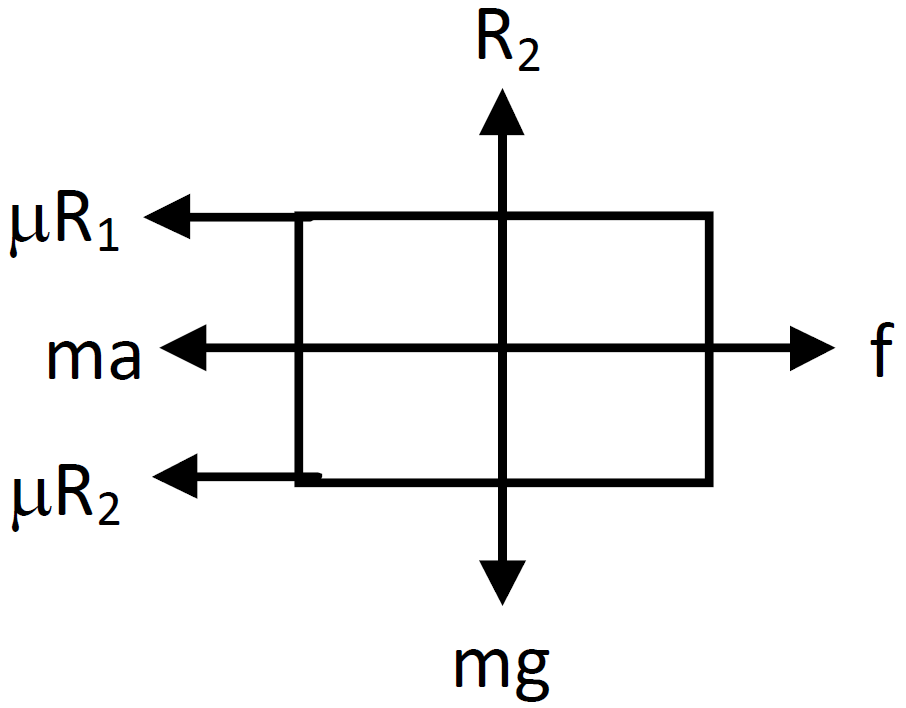
Frictional force acting on the smaller block $\text{f}=\mu\text{R}$
$=\frac{\text{F}}{2(\text{M}+\text{m})\text{g}}\times\text{mg}$
$=\frac{\text{m}\times\text{F}}{2(\text{M}+\text{m})}$
  1.  

Work done w = fs, s = d
$\text{W}=\frac{\text{mF}}{2(\text{M}+\text{m})}\times\text{d}$
$\text{W}=\frac{\text{mFd}}{2(\text{M}+\text{m})}$
View full question & answer
Question 85 Marks
Can the work by kinetic friction on an object be positive? Zero?
Answer
Yes. Let us consider a block A which is resting on another block B. Block B is resting on a smooth horizontal surface. Let the coefficient of friction between the blocks be $\mu.$
When a force F is applied on block B in the forward direction as shown in the above figure, block A moves with block B in the direction of the applied force. The frictional force on block A and the displacement will be in the forward direction. Therefore, work done by the frictional force is positive. If we consider the reference frame of block B, then displacement of block A will be zero. Therefore, work done by the frictional force is zero.
View full question & answer
Question 95 Marks
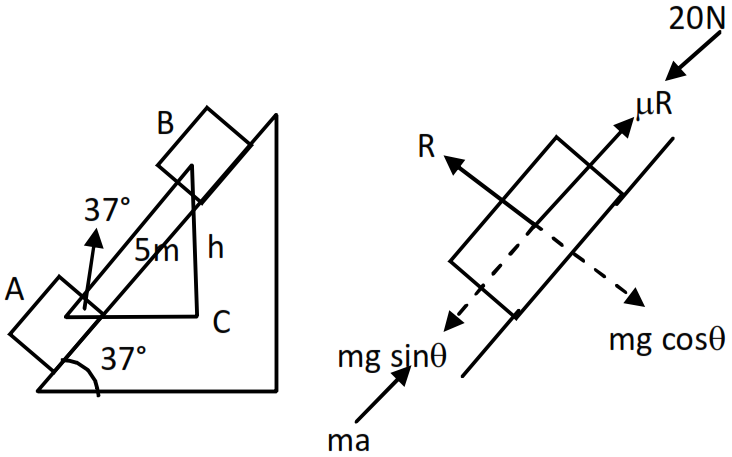
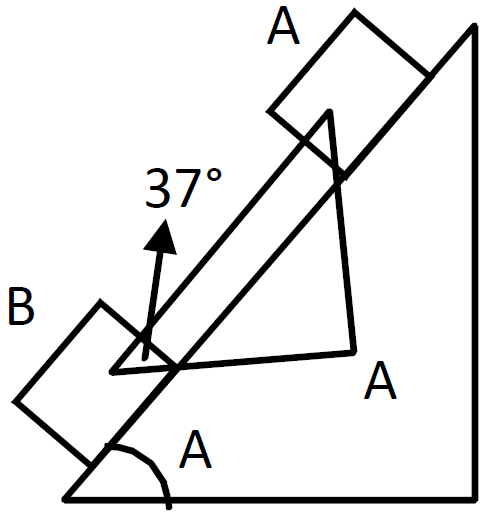
A block of mass 2.0kg is pushed down an inclined plane of inclination 37° with a force of 20N acting parallel to the incline. It is found that the block moves on the incline with an acceleration of $10m/s^2.$ If the block started from rest, find the work done.
  1. By the applied force in the first second.
  2. By the weight of the block in the first second.
  3. By the frictional force acting on the block in the first second. Take $g = 10m/s^2.$
Answer
$\text{m}=2\text{kg},\ \theta=37^\circ,\ \text{F}=20\text{N},\ \text{a}=10\text{m}/\text{sec}^2$
  1. $\text{t}=1\text{sec}$
So, $\text{s}=\text{ut}+\frac{1}{2}\text{at}^2=5\text{m}$
Work done by the applied force $\text{w} = \text{FS}\cos 0^\circ = 20 \times 5 = 100 \text{J}$
  1. $BC (h) = 5$ sin $37° = 3m$
So, work done by the weight $W = mgh = 2 × 10 × 3 = 60J$
  1. So, frictional force $\text{f}=\text{mg}\sin\theta$
work done by the frictional forces $\text{w} = \text{FS}\cos 0^\circ=(\text{mg}\sin\theta)\ \text{s} $
$= 20 \times0.60\times 5 = 60 \text{J}$
View full question & answer
Question 105 Marks
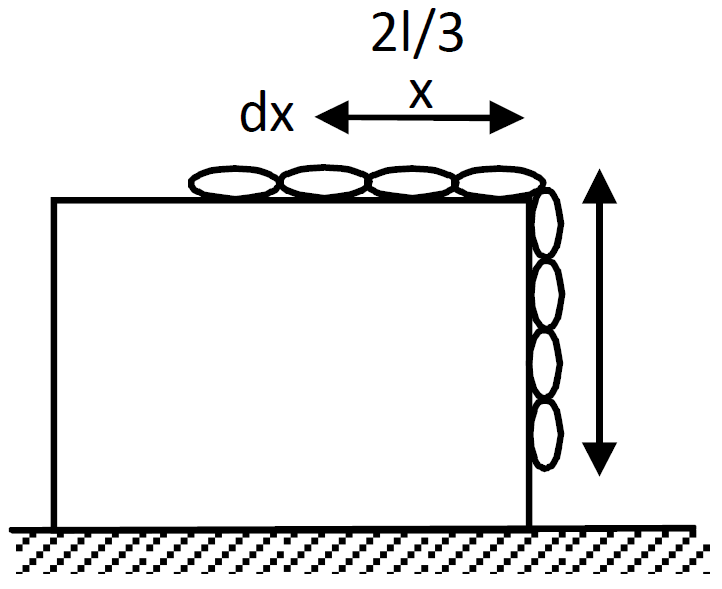
A uniform chain of length L and mass M overhangs a horizontal table with its two third part on the table. The friction coefficient between the table and the chain is $\mu.$ Find the work done by the friction during the period the chain slips off the table.
Answer

Let, x length of chain is on the table at a particular instant.
So, work done by frictional force on a small element ‘dx’.
$\text{dW}_\text{f}=\mu\text{Rx}=\mu\Big(\frac{\text{M}}{\text{L}}\text{dx}\Big)\text{gx}$ $[$ where $\text{dx}=\frac{\text{M}}{\text{L}}\text{dx}]$
Total work don by friction,
$\text{W}_\text{f}=\int\limits_\frac{2\text{L}}{3}^0\mu\frac{\text{M}}{\text{L}}\text{gx dx}$
$\therefore\ \text{W}_\text{f}=\mu\frac{\text{M}}{\text{L}}\text{g}\Big[\frac{\text{x}^2}{2}\Big]_\frac{2\text{L}}{3}^0$
$=\mu\frac{\text{M}}{\text{L}}\Big[\frac{4\text{L}^2}{18}\Big]$
$=2\mu\text{Mg}\frac{\text{L}}{9}$
View full question & answer
Question 115 Marks
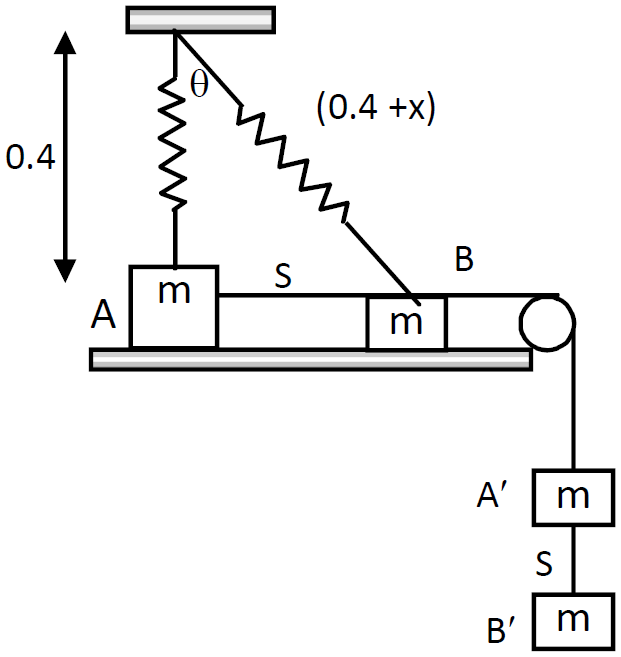
Figure shows two blocks A and B, each having a mass of 320g connected by a light string passing over a smooth light pulley. The horizontal surface on which the block A can slide is smooth. The block A is attached to a spring of spring constant 40N/m whose other end is fixed to a support 40cm above the horizontal surface. Initially, the spring is vertical and unstretched when the system is released to move. Find the velocity of the block A at the instant it breaks off the surface below it. Take $g = 10m/s^2.$
Answer
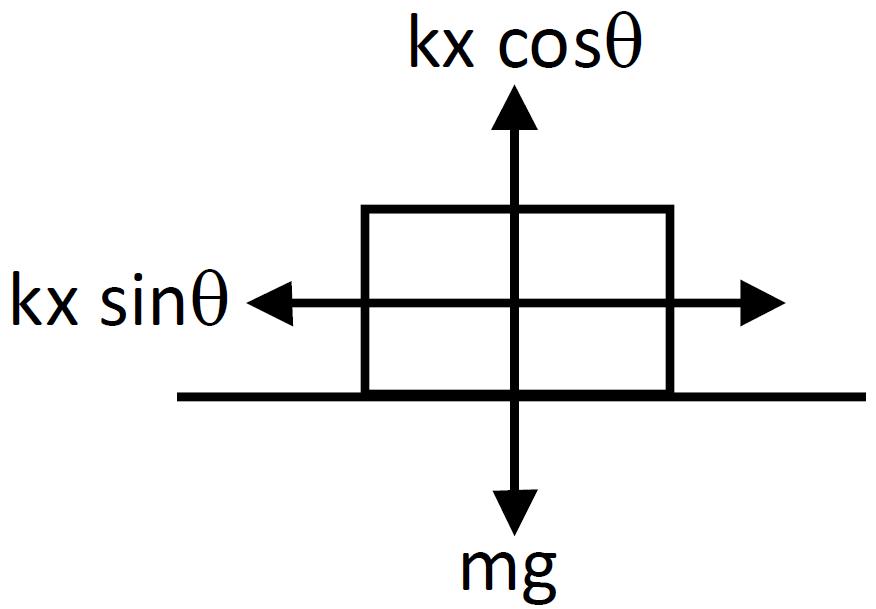
$m = 320g = 0.32kg,\ k = 40N/m\ h = 40cm = 0.4m,\ g = 10 m/s^2$ From the free body diagram,

$\text{kx}\cos\theta=\text{mg}$
(when the block breaks off R = 0)$\Rightarrow\cos\theta=\frac{\text{mg}}{\text{kx}}$
So, $\frac{0.4}{0.4+\text{x}}=\frac{3.2}{40+\text{x}}$$\Rightarrow16\text{x}=3.2\text{x}+1.28$
$\Rightarrow\text{x}=0.1\text{m}$
So, $\text{s}=\text{AB}$$\Rightarrow\sqrt{(\text{h}+\text{x})^2-\text{h}^2}$
$\Rightarrow\sqrt{(0.5)^2-(0.4)^2}=0.3\text{m}$
Let the velocity of the body at B be v, Charge in K.E. = work done (for the system)$\Big(\frac{1}{2}\text{mv}^2+\frac{1}{2}\text{mv}^2\Big)=\frac{-1}{2}\text{kx}^2+\text{mgs}$
$\Rightarrow(0.32)\times\text{v}^2=-\Big(\frac{1}{2}\Big)\times40\times(0.1)^2+0.32\times10\times(0.3)$
$\Rightarrow\text{v}=1.5\text{m}/\text{sec}$
View full question & answer
Question 125 Marks
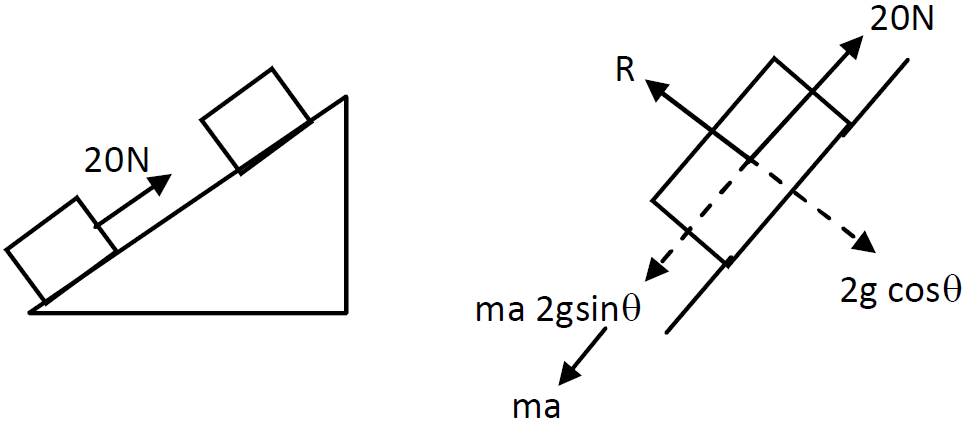
A block of mass 2.0kg kept at rest on an inclined plane of inclination 37° is pulled up the plane by applying a constant force of 20N parallel to the incline. The force acts for one second.
  1. Show that the work done by the applied force does not exceed 40J.
  2. Find the work done by the force of gravity in that one second if the work done by the applied force is 40J.
  3. Find the kinetic energy of the block at the instant the force ceases to act. Take $g = 10m/s^2.$
Answer
  1. $\text{m}=2\text{kg},\ \theta=37^\circ,\ \text{F}=20\text{N}$
From the free body diagram

$\text{F}=(2\text{g}\sin\theta)+\text{ma}$
$\Rightarrow\text{a}=(20-20\sin\theta)/\text{s}=4\text{m}/\text{sec}^2$
$\text{S}=\text{ut}+\frac{1}{2}\text{at}^2$ $(\text{u}=0,\text{t}=1\text{s},\text{a}=1.66)$
$=2\text{m}$
So, work, done W = Fs = 20 × 2 = 40J
  1. If W = 40J
$\text{S}=\frac{\text{W}}{\text{F}}=\frac{40}{20}$
h = 2 sin 37° = 1.2m
So, work done W = -mgh = -20 × 1.2 = -24J
  1. v = u + at = 4 × 10 = 40 m/sec
So, K.E. $=\frac{1}{2}\text{mv}^2=\frac{1}{2}\times2\times16=16\text{J}$
View full question & answer
Question 135 Marks
A block of weight 100N is slowly slid up on a smooth incline of inclination 37° by a person. Calculate the work done by the person in moving the block through a distance of 2.0m, if the driving force is:
  1. Parallel to the incline.
  2. In the horizontal direction.
Answer
$\text{W}=100\text{N},\theta=37^\circ,\text{S}=2\text{m}$`
  1. $\text{F}=\text{mg}\sin37^\circ=100\times0.60=60\text{N}$
So, work done, when the force is parallel to incline.
$\text{W}=\text{FS}\cos\theta=60\times2\times\cos\theta=120\text{J}$
  1. In $\triangle\text{ABC }\text{AB}=2\text{m}$
CB = 37°
So, h = C = 1m
$\therefore$ Work done when the force in horizontal direction.
W = mgh = 100 × 1.2 = 120J
View full question & answer
Question 145 Marks
A scooter company gives the following specifications about its product.
  • Weight of the scooter - 95kg.
  • Maximum speed - 60km/h.
  • Maximum engine power - 3.5hp.
  • Pick up time to get the maximum speed - 5s.
  • Check the validity of these specifications.
Answer
The specification given by the company are: $U = 0, m = 95$kg, $P_m = 3.5hp$
$\text{V}_\text{m}=60\text{km}/\text{h}=\frac{50}{3}\text{m}/\text{sec},\text{t}_\text{m}=5\text{sec}$
So, the maximum acceleration that can be produced is given by,$\text{a}=\frac{\Big(\frac{50}{3}\Big)-0}{5}=\frac{10}{3}$
So, the driving force is given by$\text{F}=\text{ma}=95\times\frac{10}{3}=\frac{950}{3}\text{N}$
So, the velocity that can be attained by maximum h.p. white supplying $\frac{950}{3}$ will be$\text{v}=\frac{\text{p}}{\text{F}}\Rightarrow\text{v}=\frac{3.5\times746\times5}{950}=8.2\text{m}/\text{sec}$
Because, the scooter can reach a maximum of 8.s m/sec while producing a force of $\frac{950}{3}\text{N},$ the specifications given are some what over claimed.
View full question & answer
Question 155 Marks
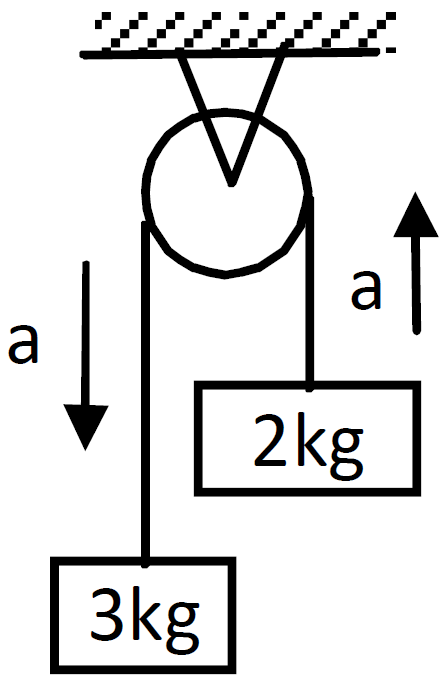
The two blocks in an Atwood machine have masses 2.0kg and 3.0kg. Find the work done by gravity during the fourth second after the system is released from rest.
Answer
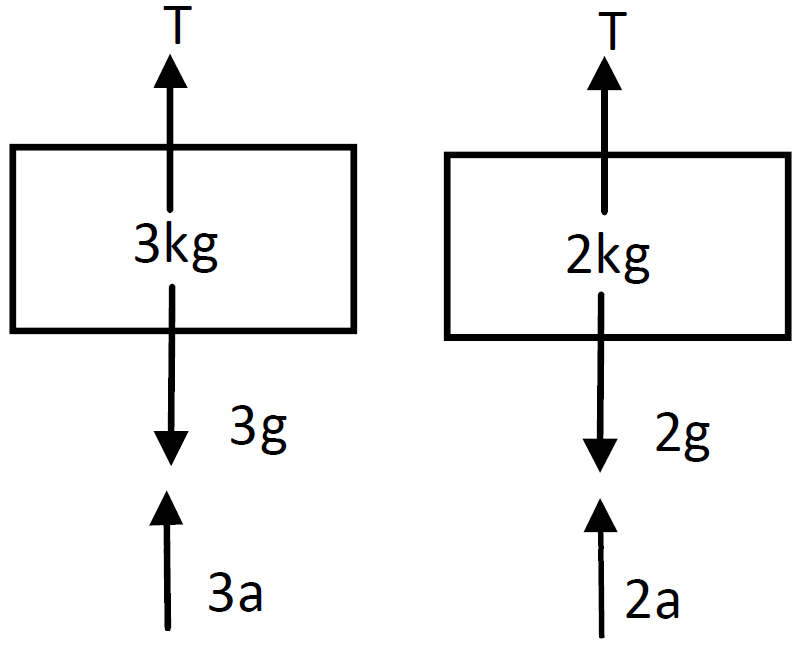
Given, $m_1 = 3 $kg, $m_2 = 2$kg, t = during $4^{th}$ second From the freebody diagram,


$T - 3g + 3a = 0 ...(i) $
$T - 2g - 2a = 0 ...(ii)$
Equation (i) & (ii), we get $3g – 3a = 2g + 2a$
$\Rightarrow\text{a}=\frac{\text{g}}{5}\text{m}/\text{sec}^2$
Distance travelled in $4^{th}$ sec is given by,$\text{S}_{4\text{th}}=\frac{\text{a}}{2}(2\text{n}-1)$
$=\frac{\Big(\frac{\text{g}}{5}\Big)}{\text{S}}(2\times4-1)$
$=\frac{7\text{g}}{10}=\frac{7\times9.8}{10}\text{m}$
Net mass ‘$m’ = m_1 - m_2 = 3 - 2 = 1kg$
So, decrease in P.E. = mgh $=1\times9.8\times\frac{7}{10}\times9.8$$=67.2=67\text{J}$
View full question & answer
Question 165 Marks
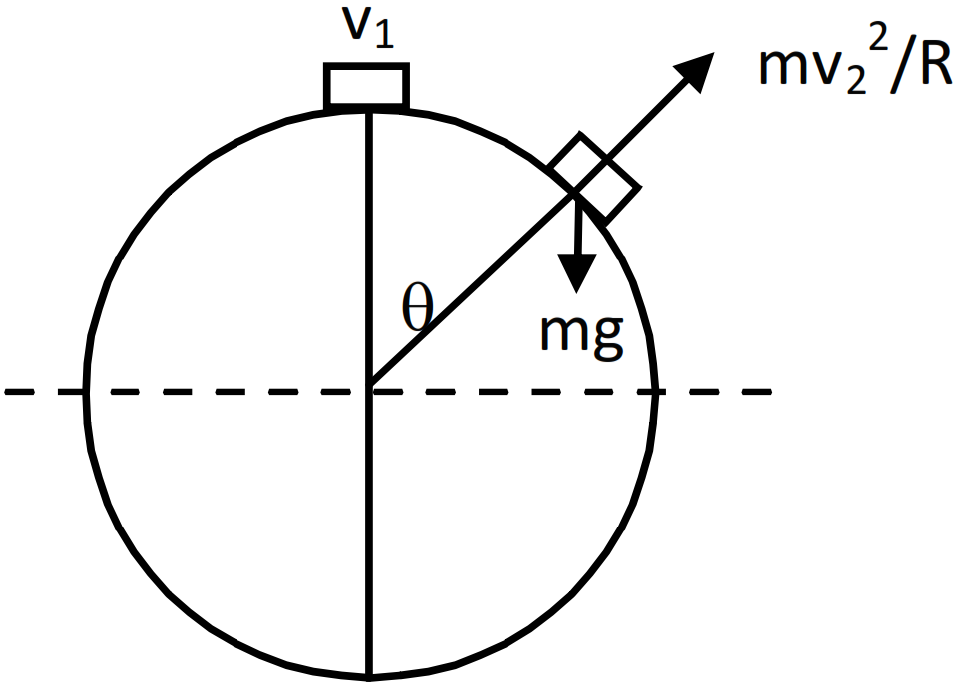
A particle of mass m is kept on the top of a smooth sphere of radius R. It is given a sharp impulse which imparts it a horizontal speed v.
  1. Find the normal force between the sphere and the particle just after the impulse.
  2. What should be the minimum value of v for which the particle does not slip on the sphere?
  3. Assuming the velocity v to be half the minimum calculated in part.
  4. Find the angle made by the radius through the particle with the vertical when it leaves the sphere.
Answer


  1. Radius =R
horizontal speed = v
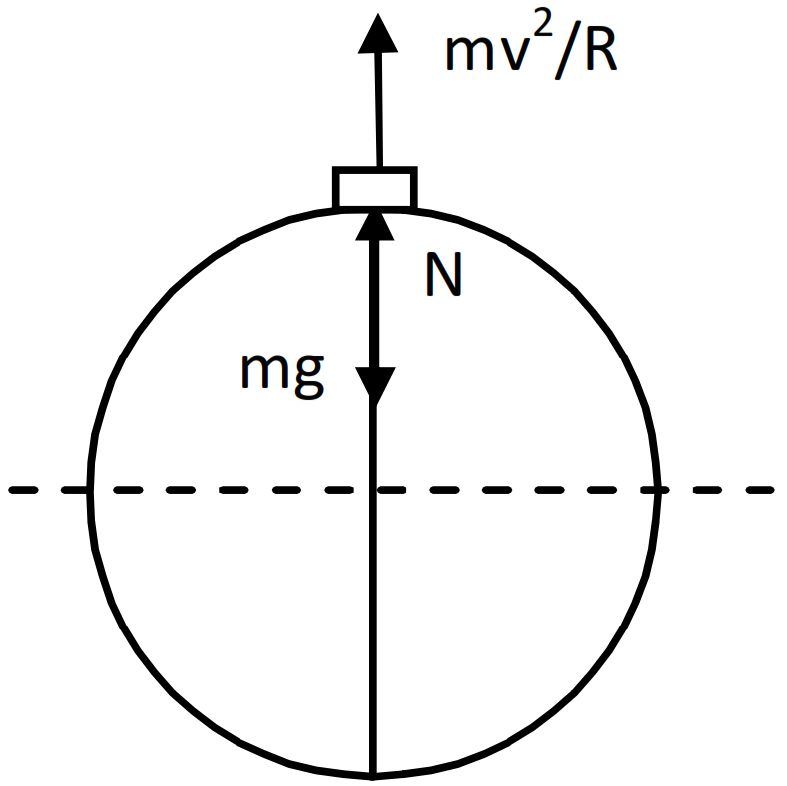
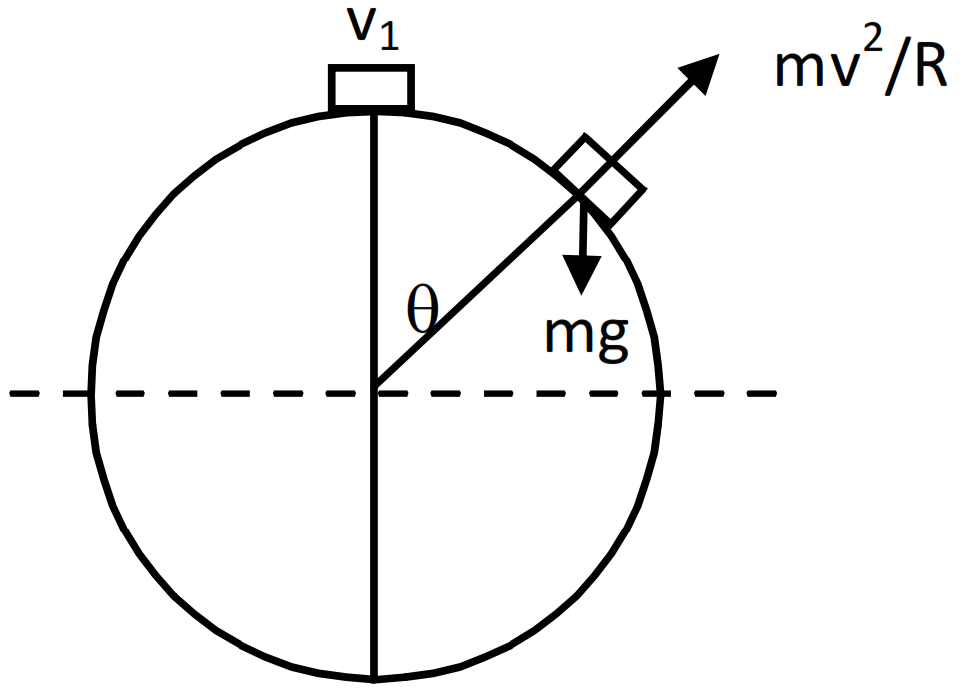
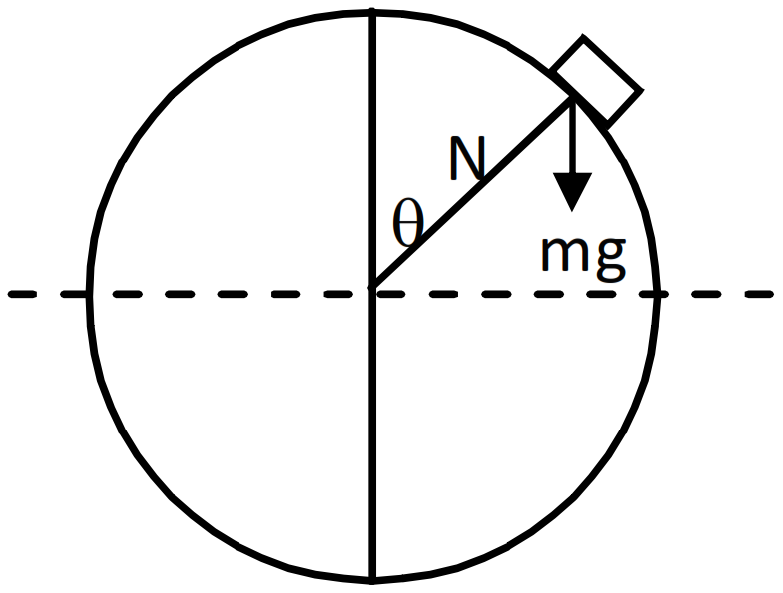
From the free body diagram, (fig)
N = Normal force $=\text{mg}-\frac{\text{mv}^2}{\text{R}}$
  1. When the particle is given maximum velocity so that the centrifugal force balances the weight, the particle does not slip on the sphere.
$\frac{\text{mv}^2}{\text{R}}=\text{mg}$
$\Rightarrow\text{v}=\sqrt{\text{gR}}$
  1. If the body is given velocity $v_1$
$\text{v}_1=\frac{\sqrt{\text{gR}}}{2}$
$\text{v}_1^2-\frac{\text{gR}}{4}$
Let the velocity be $v_2 $ when it leaves contact with the surface, (fig)
So, $\frac{\text{mv}^2}{\text{R}}=\text{mg}\cos\theta$
$\Rightarrow\text{v}_2^2=\text{Rg}\cos\theta\ \dots(1)$
Again, $\frac{1}{2}\text{mv}_2^2-\frac{1}{2}\text{mv}_1^2=\text{mgR}(1-\cos\theta)$
$\Rightarrow\text{v}_2^2=\text{v}_1^2+2\text{gR}(1-\cos\theta)\ \dots(2)$
From equn. (1) and equn (2),
$\text{Rg}\cos\theta=\Big(\frac{\text{Rg}}{4}\Big)+2\text{gR}(1-\cos\theta)$
$\Rightarrow\cos\theta=\Big(\frac{1}{4}\Big)+2-2\cos\theta$
$\Rightarrow3\cos\theta=\frac{9}{4}$
$\Rightarrow\cos\theta=\frac{3}{4}$
$\Rightarrow\theta=\cos^{-1}\Big(\frac{3}{4}\Big)$
View full question & answer
Question 175 Marks
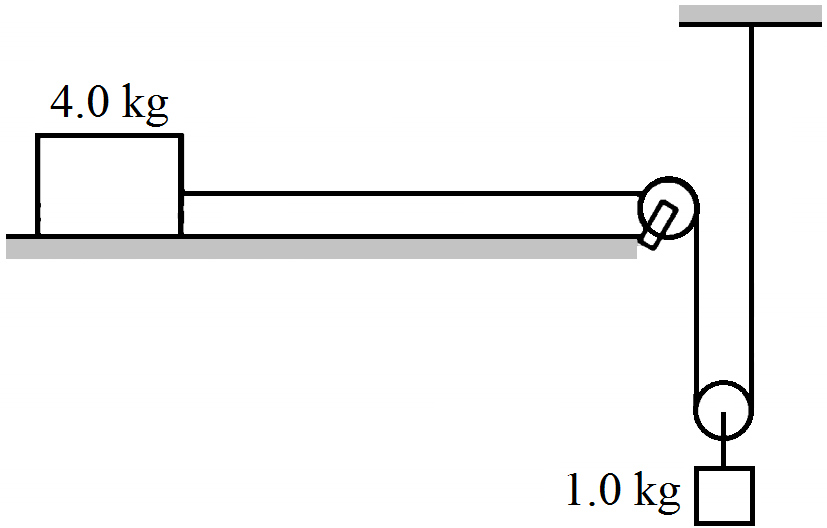
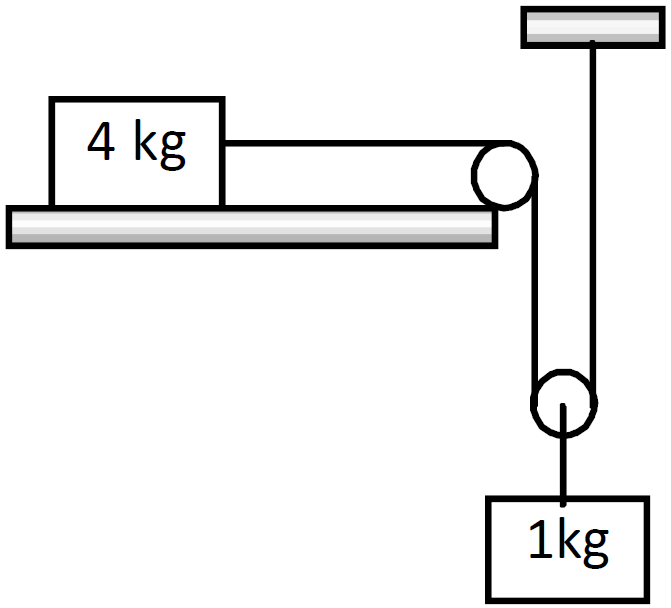
Consider the situation shown in figure. The system is released from rest and the block of mass 1.0kg is found to have a speed 0.3m/s after it has descended through a distance of 1m. Find the coefficient of kinetic friction between the block and the table.
Answer


$m_1 = 4$kg, $m_2 = 1$kg, $V_2 = 0.3$m/sec $V_1 = 2 \times (0.3) = 0.6$ m/sec
$(v_1 = 2v_2$ in this system$)h = 1m = $height descent by 1kg block
$s = 2 \times 1 = 2m$ distance travelled by 4kg block
$u = 0$
Applying change in K.E. = work done (for the system)
$\Big[\Big(\frac{1}{2}\Big)\text{m}_1\text{v}_1^2+\Big(\frac{1}{2}\Big)\text{m}_2\text{v}_2^2\Big]-0=(-\mu\text{R})\text{S}+\text{m}_2\text{gh}$ $[\text{R} = 4\text{g} = 40\text{N}]$
$\Rightarrow\frac{1}{2}\times4\times(0.36)\times\frac{1}{2}\times1\times(0.09)$
$=-\mu\times40\times2+1\times40\times1$
$\Rightarrow0.72+0.045=-80\mu+10$
$\Rightarrow\mu=\frac{9.235}{80}=0.12$
View full question & answer
Question 185 Marks
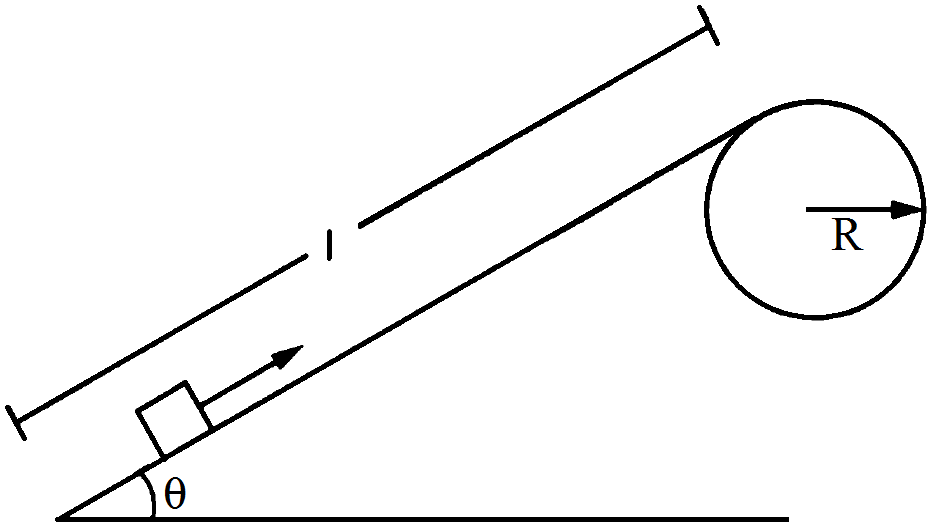
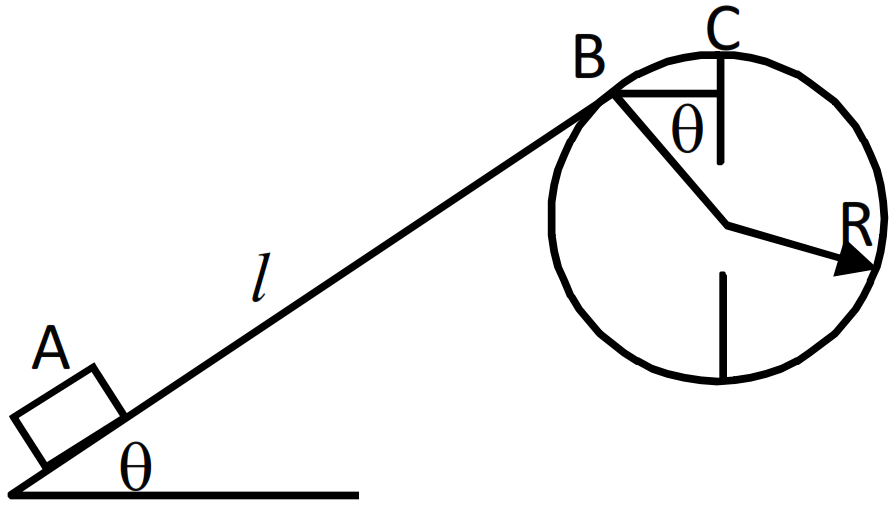
Figure shows a smooth track which consists of a straight inclined part of length 1 joining smoothly with the circular part. A particle of mass m is projected up the incline from its bottom.
  1. Find the minimum projection-speed $v_0$, for which the particle reaches the top of the track.
  2. Assuming that the projection-speed is $2v_0 $ and that the block does not lose contact with the track before reaching its top, find the force acting on it when it reaches the top.
  3. Assuming that the projection-speed is only slightly greater than $v_0$, where will the block lose contact with the track?
Answer


  1. Net force on the particle between A & B, F $=\text{mg}\sin\theta$
work done to reach B, W = FS $=\text{mg}\sin\theta\ell$
Again, work done to reach B to C = mgh $=\text{mgR}(1-\cos\theta)$
So, Total workdone $=\text{mg}[\ell\sin\theta+\text{R}(1-\cos\theta)]$
Now, change in K.E. = work done
$\Rightarrow\frac{1}{2}\text{mv}_0^2=\text{mg}[\ell\sin\theta+\text{R}(1-\cos\theta)]$
$\Rightarrow\text{v}_0=\sqrt{2\text{g}[\ell\sin\theta+\text{R}(1-\cos\theta)]}$
  1. When the block is projected at a speed $2v_0.$
Let the velocity at C will be $V_c.$
Applying energy principle,
$\Rightarrow\frac{1}{2}\text{mv}_\text{c}^2-\frac{1}{2}\text{m}(2\text{v}_0)^2=-\text{mg}[\ell\sin\theta+\text{R}(1-\cos\theta)]$
$\Rightarrow\text{v}_\text{c}^2=4\text{v}_0-2\text{g}[\ell\sin\theta+\text{R}(1-\cos\theta)]$
$\Rightarrow4.2\text{g}[\ell\sin\theta+\text{R}(1-\cos\theta)]-2\text{g}[\ell\sin\theta+\text{R}(1-\cos\theta)]$
$\Rightarrow6\text{g}[\ell\sin\theta+\text{R}(1-\cos\theta)]$
So, force acting on the body,
$\Rightarrow\text{N}=\frac{\text{mv}_\text{c}^2}{\text{R}}=6\text{mg}\Big[\Big(\frac{\ell}{\text{R}}\Big)\sin\theta+1-\cos\theta\Big]$
  1. Let the block loose contact after making an angle $\theta$
$\frac{\text{mv}^2}{\text{R}}=\text{mg}\cos\theta$
$\Rightarrow\text{v}^2={\text{R}}\text{g}\cos\theta\ \dots(1)$
Again, $\frac{1}{2}\text{mv}^2=\text{mg}(\text{R}-\text{R}\cos\theta)$
$\Rightarrow\text{v}^2=2\text{gR}(1-\cos\theta)\ \dots(2)$
From (1) and (2),
$\cos\theta=\frac{2}{3}$
$\Rightarrow\theta=\cos^{-1}\Big(\frac{2}{3}\Big)$
View full question & answer
Question 195 Marks
The bob of a pendulum at rest is given a sharp hit to impart a horizontal velocity $\sqrt{10\text{gl}},$ where l is the length of the pendulum. Find the tension in the string when,
  1. The string is horizontal.
  2. The bob is at its highest point.
  3. The string makes an angle of 60° with the upward vertical.
Answer
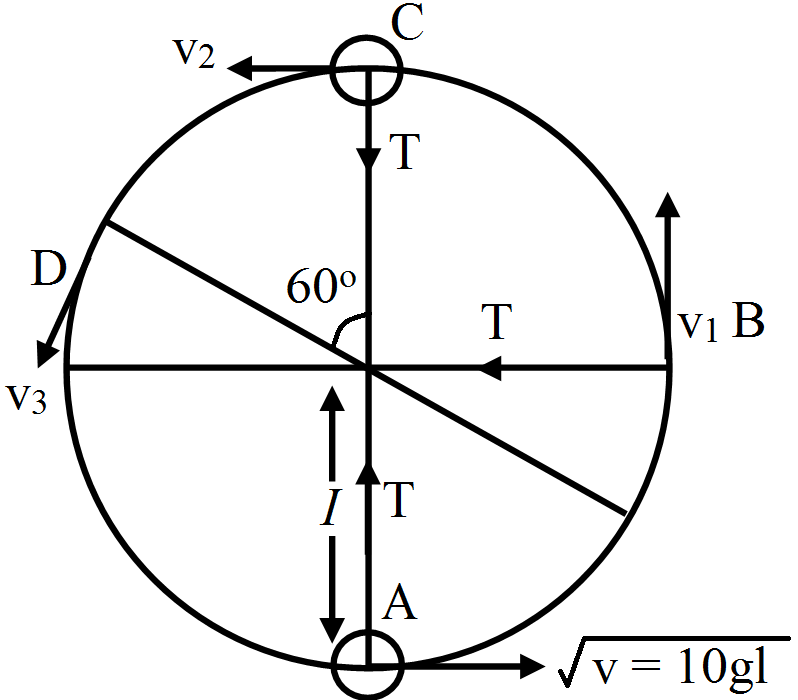
let the velocity at B be $v_1\frac{1}{2}\text{mv}^2=\frac{1}{2}\text{mv}_1^2+\text{mgl}$
$\Rightarrow\frac{1}{2}\text{m}(10\text{gl})=\frac{1}{2}\text{mv}_1^2+\text{mgl}$
$\text{v}_1^2=8\text{gl}$

So, the tension in the string at the horizontal position,$\text{T}=\frac{\text{mv}^2}{\text{R}}=\text{m}\frac{8 \text{gl}}{1}$
$=8\text{mg}$
Let the velocity at C be v_2$\frac{1}{2}\text{mv}^2=\frac{1}{2}\text{mv}^2_2+\text{mg}(2\text{l})$
$\Rightarrow\frac{1}{2}\text{m }10\text{gl}=\frac{1}{2}\text{mv}_2^2+2\text{mgl}$
$\Rightarrow\text{v}_2^2=6\text{gl}$
So, the tension in the string is given by,$$$\text{T}_\text{C}=\frac{\text{mv}_2^2}{1}-\text{mg}=5\text{mg}$
Let the velocity at point D be $ν_4$ Again,$\frac{1}{2}\text{mv}^2=\frac{1}{2}\text{mv}_3^2+\text{mgl}(1+\cos60^\circ)$
$\Rightarrow\text{v}_3^2=7\text{gl}$
So, the tension in the string$\text{T}_\text{D}=\frac{\text{mv}_3^2}{1}-\text{mg}\cos60^\circ$
$\text{m}\frac{(7\text{gl})}{1}-0.5\text{mg}$
$=7\text{mg}-0.5\text{mg}$
$=6.5\text{mg}$
View full question & answer
Question 205 Marks
A particle slides on the surface of a fixed smooth sphere starting from the topmost point. Find the angle rotated by the radius through the particle, when it leaves contact with the sphere.
Answer
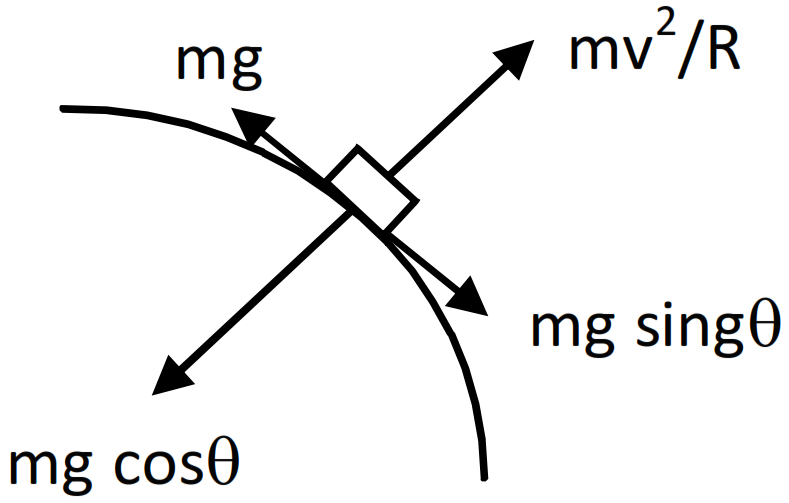
Let the velocity be v when the body leaves the surface. From the freebody diagram,

$\frac{\text{mv}^2}{\text{R}}=\text{mg}\cos\theta$ [Because normal reaction]
$\text{v}^2=\text{Rg}\cos\theta\ \dots(1)$
Again, form work-energy principle, Change in K.E. = Work done$\Rightarrow\frac{1}{2}\text{mv}^2-0=\text{mg}(\text{R}-\text{R}\cos\theta)$
$\Rightarrow\text{v}^2=2\text{gR}(1-\cos\theta)\ \dots(2)$
From (1) and (2),$\Rightarrow\text{Rg}\cos\theta=2\text{gR}(1-\cos\theta)$
$\Rightarrow3\text{gR}\cos\theta=2\text{gR}$
$\Rightarrow\cos\theta=\frac{2}{3}$
$\Rightarrow\theta=\cos^{-1}\Big(\frac{2}{3}\Big)$
View full question & answer
Question 215 Marks
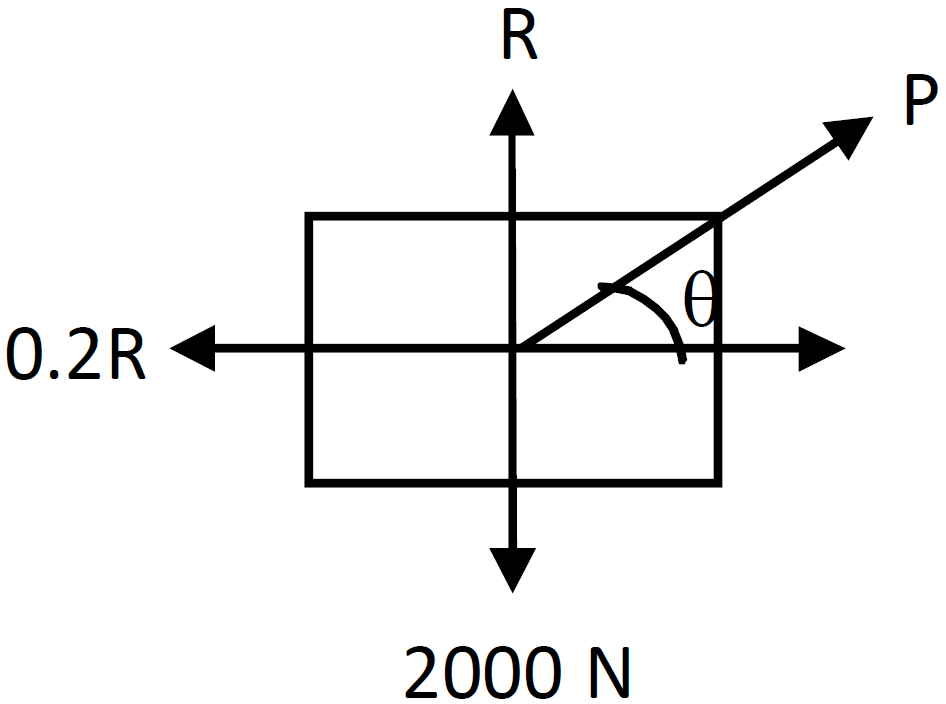
A box weighing 2000N is to be slowly slid through 20m on a straight track having friction coefficient 0.2 with the box.
  1. Find the work done by the person pulling the box with a chain at an angle $\theta $ with the horizontal.
  2. Find the work when the person has chosen a value of $\theta $ which ensures him the minimum magnitude of the force.
Answer
$\text{W}=2000\text{N},\text{S}=20\text{m},\mu=0.2$`
  1. $\text{R}+\text{P}\sin\theta-2000=0\ \dots(1)$
$\text{P}\cos\theta-0.2\text{R}=0\ \dots(2)$
From (1) and (2),
$\text{P}\cos\theta-0.2(2000-\text{P}\sin\theta)=0$
$\text{P}=\frac{400}{\cos\theta-0.2\sin\theta}\ \dots(3)$
So, work done by the person,
$\text{W}=\text{PS}\cos\theta=\frac{8000\cos\theta}{\cos\theta+0.2\sin\theta}$
$=\frac{8000}{1+0.2\sin\theta}=\frac{40000}{5+\tan\theta}$
  1. For minimum magnitude of force from equn(1),
$\frac{\text{d}}{\text{d}\theta}(\cos\theta+0.2\sin\theta)=0$
$\Rightarrow\tan\theta=0.2$
putting the value in equn (3),
$\text{W}=\frac{40000}{5+\tan\theta}$
$=\frac{40000}{5.2}\approx7690\text{J}$
View full question & answer
Question 225 Marks
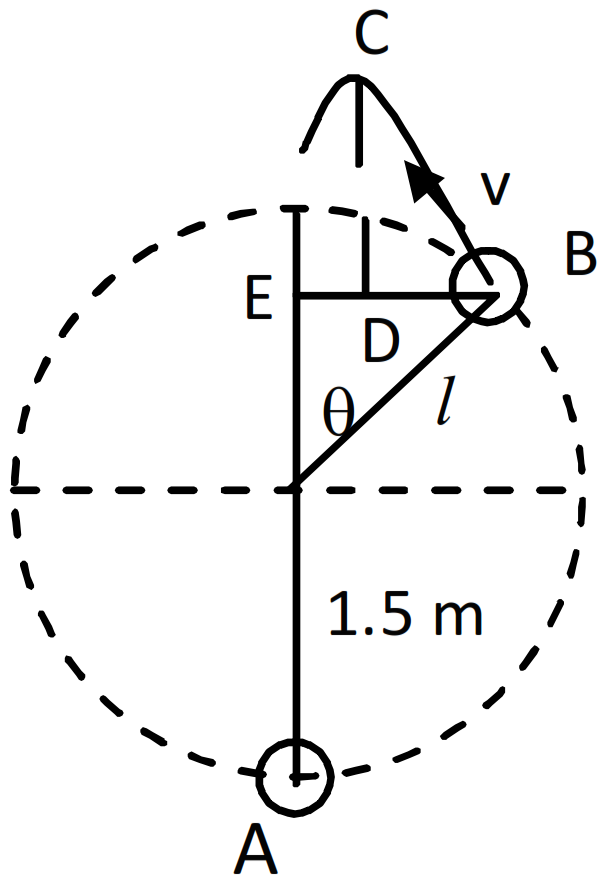
A heavy particle is suspended by a 1.5m long string. It is given a horizontal velocity of $\sqrt{57}\text{m/s}.$
  1. Find the angle made by the string with the upward vertical, when it becomes slack.
  2. Find the speed of the particle at this instant.
  3. Find the maximum height reached by the particle over the point of suspension. Take $g = 10m/s^2.$
Answer
$\text{l}=1.5\text{m},\ \text{u}=\sqrt{57}\text{m}/\text{sec}$
  1.  


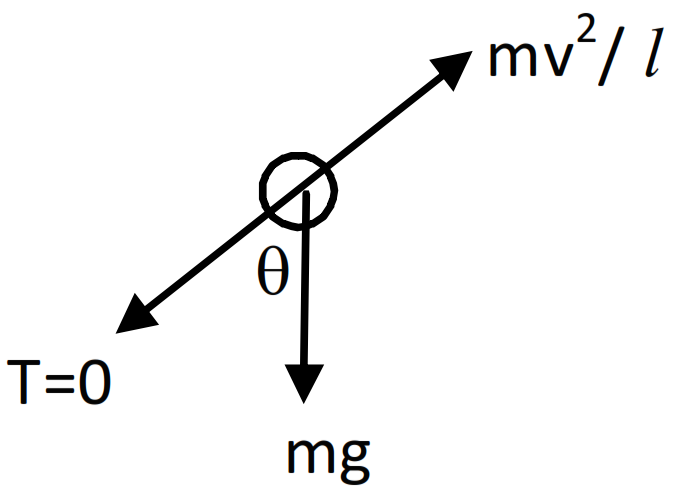
$\text{mg}\cos\theta=\frac{\text{mv}^2}{\text{l}}$
$\text{v}^2=\text{lg}\cos\theta\ \dots(1)$
Change in K.E. = Work done
$\frac{1}{2}\text{mv}^2-\frac{1}{2}\text{mu}^2=\text{mgh}$
$\Rightarrow\text{v}^2-57=-2\times1.5\text{g}(1+\cos\theta)\ \dots(2)$
$\Rightarrow\text{v}^2=57-3\text{g}(1+\cos\theta)$
Putting the value of v from equation (1),
$\Rightarrow15\cos\theta=57-30(1+\cos\theta)$
$\Rightarrow15\cos\theta=57-30-30\cos\theta$
$\Rightarrow45\cos\theta=27$
$\Rightarrow\cos\theta=\frac{3}{5}$
$\Rightarrow\theta=\cos^{-1}\Big(\frac{3}{5}\Big)=53^\circ$
  1. $\text{v}=\sqrt{57-3\text{g}(1+\cos\theta)}$ [from equation (2)]
$\Rightarrow\sqrt9=3\text{m}/\text{sec}$
  1. As the string becomes slack at point B, the particle will start making projectile motion.
$\text{H}=\text{OE}+\text{DC}=1.5\cos\theta+\frac{\text{u}^2\sin^2\theta}{2\text{g}}$
$\Rightarrow(1.5)\times\Big(\frac{3}{5}\Big)+\frac{9\times(0.8)^2}{2\times10}=1.2\text{m}$
View full question & answer
Question 235 Marks
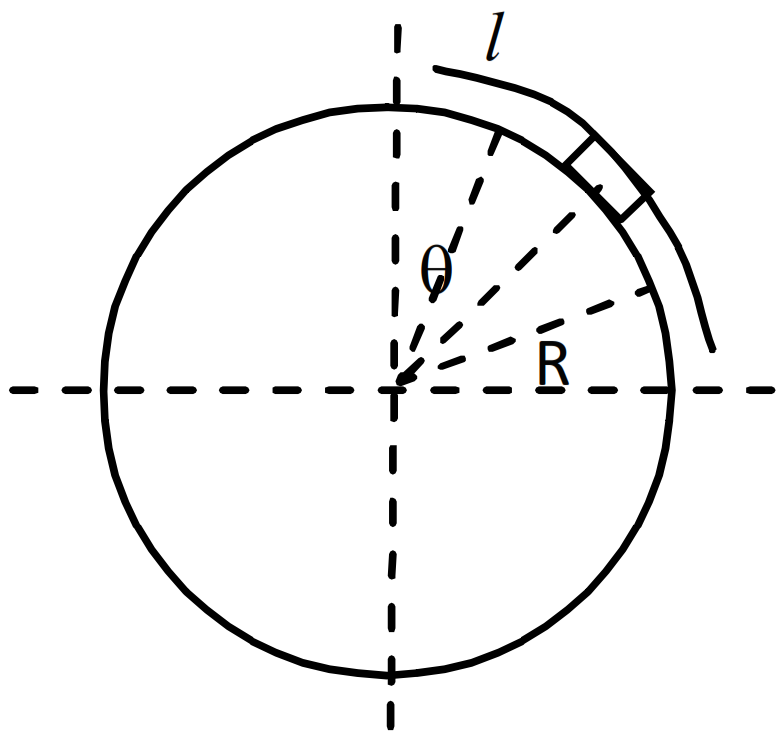
A chain of length l and mass m lies on the surface of a smooth sphere of radius R>1 with one end tied to the top of the sphere.
  1. Find the gravitational potential energy of the chain with reference level at the centre of the sphere.
  2. Suppose the chain is released and slides down the sphere. Find the kinetic energy of the chain, when it has slid through an angle $\theta.$
  3. Find the tangential acceleration $\frac{\text{dv}}{\text{dt}}$ of the chain when the chain starts sliding down.
Answer

Let us consider a small element which makes angle $'\text{d}\theta'$ at the centre.
$\therefore\ \text{dm}=\Big(\frac{\text{m}}{\ell}\Big)\text{Rd}\theta$
  1. Gravitational potential energy of ‘dm’ with respect to centre of the sphere,
$=(\text{dm})\text{gR}\cos\theta$
$=\Big(\frac{\text{mg}}{\ell}\Big)\text{R}\cos\theta\text{d}\theta$
So, Total G.P.E. $=\int\limits_0^\frac{\ell}{\text{r}}\frac{\text{mgR}^2}{\ell}\cos\theta\text{d}\theta$ $\Big[\alpha=\Big(\frac{\ell}{\text{R}}\Big)\Big]$(angle subtended by the chain at the centre)
$=\frac{\text{mR}^2\text{g}}{\ell}[\sin\theta]\Big(\frac{\ell}{\text{R}}\Big)$
$=\frac{\text{mR}\text{g}}{\ell}\sin\theta\Big(\frac{\ell}{\text{R}}\Big)$
  1. When the chain is released from rest and slides down through an angle $\theta,$ the K.E. of the chain is given,
K.E. = Change in potential energy.
$=\frac{\text{mR}^2\text{g}}{\ell}\sin\Big(\frac{\ell}{\text{R}}\Big)-\text{m}\int\frac{\text{gR}^2}{\ell}\cos\theta\text{d}\theta​​$
$=\frac{\text{mR}^2\text{g}}{\ell}\Big[\sin\Big(\frac{\ell}{\text{R}}\Big)+\sin\theta-\sin\Big\{\theta+\Big(\frac{\ell}{\text{R}}\Big)\Big\}\Big]$
  1. Since, K.E. $=\frac{1}{2}\text{mv}^2=\frac{\text{mR}^2\text{g}}{\ell}\Big[\sin\Big(\frac{\ell}{\text{R}}\Big)+\sin\theta-\sin\theta\Big\{\theta+\Big(\frac{\ell}{\text{R}}\Big)\Big\}\Big]$
Taking derivative of both sides with respect to ‘t’
$\Big(\frac{1}{2}\Big)\times2\text{v}\times\frac{\text{dv}}{\text{dt}}$
$=\frac{\text{R}^2\text{g}}{\ell}\Big[\cos\theta-\cos\Big(\theta+\Big(\frac{\ell}{\text{R}}\Big)\Big)\Big]$
$\therefore\ \Big(\text{R}\frac{\text{d}\theta}{\text{dt}}\Big)\frac{\text{dv}}{\text{dt}}$
$=\frac{\text{R}^2\text{g}}{\ell}\times\frac{\text{d}\theta}{\text{dt}}\Big[\cos\theta-\cos\Big(\theta+\Big(\frac{\ell}{\text{R}}\Big)\Big)\Big]$
When the chain starts sliding down, $\theta=0.$
So, $\frac{\text{dv}}{\text{dt}}=\frac{\text{Rg}}{\ell}\Big[1-\cos\Big(\frac{\ell}{\text{R}}\Big)\Big]$
View full question & answer
Question 245 Marks
A particle of mass m is kept on a fixed, smooth sphere of radius R at a position, where the radius through the particle makes an angle of 30° with the vertical. The particle is released from this position.
  1. What is the force exerted by the sphere on the particle just after the release?
  2. Find the distance travelled by the particle before it leaves contact with the sphere.
Answer
  1.  


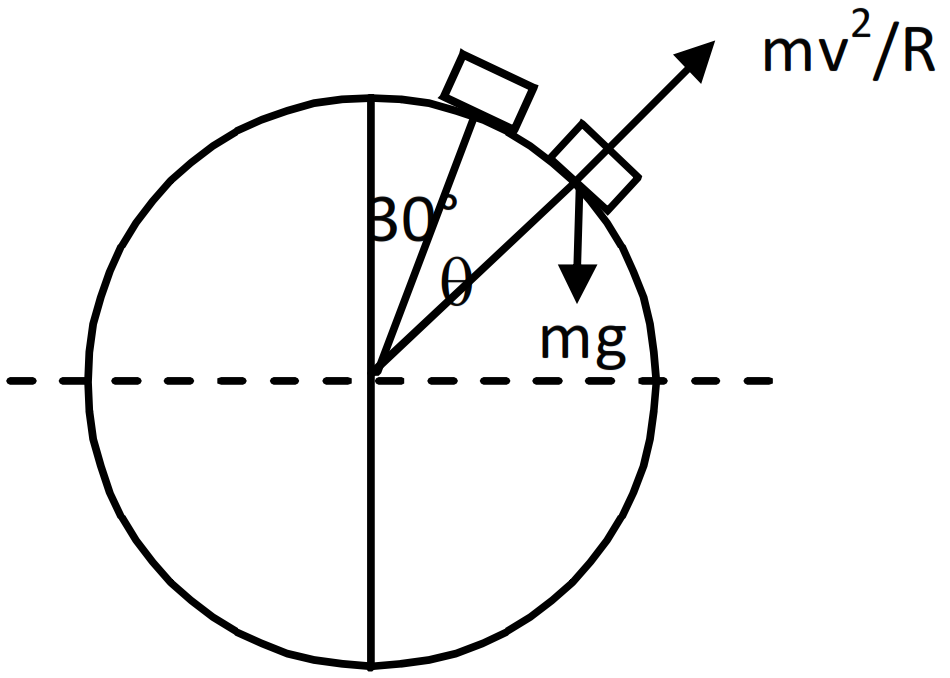
When the particle is released from rest (fig), the centrifugal force is zero. N force is zero $=\text{mg}\cos\theta$

$=\text{mg}\cos30^\circ=\frac{\sqrt3\text{mg}}{2}$
  1.  


When the particle leaves contact with the surface (fig), N = 0.

So, $\frac{\text{mv}^2}{\text{R}}\text{mg}\cos\theta$

$\Rightarrow\text{v}^2=\text{Rg}\cos\theta\ \dots(1)$

Again, $\frac{1}{2}\text{mv}^2=\text{mgR}(\cos30^\circ-\cos\theta)$

$\Rightarrow\text{v}^2=2\text{Rg}\Big(\frac{\sqrt3}{2}-\cos\theta\Big)\ \dots(2)$

From equn. (1) and equn. (2),

$\text{Rg}\cos\theta=\sqrt3\text{Rg}-2\text{Rg}\cos\theta$

$\Rightarrow3\cos\theta=\sqrt3$

$\Rightarrow\cos\theta=\frac{1}{\sqrt3}$

$\Rightarrow\theta=\cos^{-1}\frac{1}{\sqrt3}$

So, the distance travelled by the particle before leaving contact,

$\ell=\text{R}\Big(\theta-\frac{\pi}{6}\Big)$ $\Big[\text{because}30^\circ=\frac{\pi}{6}\Big]$

putting the value of $\theta,$ we get $\ell=0.43\text{R}$
View full question & answer
Question 255 Marks
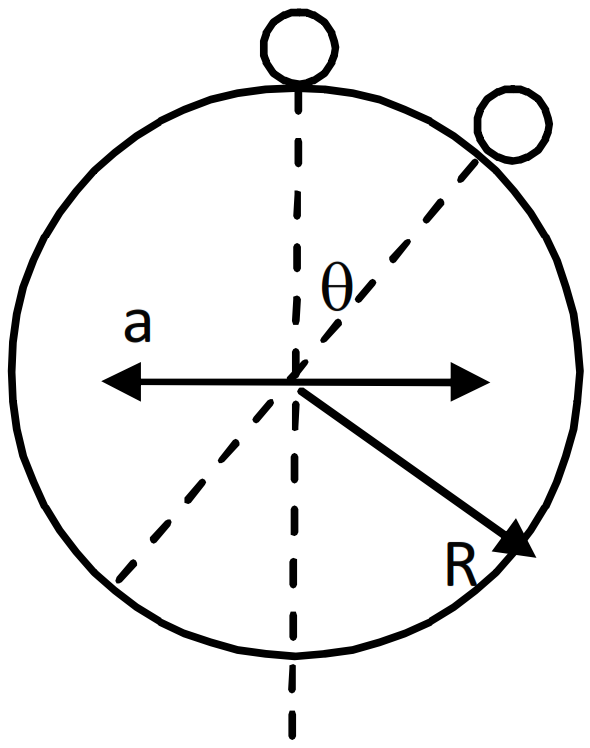
A smooth sphere of radius R is made to translate in a straight line with a constant acceleration a. A particle kept on the top of the sphere is released from there at zero velocity with respect to the sphere. Find the speed of the particle with respect to the sphere as a function of the angle $\theta$ it slides.
Answer


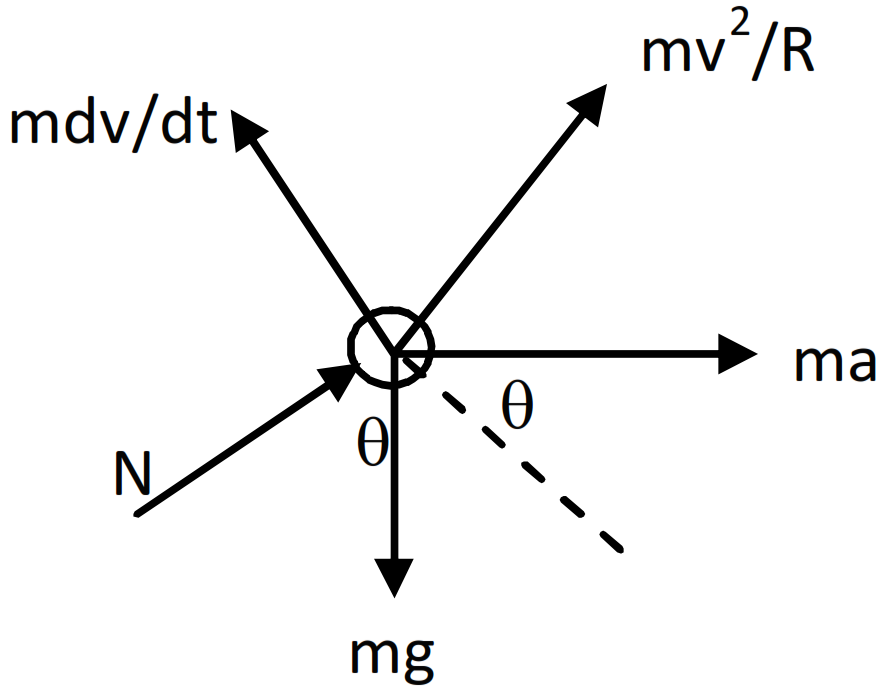
Let the sphere move towards left with an acceleration ‘a'
Let m = mass of the particle
The particle ‘m’ will also experience the inertia due to acceleration ‘a’ as it is on the sphere. It will also experience the tangential inertia force $\Big(\text{m}\Big(\frac{\text{dv}}{\text{dt}}\Big)\Big)$ and centrifugal force $\Big(\frac{\text{mv}^2}{\text{R}}\Big).$
$\text{m}\frac{\text{dv}}{\text{dt}}=\text{ma}\cos\theta+\text{mg}\sin\theta$
$\Rightarrow\text{mv}\frac{\text{dv}}{\text{dt}}=\text{ma}\cos\theta\Big(\text{R}\frac{\text{d}\theta}{\text{dt}}\Big)+\text{mg}\sin\theta\Big(\text{R}\frac{\text{d}\theta}{\text{dt}}\Big)$
Because, $\text{v}=\text{R}\frac{\text{d}\theta}{\text{dt}}$
$\Rightarrow\text{vdv}=\text{aR}\cos\theta\text{ d}\theta+\text{gR}\sin\theta\text{ d}\theta$
Integrating both sides we get,
$\frac{\text{v}^2}{2}=\text{aR}\sin\theta-\text{gR}\sin\theta+\text{C}$
Given that, at $\theta=0,\text{v}=0$
So, $\text{C}=\text{gR}$
So, $\frac{\text{v}^2}{2}=\text{aR}\sin\theta-\text{gR}\sin\theta+\text{gR}$
$\therefore\ \text{v}^2=2\text{R}(\text{a}\sin\theta+\text{g}-\text{g}\cos\theta)$
$\Rightarrow\text{v}=[2\text{R}(\text{a}\sin\theta+\text{g}-\text{g}\cos\theta)]^\frac{1}{2}$
View full question & answer