Questions

3 Marks Question

🎯

Test yourself on this topic

9 questions · timed · auto-graded

Question 13 Marks
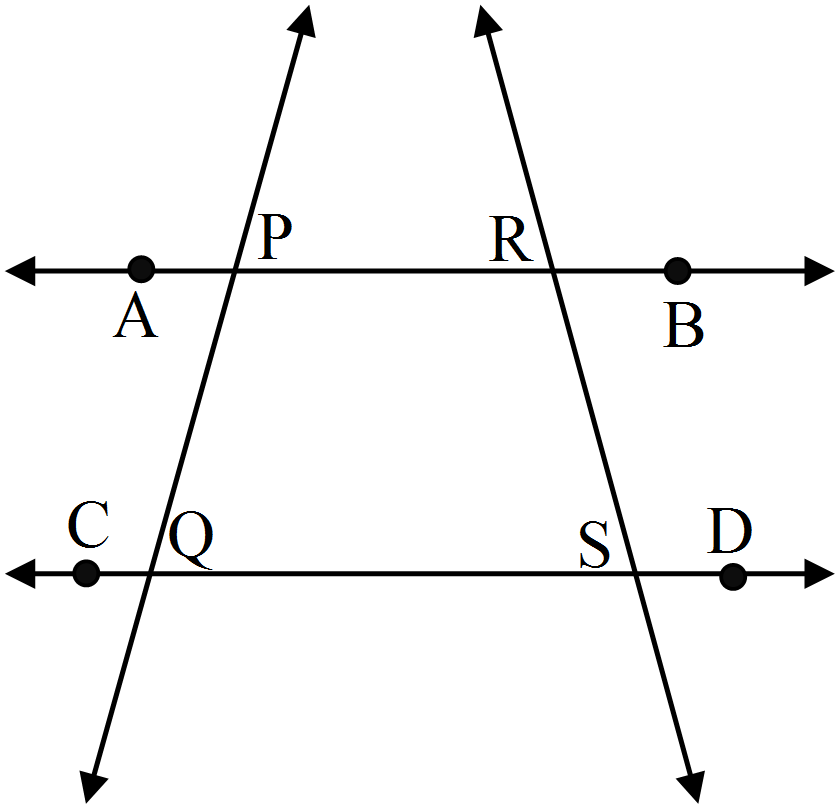
In name:
$i.\ $Five line segments.
$ii.\ $Five rays.
$iii.\ $Non$-$intersecting line segments.
Answer
$i.\ $Five line segments: $\text{PQ, RS, PR, QS, AP.}$
$ii.\ $Five rays: $\text{QC, SD, PA, RB, AND RA}.$
$iii.\ $Non intersecting line segments: $\text{PR, QS.}$
View full question & answer
Question 23 Marks
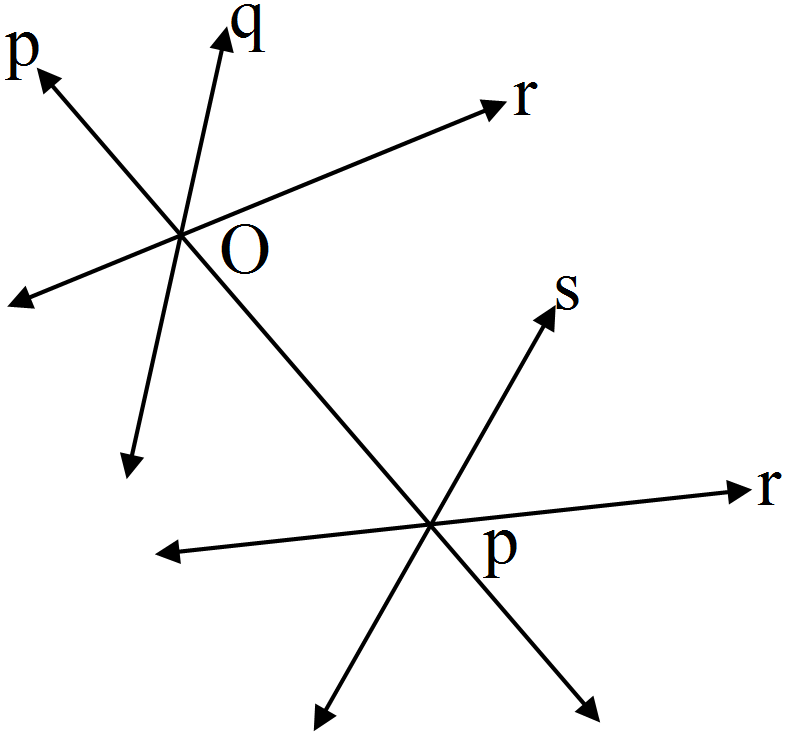
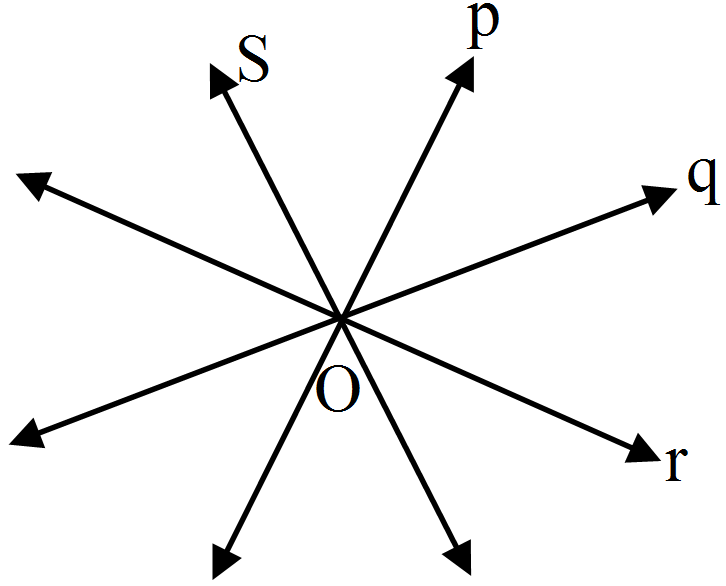
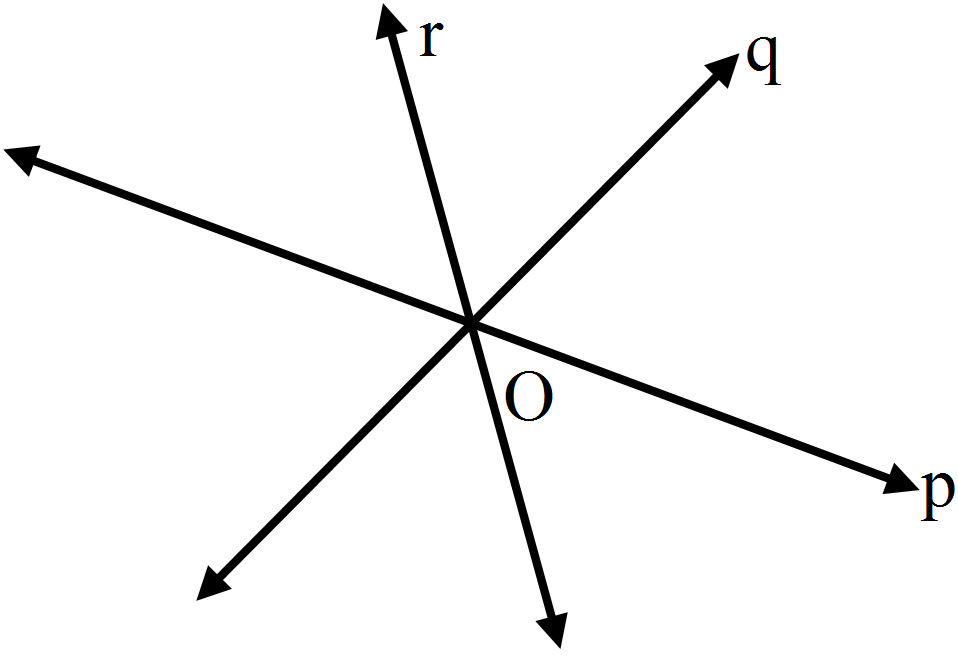
Lines p, q and r are concurrent. Also lines $p$, s and t are concurrent. Is it always true that the lines $q, r$ and s will be concurrent? Is it always true for lines $q, r$ and $t?$
Answer
Lines $p, q$, and $r$ are concurrent. So, lines $p, q$ and r intersect at a common point $O.$

 Given lines $p, s$, and t are concurrent. So, lines $p, s$ and t also intersect at a common point.
However, it is not always true that $q, r$ and s or $q, r$ and $t$ are concurrent.
View full question & answer
Question 33 Marks
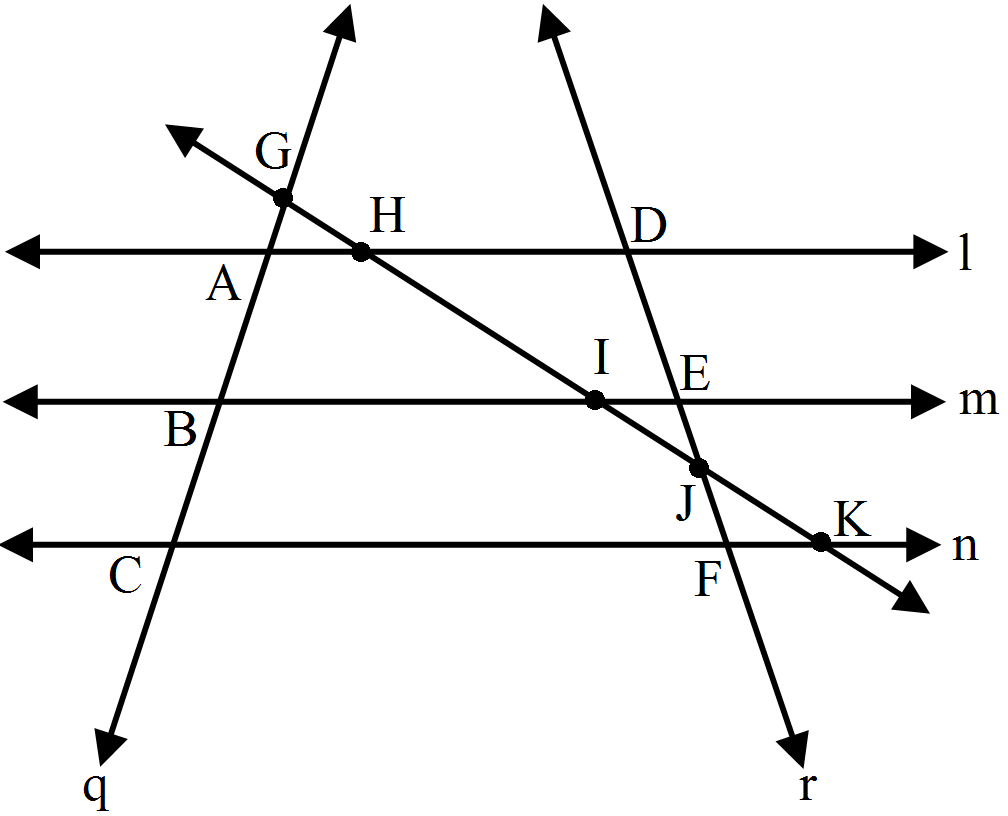
From write:
$i.\ $All paris of parallel lines.
$ii.\ $All pairs of intersecting lines.
$iii.\ $Lines whose point of intersection is $I.$
$iv.\ $Lines whose point of intersection is $D.$
$v.\ $Lines whose point of intersection is $E$.
$vi.\ $Lines whose point of intersection is $A.$
$vii.\ $Collinear points.
 
Answer
$i.\ $All pairs of intersecting lines:
$(l, m), (m, n)$ and $(l, n)$
$ii.\ $All pairs of intersecting lines:
$(l, p), (m, p), (n, p), (l, r), (m, r), (n, r), (I, q), (m, q), (n, q), (q, p), (q, r)$
$iii.\ $Lines whose point of intersection is $l:$
$(m, p)$
$iv.\ $Lines whose point of intersection is $D:$
$(l, r)$
$v.\ $Lines whose point of intersection $E:$
$(m, r)$
$vi.\ $Lines whose point of intersection is $A:$
$(l, q)$
$vii.\ $Collinear points:
$(G, A, B$ and $C) ,(D, E, J$ and $F), ( G, H, I$ and $J, K), (A, H$ and $D), (B, I$ and $E)$ and $(C, F$ and $K).$
View full question & answer
Question 43 Marks
There are a number of ways by which we can visualise a portion of a line. State whether the following represent a portion of a line of not:
$i.\ $A piece of elastic stretched to the breaking point.
$ii.\ $Wire between two electric poles.
$iii.\ $The line thread by which a spider lowers itself.
Answer
There are a number of ways by which we can visualize a portion of a line. State whether the following represent a portion of line or not:
$i.\ $A piece of elastic stretched to the breaking point $-$ Yes.
$ii.\ $Wire between two electric poles $-$ No.
$iii.\ $The line thread by which a spider lowers itself $-$ Yes.
View full question & answer
Question 53 Marks
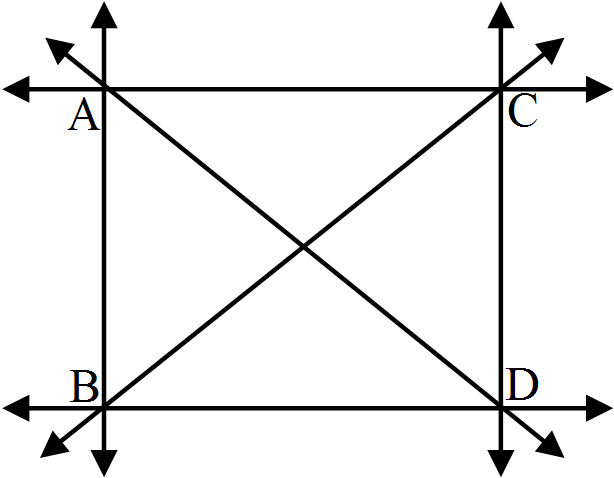
Mark four points $A, B, C$ and $D$ in your notebook such that no three of them are collinear. Draw all the lines which join them in pairs as shown.

$i.\ $How many such lines can be drawn?
$ii.\ $Write the names of these lines.
$iii.\ $Name the lines which are concurrent at $A.$
Answer
$i.\ $How many such lines can be drawn.
$ii.\ $Six lines can be drawn through these four points as given in the figure.
$iii.\ $Write the names of these lines.
$iv.\ $These lines are $\text{AB, BC, CD, BD}$ and $AD.$
$v.\ $Name the lines which are concurrent to $A.$
$vi.\ $Lines which are concurrent at $A$ are $AC, AB$ and $AD.$
View full question & answer
Question 63 Marks
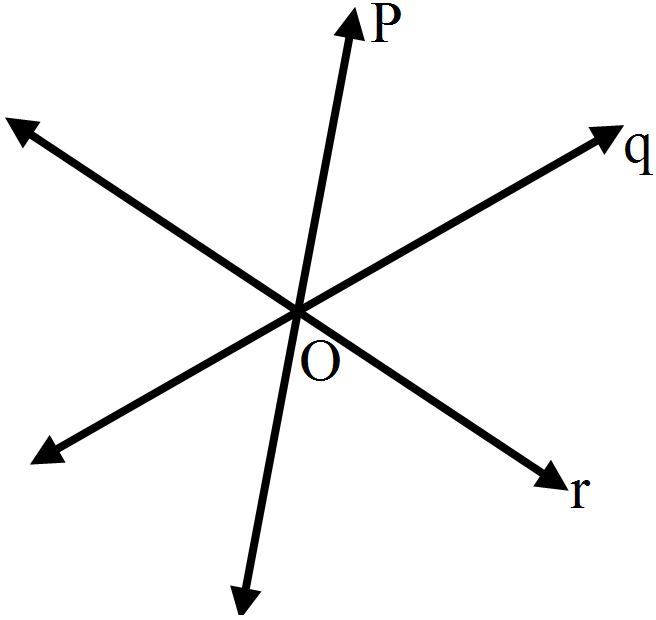
Lines $p, q$ and r are concurrent. Also lines $p, r$ and s are concurrent. Draw a figure and state whether lines $p, q, r$ and s are concurrent or not.
Answer


Thus, lines $p, q$ and r intersect at a common point $O.$
Also, lines $p, r$ and s are concurrent,
Therefore, lines $p, r,$ and s intersect at a common point. But $q$ and $r$ intersect each other at $O.$
So, $p, q$ and $r$ intersect at $O$,
Hence, $p, q, r$ and s are concurrent. Lines $p, q, r$ and s intersect at $O.$
View full question & answer
Question 73 Marks
What is the maximum number of points of intersection of three lines in a plane? What is the minimum number?
Answer
Maximum number of points of intersection of three lines in a plane will be three.
Minimum number of points of intersection of three lines in a plane will be zero.
View full question & answer
Question 83 Marks
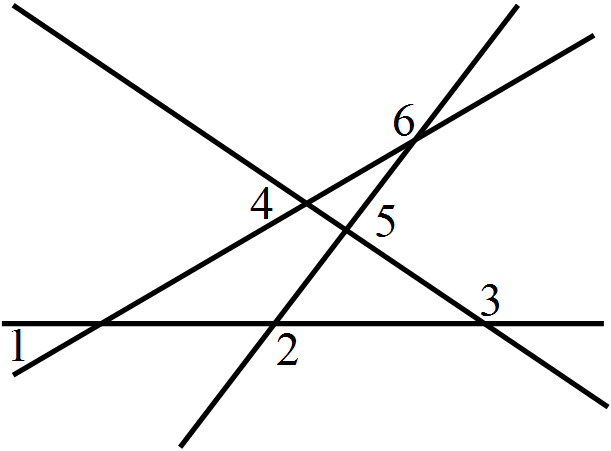
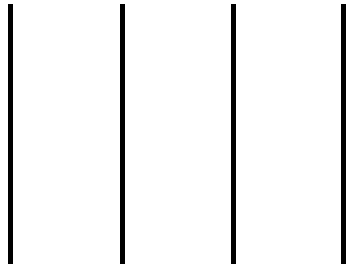
With the help of a figure, find the maximum and minimum number of points of intersection of four lines in a plane.
Answer
Maximum number of points of intersection of four lines in a plane will be six, Minimum number of points of intersection of four lines in a plane will be zero.
View full question & answer
Question 93 Marks
In name all rays with initial points as $A, B$ and $C$ respectively.
$i.\ $Is ray $\overrightarrow{\text{AB}}$ different from ray $\overrightarrow{\text{AC}}$?
$ii.\ $Is ray $\overrightarrow{\text{BA}}$ different from ray $\overrightarrow{\text{CA}}$?
$iii.\ $Is ray $\overrightarrow{\text{CP}}$ different from ray $\overrightarrow{\text{CQ}}$?
Answer
Name of all rays with initial point as A: $\overrightarrow{\text{AP}}\ \text{and}\ \overrightarrow{\text{AB}}\ \text{or}\ \overrightarrow{\text{AC}}\ \text{or}\ \overrightarrow{\text{AQ}}$ Name of all rays with initial point as $B:$ $\overrightarrow{\text{BP}}\text{or}\ \overrightarrow{\text{BA}}\ \text{and}\ \overrightarrow{\text{BC}}\ \text{or}\ \overrightarrow{\text{BQ}}$ Name of all rays with initial point as C: $\overrightarrow{\text{CP}}\ \text{or}\ \overrightarrow{\text{CA}}\ \text{or}\ \overrightarrow{\text{CB}}\ \text{and}\ \overrightarrow{\text{CQ}}$
$i.\ $No, because the origin point of both the rays $\overrightarrow{\text{AB}}$ and $\overrightarrow{\text{AC}}$ is same.
$ii.\ $Yes, because the origin point of both the rays $\overrightarrow{\text{BA}}$ and $\overrightarrow{\text{CA}}$ is different.
$iii.\ $Yes, because both the rays $\overrightarrow{\text{CP}}$ and $\overrightarrow{\text{CQ}}$ are in opposite directions.
View full question & answer