Question 12 Marks
In the following numbers, replace $*$ by the smallest number to make it divisible by $9:$
$835*86$
Answer$835686$
Here, $8 + 3 + 5 + * + 8 + 6 = 30 + *$ should be a multiple of $9.$
To be divisible of $9,$ the least value of $*$ should be $6,$ i.e., $30 + 6 = 36$, which is a multiple of $9.$
$\therefore * = 6$
View full question & answer→Question 22 Marks
Test the divisibility of the following numbers by $6:$
$251780$
AnswerA number is divisible by $6$ if it is divisible by both $2$ and $3.$
Since $251780$ is not divisible by $3,$ it is not divisible by $6.$
Checking the divisibility by $3:$
The sum of the digits of the number, $2 + 5 + 1 + 7 + 8 + 0,$ is $23,$ which is not divisible by $3.$
So, the number is not divisible by $3.$
View full question & answer→Question 32 Marks
Test the divisibility of:
$12030624$ by $8$
Answer$12030624$ by $8$
$12030624$ is divisible by $8.$
It is because the number formed by its hundreds, tens and ones digits is $624,$ which is divisible by $8.$
View full question & answer→Question 42 Marks
Find the $HCF$ of the numbers in the following using the prime factorization method: $504, 980$
AnswerThe given numbers are $504$ and $980.$ We have:
$\begin{array}{c|c}2&504\\\hline2&252\\\hline2&126\\\hline3&63\\\hline3&21\\\hline7&7\\\hline&1\end{array}$
$\begin{array}{c|c}2&980\\\hline2&490\\\hline5&245\\\hline7&49\\\hline7&7\\\hline&1\end{array}$
$504=2\times2\times2\times3\times3\times7=2^3\times3^2\times7$
$980=2\times2\times5\times7\times7=2^2\times5\times7^2$
$\therefore HCF$ of the given numbers $= 2^2\times 7 = 28$
View full question & answer→Question 52 Marks
Give the prime factorization of the following number:
$1323$
AnswerWe will use the didvision method as shown below:
$\begin{array}{c|c}3&1323\\\hline3&441\\\hline3&147\\\hline7&49\\\hline7&7\\\hline&1\end{array}$
$\therefore1323=3\times3\times3\times7\times7\times1$
$=3^3\times7^2$
View full question & answer→Question 62 Marks
Give the prime factorization of the following number: $18$
AnswerWe will use the didvision method as shown below:
$\begin{array}{c|c}2&18\\\hline2&9\\\hline3&3\\\hline&1\end{array}$
$\therefore18=2\times3\times3$ $=2\times3^2$
View full question & answer→Question 72 Marks
Which of the following are prime numbers? $137$
AnswerA number between $100$ and $200$ is a prime number if it is not divisible by any prime number less than $15.$
Similarly, a number between $200$ and $300$ is a prime number if it is not divisible by any prime number less than $20. $
$137$ is a prime number, because it is not divisible by $2, 3, 5, 7$ and $11.$
View full question & answer→Question 82 Marks
The product of two numbers is $2560$ and their $LCM$ is $320.$ Find their $HCF.$
AnswerProduct of the two numbers $= 2560.$
$HCF = 320$
We know that,
$LCM \times HCF =$ Product of two numbers
$\therefore HCF =\frac{2560}{320}=8$
View full question & answer→Question 92 Marks
Test the divisibility of the following numbers by $7:$
$2345$
AnswerTo determine if a number is divisible by $7,$ double the last digit of the number and subtract it from the number formed by the remaining digits.
$2345$ is divisible by $7.$
We have $234 - 2 × 5 = 224,$ which is a multiple of $7.$
View full question & answer→Question 102 Marks
Which of the following are prime numbers? $331$
AnswerA number between $100$ and $200$ is a prime number if it is not divisible by any prime number less than $15.$
Similarly, a number between $200$ and $300$ is a prime number if it is not divisible by any prime number less than $20.$
$331$ is a prime number, because it is not divisible by $2, 3, 5, 7, 11, 13, 17$ and $19.$
View full question & answer→Question 112 Marks
In the following numbers, replace $*$ by the smallest number to make it divisible by $3: 8*711$
Answer$81711$ Here, $8 + * + 7 + 1 + 1 = 17 + *$ should be a multiple of $3.$
To be divisible by $3,$ the least value of $*$ should be $1, $
i.e., $17 + 1 = 18,$ which is a multiple of $3.$
$\therefore * = 1$
View full question & answer→Question 122 Marks
Find the $LCM$ of the numbers given below: $60, 75$
AnswerThe given numbers are $60$ and $75.$ We have:
$\begin{array}{c|c}3&60,75\\\hline5&20,25\\\hline5&4,5\\\hline2&4,5\\\hline2&2,1\\\hline&1,1\end{array}$
$\therefore LCM = 3 × 5 × 5 × 2 × 2$
$= 300$
View full question & answer→Question 132 Marks
Test the divisibility of the following numbers by $7: 6021$
AnswerTo determine if a number is divisible by $7,$
double the last digit of the number and subtract it from the number formed by the remaining digits.
$6021$ is divisible by $7.$ We have $602 - 2 \times 1 = 600,$ which is not a multiple of $7.$
View full question & answer→Question 142 Marks
Write all prime numbers between $50$ and $100.$
Answer$53, 59, 61, 67, 71, 73, 79, 83, 89, 97$ are the prime numbers between $50$ and $100.$
View full question & answer→Question 152 Marks
Which of the following are prime numbers? $161$
AnswerA number between $100$ and $200$ is a prime number if it is not divisible by any prime number less than $15.$ Similarly, a number between $200$ and $300$ is a prime number if it is not divisible by any prime number less than $20.$ $161$ is a not prime number, because it is divisible by $7.$
View full question & answer→Question 162 Marks
Show that the following pairs are co-primes: $59, 97$
AnswerThe given numbers are $59$ and $97.$
$59 = 59 \times 1 97 = 97 \times 1$
$\therefore HCF = 1 $
Since $59$ and $97$ does not have any common factor other than $1,$ the two numbers are co-primes.
View full question & answer→Question 172 Marks
Which of the following are prime numbers$?$
$397$
AnswerA number between $100$ and $200$ is a prime number if it is not divisible by any prime number less than $15.$
Similarly, a number between $200$ and $300$ is a prime number if it is not divisible by any prime number less than $20.$
$397$ is a prime number, because it is not divisible by $2, 3, 5, 7, 11, 13, 17$ and $19.$
View full question & answer→Question 182 Marks
Test the divisibility of the following numbers by $7: 14126$
AnswerTo determine if a number is divisible by $7,$
double the last digit of the number and subtract it from the number formed by the remaining digits.
$14126$ is divisible by $7.$
We have $1412 - 2 \times 6 = 1400,$
which is a multiple of $7.$
View full question & answer→Question 192 Marks
In the following numbers, replace $*$ by the smallest number to make it divisible by $3: 6*1054$
Answer$621054$ Here, $6 + * + 1 + 0 + 5 + 4 = 16 + *$ should be a multiple of $3.$ To be divisible by $3,$ the least value of $*$ should be $2,$ i.e., $16 + 2 = 18,$ which is a multiple of $3.$ $\therefore * = 2$
View full question & answer→Question 202 Marks
Test the divisibility of: $10001001$ by $3$
Answer$10001001$ by $3$
$10001001$ is divisible by $3.$ It is because the sum of its digits, $1 + 0 + 0 + 0 + 1 + 0 + 0 + 1,$ is $3,$ which is divisible by $3.$
View full question & answer→Question 212 Marks
In the following numbers, replace $*$ by the smallest number to make it divisible by $9:$
$6678*1$
Answer$667881$
Here, $6 + 6 + 7 + 8 + * + 1 = 28 + *$ should be a multiple of $9.$
To be divisible by $9,$ the least value of $* $ should be $8,$ i.e., $28 + 8 = 36,$ which is a multiple of $9.$
$\therefore * = 8$
View full question & answer→Question 222 Marks
What are composite numbers? Can a composite number be odd? If yes, write the smallest odd composite number.
AnswerCOMPOSITE NUMBERS: Numbers having more than two factors are known as composite numbers. Yes a composite number can odd. The smallest odd composite number is $9.$
View full question & answer→Question 232 Marks
Find the $LCM$ of the numbers given below: $42, 63$
AnswerThe given numbers are $42$ and $63.$ We have:
$\begin{array}{c|c}7&42,63\\\hline3&6,9\\\hline3&2,3\\\hline2&2,1\\\hline&1,1\end{array}$
$\therefore LCM = 7 × 3 × 3 × 2 × 1$
$= 126$
View full question & answer→Question 242 Marks
Test the divisibility of the following numbers by $11:$
$66311$
AnswerA number is divisible by $11$ if the difference of the sum of its digits at odd places and the sum of its digits at even places is either $0$ or a multiple of $11.$
$66311$ is not divisible by $11.$
Sum of the digits at odd places $= (1 + 3 + 6) = 10$
Sum of the digits at even places $= (1 + 6) = 7$
Difference of the two sums $= (10 - 7) = 3,$
which is not divisible by $11.$
View full question & answer→Question 252 Marks
Write seven consecutive composite numbers less than $100$ having no prime number between them.
AnswerSeven consecutive composite numbers less than $100$ having no prime number between them are $90, 91, 92, 93, 94, 95$ and $96.$
View full question & answer→Question 262 Marks
Give the prime factorization of the following number: $1035$
AnswerWe will use the didvision method as shown below:
$\begin{array}{c|c}3&1035\\\hline3&345\\\hline5&115\\\hline23&23\\\hline&1\end{array}$
$\therefore1035=3\times3\times5\times23$
$=3^2\times5\times23$
View full question & answer→Question 272 Marks
In the following numbers, replace * by the smallest number to make it divisible by $9:$
$2*135$
Answer$27135$
Here, $2 + * + 1 + 3 + 5 = 11 + *$ should be a multiple of $9.$
To be divisible by $9,$ the least value of $*$ should be $7,$ i.e., $11 + 7 = 18$, which is a multiple of $9.$
$\therefore * = 7$
View full question & answer→Question 282 Marks
Test the divisibility of the following numbers by $11:$
$137269$
AnswerA number is divisible by $11$ if the difference of the sum of its digits at odd places and the sum of its digits at even places is either $0$ or a multiple of $11.$
$137269$ is divisible by $11.$
Sum of the digits at odd places $= (9 + 2 + 3) = 14$
Sum of the digits at even places $= (6 + 7 + 1) = 14$
Difference of the two sums $= (14 - 14) = 0,$ which is a divisible by $11.$
View full question & answer→Question 292 Marks
Test the divisibility of the following numbers by $7: 826$
AnswerTo determine if a number is divisible by $7,$
double the last digit of the number and subtract it from the number formed by the remaining digits.
If their difference is a multiple of $7,$ the number is divisible by $7.$
$826$ is divisible by $7.$
We have$ 82 - 2 \times 6 = 70$, which is a multiple of $7.$
View full question & answer→Question 302 Marks
In the following numbers, replace $*$ by the smallest number to make it divisible by $3: 27*4$
Answer$2724$
Here, $2 + 7 + * + 4 = 13 + * $ should be a multiple of $3.$
To be divisible by $3,$ the least value of $*$ should be $2,$
i.e., $13 + 2 = 15,$ which is a multiple of $3.$
$\therefore * = 2$
View full question & answer→Question 312 Marks
Test the divisibility of: $1000001$ by $11$
Answer$10000001$ by $11$
$10000001$ is divisible by $11.$
Sum of digits at odd places $= (1 + 0 + 0 + 0) = 1$
Sum of digits at even places $= (0 + 0 + 0 + 1) = 1$
Difference of the two sums $= (1 - 1) = 0,$
which is divisible by $11.$
View full question & answer→Question 322 Marks
Test the divisibility of the following numbers by $8:$
$901674$
AnswerA number is divisible by $8$ if the number formed by the last three digits (digits in the hundreds, tens and units places) is divisible by $8.$
$901674$ is not divisible by $8.$
It is because the number formed by its hundreds, tens and ones digits, i.e., $674,$ is not divisible by $8.$
View full question & answer→Question 332 Marks
The $HCF$ of two numbers is $145$ and their $LCM$ is $2175.$ If one of the numbers is $725,$ find the other.
Answer$HCF = 145$
$LCM = 2175$
One of the numbers $= 725$
We know that,
$HCF \times LCF =$ Product of two numbers
$\therefore$ Other number $=\frac{145\times2175}{725}=435$
View full question & answer→Question 342 Marks
Find the $LCM$ of the numbers given below: $36, 60, 72$
AnswerThe given numbers are $36, 60$ and $72.$
We have:
$\begin{array}{c|c}2&36,60,72\\\hline2&18,30,36\\\hline3&9,15,18\\\hline3&3,5,6\\\hline5&1,5,2\\\hline2&1,1,2\\\hline&1,1,1\end{array}$
$\therefore LCM = 2 \times 2 \times 2 \times 3 \times 3 \times 5$
$= 360$
View full question & answer→Question 352 Marks
Give the prime factorization of the following number: $9317$
AnswerWe will use the didvision method as shown below: $\begin{array}{c|c}7&9317\\\hline11&1331\\\hline11&121\\\hline11&11\\\hline&1\end{array}$ $\therefore9317=7\times11\times11\times11$ $=7\times11^3$
View full question & answer→Question 362 Marks
Test the divisibility of the following numbers by $8:$
$36792$
AnswerA number is divisible by $8$ if the number formed by the last three digits (digits in the hundreds, tens and units places) is divisible by $8.$
$36792$ is divisible by $8.$
It is because the number formed by its hundreds, tens and ones digits, i.e., $792,$ is divisible by $8$
View full question & answer→Question 372 Marks
Test the divisibility of the following numbers by $8: 1790184$
AnswerA number is divisible by $8$ if the number formed by the last three digits (digits in the hundreds, tens and units places) is divisible by $8. 1790184$ is divisible by $8.$ It is because the number formed by its hundreds, tens and ones digits, i.e., $184,$ is divisible by $8.$
View full question & answer→Question 382 Marks
Find the $HCF$ of $:2$ and an even number.
Answer$2$ and $4$ are two prime numbers.
Now, $HCF$ of $2$ and $4$ is as follows:
$2 = 2 \times 1$
$4 = 2 \times 2 \times 1$
$\therefore HCF =2 \times 1 = 2$
View full question & answer→Question 392 Marks
Find the $HCF$ of the numbers in the following using the division method: $1965, 2096$
AnswerThe given numbers are $1965 $ and $2096.$ We have:
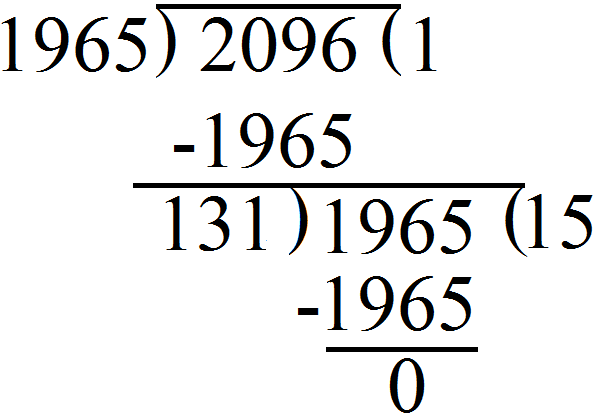
$\therefore$ The $HFC$ is $131.$ View full question & answer→Question 402 Marks
Which of the following are prime numbers? $217$
AnswerA number between $100$ and $200$ is a prime number if it is not divisible by any prime number less than $15.$
Similarly, a number between $200$ and $300$ is a prime number if it is not divisible by any prime number less than $20.$
$217$ is a not prime number, because it is divisible by $7.$
View full question & answer→Question 412 Marks
Find the $HCF$ of the numbers in the following using the division method: $2241, 2324$
AnswerThe given numbers are $2241$ and $2341.$ We have:
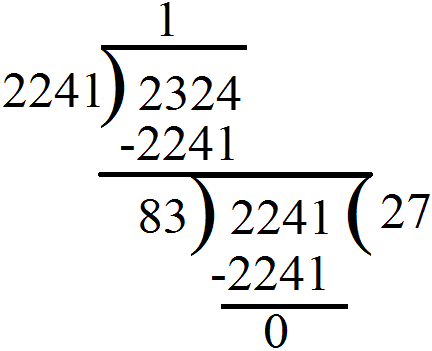
$\therefore$ The $HFC = 83.$ View full question & answer→Question 422 Marks
Test the divisibility of the following numbers by $8: 2138$
AnswerA number is divisible by $8$ if the number formed by the last three digits (digits in the hundreds, tens and units places) is divisible by $8.$
$2138$ is not divisible by $8.$ It is because the number formed by its hundreds, tens and ones digits, i.e., $138,$ is not divisible by $8.$
View full question & answer→Question 432 Marks
Test the divisibility of the following numbers by $11: 4334$
AnswerA number is divisible by $11$ if the difference of the sum of its digits at odd places and the sum of its digits at even places is either $0$ or a multiple of $11.$
$4334$ is divisible by $11.$
Sum of the digits at odd places $= (4 + 3) = 7$
Sum of the digits at even places $= (3 + 4) = 7$
Difference of the two sums $= (7 - 7) = 0,$
which is divisible by $11.$
View full question & answer→Question 442 Marks
Test the divisibility of the following numbers by $6: 872536$
AnswerA number is divisible by $6$ if it is divisible by both $2$ and $3.$
Since $872536$ is not divisible by $3,$ it is not divisible by $6$.
Checking the divisibility by $3:$ The sum of the digits of the number,
$8 + 7 + 2 + 5 + 3 + 6,$ is $31$, which is not divisible by $3.$
So, the number is not divisible by $3.$
View full question & answer→Question 452 Marks
Give the prime factorization of the following number:
$2907$
AnswerWe will use the didvision method as shown below:
$\begin{array}{c|c}3&2907\\\hline3&969\\\hline17&323\\\hline19&19\\\hline&1\end{array}$
$\therefore4641=3\times3\times17\times19$
$=3^2\times17\times19$
View full question & answer→Question 462 Marks
Test the divisibility of: $2134563$ by $9$
Answer$2134563$ by $9$
$2134563$ is not divisible by $9.$
It is because the sum of its digits,
$2 + 1 + 3 + 4 + 5 + 6 + 3,$ is $24,$
which is not divisible by $9.$
View full question & answer→Question 472 Marks
Which of the following are prime numbers$?$
$103$
AnswerA number between $100$ and $200$ is a prime number if it is not divisible by any prime number less than $15.$
Similarly, a number between $200$ and $300$ is a prime number if it is not divisible by any prime number less than $20.$
$103$ is a prime number, because it is not divisible by $2, 3, 5, 7, 11$ and $13.$
View full question & answer→Question 482 Marks
In the following numbers, replace $*$ by the smallest number to make it divisible by $3: 234*17$
Answer$234117$
Here, $2+ 3 +4 + * + 1 + 7 = 17 + *$ should be a multiple of $3.$
To be divisible by 3, the least value of $*$ should be $1,$
i.e., $17 + 1 = 18,$ which is a multiple of $3.$
$\therefore * = 1$
View full question & answer→Question 492 Marks
Give the prime factorization of the following number: $252$
AnswerWe will use the didvision method as shown below:
$\begin{array}{c|c}2&252\\\hline2&126\\\hline3&63\\\hline3&21\\\hline7&7\\\hline&1\end{array}$
$\therefore252=2\times2\times3\times3\times7\times1$
$=2^2\times3^2\times7\times1$
View full question & answer→Question 502 Marks
Give the prime factorization of the following number: $945$
AnswerWe will use the didvision method as shown below:
$\begin{array}{c|c}3&945\\\hline3&315\\\hline3&105\\\hline5&35\\\hline7&7\\\hline&1\end{array}$
$\therefore945=3\times3\times3\times5\times7\times1$
$=3^3\times5\times7$
View full question & answer→