MCQ 11 Mark
Which of the following shows the maximum rise in temperature$?$
- A
$23^\circ$ to $32^\circ$
- ✓
$-10^\circ $ to $+1^\circ $
- C
$-18^\circ $ to $-11^\circ $
- D
$-5^\circ $ to $+5^\circ $
AnswerCorrect option: B. $-10^\circ $ to $+1^\circ $
$a.\ 32^\circ -23^\circ = 9^\circ $
$b.\ 1^\circ -(-10^\circ ) = 1^\circ +10^\circ = 11^\circ $
$c.\ 11^\circ -(-18^\circ ) = 11^\circ + 18^\circ = 7^\circ $
$d.\ 5^\circ -(-5 ) = 5^\circ +5^\circ = 10^\circ $
Therefore, the maximum rise is shown by option bis $11$ degrees.
View full question & answer→MCQ 21 Mark
$-7 - (-8) =$
AnswerGiven that We have to find the value of given expression
$- 7 - (-8)$
we know that $(−) \times (−) = +$
and $(+) \times (−)=−$
$= -7 + 8$
$= 1$
So option $C$ is correct
View full question & answer→MCQ 31 Mark
Mark the correct aftemative of the following The successor of $-79$ is:
Answer If a is an integer, then its successor is $a + 1.$ So
Successor of $-79 = -79 + 1$
$= -(79 - 1)$
$= -78$
Hence, the correct option is $(b).$
View full question & answer→MCQ 41 Mark
How many $INR\ 1$ coins make $INR\ 10$ ______________.
Answer$10 × 1 = 10$
$\therefore 10\ INR\ 1$ coins make $INR\ 10.$
View full question & answer→MCQ 51 Mark
The largest number that divides $64$ and $72$ and leave the remainders $12$ and $7$ respectively, is:
AnswerSubtract $12$ and $7$ from $64$ and $72$ respectively.
$64 - 12 = 52$
$72 - 7 = 65$
The required number is the $HCF$ of $52$ and $65.$
Now,
$52 = 4 \times 13$
$65 = 5 \times 13$
$\therefore HCF\ 52$ and $65 = 13$
Therefore, the largest number that divides $64$ and $72$ and leave the remainder $12$ and $7$ respectively, is $13.$
Hence, the correct option is $(b)$.
View full question & answer→MCQ 61 Mark
The sum of four consecutive integers is $46$ then the four integers are
- A
$11, 12, 13, 14$
- ✓
$10, 11, 12, 13$
- C
$6, 7, 8, 9$
- D
$20, 21, 22, 23$
AnswerCorrect option: B. $10, 11, 12, 13$
$x + (x + 1) + (x + 2) + (x + 3) = 46$
$= 4x + 6 = 46$
$= 4x = 40$
$= x = 10$
the integers are $x_1 = 10,$ $x_2 = 11, x_3 = 12, x_4 = 13$
correct option is $B.$
View full question & answer→MCQ 71 Mark
On the number line, the integer $5$ is located:
- A
To the left of $0.$
- ✓
To the right of $0.$
- C
To the left of $1.$
- D
To the left of $-2.$
AnswerCorrect option: B. To the right of $0.$
We know that, all the positive integers lie on the right of $0.$
So, integer $5$ is also located to the right of $0.$
View full question & answer→MCQ 81 Mark
Subtract $-134$ from the sum of $38$ and $-87$
AnswerSum $: 38 - 87 = - 49$
Now, $-49 - (-134) = -49 + 134 = 85$
View full question & answer→MCQ 91 Mark
The additive inverse of a negative integer:
AnswerAdditive inverse of an integer is obtained by changing the sign of the integer.
Therefore, the additive inverse of a negative integer is always positive.
Let a nagative integer be $-5.$ Then, additive inverse of $-5 = -(-5) = 5.$
View full question & answer→MCQ 101 Mark
Mark against the correct answer in the following:
The sum of two integers is $-25.$ If one of them is $30$ then the other is
AnswerLet $x$ be the other integer
$x + 30 = -25$
$x = -25 - 30$
$x = -55$
View full question & answer→MCQ 111 Mark
$86 + (-28) + 12 + (-34)$ is equal to:
Answer$86 + (-28) + 12 + (-34) = 86 + (-28) - (34 - 12)$
$= 86 + (-28) - 22$
$= (86 - 28) - (34 - 12)$
$= 58 - 22$
$= 36$
Hence, the correct option is $(c).$
View full question & answer→MCQ 121 Mark
The successor of the predecessor of $-50$ is:
AnswerFor predecessor, we subtract $1$ from the given integer and for successor, we add $1$ to the given integer.
The predecessor of $-50 = -50 -1 = -51$ and the successor of $-51 = -51 + 1 = -50.$
View full question & answer→MCQ 131 Mark
Encircle the odd one of the following
- A
$(−9) \times 5 \times 6 \times (−3)$
- B
$9 \times (−5) \times 6 \times (−3)$
- ✓
$(−9) \times (−5) \times (−6) \times 3$
- D
$9 \times (−5) \times (−6) \times 3$
AnswerCorrect option: C. $(−9) \times (−5) \times (−6) \times 3$
$a.\ (−9) \times 5 \times 6 \times (−3) = 810$
$b.\ 9 \times (−5) \times 6 \times (−3) = 810$
$c.\ (−9) \times (−5) \times (−6) \times 3 = −810$
$d.\ 9 \times (−5) \times (−6) \times 3 = 810$
By the above calculation, we can see that option $c$ gives $- 810$ while other options give $810.$ Thus, optionc is different from all others.
View full question & answer→MCQ 141 Mark
Every integer less than $0$ has the sign.
AnswerOption $B$ is right.
Every integer less than $0$ has the negative sign.
View full question & answer→MCQ 151 Mark
$(-36) + (+12) =$
Answer$(-36) + (+12) = -36 + 12 = -24$
View full question & answer→MCQ 161 Mark
How much $5$ is less than $- 2$ is .
AnswerNow, $5$ is less than $-2 $ is $- 2 - 5 = -7$
View full question & answer→MCQ 171 Mark
The sum of two integers is $-35.$ If one of them is $40,$ then the other is:
AnswerSum of integers $= -35$
One of the numbers $= 40$
Other number $= (-35) - (40)$
$= -35 - 40$
$= -(35 + 40)$
$= -75$
Therefore, the other number is $-75$
Hence, the correct option is $(b).$
View full question & answer→MCQ 181 Mark
Absolute value of $-58$ is:
AnswerAbsolute value describes the distance of a number on the number line from $0$ without considering which direction from zero the number lies.
The absolute value of a number is never negative. Absolute value makes numbers positive.
Absolute value of $-58$ is $|-58| = 58$
View full question & answer→MCQ 191 Mark
Smallest negative number is
AnswerWe know that we cannot define a largest positive number, similarly the smallest negative number cannot be defined. Hence, option $D$ is correct.
View full question & answer→MCQ 201 Mark
Find the next term in the following sequence. $2, 3, 11, 38, 102,?$
AnswerThe sequence is $+ 1^3, + 2^3, + 3^3, + 4^3,+ 5^3.2 + 1$
$= 3, 3 + 8 = 11, 11 + 27$
$= 38, 38 + 64$
$= 102, 102 + 125 = 227$
View full question & answer→MCQ 211 Mark
The smallest positive integer is
Answersmallest positive integer in the given options is obviously $1...$since zero is not considered as positive or negative integer..
View full question & answer→MCQ 221 Mark
Fathers age is three times the sum of ages of histwo children. After five years his age will be twicethe sum of ages of two children. The age of thefather is.
MCQ 231 Mark
Sum of two integers is $+62.$ If one of the integer is $-48,$ then the other is
- A
$+ 14$
- B
$-14$
- C
$-110$
- ✓
$+ 110$
AnswerCorrect option: D. $+ 110$
Let the other integer be $xx.$ One of the integer is given that is $-48$Also, it is given that the sum of the two integers is $+62.$ Therefore, we have:
$x + (−48) = + 62$
$\Rightarrow x - 48 - 62$
$\Rightarrow x = 62 + 48$
$\Rightarrow x = 110$
Hence, the other integer is $+110.$
View full question & answer→MCQ 241 Mark
Fathers age is three times the sum of ages of histwo children. After five years his age will be twicethe sum of ages of two children. The age of thefather is
AnswerLet the age of the sons be $x$ and $y.$
Given that Father $8217;s$ age is three times the age of his two children.
Therefore, the present age of the father is $3 (x + y)$
Now, it is also given, after $5$ years, his age will be twice the sum of the ages of his children.
Therefore, after $55$ years age of the father will be $3 (x + y) + 5$ and age of the children will be $x + 5$ and $y + 5.$
$3 (x + y) + 5 = 2(x + 5 + y + 5)$
$3x + 3y + 5 = 2x + 10 + 2y + 10$
$3x + 3y + 5 = 2x + 2y + 20$
$3x - 2x + 3y - 2y = 20–5$
$x + y = 15$
Now the age of father was $3(x + y) + 3 (15) = 45 ($Putting the value of $x + y)$
Thus the age of the father is $45$
View full question & answer→MCQ 251 Mark
Which of the following statement is true?
- A
$-7 > -5$
- ✓
$-7 < -5$
- C
$(-7) + (-5) > 0$
- D
$(-7) - (-5) > 0$
AnswerCorrect option: B. $-7 < -5$
On the number line, $-7$ is to the left of $-5,$ so $-7 < -5.$
Hence, the correct option is $(b).$
View full question & answer→MCQ 261 Mark
Evaluate: $+ 5 - 6 = ? + 5 − 6 =?$
AnswerWrite given integers in addition expression and we get:
$(+5) + (-6)$
Subtract smaller integer $5$ from bigger integer $6$ as follows: $6 − 5 = 1$
Since, the bigger integer $-6$ is a negative integer, so the result should also be negative that is $-1$
Hence, $+ 5 - 6 = -1$
View full question & answer→MCQ 271 Mark
$|-|-7| - 3|$ is equal to:
Answer$|-|-7| - 3| = |-7 - 3| (\because |-7| = 7)$
$= |-10|$
$= 10 (\because |-10| = 10)$
Hence, the correct option is $(c).$
View full question & answer→MCQ 281 Mark
Which of the following is an example of integer
- ✓
$-5$
- B
$\frac{5}{2}$
- C
$1.4$
- D
$\frac{-7}{2}$
Answer$-5$ is an integer number.
View full question & answer→MCQ 291 Mark
Sum of $X$ and $Y$ is $-2.$ If $X = 43,$ the $Y$ is:
Answer$X + Y = -2X - 43 + Y$
$= -2 $
$\Rightarrow Y = -2 - 43$
$= -45$
View full question & answer→MCQ 301 Mark
$(-12) \times (-9) - 6 \times (-8)$ is equal to:
Answer$(-12) \times (-9) - 6 \times (-8) = (12 \times 9) - 6 \times (-8)$
$= 108 - 6 \times (-8)$
$= 108 + 6 \times 8$
$= 108 + 48$
$= 156$
Hence, the correct option is $(a).$
View full question & answer→MCQ 311 Mark
The least integer lying between $-10$ and $-15$ is:
AnswerThe integers lying between $-10$ and $-15$ are $-11, -12, -13$ and $-14.$
The least integer among these is $-14. [$because with negative sign, greater number is smaller$]$
View full question & answer→MCQ 321 Mark
In which of the following pairs of integers, the first integer is not on the left of the other integer on the number line?
- A
$(-1, 10)$
- ✓
$(-3, -5)$
- C
$(-5, -3)$
- D
$(-6, 0)$
AnswerCorrect option: B. $(-3, -5)$
Firstly, draw a number line and mark all the given pairs of integers on it.

Clearly, we observe that $-3$ is on the right of $-5.$
View full question & answer→MCQ 331 Mark
Consider the five numbers:
$0.5,0,-6,-2/7,\sqrt{5}.$
Choose the correct options -
- ✓
- B
There are four rational numbers.
- C
There is only one irrational number.
- D
Answer$0,-6$, are integers. $0.5,0,-6,-\frac{2}{7},$ are rational number
$\sqrt{5}$ is an irrational number. All are real numbers.
View full question & answer→MCQ 341 Mark
Which of the following are the examples of negative numbers$?$
Answer In our daily systems, we take zero or ground level as the reference point. If a number is less than $0,$ it will
be negative and if greater, positive. If a level is below the ground level, it is said to be negative.
View full question & answer→MCQ 351 Mark
Smallest negative number:
AnswerSmallest negative number does not exist. because numbers are endless.
View full question & answer→MCQ 361 Mark
Mark against the correct answer in the following:
The successor of $-18$ is:
AnswerIn succession, we move from the left to right of the number line.
View full question & answer→MCQ 371 Mark
The smallest positive integer is:
AnswerSmallest positive integer in the given options is obviously $1$ since zero is not considered as positive or
negative integer.
View full question & answer→MCQ 381 Mark
Find the missing term in the given sequence. $4, 9, 29, ?, 599, 35994,9,29, ? ,599, 3599$
AnswerThe sequence is $\times 2 + 1, \times 3 + 2, \times 4 + 3, \times 5 + 4, \times 6 +$
$4 \times 2 + 1 = 9, 9 \times 3 + 2 = 29, 29 \times 4 + 3 = 119, 119 \times 5 + 4 = 599,$
$599 \times 6 +5 = 359$
Hence the correct answer is option $D$
View full question & answer→MCQ 391 Mark
$(+13)-(+12)$ is equal to
View full question & answer→MCQ 401 Mark
Which of the following pairs of integers have $5$ as a difference$?$
- A
$10, 5$
- B
$-10, -5$
- C
$15, 20$
- ✓
both $(a)$ and $(b)$
AnswerCorrect option: D. both $(a)$ and $(b)$
$a.\ 10 - 5 = 5$
$b.\ (-5) - (-10) = -5 + 10 = 5$
$c.\ 15 - (-20) = 15 + 20 = 35$
Hence, the correct option is $(d).$
View full question & answer→MCQ 411 Mark
Subtract the following algebraic expressions.
$- 4g$ from $-10g$
Answer$-10g - (-4g)$
$= −10g + 4g$
$= g(-10+4)$
$= -g\times 6$
$= -6g$
View full question & answer→MCQ 421 Mark
Opposite of earning $Rs. 100$
- A
$+ Rs. 100$
- B
Profit of $Rs. 100$
- ✓
Spending $Rs. 100$
- D
AnswerCorrect option: C. Spending $Rs. 100$
Earning of $Rs. 100$ means we got $Rs. 100.$
Therefore, opposite of earning is spending means we give $Rs.100$
Option $C$ is correct.
View full question & answer→MCQ 431 Mark
The integer $‘5$ units to the right of $0$ on the number line’ is:
AnswerFirstly, draw a number line and mark some points at equal distance on it. Mark a point as zero on it. On moving $5$ units to the right of $0$, we reach on $+5.$
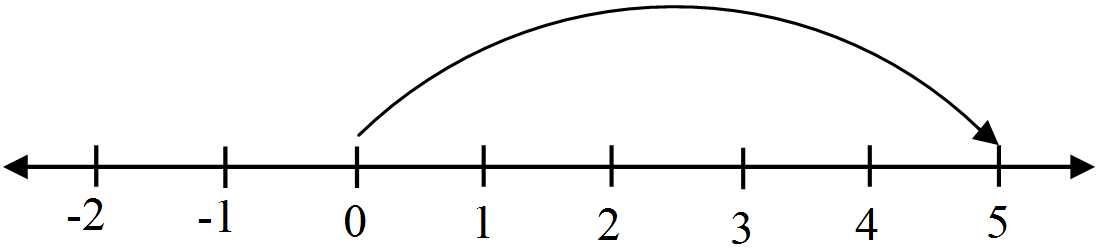
Hence, point $4$ represents $+5.$
Note: All the positive integers lie to the right of $0$ and the negative integers to the left of $0$ on the number line. View full question & answer→MCQ 441 Mark
$-123 - 456 - 890 =$
- A
$-100$
- B
$100$
- ✓
$-1469$
- D
$1469$
AnswerCorrect option: C. $-1469$
Given that We have to find the value of given expression
$-123 - 456 - 890$
we know that $(-) \times (-) = +$
and $= -(+) \times (-) = -$
$-123 - 456 - 890$
$= -579 - 890$
$= -1469$
So option $C$ is correct
View full question & answer→MCQ 451 Mark
The sum of two integers is $− 23.$ If one of them is $18$, then the other is:
AnswerSum of integers $= -23$
One of the numbers $= 18$
Other number $= (-23) - (18)$
$= -23 - 18$
$= -(23 + 18)$
$= -41$
Therefore, the other number is $− 41.$
Hence, the correct option is $(d).$
View full question & answer→MCQ 461 Mark
Mark $(\checkmark)$ against the correct answer in the following:
The predecessor of $-99$ is:
AnswerCorrect option: B. $-100$
The predecessor of a number lies to the left of the number.
$-100$ lies to the left of $-99.$
Hence, $-100$ is a predecessor of $-99.$
View full question & answer→MCQ 471 Mark
$−123+23+45=$
AnswerGiven that We have to find the value of given expression
$-123+23+45$
we know that $= +(−)×(−)=+$
and $= (+)×(−)=−$
$-123+23+45$
$=-100+45$
$=−55$
option $C$ is correct
View full question & answer→MCQ 481 Mark
Which of the following numbers is/are composite
- ✓
$1111.........1(91\ \mbox{digits})$
- B
$1111.........1(61 \ \mbox{digits})$
- C
$1111.........1(175\ \mbox{digits})$
- D
$1111.........1(105\ \mbox{digits})$
AnswerCorrect option: A. $1111.........1(91\ \mbox{digits})$
$1111.........1(91\ \mbox{digits})$
View full question & answer→MCQ 491 Mark
The statement "When an integer is added to itself, the sum is greater than the integer" is:
- A
- B
- ✓
True only when the integer is positive.
- D
True for non-negative integers.
AnswerCorrect option: C. True only when the integer is positive.
Suppose we take two integers one positive $(+1)$ and other negative $-1.$
On adding $1$ to itself, we get $1 + 1 = 2.$
Here, the sum is greater than the integer $(+1).$
Again, adding $-1$ to itself, we get $-1 + (-1) = -1 -1 = -2$
Here, the sum is less than the integer $-1.$
Hence, the given statement is true only when the integer is positive.
View full question & answer→MCQ 501 Mark
Mark the correct aftemative of the following:
The predecessor of $-99$ is:
AnswerCorrect option: B. $-100$
If a is an integer, then its predecessor is a$ - 1.$
So Predecessor of $-99 =-99 - 1$
$= -(99 + 1)$
$= -100$
Hence, the correct option is $(b).$
View full question & answer→