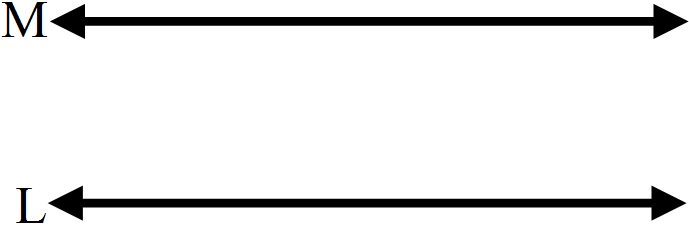
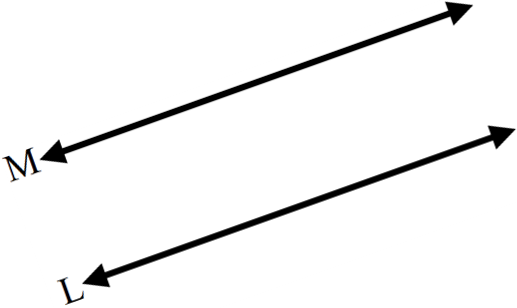
Find the distance between the parallel lines $l$ and $m$, using a set square.
Answer
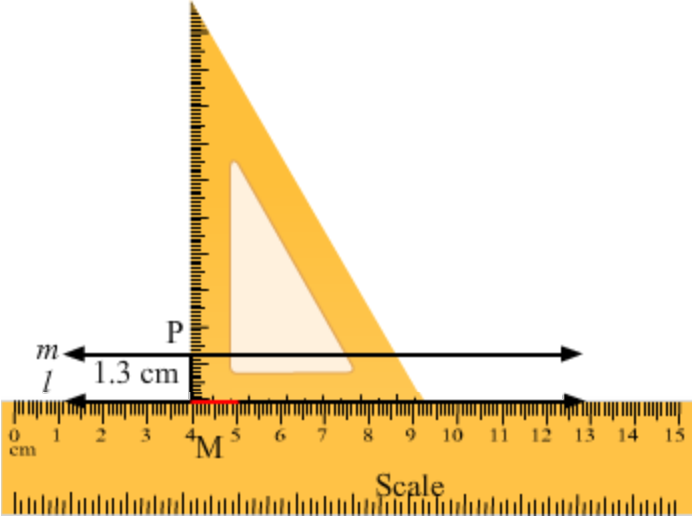
Distance between $l$ and $m$ is $1.3\ cm$. Place the ruler so that one of its measuring edges lies along the line $l$. Hold it with one hand. Now place a set square with one arm of the right angle coinciding with the edge of the ruler. Draw the line segment $PM$ along the edge of the set square, as shown in the figure. Then, measure the distance $(PM)$ between $l$ and $m$, which will be equal to $1.3\ cm.$
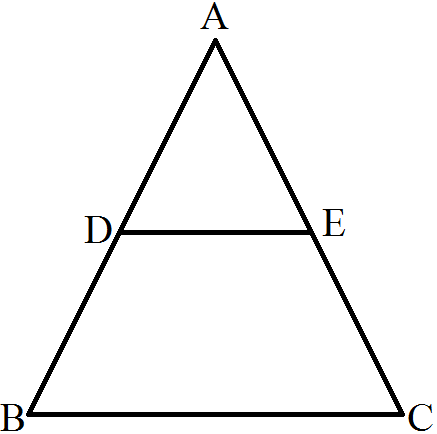
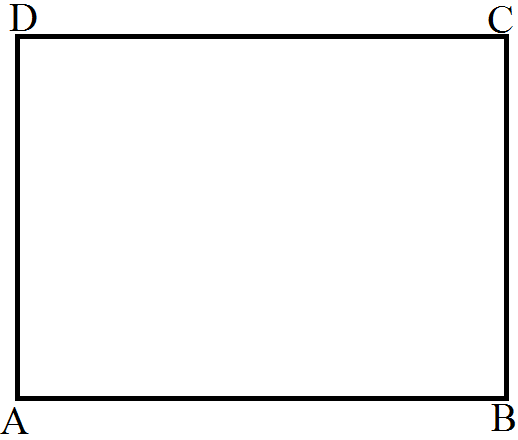
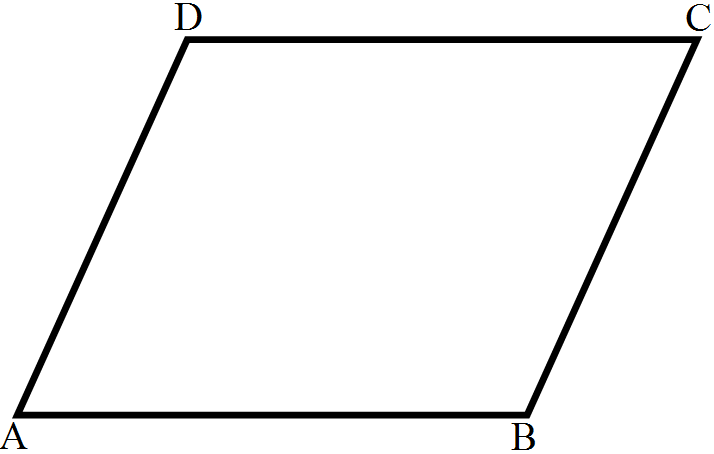
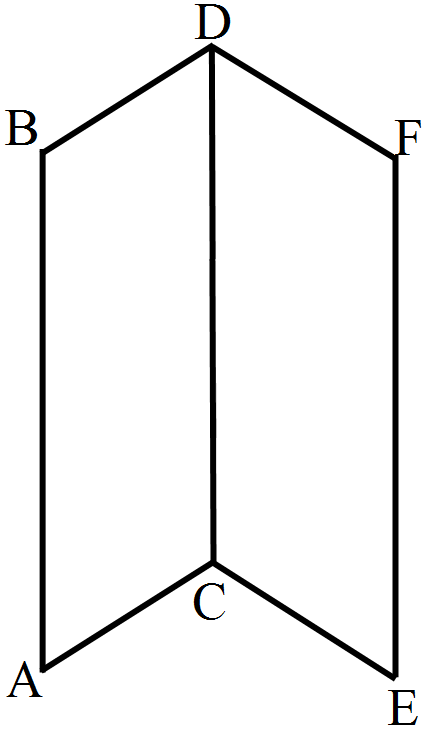
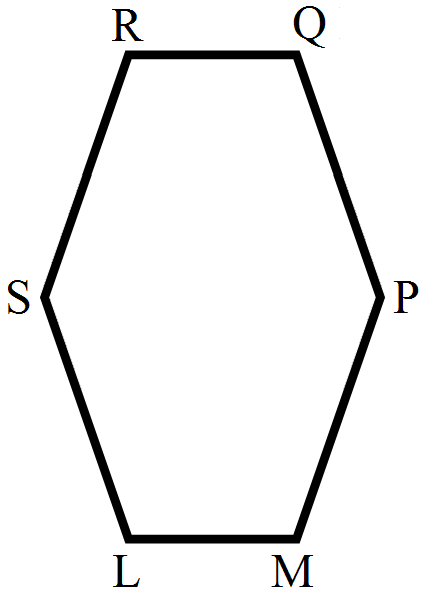
Indentify parallel line segments in the figures given below:
Answer
$AB\ ||\ DC$ and $AD\ ||\ BC.$
This is because these pairs of line segments do not intersect each other.
AB does not intersect $DC$ and $AD$ does not intersect $BC$.
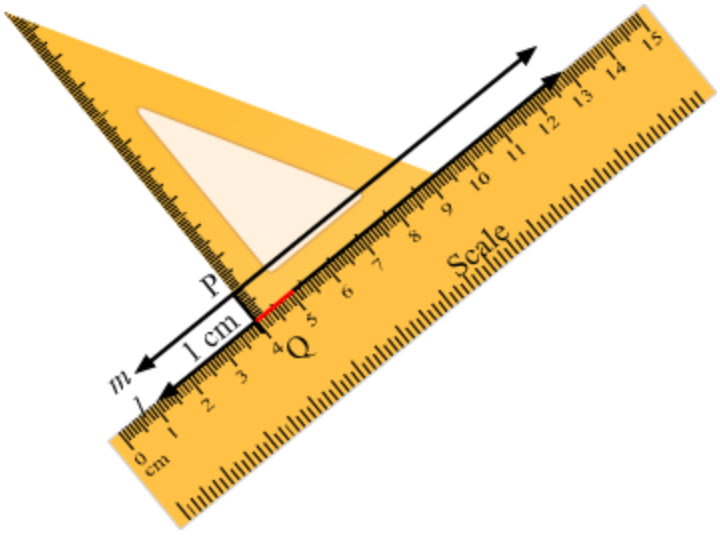
Find the distance between the parallel lines $l$ and $m$, using a set square.
Answer
Distance between $l$ and $m$ is $1\ cm.$ Place the ruler so that one of its measuring edges lies along the line $l$. Hold it with one hand. Now place a set square with one arm of the right angle coinciding with the edge of the ruler. Draw the line segment $PM$ along the edge of the set square, as shown in figure. Then, measure the distance $(PQ)$ between $l$ and $m$ as $1\ cm$.