Questions

5 Marks Questions

🎯

Test yourself on this topic

4 questions · timed · auto-graded

Question 15 Marks
What least number must be subtracted from $13601$ to get a number exactly divisible by $87?$
Answer
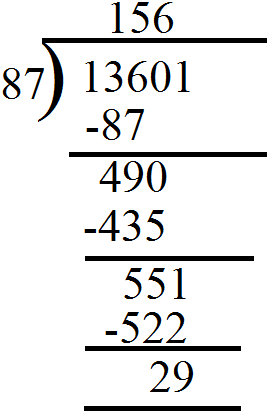
First, we will divide $13601$ by $87.$

Remainder $= 29$ So, $29$ must be subtracted from $13601$ to get a number exactly divisible by $87.$ i.e.,$ 13601 - 29 = 13572$ Now, we have:
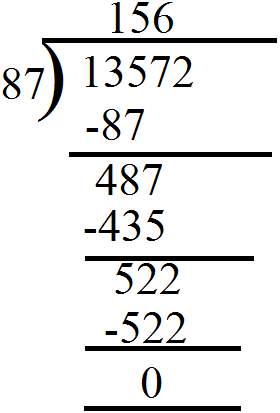
$\therefore 29$ must be subtracted from $13601$ to make it divisible by $87.$
View full question & answer
Question 25 Marks
What least number must be added to $1056$ to get a number exactly divisible by $23?$
Answer
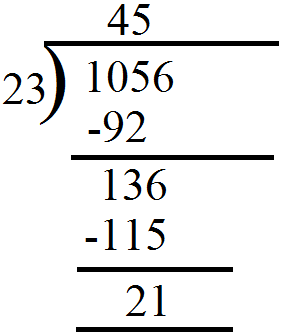
First, we will divide $1056$ by $23.$

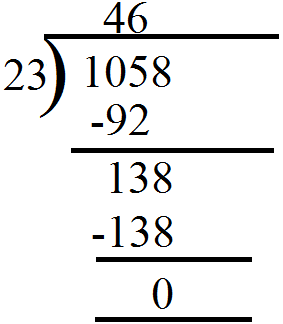
 Required number $= 23 - 21 = 2$ So, $2$ must be added to $1056$ to make it exactly divisible by $23.$ i.e., $1056 + 2 = 1058$ Now, we have:

​​​​​​​ $\therefore 1058$ is exactly divisible by $23.$
View full question & answer
Question 35 Marks
What least number must be subtracted from $13801$ to get a number exactly divisible by $87?$
Answer
We have to find the least number that must be subtracted from $13801$ to get a number exactly divisible by $87.$
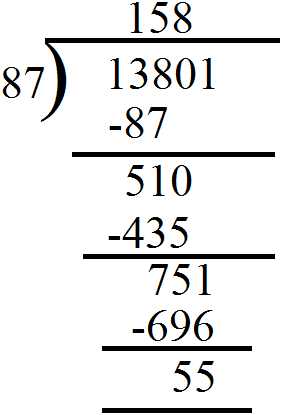
So, first we will divide $13801$ by $87$

Remainder $= 55$
The number $55$ should be subtracted from $13801$ to get a number divisible by $87.$
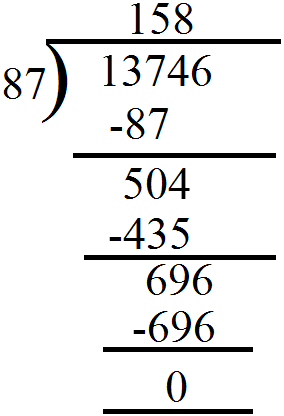
i.e., $13801 - 55 = 13746$​​​​​​​

$\therefore 13746 $ is divisible by $87.$
View full question & answer
Question 45 Marks
Match the following columns on whole numbers:
S.No.
Column A
S.No.
Column B
$(a)$
$137 + 63 = 63 + 137$
$(i)$
Associativity of multiplication
$(b)$
$(16 \times 25)$ is a number
$(ii)$
Commutativity of multiplication
$(c)$
$365 \times 18 = 18 \times 365$
$(iii)$
Distributive law of multiplication over addition.
$(d)$
$(d) (86 \times 14) \times 25 = 86 \times (14 \times 25)$
$(iv)$
Commutativity of addition
$(e)$
$23 \times (80 + 5) = (23 \times 80) + (23 \times 5)$
$(v)$
Closure property for multiplication
Answer
S.No.
Column A
S.No.
Column B
$(a)$
$137 + 63 = 63 + 137$
$(iv)$
Commutativity of addition
$(b)$
$(16 \times 25)$ is a number
$(v)$
Closure property for multiplication
$(c)$
$365 \times 18 = 18 \times 365$
$(ii)$
Commutativity of multiplication
$(d)$
$(86 \times 14) \times 25 = 86 \times (14 \times 25)$
$(i)$
Associativity of multiplication
$(e)$
$23 \times (80 + 5) = (23 \times 80) + (23 \times 5)$
$(iii)$
Distributive law of multiplication over addition
View full question & answer