Questions

[5 Marks Each] QUE-ANS

🎯

Test yourself on this topic

6 questions · timed · auto-graded

Question 15 Marks
Can we reverse the following changes? If yes, suggest the name of the method:
  1. Water into water vapour.
  2. Water vapour into water.
  3. Ice into water.
  4. Curd into milk.
Answer
  1. Yes, by condensation water vapour can be converted into water.
  2. Yes, by evaporation water converted into its vapour form.
  3. Yes, by freezing water converted into ice.
  4. Not possible.
View full question & answer
Question 25 Marks
Paheli mixed flour and water and:
  1. Made a dough.
  2. Rolled the dough to make a chapati.
  3. Baked the chapati on a pan.
  4. Dried the chapati and ground it in a grinder to make powder. Identify the changes (i) to (iv) as the changes that can be reversed or that cannot be reversed.
Answer
  1. Made a dough this change cannot be reversed.
  2. Rolled the dough to make a chapatti. This change can be reversed.
  3. Baked the chapatti on a pan, this change cannot be reversed.
  4. Dried the chapatti and ground it in a grinder to make powder, this change cannot be reversed.
View full question & answer
Question 35 Marks
Give examples to explain the difference between changes that can or cannot be reversed.
Answer
To explain the differences between changes that can or cannot be reversed, some examples are given below:
  1. If we inflate a balloon, the size and shape of the balloon undergoes a change. However, the original size and shape of the balloon can be obtained back by allowing the air to escape from the balloon. This means that the change that occurs by inflating a balloon can be reversed. But, if the balloon bursts after being inflated, then its original size and shape cannot be obtained back. Thus, in this case, the change cannot be reversed.
  2. If we fold a piece of paper, then the shape and size of the paper undergoes a change. In this case, the original shape and size of the original paper can be obtained back. Thus, this change can be reversed. However, if we cut the piece of paper, the change in the shape and size of the paper cannot be reversed.
  3. After we roll out a chapatti from a ball of dough, the chapatti can be converted back into a ball. Thus, the change occurring here can be reversed. But, if we cook the chapatti on a tawa, then it cannot be converted back into a ball of dough. Thus, the change is irreversible.
View full question & answer
Question 45 Marks
Give some examples from daily life where expansion of metal by heating is used. Explain.
Answer
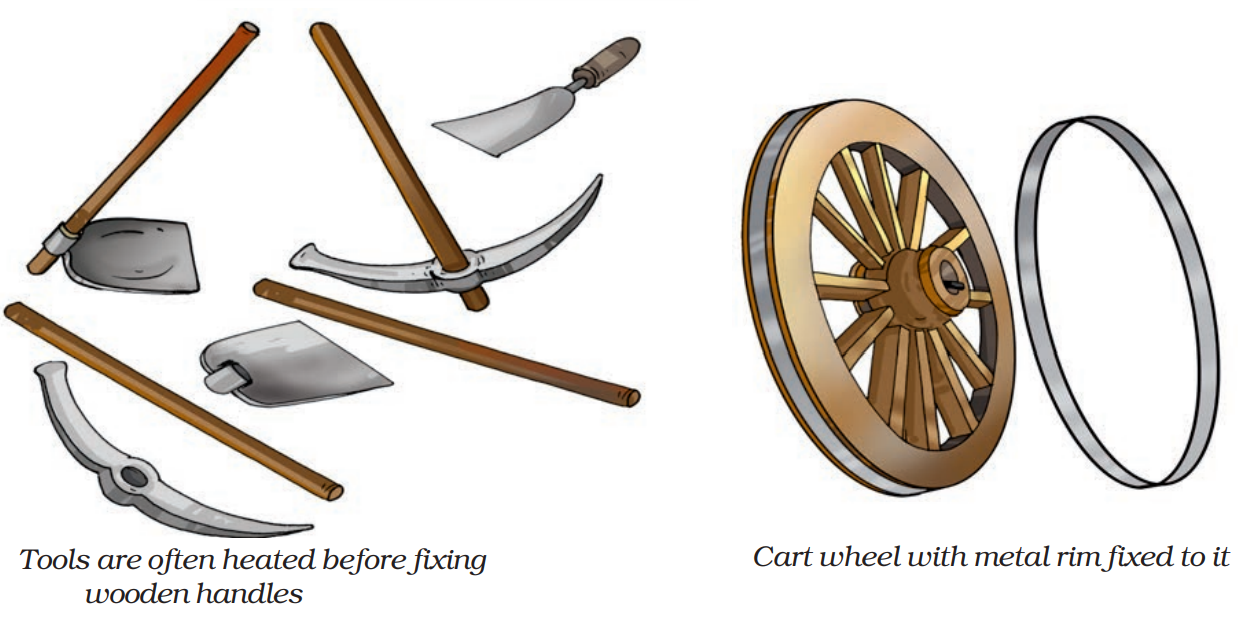
Fixing of a metal rim on an wooden wheel and fixing of wooden handles in iron blade in agricultural tools are such examples.
The iron blade of these tools has a ring in which the wooden handle is fixed. Normally, the ring is slightly smaller in size than the wooden handle. To fix the handle, the ring is heated and it becomes slightly larger in size (expands). Now, the handle easily fits into the ring. When the ring cools down, it contracts and fits tightly onto the handle.
Such a change is also used for fixing the metal rim on a wooden wheel of a«cart as shown in Fig. Again the metal rim is made slightly smaller than the wooden wheel. On heating, the rim expands and fits onto the wheel. Cold water is then poured over the rim, which contracts and fits tightly onto the wheel.
View full question & answer
Question 55 Marks
Give one example in each case:
  1. Change which occurs on heating but can be reversed.
  2. Change which occurs on heating but cannot be reversed.
  3. Change which occurs on cooling but can be reversed.
  4. Change which occurs on mixing two substances, but can be reversed.
  5. Change which occurs on mixing two substances, but cannot be reversed.
Answer
The example of each case is as follows:
  1. Heating of an iron rod.
  2. Baking of chapatti.
  3. Formation of ice from water.
  4. Formation of salt solution.
  5. Mixing of cement and water.
View full question & answer
Question 65 Marks
It was Paheli’s birthday, her brother Simba was helping her to decorate the house for the birthday party and their parents were also busy making other arrangements. Following were the activities going on at Paheli’s home:
  1. Simba blew balloons and put them on the wall.
  2. Some of the balloons got burst.
  3. Paheli cut colourful strips of paper and put them on the wall with the help of tape.
  4. She also made some flowers by origami (paper folding) to decorate the house.
  5. Her father made dough balls.
  6. Mother rolled the dough balls to make puries.
  7. Mother heated oil in a pan.
  8. Father fried the puries in hot oil.
Identify the activities at Paheli’s home as those that can be reversed and those which cannot be reversed.
Answer
Reversed changes are as follows:
  1. Simba blew balloons and put them on the wall.
  1. Making of some flowers by origami (paper folding) to decorate the house.
  2. Her father made dough balls.
  3. Mother rolled the dough balls to make puries
  4. Mother heated oil in a pan.
Changes that cannot be reversed are as follows:
  1. Some of the balloons got burst.
  1. Paheli cut colourful strips of paper and put them on the wall with the help of tape.
  1. Father fried the puries in hot oil.
View full question & answer