Questions

3 Marks Question

🎯

Test yourself on this topic

38 questions · timed · auto-graded

Question 13 Marks
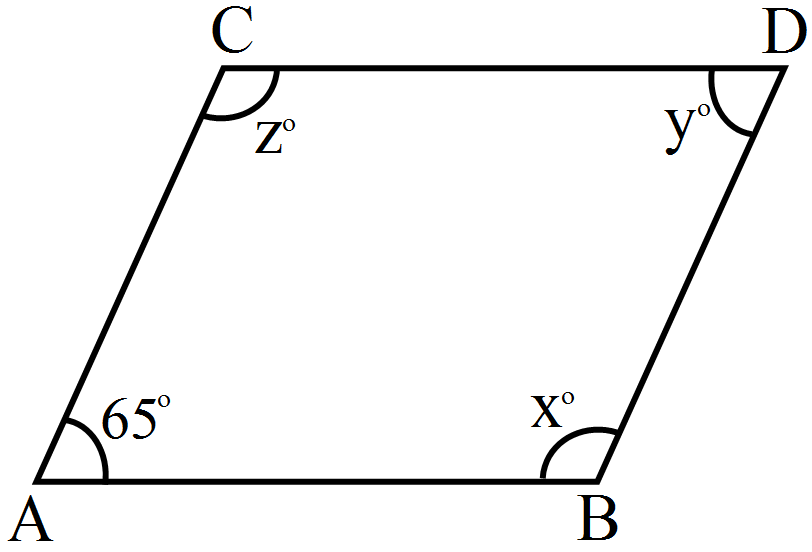
In Figure, $AB\ ||\ CD$ and $AC\ ||\ BD$. Find the values of $x, y, z$.
Answer
Since, $AC\ ||\ BD$ and $CD\ ||\ AB$,
$ABCD$ is a parallelogram Adjacent angles of parallelogram,
$\angle \text{CAD}+\angle \text{ACD}=180^\circ$
$=\angle \text{ACD}=180^\circ-65^\circ$
$=115^\circ$
Opposite angles of parallelogram,
$=\angle \text{CAD}=\angle \text{CDB}=65^\circ$
$=\angle \text{ACD}=\angle \text{DBA}=115^\circ$
View full question & answer
Question 23 Marks
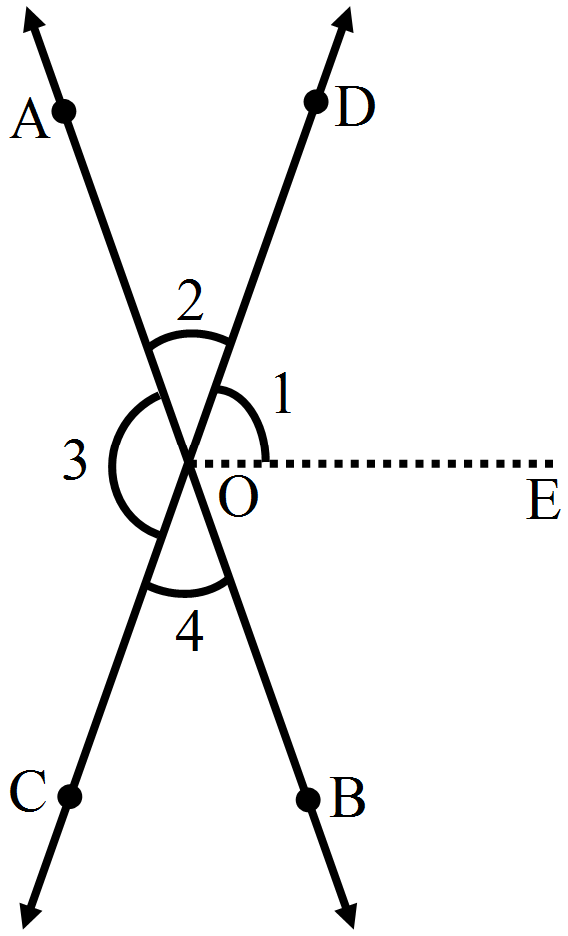
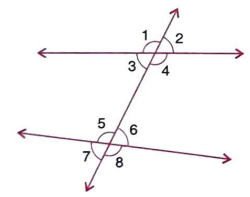
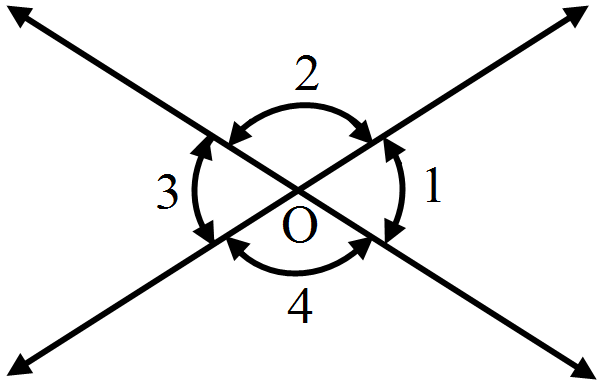
In Fig., it being given that $\angle1 = 65^\circ,$ find all the other angles.
Answer
Given,
$\angle1=\angle3 $ are the vertically opposite angles
Therefore, $\angle3 = 65^\circ$
Here, $\angle1 + \angle2 = 180^\circ$ are the linear pair
Therefore, $\angle2 = 180^\circ-65^\circ$
$= 115^\circ$
$\angle2 = \angle4$ are the vertically opposite angles
Therefore, $\angle2 = \angle4 = 115^\circ$
And $\angle3 = 65^\circ$
View full question & answer
Question 33 Marks
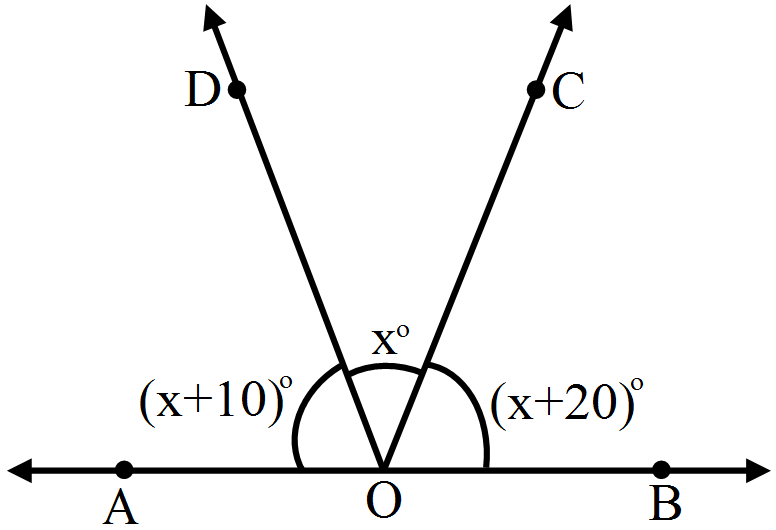
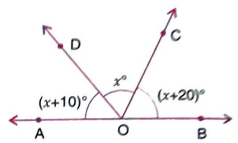
In Figure, find $\angle \text{x}.$ Further find $\angle \text{BOC}, \angle \text{COD}, \text{ and }\angle \text{AOD}$
Answer
$\angle \text{AOD}+\angle \text{DOC}+\angle \text{COB}=180^\circ$ (Linear pair)
$(\text{x}+10)^\circ+\text{x}^\circ+(\text{x}+20)^\circ=180^\circ$
$3\text{x}+30^\circ=180^\circ$
$3\text{x}=180^\circ-30^\circ$
$3\text{x}=150^\circ$
$\text{x}=\frac{150^\circ}{3}=50^\circ$
$\angle \text{BOC}=\text{x}+20^\circ$
$=50^\circ+20^\circ=70^\circ$
$\angle \text{COD}=\text{x}=50^\circ$
$\angle \text{AOD}=\text{x}+10^\circ$
$=50^\circ+10^\circ=60^\circ$
View full question & answer
Question 43 Marks
In Figure, $OE$ is the bisector of $\angle \text{BOD}.$ If $\angle1 =70^\circ,$ Find the magnitude of $\angle2, \angle3, \angle4$
Answer
Since $OE$ is the bisector of $\angle\text{BOD},$
$\therefore\angle\text{DOE}=\angle\text{EOB}$
$\angle2+\angle1+\angle\text{EOB}=180^\circ$ (Linear pair)
$\angle2+\angle1=180^\circ$ $(\angle1=\angle\text{EOB})$
$\Rightarrow\angle2=180^\circ-2\angle1=180^\circ-2\times 70^\circ$
$\Rightarrow 180^\circ-140^\circ=40^\circ$
$\angle4=\angle2=40^\circ$ (Vertically opposite angles)
$\angle3=\angle\text{DOB}=\angle1+\angle\text{EOB}$$[\angle3=\angle\text{DOB}$ (Vertically opposite)$]$
$=70^\circ+70^\circ$
$=140^\circ$
View full question & answer
Question 53 Marks
If two supplementary angles have equal measure, what is the measure of each angle?
Answer
Let $p$ and $q$ be the two supplementary angles that are equal $\angle \text{p}=\angle \text{q}$
So, $\angle \text{p}+\angle \text{q}=180^\circ$
$\Rightarrow\angle \text{p}+\angle \text{p}=180^\circ$
$\Rightarrow2\angle \text{p}=180^\circ$
$\Rightarrow \angle \text{p}=\frac{180^\circ}{2}$
$\Rightarrow \angle \text{p}=90^\circ$
Therefore, $\angle \text{p}=\angle \text{q}=90^\circ$
View full question & answer
Question 63 Marks
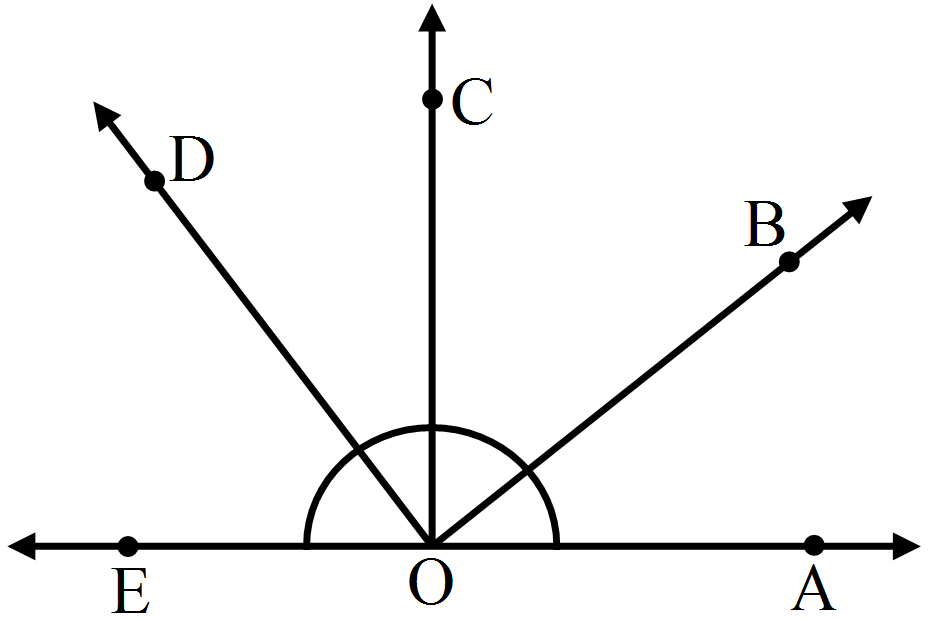
How many pairs of adjacent angles, in all, can you name in Figure?
Answer
There are $10$ adjacent pairs, $\angle \text{EOD}\text{ and }\angle \text{DOC}$
$\angle \text{COD}\text{ and }\angle \text{BOC}$
$\angle \text{COB}\text{ and }\angle \text{BOA}$
$\angle \text{AOB}\text{ and }\angle \text{BOD}$
$\angle \text{BOC}\text{ and }\angle \text{COE}$
$\angle \text{COD}\text{ and }\angle \text{COA}$
$\angle \text{DOE}\text{ and }\angle \text{DOB}$
$\angle \text{EOD}\text{ and }\angle \text{DOA}$
$\angle \text{EOC}\text{ and }\angle \text{AOC}$
$\angle \text{AOB}\text{ and }\angle \text{BOE}$
View full question & answer
Question 73 Marks
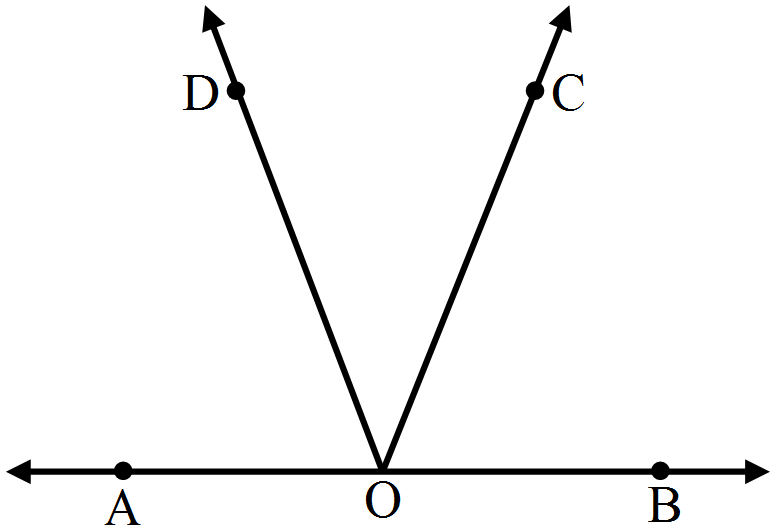
In Figure, write all pairs of adjacent angles and all the linear pairs.

Answer
Pairs of adjacent angles are:
$\angle\text{DOA and }\angle\text{DOC}$
$\angle \text{BOC}\text{ and }\angle \text{COD}$
$\angle \text{AOD}\text{ and } \angle \text{BOD}$
$\angle \text{AOC}\text{ and }\angle \text{BOC}$
Linear pairs:
$\angle \text{AOD}\text{ and }\angle \text{BOD}$
$\angle \text{AOC}\text{ and }\angle \text{BOC}$
View full question & answer
Question 83 Marks
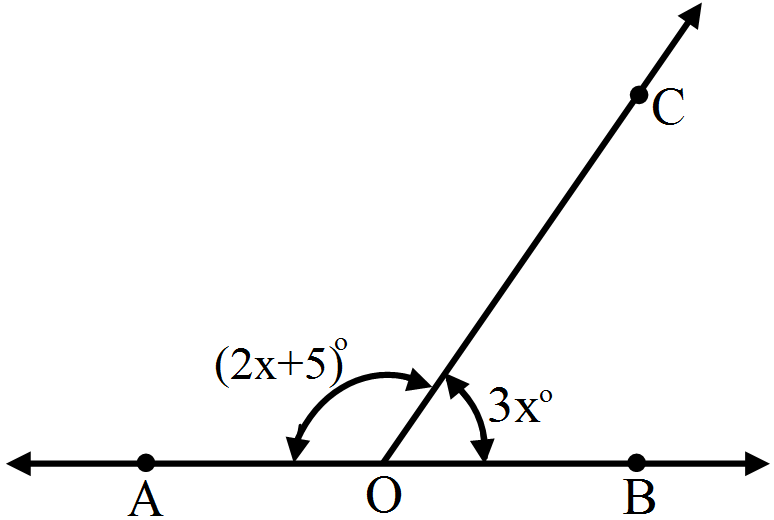
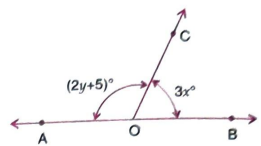
In Fig. $OA$ and $OB$ are the opposite rays: If $x = 25^\circ $, what is the value of $y$?
Answer
$\angle \text{AOC}+\angle \text{BOC}=180^\circ-\text{Linear pair}$
$\Rightarrow 2\text{y}+5+3\text{x}=180^\circ$
$\Rightarrow 3\text{x}+2\text{y}=175^\circ$
If $\text{x}=25^\circ,$ then
$\Rightarrow 3(25^\circ)+2\text{y}=175^\circ$
$\Rightarrow 75^\circ+2\text{y}=175^\circ$
$\Rightarrow 2\text{y}=175^\circ-75^\circ$
$\Rightarrow2\text{y}=100^\circ$
$\Rightarrow \text{y}=\frac{100^\circ}{2}$
$\Rightarrow \text{y}=50^\circ$
View full question & answer
Question 93 Marks
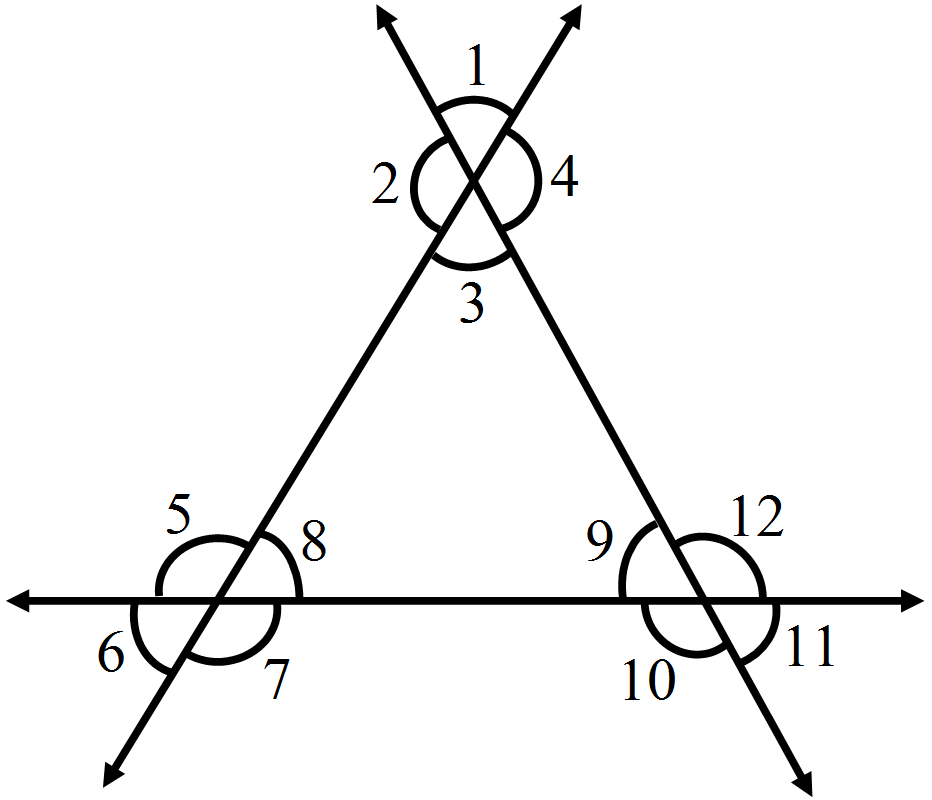
In Figure, name each linear pair and each pair of vertically opposite angles.
Answer
Two adjacent angles are said to be linear pair of angles, if their non-common arms are two opposite rays.
$\angle1 \text{ and } \angle2$
$\angle2 \text{ and } \angle3$
$\angle3 \text{ and } \angle4$
$\angle1 \text{ and } \angle4$
$\angle5 \text{ and } \angle6$
$\angle6 \text{ and } \angle7$
$\angle7 \text{ and } \angle8$
$\angle8 \text{ and } \angle5$
$\angle9 \text{ and } \angle10$
$\angle10 \text{ and } \angle11$
$\angle11 \text{ and } \angle12$
$\angle12 \text{ and } \angle9$
The two angles are said to be vertically opposite angles if the two intersecting lines have no common arms.
$\angle1 \text{ and } \angle3$
$\angle4 \text{ and } \angle2$
$\angle5 \text{ and } \angle7$
$\angle6 \text{ and } \angle8$
$\angle9 \text{ and } \angle11$
$\angle10 \text{ and } \angle12$
View full question & answer
Question 103 Marks
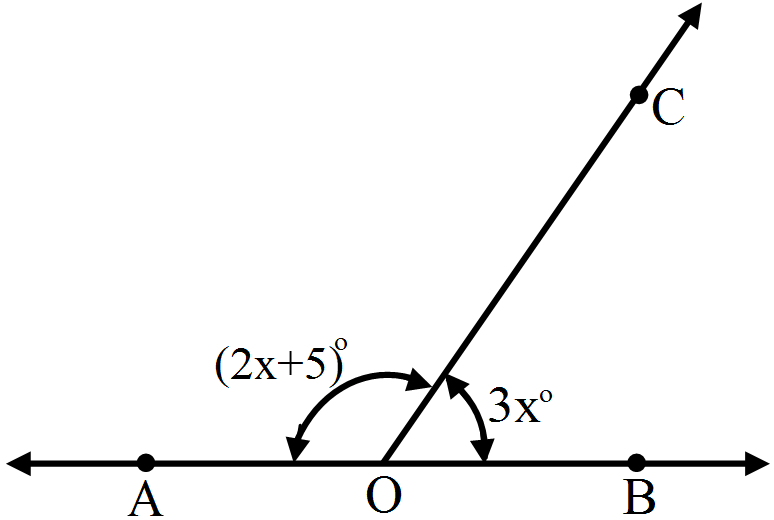
In Fig. $OA$ and $OB$ are the opposite rays: If $y = 35^\circ $, what is the value of $x$?
Answer
$\angle \text{AOC}+\angle \text{BOC}=180^\circ-\text{Linear pair}$
$\Rightarrow 2\text{y}+5+3\text{x}=180^\circ$
$\Rightarrow 3\text{x}+2\text{y}=175^\circ$
If $\text{y}=35^\circ,$ then $3\text{x}+2(35^\circ)=175^\circ$
$\Rightarrow 3\text{x}+70^\circ=175^\circ$
$\Rightarrow 3\text{x}=175^\circ-70^\circ$
$\Rightarrow 3\text{x}=105^\circ$
$\Rightarrow \text{x}=\frac{105^\circ}{3}$
$\Rightarrow \text{x}=35^\circ$
View full question & answer
Question 113 Marks
If the complement of an angle is $28^\circ $, then find the supplement of the angle.
Answer
Here, let $p$ be the complement of the given angle $28^\circ$
Therefore, $\angle \text{p}+28^\circ=90^\circ$
$\Rightarrow \angle \text{p}=90^\circ-28^\circ$
$=62^\circ$
So, the supplement of the angle $= 180^\circ - 62^\circ = 118^\circ$
View full question & answer
Question 123 Marks
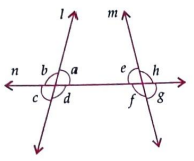
In Fig. line n is a transversal to lines 1 and m. Identify the following:
Pairs of interior and exterior angles on the same side of the transversal in Fig.
Image
Answer
Interior angles: $\angle d, \angle f ; \angle a, \angle e ;$
Exterior angles: $\angle c, \angle g ; \angle b, \angle h$.
View full question & answer
Question 133 Marks
In Fig. line n is a transversal to lines 1 and m. Identify the following:
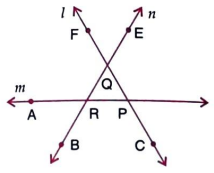
Angle alternate to $\angle P Q R$, angle corresponding to $\angle R Q F$ and angle alternate to $\angle P Q E$ in Fig.
Image
Answer
$\angle Q R A, \angle B R A, \angle B R A$
View full question & answer
Question 153 Marks
In Fig. line n is a transversal to lines 1 and m. Identify the following:
Angles alternate to $\angle d$ and $\angle g$ and angles corresponding to angles $\angle \int$ and $\angle n$ in Fig.
Image
Answer
$\angle e, \angle b, \angle c, \angle a$
View full question & answer
Question 173 Marks
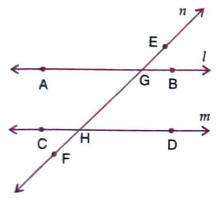
In Fig. line n is a transversal to lines 1 and m. Identify the following:
Alternate and corresponding angles in Fig.
Image
Answer
Alternate angles: $\angle B G H$ and $\angle C H G ; \angle A G H$ and $\angle D H G$.
Corresponding angles: $\angle E G B$ and $\angle G H D ; \angle E G A$ and $\angle G H C ; \angle B G H$ and $\angle D H F$; $\angle A G H$ and $\angle C H F$.
View full question & answer
Question 183 Marks
In Fig. write down: (i) each linear pair
Image
Answer
$\angle 1, \angle 2 ; \angle 2, \angle 4 ; \angle 3, \angle 4 ; \angle 1, \angle 3 ; \angle 5, \angle 6 ; \angle 5, \angle 7 ; \angle 7, \angle 8 ; \angle 6, \angle 8$
View full question & answer
Question 193 Marks
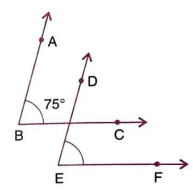
In Fig. the corresponding arms of $\angle A B C$ and $\angle D E F$ are parallel. If $\angle A B C=75^{\circ}$, find $\angle D E F$.
Image
Answer
$75^{\circ}$
View full question & answer
Question 203 Marks
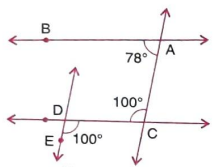
In Fig. state which lines are parallel and why?
Image
Answer
$A C \| D E$, because alternate angles are equal
View full question & answer
Question 213 Marks
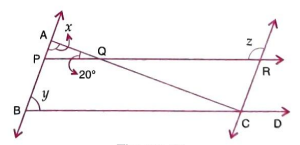
In Fig. line $C A \perp A B \|$ line $C R$ and line $P R \|$ line $B D$. Find $\angle x, \angle y$ and $\angle z$.
Image
Answer
$x=90^{\circ}, y=70^{\circ}, z=110^{\circ}$
View full question & answer
Question 223 Marks
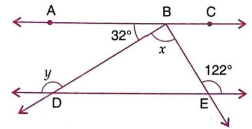
In Fig. line $A C \|$ line $D E$ and $\angle A B D=32^{\circ}$. Find out the angles $x$ and $y$, if $\angle E=122^{\circ}$.
Image
Answer
$x=90^{\circ}, y=148^{\circ}$
View full question & answer
Question 283 Marks
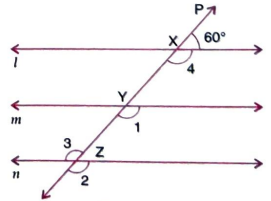
In Fig. $l, m$ and $n$ are parallel lines intersected by transversal $p$ at $X, Y$ and $Z$ respectively. Find $\angle 1, \angle 2$ and $\angle 3$.
Image
Answer
$\angle 1=120^{\circ}, \angle 2=120^{\circ}, \angle 3=120^{\circ}$
View full question & answer
Question 293 Marks
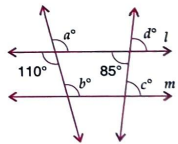
In Fig. line $l \| m$. Find the values of $a, b, c, d$. Give reasons.
Image
Answer
$a=110^{\circ}, b=110^{\circ}, c=85^{\circ}, d=85^{\circ}$
View full question & answer
Question 303 Marks
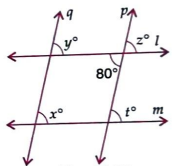
In Fig. $l \| m$ and $p \| q$. Find the values of $x, y, z, t$.
Image
Answer
$x=80^{\circ}, y=80^{\circ}, z=80^{\circ}, t=80^{\circ}$ 9. $\angle 3=80^{\circ}, \angle 4=40^{\circ}$
View full question & answer
Question 313 Marks
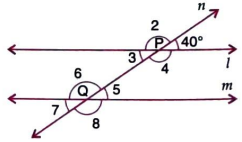
In Fig. line $l \| m$ and $n$ is a transversal. If $\angle 1=40^{\circ}$, find all the angles and check that all corresponding angles and alternate angles are equal.
Image
Answer
$\angle 2=140^{\circ}, \angle 3=40^{\circ}, \angle 4=140^{\circ}, \angle 5=40^{\circ}, \angle 6=140^{\circ}, \angle 7=40^{\circ}, \angle 8=140^{\circ}$
View full question & answer
Question 353 Marks
In Fig.find $\angle x$. Further find $\angle B O C, \angle C O D$ and $\angle A O D$.
Image
Answer
$x=50^{\circ}, \angle B O C=70^{\circ}, \angle C O D=50^{\circ}, \angle A O D=60^{\circ}$
View full question & answer
Question 363 Marks
If the complement of an angle is $28^{\circ}$, then find the supplement of the angle.
Answer
$118^{\circ}$
View full question & answer
Question 383 Marks
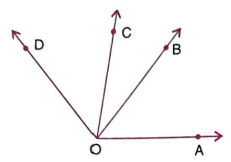
Write down each pair of adjacent angles shown in Fig.
Image
Answer
$\angle A O B, \angle B O C ; \angle A O C, \angle C O D ; \angle B O C, \angle C O D ; \angle A O B, \angle B O D$
View full question & answer