Questions

2 Marks Questions

🎯

Test yourself on this topic

20 questions · timed · auto-graded

Question 12 Marks
The diagonals of a rhombus measure $16 \ cm$ and $30 \ cm$. Find its perimeter.
Answer
Halves of diagonals of a rhombus make the legs of a right angle triangle while hypotenuse is made by a side of the rhombus. So, side of the rhombus can be calculated by using Pythagoras rule;
We know; $h^2=l^2+b^2$
$\Rightarrow h^2=8^2+15^2$
$=64+225=289$
$\Rightarrow h^2=17 \times 17$
$\Rightarrow h=17 \mathrm{~cm}$
Hence, Perimeter $=4 \times$ side $=17 \times 4=68 \mathrm{~cm}$
View full question & answer
Question 22 Marks
Find the perimeter of the rectangle whose length is $40 \ cm$ and a diagonal is $41 \ cm.$
Answer
Breadth of the rectangle can be calculated by using Pythagoras rule because length, breadth and diagonal would make a right-angled triangle.
$\text { So, } h^2=p^2+b^2$
$\Rightarrow 41^2=40^2+b^2$
$\Rightarrow 1681=1600+b^2$
$\Rightarrow b^2=1681-1600=81$
$\Rightarrow b^2=9 \times 9$
$\Rightarrow b=9 \mathrm{~cm}$
Perimeter can be calculated as follows:
$\text { Perimeter }=2 \text { (length }+ \text { breadth })$
$=2(40+9)=2 \times 49=98 \mathrm{~cm}$
 
View full question & answer
Question 32 Marks
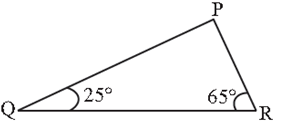
Angles $Q$ and $R$ of a $\triangle PQR$ are $25^\circ $ and $65^\circ $. Write which of the following is true:
Answer
As per the question, we can see that:
In $\triangle P Q R$, we have
$\angle \mathrm{Q}=25^{\circ} \text { and } \angle \mathrm{R}=65^{\circ}$
We know that,
The sum of interior angles of a triangle $=180^{\circ}$
$\angle \mathrm{PQR}+\angle \mathrm{PRQ}+\angle \mathrm{QPR}=180^{\circ}$
$25^{\circ}+65^{\circ}+\angle \mathrm{QPR}=180^{\circ}$
$90^{\circ}+\angle \mathrm{QPR}=180^{\circ}$
$\angle \mathrm{QPR}=180^{\circ}-90^{\circ}=90^{\circ}$
Hence, $\triangle P Q R$ is right angled at point $P$
Therefore,
By using Pythagoras theorem, we get:
$(P R)^2+(P Q)^2=(Q R)^2$
 
View full question & answer
Question 42 Marks
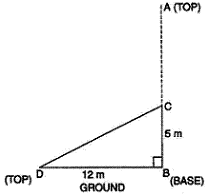
A tree is broken at a height of $5 \ m$ from the ground and its top touches the ground at a distance of $12 \ m$ from the base of the tree. Find the original height of the tree.
Answer

$A C=C D \ldots$ [Given]
In right angled triangle $DBC,$
$D C^2=B C^2+B D^2$
[By Pythagoras Property]
$D C^2=5^2+12^2$
$D C^2=25+144$
$D C^2=169 \mathrm{~m}^2$
$D C=13 \mathrm{~m}$
$A C=13 \mathrm{~m}$
$A B=A C+B C=13+5=18 \mathrm{~m}$
Therefore, the original height of the tree $=18 \mathrm{~m}$.
View full question & answer
Question 52 Marks
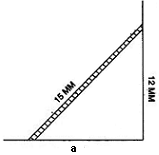
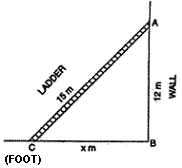
A $15 \ m$ long ladder reached a window $12 \ m$ high from the ground on placing it against a wall at distance a. Find the distance of the foot of the ladder from the wall.
Answer


Let the distance of the foot of the ladder from the wall be $x \ m$ . Then,
$x^2+12^2=15^2 \ldots$ [By Pythagoras Property]
$x^2+144=225$
$x^2=225-144$
$x^2=81$
$x=9$
Hence, the distance of the foot of the ladder from the wall is $9 \ m.$
View full question & answer
Question 62 Marks
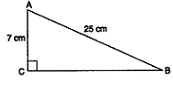
$ABC$ is a triangle right-angled at $C$. If $AB = 25 cm$ and $AC = 7 cm$, find $BC$
Answer

$A C^2+B C^2=A B^2 \ldots .[\text {By Pythagoras Property}]$
$7^2+B C^2=25^2$
$49+B C^2=625$
$B C^2=625-49$
$B C^2=576$
$B C=24 \mathrm{~cm}$.
View full question & answer
Question 72 Marks
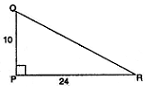
$PQR$ is a triangle right-angled at $P$. If $PQ = 10\ cm$ and $PR = 24\ cm$, find $QR.$
Answer


$\mathrm{QR}^2=\mathrm{QP}^2+\mathrm{PR}^2 \ldots .[\text {By Pythagoras Property}]$
$\mathrm{QR}^2=10^2+24^2$
$\mathrm{QR}^2=100+576$
$\mathrm{QR}^2=676$
$\mathrm{QR}=26 \mathrm{~cm}$
 
View full question & answer
Question 82 Marks
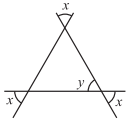
Find the values of the unknowns $x$ and $y$ in the diagram-
Answer
$x^{\circ}=y^{\circ} \ldots .. (1)$ [Vertically opposite angles are equal]
$x^{\circ}+x^{\circ}+y^{\circ}=180^{\circ} \ldots .$. [By the angle-sum property of a triangle]
$\therefore 2 x^{\circ}+y^{\circ}=180^{\circ}$
$\therefore 2 x^{\circ}+x^{\circ}=180^{\circ}[\text { Using (1)] }$
$\therefore 3 x^{\circ}=180^{\circ}$
$\therefore x^{\circ}=\frac{180^{\circ}}{3}$
$\therefore x^{\circ}=60^{\circ} . . . .(2)$
$\therefore y^{\circ}=60^{\circ} \ldots \ldots . .[\text { Using (1)] }$
$\therefore y=60^{\circ}$
From $(2), x=60^{\circ}$
View full question & answer
Question 92 Marks
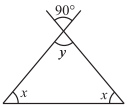
Find the values of the unknowns $x$ and $y$ in the diagram -
Answer
$y^{\circ}=90^{\circ} \ldots . . .(1)$
$\therefore y=90^{\circ} \ldots .$. . [Vertically opposite angles are equal]
$x^{\circ}+x^{\circ}+y^{\circ}=180^{\circ} \ldots . . . .$ [ By the angle-sum property of a triangle]
$\therefore 2 x^{\circ}+y^{\circ}=180^{\circ}$
$\therefore 2 x^{\circ}+90^{\circ}=180^{\circ}$ [Using $(1)]$
$\therefore 2 x^{\circ}=180^{\circ}-90^{\circ}$
$\therefore 2 x^{\circ}=90^{\circ}$
$\therefore x=\frac{90^{\circ}}{2}$
$\therefore x=45^{\circ}$
 
View full question & answer
Question 102 Marks
Find the values of the unknowns $x$ and $y$ in the diagram:-
Answer
$x^\circ = 80^\circ . . . . (1)$
$ \therefore x = 80^\circ . . . .$ [Vertically opposite angles are equal]
$x^\circ + 30^\circ + y^\circ = 180^\circ . . . $[ By the angle-sum property of a triangle]
$\Rightarrow x^\circ + y^\circ = 180^\circ – 30^\circ $
$ \Rightarrow x^\circ + y^\circ = 150^\circ $
$ \Rightarrow 80^\circ + y^\circ = 150^\circ $ [Using $(1)]$
$ \Rightarrow y^\circ = 150^\circ – 80^\circ $
$ \Rightarrow y^\circ = 70^\circ $
View full question & answer
Question 112 Marks
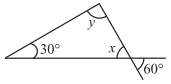
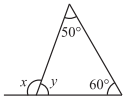
Find the values of the unknowns $x$ and $y$ in the diagram :-
Answer
$x^\circ = 50^\circ + 60^\circ .....$[ By the exterior-angle property of a triangle]
$\therefore x^\circ = 110^\circ $
$ \therefore x = 110^\circ $
$y^\circ + 50^\circ + 60^\circ = 180^\circ .....$.[ By the angle-sum property of a triangle]
$\therefore y^\circ + 110^\circ = 180^\circ $
$ \therefore y^\circ = 180^\circ – 110^\circ $
$ \therefore y^\circ = 70^\circ $
$ \therefore y = 70^\circ $
View full question & answer
Question 122 Marks
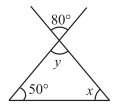
Find the values of the unknowns $x$ and $y$ in the diagram :
Answer
$y^\circ = 80^\circ .....(1) $ [Vertically opposite angles are equal]
$\therefore y = 80^\circ $
$ \therefore x^\circ + 50^\circ + y^\circ = 180^\circ .....$[ By the angle-sum property of a triangle]
$\therefore x^\circ + y^\circ = 180^\circ – 50^\circ $
$ \therefore x^\circ + y^\circ = 130^\circ $
$ \therefore x^\circ + 80^\circ = 130^\circ $
$ \therefore x^\circ = 130^\circ – 80^\circ .....$[Using $(1)]$
$ \therefore x^\circ = 50^\circ $
$ \therefore x = 50^\circ $
View full question & answer
Question 132 Marks
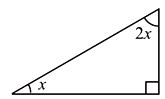
Find the value of the unknown $x$ in the diagram:
Answer
From the given figure, we have
$1^{\text {st }}$ interior angle $=x, 2^{\text {nd }}$ interior angle $=2 x$ and $3^{\text {rd }}$ interior angle $=90^{\circ}$
We have to find out the value of $x$
Thus, $x+2 x+90^{\circ}=180^{\circ}$ (angle sum property of triangle)
$3 x+90^{\circ}=180^{\circ}$
$3 x=180^{\circ}-90^{\circ}$
$3 x=90^{\circ}$
$x=\frac{90}{3}$
$x=30^{\circ}$
Hence, the value of $x$ is $30^{\circ}$
View full question & answer
Question 142 Marks
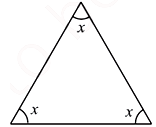
Find the value of the unknown $x$ in the diagram:
Answer
From the given figure, we have
$1^{\text {st }}$ interior angle $=x, 2^{\text {nd }}$ interior angle $=x$, and $3^{\text {rd }}$ interior angle $=x$
We have to find out the value of $x$
Here, $x+x+x=180^{\circ}$ (angle sum property of triangle)
$3 x=180^{\circ}$
$x=\frac{180}{3}$
$x=60^{\circ}$
Hence, the value of $x$ is $60^{\circ}$
View full question & answer
Question 152 Marks
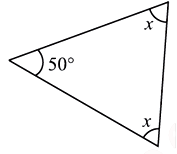
Find the value of the unknown $x$ in the diagram:
Answer
From the given figure, we have
$1^{\text {st }}$ interior angle $=50^{\circ}, 2^{\text {nd }}$ interior angle $=x$ and $3^{\text {rd }}$ interior angle $=x$
We have to find out the value of $x$
Thus,
$50^{\circ}+x+x=180^{\circ}$ (angle sum property of triangle)
$2 x+50^{\circ}=180^{\circ}$
$2 x=180^{\circ}-50^{\circ}$
$2 x=130^{\circ}$
$x=\frac{130}{2}$
$x=65^{\circ}$
Hence, the value of $x$ is $65^{\circ}$
View full question & answer
Question 162 Marks
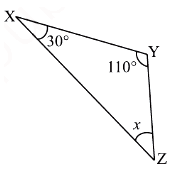
Find the value of the unknown $x$ in the diagram:
Answer
From the given figure, we have
$1^{\text {st }}$ interior angle $=x, 2^{\text {nd }}$ interior angle $=30^{\circ}$ and $3^{\text {rd }}$ interior angle $=110^{\circ}$
Thus,
$x+30^{\circ}+110^{\circ}=180^{\circ} \text { (angle sum property of triangle) }$
$x+140^{\circ}=180^{\circ}$
$x=180^{\circ}-140^{\circ}$
$x=40^{\circ}$
Hence, the value of $x$ is $40^{\circ}$
View full question & answer
Question 172 Marks
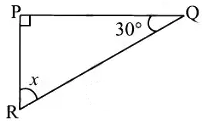
Find the value of the unknown $x$ in the diagram:
Answer
From the given figure, we have
$1^{\text {st }}$ interior angle $=x, 2^{\text {nd }}$ interior angle $=90^{\circ}$ and $3^{\text {rd }}$ interior angle $=30^{\circ}$
Thus,
$x+90^{\circ}+30^{\circ}=180^{\circ} \text { (angle sum property of triangle) }$
$x+120^{\circ}=180^{\circ}$
$x=180^{\circ}-120^{\circ}$
$x=60^{\circ}$
Hence, the value of $x$ is $60^{\circ}$
View full question & answer
Question 182 Marks
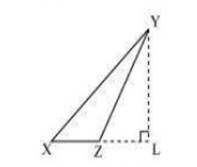
Draw rough sketches for the $\triangle XYZ, YL$ is an altitude in the exterior of the triangle.
Answer
Given,
$\triangle XYZ$, where $YL$ is an altitude in the exterior of the triangle.
Therefore,
The rough sketch for the given figure is as follows:
View full question & answer
Question 192 Marks
Draw rough sketches for the $\triangle PQR, PQ$ and $PR$ are altitudes of the triangle.
Answer
We have,
$\triangle PQR$, where, $PQ$ and $QR$ are the altitudes of the triangle.
Therefore,
The rough sketch for the given figure is as follows:

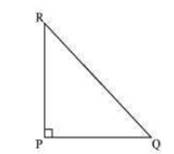
It is a right-angled triangle $PQR$, right-angled at $P.$
As $PQ \perp PR$
and $PR \perp PQ$
Thus, $PQ$ and $PR$ are altitudes of $\triangle PQR.$
View full question & answer
Question 202 Marks
Draw rough sketches for the $\triangle ABC, BE$ is a median.
Answer
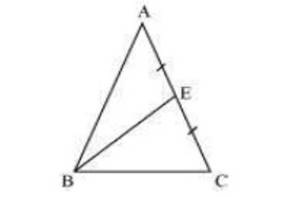
Given a $\Delta ABC$ and in this triangle, $BE$ is a median.
Therefore,
The rough sketch for the given figure is as follows:

Median is the line that divides the opposite side into two equal parts.
View full question & answer