Questions · Page 2 of 2

1 Marks Question

Question 511 Mark
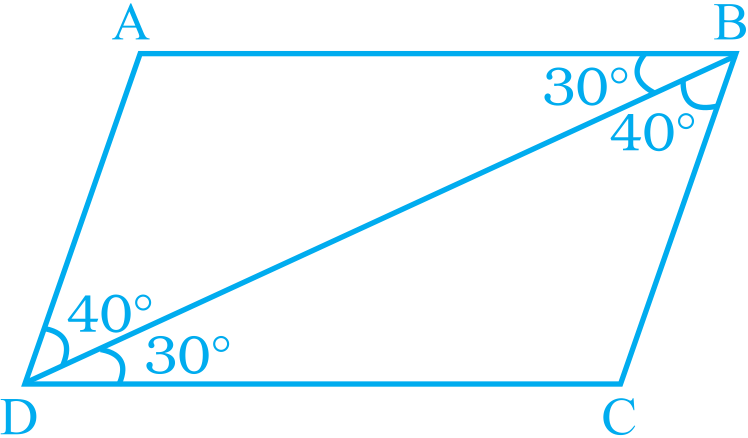
In given pairs of triangles of Figure. applying only $ASA$ congruence criterion, determine which triangles are congruent. Also, write the congruent triangles in symbolic form.
Answer
$∆\text{ABD} ≅ ∆\text{CDB}$
View full question & answer
Question 521 Mark
Two angles are said to be, ________ if they have equal measures.
Answer
Two angles are said to be, congruent if they have equal measures.Solution:
Two angles are said to be congruent, if they have equal measures.
View full question & answer
Question 531 Mark
Measures of each of the angles of an equilateral triangle is ________.
Answer
Measures of each of the angles of an equilateral triangle is $60^\circ$ as all the angles in an equilateral triangle are equal. Let $x$ be the angle of equilateral. According to the angle sum property of a triangle.
$x + x + x = 180^\circ $
$\Rightarrow \ 3\text{x}={180^{\circ}}$
$\Rightarrow \ 3\text{x}=\frac{180^{\circ}}{3}$
$\Rightarrow \ \text{x}=60^{\circ}$
View full question & answer
Question 541 Mark
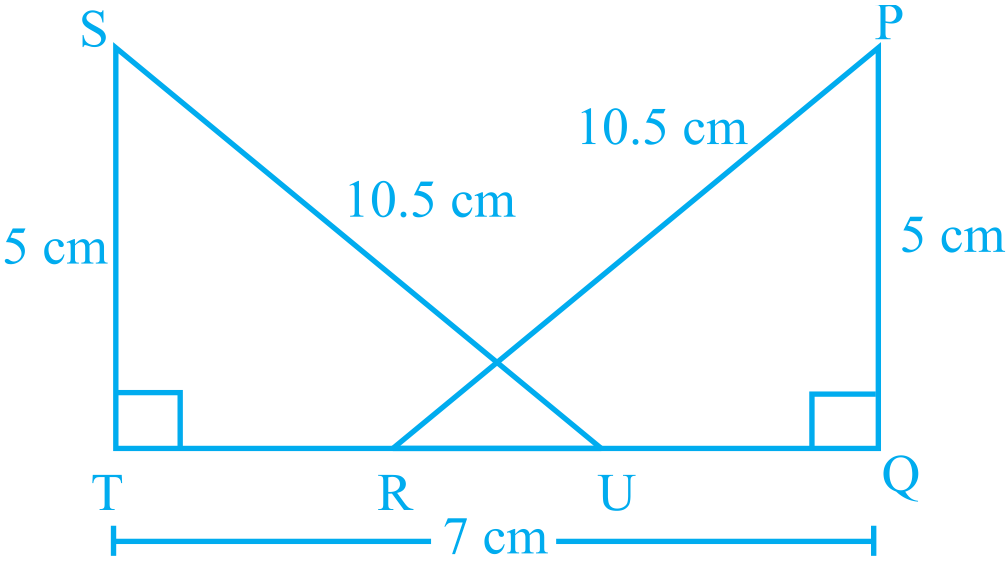
In the following pair of triangles of Figure. the lengths of the sides are indicated along the sides. By applying $SSS$ congruence criterion, determine which triangles are congruent. If congruent, write the results in symbolic form.
Answer
$\triangle\text{STU} \cong \triangle\text{PQR}$
View full question & answer
Question 551 Mark
Two acute angles are congruent.
Answer
False. Solution: Because the measure of two acute angles may be different.
View full question & answer
Question 561 Mark
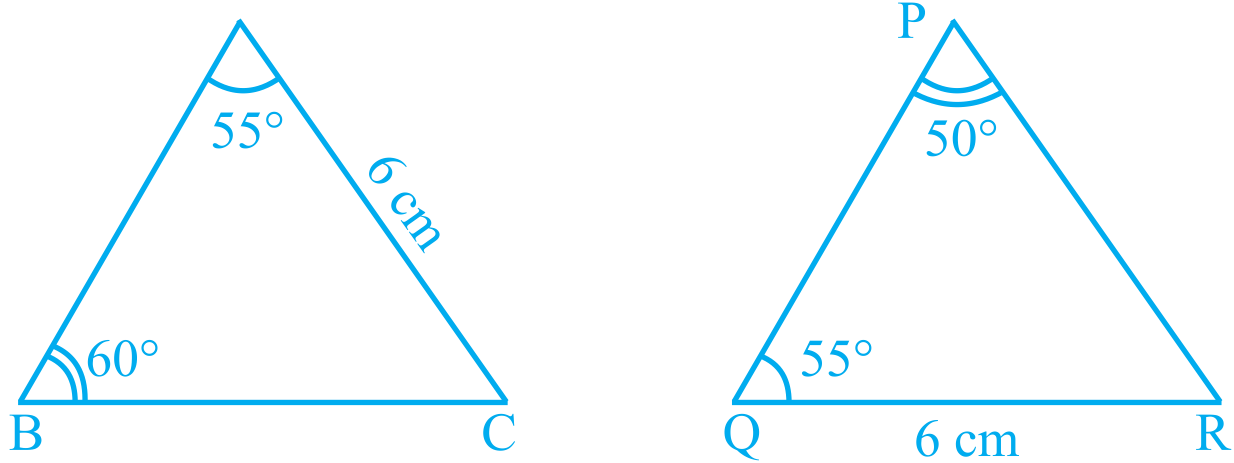
In given pairs of triangles of Figure. applying only $ASA$ congruence criterion, determine which triangles are congruent. Also, write the congruent triangles in symbolic form.
Answer
Not possible, because the side is not included between two angles.
View full question & answer
Question 571 Mark
A one rupee coin is congruent to a five rupee coin.
Answer
False. Solution: Because they don’t have same shape and same size.
View full question & answer
Question 581 Mark
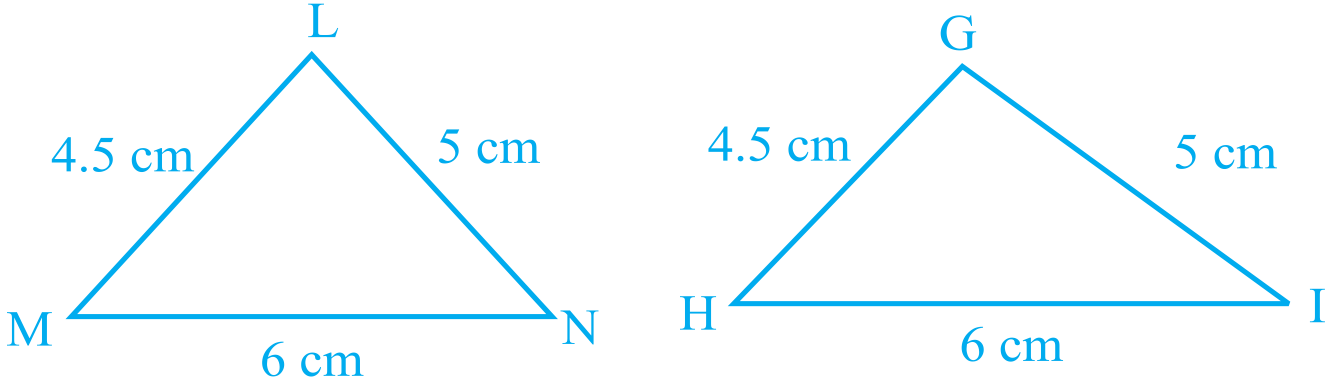
In the following pair of triangles of Figure. the lengths of the sides are indicated along the sides. By applying $SSS$ congruence criterion, determine which triangles are congruent. If congruent, write the results in symbolic form.
Answer
$\triangle\text{LMN} \cong \triangle\text{GHI}$
View full question & answer
Question 591 Mark
If the areas of two circles are the same, they are congruent.
Answer
True.
Solution:
Because areas of two circles will be equal only if their radii are equal and circle with same radii will superimpose to each other.
View full question & answer
Question 601 Mark
Every triangle has at least _________ acute angle (s).
Answer
Every triangle has atleast two acute angle (s). Solution: Every triangle has atleast two acute angles.
View full question & answer
Question 611 Mark
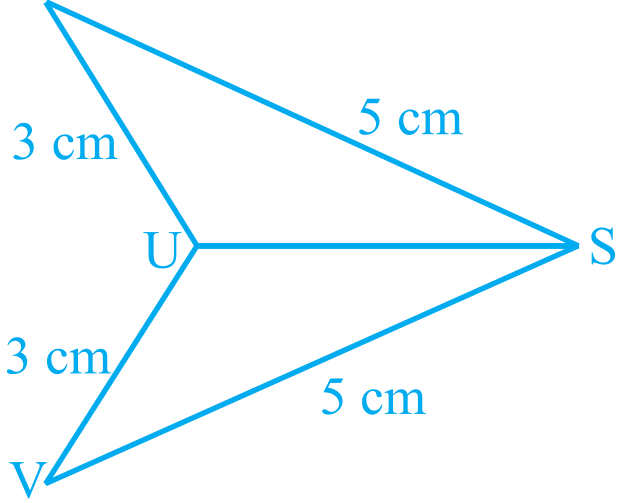
In the following pair of triangles of Figure. the lengths of the sides are indicated along the sides. By applying $SSS$ congruence criterion, determine which triangles are congruent. If congruent, write the results in symbolic form.
Answer
$\triangle\text{STU} \cong \triangle\text{SVU}$
View full question & answer
Question 621 Mark
If the areas of two rectangles are same, they are congruent.
Answer
False. Solution: Because rectangles with the different length and breadth may have equal areas. But, they will not superimpose to each other.
View full question & answer
Question 631 Mark
The ________ triangle always has altitude outside itself.
Answer
The obtuse triangle always has altitude outside itself. Solution: The obtuse angled triangle always has altitude outside itself.
View full question & answer
Question 641 Mark
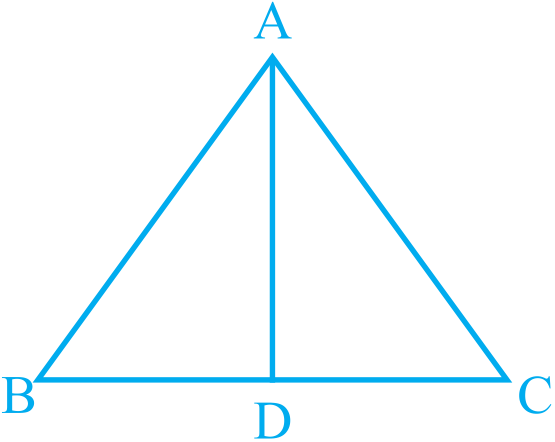
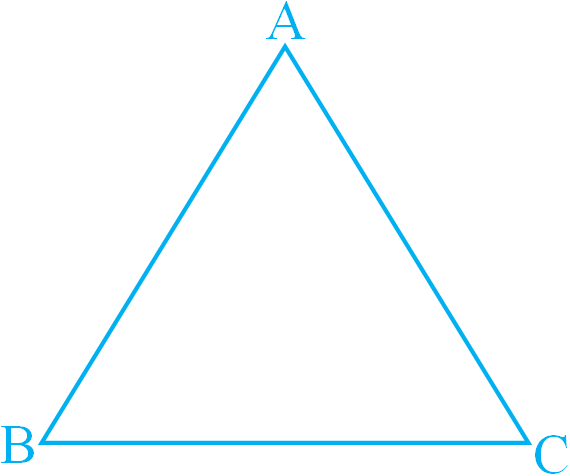
$ABC$ is an isosceles triangle with $AB = AC$ and $D$ is the mid-point of base $BC$ Figure. Is $Δ\text{ABD} ≅ Δ\text{ACD}?$ If so why?
Answer
Given, $AB = AC$ and $BD = CD$ Yes, by SSS congruence criterion, $Δ\text{ABD} ≅ Δ\text{ACD}$
View full question & answer
Question 651 Mark
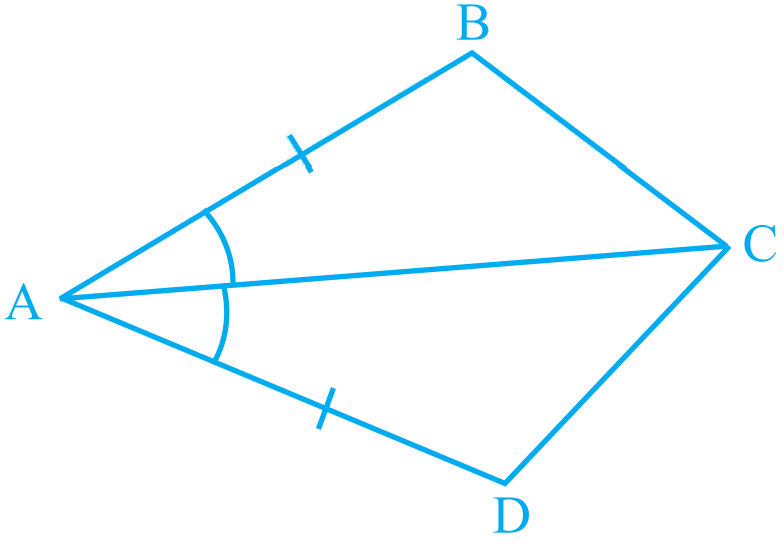
In Figure. $AB = AD$ and $\angle\text{BAC}=\angle\text{DAC}.$ then
$i. \triangle.........\cong\triangle\text{ABC}.$
$ii. \text{BC} =.................$
$iii. \angle\text{BCA}=..........$
$iv.$ Line segment $AC$ bisects $..........$ and $..........$
Answer
In $\triangle\text{ABC}$ and $\triangle\text{ADC},$
$\text{AB} = \text{AD} [$given$]$
$AC = AC [$common side$]$
$\angle\text{BAC}=\angle\text{DAC} [$given$]$
By $\ce{SAS}$ congruence criterion,
$\triangle\text{ADC}\cong\triangle\text{ABC}$
Now,$\text{ BC} =\text{ DC} [$by $\ce{CPCT}]$
Also, $\angle\text{BCA}=\angle\text{DCA} [$by $\ce{CPCT}]$
Line segment $AC$ bisects $\angle\text{BAD}$ and $\angle\text{BCD}.$
Since, $\angle\text{BAC}=\angle\text{DAC}$
and $\angle\text{BCA}=\angle\text{DCA}$
View full question & answer
Question 661 Mark
Sum of any two angles of a triangle is always greater than the third angle.
Answer
It is not necessary that sum of any two angles of a triangle is always greater than the third angle,
e.g. Let the angles of a triangle be $20^\circ , 50^\circ$ and $110^\circ ,$ respectively.
Hence, $20^\circ + 50^\circ = 70^\circ ,$ which is less than $110^\circ .$
View full question & answer
Question 671 Mark
If two legs of a right triangle are equal to two legs of another right triangle, then the right triangles are congruent.
Answer
True. Solution: If two legs of a right angled triangle are equal to two legs of another right angled triangle, then their third leg will also be equal. Hence, they will have same shape and same size.
View full question & answer
Question 681 Mark
If the areas of two squares is same, they are congruent.
Answer
True.
Solution:
Because two squares will have same areas only if their sides are equal and squares with same sides will superimpose to each other.
View full question & answer
Question 691 Mark
In given pairs of triangles of Figure. using only $RHS$ congruence criterion, determine which pairs of triangles are congruent. In case of congruence, write the result in symbolic form:
Answer
Not possible, because there is not any right angle.
View full question & answer
Question 701 Mark
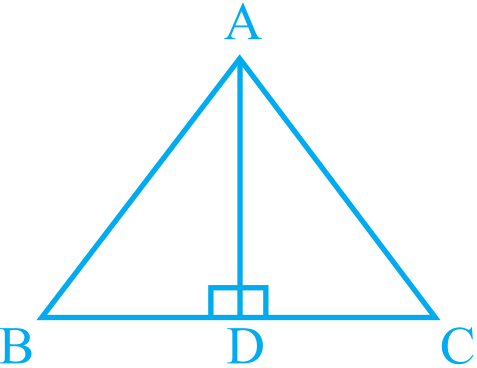
In Figure.$AD \bot BC$ and $AD$ is the bisector of angle $BAC.$ Then, $\triangle\text{ABD} \cong\triangle\text{ACD}$ by $RHS.$

In $\triangle\text{ABD}$ and $\triangle\text{ACD},$
$\text{AD} = \text{AD}$ [common side] $\angle\text{BAD}=\angle\text{CAD}$
$[\because AD$ is the bisector of $\angle\text{BAC}]$ By $ASA$ congruence criterion, $\triangle\text{ABD}\cong\triangle\text{ACD}$
Answer
In $\triangle\text{ABD}$ and $\triangle\text{ACD},$
$\text{AD} = \text{AD}$ [common side]
$\angle\text{BAD}=\angle\text{CAD}$
$[\because AD$ is the bisector of $\angle\text{BAC}]$
By $ASA$ congruence criterion, $\triangle\text{ABD}\cong\triangle\text{ACD}$
View full question & answer
Question 711 Mark
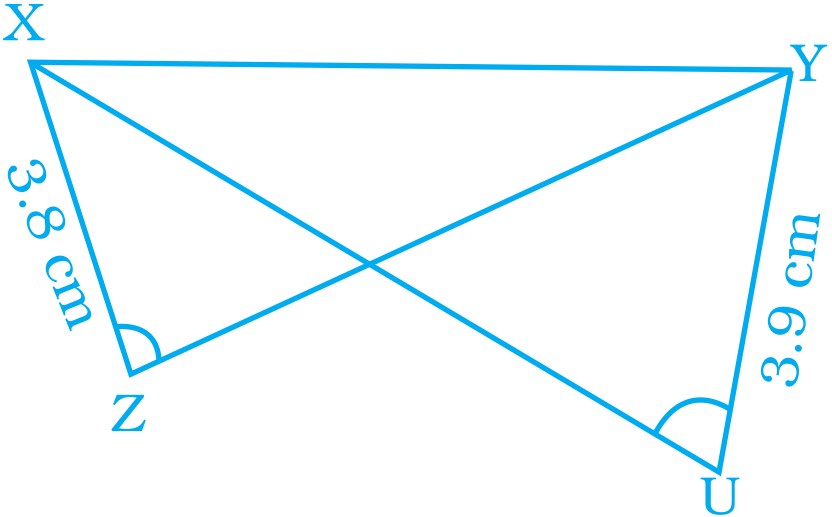
In Figure. which pairs of triangles are congruent by $SAS$ congruence criterion (condition)? If congruent, write the congruence of the two triangles in symbolic form.
Answer
Not congruent, because angle is not included between two sides.
View full question & answer
Question 721 Mark
Two rectangles are congruent, if they have same ________ and _________.
Answer
Two rectangles are congruent, if they have same length and breadth. Solution: Two rectangles are congruent, if they have same length and breadth.
View full question & answer
Question 731 Mark
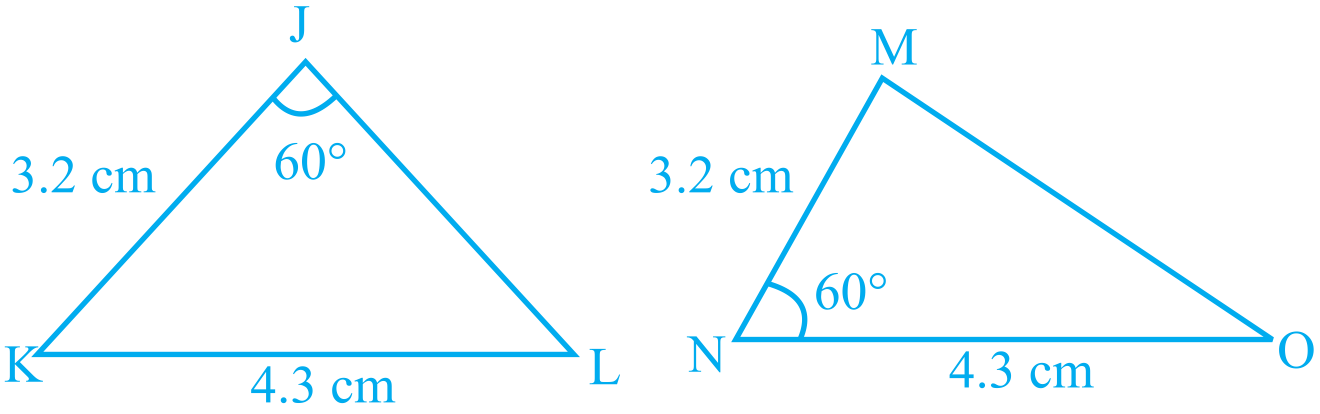
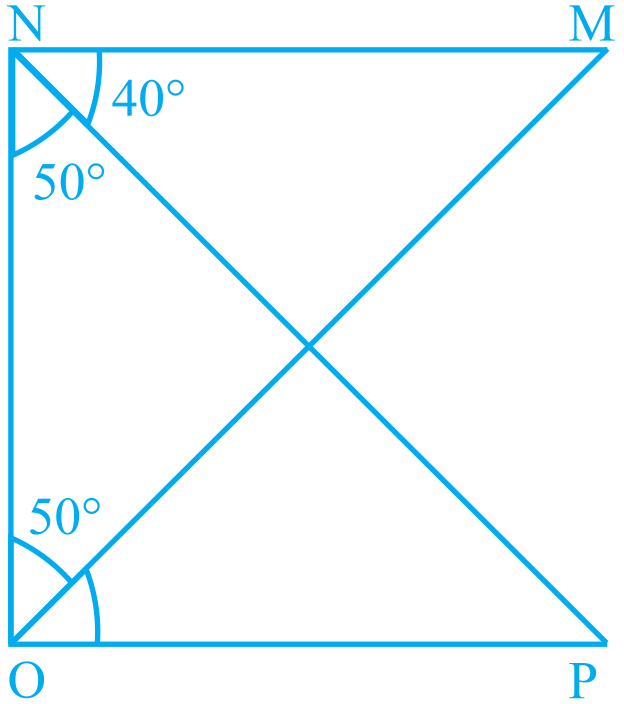
In given pairs of triangles of Figure. applying only $ASA$ congruence criterion, determine which triangles are congruent. Also, write the congruent triangles in symbolic form.​​​​​​​
​​​​​​​​​​​​​​
Answer
$∆\text{MNO} ≅ ∆\text{PON}$
View full question & answer
Question 741 Mark
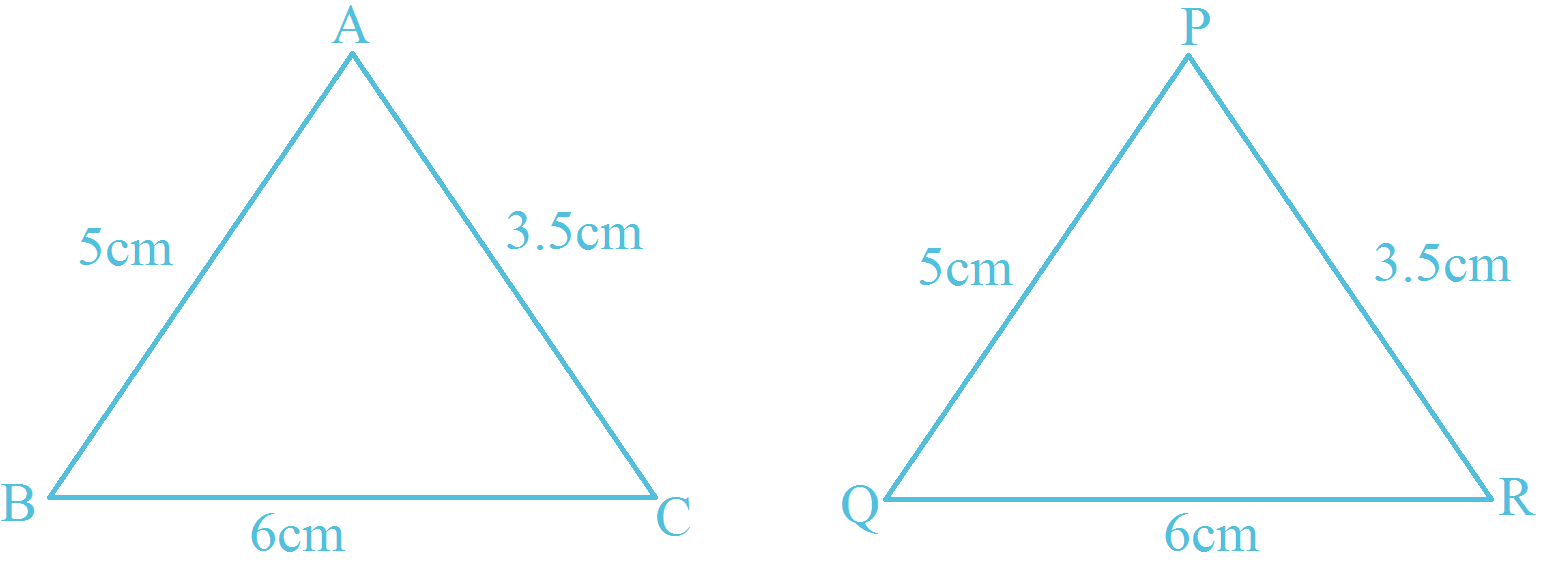
In $\triangle\text{ABC}, AB = 3.5\ cm, AC = 5\ cm, BC = 6\ cm$ and in $\triangle\text{PQR},$ $PR= 3.5\ cm, PQ = 5\ cm, RQ = 6\ cm.$ Then $\triangle\text{ABC} \cong \text{PQR}.$
Answer

In $\triangle\text{ABC}$ and $\triangle\text{PRQ},$
$AB = PR = 3.5\ cm, BC = RQ = 6\ cm$ and $AC = PQ = 5\ cm$
By $SSS$ congruence criterion, $\triangle\text{ABC}\cong\triangle\text{PRQ}$
View full question & answer
Question 751 Mark
Two right angles are congruent.
Answer
True. Solution: Since, the measure of right angles is always same.
View full question & answer
Question 761 Mark
The difference between the lengths of any two sides of a triangle is smaller than the length of third side.
Answer
The difference between the lengths of any two sides of a triangle is smaller than the length of third side. $AB - BC < AC$
View full question & answer
Question 771 Mark
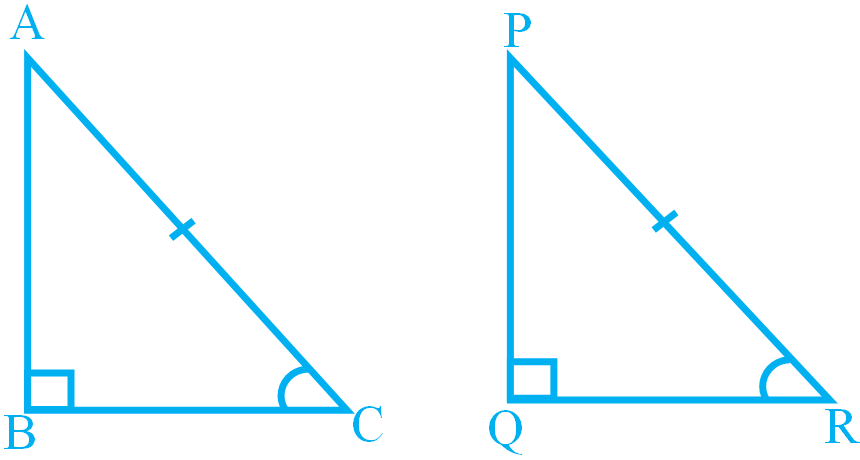
If hypotenuse and an acute angle of one right triangle are equal to the hypotenuse and an acute angle of another right triangle, then the triangles are congruent.
Answer

In $\triangle\text{ABC}$ and $\triangle\text{PQR},$
$\angle\text{B}=\angle\text{Q}=90^{\circ}$
$\angle\text{C}=\angle\text{R}$ [given] $\angle\text{A}=\angle\text{P}$
Now, In $\triangle\text{ABC}$ and $\triangle\text{PQR},$
$\angle\text{A}=\angle\text{P}$
$\text{AC} =\text{ PR}$
$\angle\text{C}=\angle\text{R}$
By $ASA$ congruene criterian, $\triangle\text{ABC}\cong\triangle\text{PQR}$
View full question & answer
Question 781 Mark
It is possible to have a right-angled equilateral triangle.
Answer
In a right angled triangle, one angle is equal to $90^\circ$ and in equilateral triangle, all angles are equal to $60^\circ .$
View full question & answer
Question 791 Mark
Two circles having same circumference are congruent.
Answer
True.
Solution:
If two circles have same circumference, then their radii will be equal. Hence, the circles will superimpose to each other.
View full question & answer
Question 801 Mark
In a triangle, sum of squares of two sides is equal to the square of the third side.
Answer
False. Solution: Only in a right angled triangle, the sum of two shorter sides is equal to the square of the third side.
View full question & answer
Question 811 Mark
Without drawing the triangles write all six pairs of equal measures in each of the following pairs of congruent triangles. $\triangle\text{STU} \cong \triangle\text{DEF}$
Answer
We know that, corresponding parts of congruent triangles are equal. $\triangle\text{STU} \cong \triangle\text{DEF}$ $\angle\text{S}=\angle\text{D},\angle\text{T}=\angle\text{E}$ and $\angle\text{U}=\angle\text{F},\text{ST}=\text{DE},\text{TU}=\text{EF}$ and $\text{SU}=\text{DF}$
View full question & answer
1 Marks Question - Page 2 - Maths STD 7 Questions - Vidyadip