Questions

2 Marks Questions

🎯

Test yourself on this topic

25 questions · timed · auto-graded

Question 12 Marks
Why do we need the water cycle?
Answer
The Earth is covered by water, however, almost 97% is salt water found in the oceans. We cannot drink salt water or use it for crops because of the salt content. We can remove salt from ocean water, but the process is very expensive.
View full question & answer
Question 22 Marks
A list of jumbled words are given here. Write the correct form of each word.
  1. $WASHFERRET.$
  2. $CHARREGE.$
  3. $QUIFERA.$
  4. $WOSN.$
Answer
  1. $FRESH\ WATER$
  2. $RECHARGE$
  3. $AQUIFER$
  4. $SNOW$
View full question & answer
Question 32 Marks
Why do plants die in summers, if they are not watered?
Answer
Plants need water to obtain nutrients from the soil to prepare food and also transpiration rate is high in summers. So, they die from lack of nutrients.
View full question & answer
Question 42 Marks
Write short notes on:
  1. In filtration.
  2. Aquifer.
Answer
  1. In filtration: The water from rain, rivers, lakes and ponds seeps through the soil and fills the space below the ground. The process of seeping of water through the soil is called infiltration.

  2. Aquifer: Some places groundwater is stored between layers of hard rock. This is called aquifer. Water from aquifers is pumped and taken out through hand pumps and tube wells.

View full question & answer
Question 52 Marks
Fill in the blanks in the given passage: The rainwater and ________________ from other sources such as rivers and ponds seeps through the ______________ and fills the empty spaces and cracks deep below the ground. The process of seeping of water into the ground is called ______________.
Answer
The rainwater and water from other sources such as rivers and ponds seeps through the soil and fills the empty spaces and cracks deep below the ground. The process of seeping of water into the ground is called infiltration.
View full question & answer
Question 62 Marks
Can we keep on drawing water from underground, how it will affect the water table?
Answer
Water drawn from under the ground gets replenished by seepage of rainwater; the water table is not affected as long as we draw as much water as is replenished by natural processes, and however it may go down if the water is not sufficiently replenished.
View full question & answer
Question 72 Marks
Explain how increasing agricultural activities are responsible for depletion of water table.
Answer
A majority of farmers in India depend upon rains for irrigating their crops. Irrigation systems such as canals are there only in a few places. Even these systems may suffer from lack of water due to erratic rainfall. Therefore, farmers have to use groundwater for irrigation. Population pressure on agriculture forces increasing use of groundwater day by day. This results in depletion of water table.
View full question & answer
Question 82 Marks
All the rain that falls over an area is not utilised. Do you agree? Explain.
Answer
Precipitation (rain) is a natural process and is a part of natural water cycle. It replenishes all the natural resources of water like ponds, lakes, river and finally oceans and seas too.
When we say utilisation of rainwater, we mean that rain in a particular area.
Yes, it is not properly utilised as most of the water is run off as surface water to the rivers and goes to oceans.
We can harness/ harvest this water to local waterbodies like ponds, lakes and groundwater by proper planning as it is being done in some districts of Rajasthan successfully.
View full question & answer
Question 92 Marks
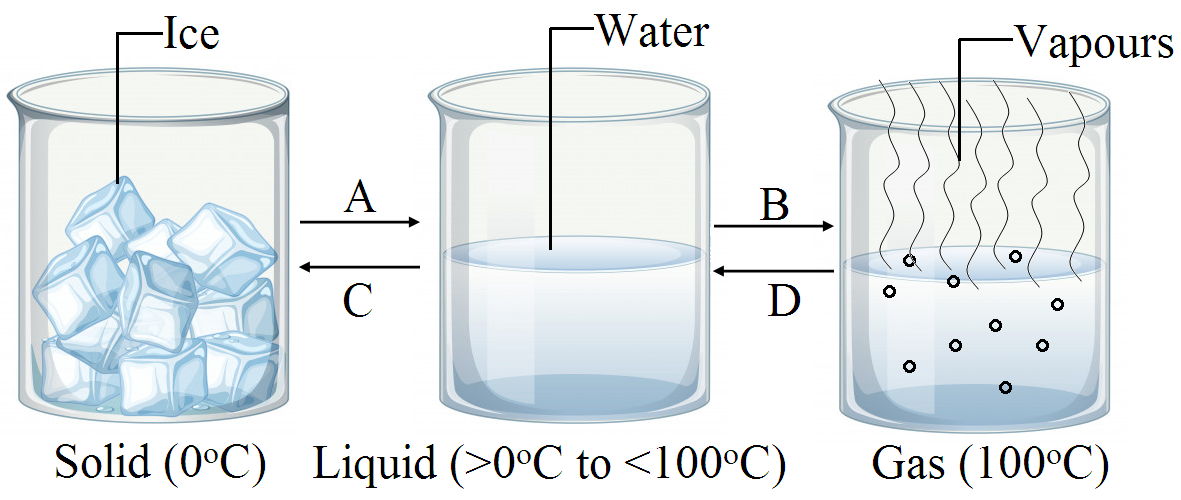
Given below are three states of water in a beaker. These states are inter-convertible. Name the process forward and backforth labelled $A, B, C, D,$ which cause these conversions.
Answer
$A$-Melting, $6$-Boiling, $C$-Freezing, $D$-Condensation.
View full question & answer
Question 102 Marks
Place the following statements in a proper order to form a meaningful paragraph:
  1. Which inturn decreases the seepage of rainwater into the ground.
  2. This decreases the open areas like parks and playgrounds.
  3. Increasing population create demand for construction of houses, shops, offices, roads and pavements.
  4. This results in depletion of water table and creates scarcity of more water.
Answer
  1. Increasing population create demand for construction of houses, shops, offices, roads and pavements.
  1. This decreases the open areas like parks and playgrounds.
  1. Which inturn decreases the seepage of rainwater into the ground.
  1. This result in depletion of water table and creates scarcity of more water.
View full question & answer
Question 112 Marks
What is rainwater harvesting?
Answer
Rainwater harvesting is defined as the method of collecting rainwater on roof-tops and directing it into the ground so as to raise the water table or use for household purposes.
View full question & answer
Question 122 Marks
Certain pattern of the rainfall in our country leads to scarcity of water. Explain that pattern. Which part of the country gets rainfall twice a year?
Answer
We face shortage of water mainly because water is not evenly distributed by the nature on the earth. Some places such as North East India get so much rains, so that it gets flooded almost every year. On the other hand, Thar desert in Rajasthan may get rains rarely in the monsoon season. This uneven pattern of rains causes water scarcity in India at some places.
View full question & answer
Question 132 Marks
What is rain water harvesting and how it is important?
Answer
Instead of letting rainwater run-off into the sea, it can be used to recharge ground water. This is known as rainwater harvesting.
Rainwater harvesting can be used to raise the water table in arid areas. It can also be used to create water storage areas.
View full question & answer
Question 142 Marks
Why water is considered as a precious resource?
Answer
Water is a precious source because all our daily activities are carried out with the help of water only. Water is found everywhere but not everywhere it is drinkable/ usable. Though the seas have no lack of water but still we can't drink or use it anywhere. Water helps in nourishment of animals and plants. We can't live without water and because it is scarce, that’s why water is precious.
View full question & answer
Question 152 Marks
What is drip irrigation?
Answer
Drip irrigation is a technique in which water is supplied drop by drop near the plant roots through small openings called drippers. This method avoids wastage of water and is a very economical way of irrigation.
View full question & answer
Question 162 Marks
What factors are responsible for the uneven distribution of water over the globe?
Answer
The factors responsible for the uneven distribution of water over the globe are the uneven rainfall patterns and uneven climatic conditions.
View full question & answer
Question 172 Marks
Explain how increasing industries are responsible for depletion of water table.
Answer
Water is used by all the industries. Almost everything that we use needs water somewhere in its production process. The number of industries is increasing continuously. Water used by most of the industries is drawn from the ground.
View full question & answer
Question 182 Marks
The water bearing layer of the earth called $P$ is made up of two components $O$ and $R$, in which $R$ water collect under the ground. The top level of layer Pis called $S$. When too many tubewells are used in an area, the level of $S$ in that area goes down. What are $P, Q, R$ and $S$?
Answer
$P$-Aquifer, $Q$-Soil, $R$-Permeable rocks. $S$-Water table.
View full question & answer
Question 192 Marks
How farming can also benefit from good water management.
Answer
Farming, which typically requires huge quantities of water, can also benefit from good water management. Drip irrigation is an economical way of using water. This technique involves the use of tubes to deliver water straight to the base of a plant, where it is taken up by the roots.
View full question & answer
Question 202 Marks
Does scarcity of water affect plants and other forms of life indirectly? Give reasons to support your answer.
Answer
Yes, scarcity of water affects every form of life. It leads to crop failure, fall in production and ultimately loss of life due to starvation.
View full question & answer
Question 212 Marks
Explain the role of water in the life of plants.
Answer
Plants need water to absorb nutrients from the soil and make their food. Without water, plants would die, and greenery would be lost. This, in turn, would mean the end of all life on the earth, because without plants, there would be no food, oxygen or rainfall. There would also be many other problems.
View full question & answer
Question 222 Marks
How can you observe the three forms of water $(a)$ in nature and $(b)$ at home?
Answer
The three forms of water:
  1. In nature are snow (solid), water (liquid) and water vapour (gas).
  2. At home are ice (solid), water (liquid) and steam (gas).
View full question & answer
Question 232 Marks
The substance Wis necessary for the normal growth and development of all types of plants and animals. An acute scarcity of substance Whas an ill effect on plants which can hinder the natural process $X$ in plants causing a severe shortage of/ leading to famine. It may also lead the shortage of $Z$ which is essential for breathing and respiration. What could $W, X, Y$ and $Z$ be?
Answer
$W$-Water, $X$-Photosynthesis.
$Y$-Food, $Z$-Oxygen.
View full question & answer
Question 242 Marks
How cloud is formed?
Answer
The evaporated water above the earth surface is carried away by warm air. As the warm air moves higher from the surface of the Earth, it starts to cool down. It is because the water vapour present starts to condense to form tiny water droplets. These droplets float in the air and form cloud.
View full question & answer
Question 252 Marks
Explain how we can recharge ground water?
Answer
The rainwater and water from other sources such as rivers and ponds seeps through the soil and fills the empty spaces and cracks deep below the ground. The process of seeping of water into the ground is called infiltration. The groundwater thus gets recharged by this process. At places the groundwater is stored between layers of hard rock below the water table. This is known as an aquifer. Water in the aquifers can be usually pumped out with the help of tube wells or hand pumps.
View full question & answer