Question 13 Marks
In the given figure, m and it are two plane mirrors perpendicular to each other. Show that the incident ray $CA$ is parallel to the reflected ray $BD$. 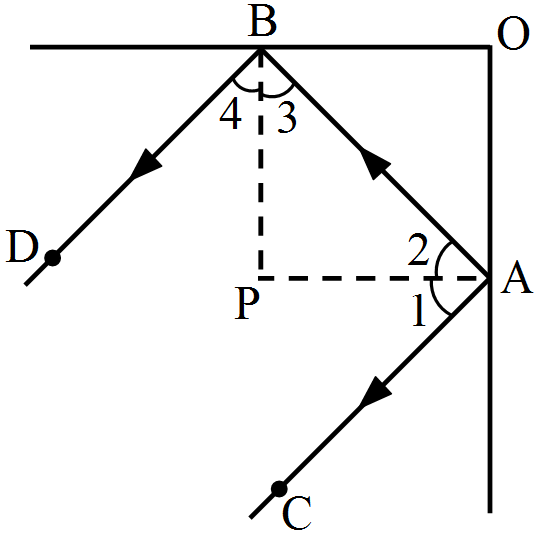
Answer
View full question & answer→Let the normal to mirrors $m$ and $n$ intersect at $P$.
Now, $\text{OB }\bot\text{ m }\bot\text{ OC},\ \bot\ \text{n}$ and $\text{m }\bot\text{ n}.$
$\Rightarrow\text{OB }\bot\text{ OC}$
$\Rightarrow\angle\text{APB}=90^\circ$
$\Rightarrow\angle2+\angle3=90^\circ$ (sum of acute angles of a right triangle is $90^\circ$ ) By the laws of reflection,
we have $\angle1=\angle2$ and $\angle4=\angle3$ (angle of incidence = angle of reflection)
$\Rightarrow\angle1+\angle4=\angle2+\angle3=90^\circ$
$\Rightarrow\angle1+\angle2+\angle3+\angle4=180^\circ$
$\Rightarrow\angle\text{CAB}+\angle\text{ABD}=180^\circ$ But,
$\angle\text{CAB}$ and $\angle\text{ABD}$ consecutive interior angles formed,
when the transversal $AB$ cuts $CA$ and $BD$.
$\therefore$ $CA\ ||\ BD$
Now, $\text{OB }\bot\text{ m }\bot\text{ OC},\ \bot\ \text{n}$ and $\text{m }\bot\text{ n}.$
$\Rightarrow\text{OB }\bot\text{ OC}$
$\Rightarrow\angle\text{APB}=90^\circ$
$\Rightarrow\angle2+\angle3=90^\circ$ (sum of acute angles of a right triangle is $90^\circ$ ) By the laws of reflection,
we have $\angle1=\angle2$ and $\angle4=\angle3$ (angle of incidence = angle of reflection)
$\Rightarrow\angle1+\angle4=\angle2+\angle3=90^\circ$
$\Rightarrow\angle1+\angle2+\angle3+\angle4=180^\circ$
$\Rightarrow\angle\text{CAB}+\angle\text{ABD}=180^\circ$ But,
$\angle\text{CAB}$ and $\angle\text{ABD}$ consecutive interior angles formed,
when the transversal $AB$ cuts $CA$ and $BD$.
$\therefore$ $CA\ ||\ BD$