Question
$0.6\text{x}+\frac45=0.28\text{x}+1.16$

Answer

$0.6\text{x} + \frac45 = 0.28\text{x} + 1.16$
Transposing 0.28x to L.H.S. and 45 to R.H.S., we get
= 0.6x - 0.28x = 1.16 - 45
= 0.32x = 1.16 - 0.8
= 0.32x = 0.36
Dividing both sides by 0.32, we get
= 0.32 × 0.32 = 0.360.32
= x = 98
Verification:
Substituting x = 98 on both sides, we get
$0.6\Big(\frac98\Big) + 45 = 0.28\Big(\frac98\Big) + 1.16$
$\frac{5.4}{8} + \frac45 = \frac{2.52}8 + 1.16$
$0.675 + 0.8 = 0.315 + 1.16$
$1.475 = 1.475$
L.H.S. = R.H.S.
Hence, verified.

Need a full question paper?

Generate a complete, print-ready paper with questions like this in minutes — across 16+ boards, with answer keys.
Start Generating Free

Similar questions

A rectangular grassy lawn measuring 40m by 25m is to be surrounded externally by a path which is 2m wide. Calculate the cost of leveling the path at the rate of Rs. 8.25 per square metre.
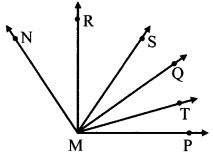
Are the following pairs adjacent angles? If not, state the reason.
Image


  1. ∠PMQ and ∠RMQ
  2. ∠RMQ and ∠SMR
  3. ∠RMS and ∠RMT
  4. ∠SMT and ∠RMS
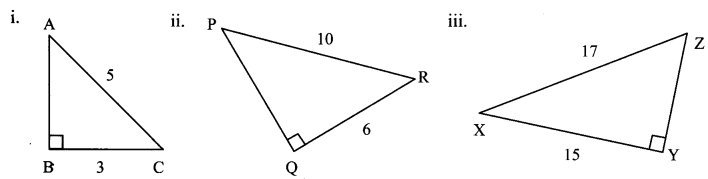
Draw right-angled triangles with the lengths of hypotenuse and one side as shown in the rough figures below. Measure the third side. Verify the Pythagoras’ theorem.
Image
Simplify:
$\left(3 x^2+5 x-7\right)(x-1)-\left(x^2-3 x+3\right)(x+4)$
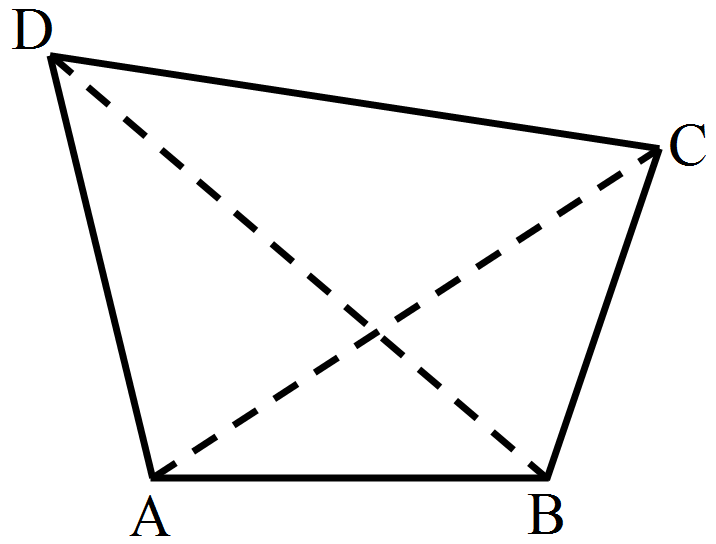
ABCD is quadrilateral.
Prove that (AB + BC + CD + DA) > (AC + BD)
The mean of 200 items was 50. Later on, it was discovered that the two items were misread as 92 and 8 instead of 192 and 88. Find the correct mean.
Two parallel lines I and $m$ are cut by a transversal $t$. If the interior angles of the same side of $t$ be $(2 x-8)^{\circ}$ and $(3 x-7)^{\circ}$, find the measure of each of these angles.
The radius of one circular field is 5m and that of the other is 13m. Find the radius of the circular field whose area is the difference of the areas of first and second field.
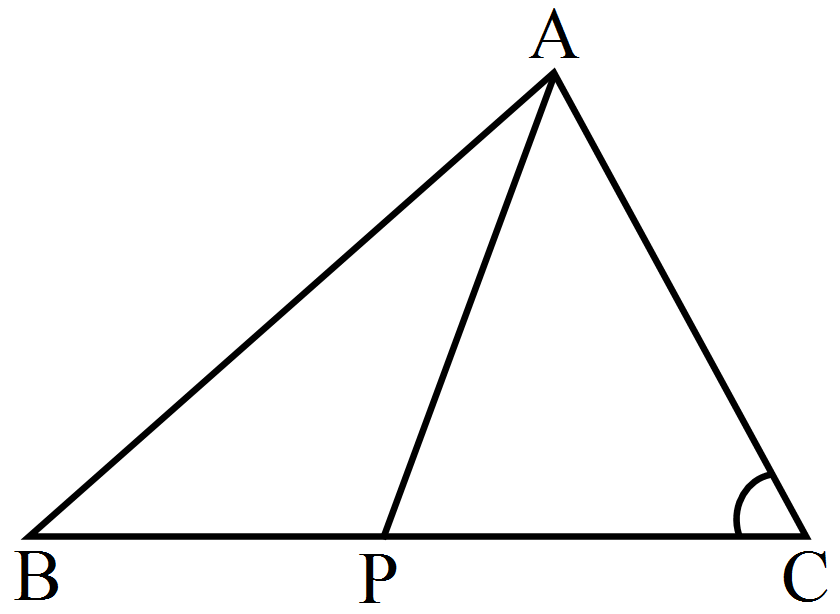
In the given figure, P is a point on the side BC of$\triangle\text{ABC}$. Prove that (AB + BC + AC) > 2AP Hint: (AB + BP) > AP (In $\triangle\text{ABP}$) (PC + AC) > AP (In $\triangle\text{APC}$)Now, add the corresponding sides.
On a sheet of card paper, draw a right-angled triangle of sides 3 cm, 4 cm and 5 cm. Construct a square on each of the sides. Find the area of each of the squares and verify Pythagoras’ theorem.