MCQ
$1 a.m.u.$  is equivalent to
  • A
    $1.6 \times {10^{ - 12}}Joule$
  • B
    $1.6 \times {10^{ - 19}}Joule$
  • $1.5\, \times {10^{ - 10}}Joule$
  • D
    $1.5 \times {10^{ - 19}}Joule$

Answer

Correct option: C.
$1.5\, \times {10^{ - 10}}Joule$
c
(c)$1 amu$ $ = 1.66 \times {10^{ - 27}}\,kg$
$E = m{c^2} = 1.66 \times {10^{ - 27}} \times {(3 \times {10^8})^2} = 1.5 \times {10^{ - 10}}\,J$

Need a full question paper?

Generate a complete, print-ready paper with questions like this in minutes — across 16+ boards, with answer keys.
Start Generating Free

Similar questions

A body of mass $5\; kg$ is moving with a momentum of $10\; kg m / s$. A force of $0.2\; N$ acts on it in the direction of motion of the body for $10\; sec$. Find the increase in its kinetic energy.
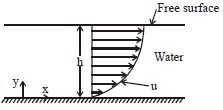
For the situation shown in the figure, water flows on the surface of a fixed plate. The
velocity of water as a function of distance $'y'$ is given as : $u = \alpha \left[ {\frac{y}{h} - 2{{\left( {\frac{y}{h}} \right)}^2}} \right]$ . Determine the magnitude of the shear stress that the water applies at the base of the plate. Coefficient of viscosity is $\eta$
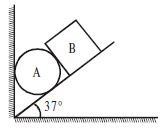
A perfect smooth sphere $A$ of mass $2\  kg$ is in contact with a rectangular block $B$ of mass $4\  kg$ and vertical wall as shown in the figure. All surfaces are smooth. Find normal reaction by vertical wall on sphere $A$  .......... $N$
A steady current $I$ flows along an infinitely long hollow cylindrical conductor of radius $R$. This cylinder is placed coaxially inside an infinite solenoid of radius $2 \ R$. The solenoid has $n$ turns per unit length and carries a steady current $I$. Consider a point $P$ at a distance $r$ from the common axis. The correct statement$(s)$ is (are) :

$(A)$ In the region $0 < r < R$, the magnetic field is non-zero.

$(B)$ In the region $R < r < 2 R$, the magnetic field is along the common axis.

$(C)$ In the region $R < r < 2 R$, the magnetic field is tangential to the circle of radius $r$, centered on the axis.

$(D)$ In the region $r > 2 R$, the magnetic field is non-zero.
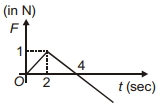
Force acting on a body varies with time as shown below. If initial momentum of the body is $\vec{p}$, then the time taken by the body to retain its momentum $\vec{p}$ again is ........... $s$
Angular displacement $(\theta )$ of a flywheel varies with time as $\theta  = at + b{t^2} + c{t^3}$ then angular acceleration is given by  
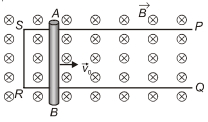
A conducting rod $A B$ of length $l$ is projected on a frictionless frame $P S R Q$ with velocity $v_0$ at any instant. The velocity of the rod after time $t$ is
Gravitational acceleration on the surface of a planet is $\frac{\sqrt 6}{11}g$ , where $g$ is the gravitational acceleration on the surface of the earth. The average mass  density of the planet is $\frac{2}{3}\, times$ that of the earth. If the escape speed on the surface of the earth is taken to be $11\, kms^{-1}$, the escape speed on the surface of  the  planet in $kms^{-1}$ will be
In an $ac$ circuit, the current is given by $i = 5\sin \,\left( {100\,t - \frac{\pi }{2}} \right)$ and the $ ac$ potential is$V = 200\sin \,(100)\,volt.$ Then the power consumption is.......$ watts$
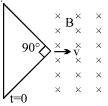
The figure shows an isosceles triangle wire frame with apex angle equal to $\pi /2$. The frame starts entering into the region of uniform magnetic field $B$ with constant velocity $v$ at $t= 0$. The longest side of the frame is perpendicular to the direction of velocity. If $i$ is the instantaneous current through the frame then choose the alternative showing the correct variation of $i$ with time.