MCQ
Angular displacement $(\theta )$ of a flywheel varies with time as $\theta  = at + b{t^2} + c{t^3}$ then angular acceleration is given by  
  • A
    $a + 2bt - 3c{t^2}$
  • B
     $2b - 6t$
  • C
    $a + 2b - 6t$
  •   $2b + 6ct$

Answer

Correct option: D.
  $2b + 6ct$
d
(d)   Angular acceleration $\alpha  = \frac{{{d^2}\theta }}{{d{t^2}}} = \frac{{{d^2}}}{{d{t^2}}}(at + b{t^2} + c{t^3})$$ = 2b + 6ct$

Need a full question paper?

Generate a complete, print-ready paper with questions like this in minutes — across 16+ boards, with answer keys.
Start Generating Free

Similar questions

In a region, the potential is represented by $V(x, y, z) = 6x - 8xy - 8y + 6yz$, where $V$ is in volts and $x, y, z$ are in metres. The electric force experienced by a charge of $2$ coulomb situated at point $( 1, 1, 1)$ is
Work done in increasing the size of a soap bubble from a radius of $3\, cm$ to $5\,cm$ is  (Surface tension of soap solution $= 0.03 \,Nm^{-1})$
In kinetic theory of gases, which of the following statements regarding elastic collisions of the molecules is wrong
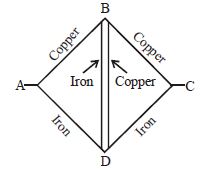
Six wire each of cross-sectional area $A$ and length $l$ are combined as shown in the  figure. The thermal conductivities of copper and iron are $K_1$ and $K_2$ respectively.  The equivalent thermal resistance between points $A$ and $C$ is :-
In the adjacent shown circuit, a voltmeter of internal resistance $R$, when connected across $B$ and $C$ reads $\frac{{100}}{3}\,V$. Neglecting the internal resistance of the battery, the value of $R$ is ................. $k  \Omega$
A person in front of a mountain is beating a drum at the rate of $40$ per minute and hears no distinct echo. If the person moves $90 \,m$ closer to the mountain, he has to beat the drum at $60$ per minute to not hear any distinct echo. The speed of sound is .............. $ms^{-1}$
The point on the pressure temperature phase diagram where all the phases co-exist is called
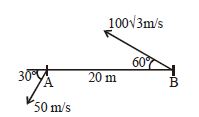
Velocity of two particles $A$ and $B$ separated by distance $20\ m$ apart is as shown in figure then ........ $rad/s$ will be the angular velocity of $B$ with respect to $A$
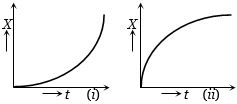
Figures $(i)$ and $(ii)$ below show the displacement-time graphs of two particles moving along the x-axis. We can say that
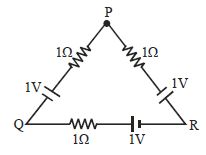
In given circuit find potential difference between $P$ and $Q$ .................. $V$