MCQ
$1$ atomic mass unit is equal to
  • A
    $\frac{1}{25} \ll$ (mass of $\mathrm{F}_2$ molecules$)$
  • B
    $\frac{1}{14}$ (mass of $\mathrm{N}_2$ molecules$)$
  • $\frac{1}{12} ($mass of one $C-$atom$)$
  • D
    $\frac{1}{16} ($mass of $\mathrm{O}_2$ molecules$)$

Answer

Correct option: C.
$\frac{1}{12} ($mass of one $C-$atom$)$

Need a full question paper?

Generate a complete, print-ready paper with questions like this in minutes — across 16+ boards, with answer keys.
Start Generating Free

Similar questions

Let $I_A $and $I_B$ be moments of inertia of a body about two axes $A$ and $B$ respectively. The axis $A$ passes through the centre of mass of the body but $B$ does not:
A current of 10 ampere is flowing in a wire of length 1.5 m. A force of 15 N acts on it when it is placed in a uniform magnetic field of 2 tesla. The angle between the magnetic field and the direction of the current is(a) 30 °(b) 45 °(c) 60 °(d) 90 °
       
A parallel-plate capacitor is connected to a battery. A metal sheet of negligible thickness is placed between the plates. The sheet remains parallel to the plates of the capacitor:
If the binding energy of the electron in a hydrogen atom is $13.6\ eV,$ the energy required to remove the electron from the first excited state of $Li^{++}$ is
In Young’s double slit experiment, the intensity of light coming from the first slit is double the intensity from the second slit. The ratio of the maximum intensity to the minimum intensity on the interference fringe pattern observed is (a) 34(b) 40(c) 25(d) 38
       
Consider a simple circuit shown in Fig. stands for a variable resistance $R\ '. R\ '$ can vary from $R_0$ to infinity. $r$ is internal resistance of the battery $(r < < R < < R_0).$
Speed of electromagnetic waves in vacuum is:
The distance of closest approach of an alpha particle is $d$ when it moves with a speed $V$ towards a nucleus.
Another alpha particle is projected with higher energy such that the new distance of the closest approach is $d/2$ . What is the speed of projection of the alpha particle in this case?
The electrons cannot exist inside the nucleus because:
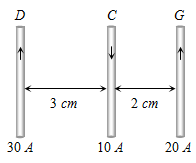
Three long, straight parallel wires carrying current, are arranged as shown in figure. The force experienced by a $25 \ cm$ length of wire $C$ is