Question 11 Mark
The energy of the highest energy photon of Balmer series of hydrogen spectrum is close to(a) 13.6 eV(b) 3.4 eV(c) 1.5 eV (d) 0.85 eV
MCQ 21 Mark
Which state of triply ionised Baryllium $(Be^{+++})$ has the same orbital radius as that of the ground state of hydrogen
- A
$n = 4$
- B
$n = 3$
- ✓
$n = 2$
- D
$n = 1$
AnswerCorrect option: C. $n = 2$
$n = 2$
View full question & answer→MCQ 31 Mark
The Rutherford $\alpha$-particle experiment shows that most of the $\alpha$-particles pass through almost unscattered while some are scattered through large angles. What information does it give about the structure of the atom
- A
- B
The whole mass of the atom is concentrated in a small centre called nucleus
- C
Nucleus is positively charged
- ✓
View full question & answer→MCQ 41 Mark
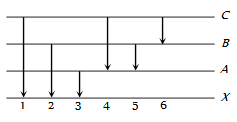
The figure indicates the energy level diagram of an atom and the origin of six spectral lines in emission $($e.g. line no. $5$ arises from the transition from level $B$ to $A).$ The following spectral lines will also occur in the absorption spectrum
- A
$1, 4, 6$
- B
$4, 5, 6$
- ✓
$1, 2, 3$
- D
$1, 2, 3, 4, 5, 6$
AnswerCorrect option: C. $1, 2, 3$
$1, 2, 3$
View full question & answer→MCQ 51 Mark
Imagine an atom made up of a proton and a hypothetical particle of double the mass of the electron but having the same charge as the electron. Apply the Boh’r atom model and consider all possible transitions of this hypothetical particle to the first excited level. The longest wavelength photon that will be emitted has wavelength l $($given in terms of the Rydberg constant $R$ for the hydrogen atom$)$ equal to
- A
$9/(5R)$
- B
$36/(5R)$
- ✓
$18/(5R)$
- D
$4/R$
AnswerCorrect option: C. $18/(5R)$
$18/(5R)$
View full question & answer→MCQ 61 Mark
The first excited state of hydrogen atom is $10.2\ eV$ above its ground state. The temperature is needed to excite hydrogen atoms to first excited level, is
- ✓
$ 7.9 \times 10^4 K$
- B
$3.5 \times 10^4 K$
- C
$5.8 \times 10^4 K$
- D
$14 \times 10^4 K$
AnswerCorrect option: A. $ 7.9 \times 10^4 K$
$ 7.9 \times 10^4 K$
View full question & answer→MCQ 71 Mark
An atomic power nuclear reactor can deliver $300\ MW.$ The energy released due to fission of each nucleus of uranium atom $U^{238}$ is $170\ MeV.$ The number of uranium atoms fissioned per hour will be
- A
$30 \times 10^{25}$
- ✓
$4 \times 10^{22}$
- C
$10 \times 10^{20}$
- D
$5 \times 10^{15}$
AnswerCorrect option: B. $4 \times 10^{22}$
$4 \times 10^{22}$
View full question & answer→MCQ 81 Mark
The rate of disintegration was observed to be $10^{17}$ disintegrations per sec when its half life period is $1445$ years. The original number of particles are
- A
$8.9 \times 10^{27}$
- ✓
$6.6 \times 10^{27}$
- C
$1.4 \times 10^{16}$
- D
$1.2 \times 10^{17}$
AnswerCorrect option: B. $6.6 \times 10^{27}$
$6.6 \times 10^{27}$
View full question & answer→MCQ 91 Mark
Carbon dating is best suited for determining the age of fossils if their age in years is of the order of
- A
$10^3$
- ✓
$10^4$
- C
$10^5$
- D
$10^6$
AnswerCorrect option: B. $10^4$
$10^4$
View full question & answer→MCQ 101 Mark
Complete the reaction $\mathrm{n}+{ }_{92}^{235} \mathrm{U} \rightarrow{ }_{56}^{144} \mathrm{Ba}+\cdots+3 \mathrm{n}$
- ✓
${ }_{36}^{89} \mathrm{Kr}$
- B
${ }_{36}^{90} \mathrm{Kr}$
- C
${ }_{36}^{91} \mathrm{Kr}$
- D
${ }_{36}^{92} \mathrm{Kr}$
AnswerCorrect option: A. ${ }_{36}^{89} \mathrm{Kr}$
${ }_{36}^{89} \mathrm{Kr}$
View full question & answer→MCQ 111 Mark
${ }_6^{12} C$ absorbs an energetic neutron and emits beta particles. The resulting nucleus is
- A
${ }_7^{14} N$
- ✓
${ }_7^{13} N$
- C
${ }_5^{13} B$
- D
${ }_6^{13} C$
AnswerCorrect option: B. ${ }_7^{13} N$
${ }_7^{13} N$
View full question & answer→MCQ 121 Mark
$1$ atomic mass unit is equal to
- A
$\frac{1}{25} \ll$ (mass of $\mathrm{F}_2$ molecules$)$
- B
$\frac{1}{14}$ (mass of $\mathrm{N}_2$ molecules$)$
- ✓
$\frac{1}{12} ($mass of one $C-$atom$)$
- D
$\frac{1}{16} ($mass of $\mathrm{O}_2$ molecules$)$
AnswerCorrect option: C. $\frac{1}{12} ($mass of one $C-$atom$)$
$\frac{1}{12} ($mass of one $C-$atom$)$
View full question & answer→MCQ 131 Mark
If in a nuclear fusion process the masses of the fusing nuclei be $\mathrm{m}_1$ and $\mathrm{m}_2$ and the mass of the resultant nucleus be $\mathrm{m}_3$, then
- A
$\ce{m_3=m_1+m_2}$
- B
$\mathrm{m}_3=\left|\mathrm{m}_1+\mathrm{m}_2\right|$
- ✓
$\mathrm{m}_3<\left(\mathrm{m}_1+\mathrm{m}_2\right)$
- D
$m_3 > \left(m_1+m_2\right)$
AnswerCorrect option: C. $\mathrm{m}_3<\left(\mathrm{m}_1+\mathrm{m}_2\right)$
$\mathrm{m}_3 < \left(\mathrm{m}_1+\mathrm{m}_2\right)$
View full question & answer→MCQ 141 Mark
$M_p$ denotes the mass of a proton and $M_n$ that of a neutron. A given nucleus, of binding energy $B,$ contains $Z$ protons and $N$ neutrons. The mass $M(N, Z)$ of the nucleus is given by $(c$ is the velocity of light$)$
- A
$\ce{M(N, Z)=N M_n+Z M_p-B c^2}$
- B
$\mathrm{M}(\mathrm{N}, \mathrm{Z})=\mathrm{NM}_{\mathrm{n}}+\mathrm{ZM}_{\mathrm{p}}+\mathrm{Bc}^2$
- ✓
$\mathrm{M}(\mathrm{N}, \mathrm{Z})=\mathrm{NM}_{\mathrm{n}}+\mathrm{ZM}_{\mathrm{p}}-\mathrm{B} / \mathrm{c}^2$
- D
$\ce{M(N, Z)=N M_n+Z M_p+B / c^2}$
AnswerCorrect option: C. $\mathrm{M}(\mathrm{N}, \mathrm{Z})=\mathrm{NM}_{\mathrm{n}}+\mathrm{ZM}_{\mathrm{p}}-\mathrm{B} / \mathrm{c}^2$
$\mathrm{M}(\mathrm{N}, \mathrm{Z})=\mathrm{NM}_{\mathrm{n}}+\mathrm{ZM}_{\mathrm{p}}-\mathrm{B} / \mathrm{c}^2$
View full question & answer→MCQ 151 Mark
The half-life of a sample of a radioactive substance is $1$ hour. If $8\times 10^{10}$ atoms are present at $t = 0,$ then the number of atoms decayed in the duration $t = 2$ hour to $t = 4$ hour will be
- A
$2\times 10^{10}$
- ✓
$1.5\times 10^{10}$
- C
- D
AnswerCorrect option: B. $1.5\times 10^{10}$
$1.5\times 10^{10}$
View full question & answer→MCQ 161 Mark
If $M$ is the atomic mass and $A$ is the mass number, packing fraction is given by
- A
$\frac{ A }{ M - A }$
- B
$\frac{ A - M }{ A }$
- C
$\frac{ M }{ M - A }$
- ✓
$\frac{ M - A }{ A }$
AnswerCorrect option: D. $\frac{ M - A }{ A }$
$\frac{ M - A }{ A }$
View full question & answer→MCQ 171 Mark
When $U^{235}$ is bombarded with one neutron, the fission occurs and the products are three neutrons, $36^{ Kr ^{94}}$ and
- A
$53^{1^{142}}$
- ✓
$56^{ Ba ^{139}}$
- C
$58^{ C e^{199}}$
- D
$54^{X e^{159}}$
AnswerCorrect option: B. $56^{ Ba ^{139}}$
$56^{ Ba ^{139}}$
View full question & answer→MCQ 181 Mark
The energy in $\text{MeV}$ is released due to transformation of $1 \ kg$ mass completely into energy $(c = 3 \times 10^8 m/s)$
- A
$7.625 \times 10 \mathrm{MeV}$
- B
$10.5 \times 10^{29} \mathrm{MeV}$
- C
$2.8 \times 10^{-28} \mathrm{MeV}$
- ✓
$5.625 \times 10^{29} \mathrm{MeV}$
AnswerCorrect option: D. $5.625 \times 10^{29} \mathrm{MeV}$
$5.625 \times 10^{29} \mathrm{MeV}$
View full question & answer→MCQ 191 Mark
In a nuclear reactor, the fuel is consumed at the rate of $1\ mg/s.$ The power generated in kilowatt is
- A
$9\times 10^4$
- ✓
$9\times 10^7$
- C
$9\times 10^8$
- D
$9\times 10^{12}$
AnswerCorrect option: B. $9\times 10^7$
$9 \times 10^7$
View full question & answer→MCQ 201 Mark
The nucleus $92^{\mathrm{U}^{254}}$ splits exactly in half in a fission reaction in which two neutrons are released. The resultant nuclei are
- ✓
$46^{\mathrm{Pd}^{116}}$
- B
$45^{\mathrm{Rh}^{117}}$
- C
$45^{\mathrm{Rh}^{116}}$
- D
$46^{\mathrm{Pd}^{117}}$
AnswerCorrect option: A. $46^{\mathrm{Pd}^{116}}$
$46^{\mathrm{Pd}^{116}}$
View full question & answer→MCQ 211 Mark
An electron changes its position from orbit $n = 4$ to the orbit $n = 2$ of an atom. The wavelength of the emitted radiation’s is $(R =$ Rydberg’s constant$)$
- A
$\frac{16}{R}$
- ✓
$\frac{16}{3R}$
- C
$\frac{16}{5R}$
- D
$\frac{16}{7R}$
AnswerCorrect option: B. $\frac{16}{3R}$
$\frac{16}{3R}$
View full question & answer→MCQ 221 Mark
If the energy of a hydrogen atom in nth orbit is $E_n$, then energy in the nth orbit of a singley ionized helium atom will be
- ✓
$4E_n$
- B
$E_n/4$
- C
$2E_n$
- D
$E_n/2$
AnswerCorrect option: A. $4E_n$
$4E_n$
View full question & answer→MCQ 231 Mark
In the given reaction $\mathrm{z}^{\mathrm{X}^{\mathrm{A}}} \rightarrow \mathrm{z}+1^{\mathrm{Y}^{\mathrm{A}}} \rightarrow \mathrm{z}-1^{\mathrm{K}^{\mathrm{A}-4}} \rightarrow \mathrm{z}-1^{\mathrm{K}^{\mathrm{A}-4}}$ Radioactive radiations are emitted in the sequence
- A
$\alpha, \beta, \gamma$
- ✓
$\beta, \alpha, \gamma$
- C
$\gamma, \alpha, \beta$
- D
$\beta, \gamma, \alpha$
AnswerCorrect option: B. $\beta, \alpha, \gamma$
$\beta, \alpha, \gamma$
View full question & answer→MCQ 241 Mark
The average kinetic energy of the thermal neutrons is of the order of $($Boltzmann's constant $\mathrm{K}_{\mathrm{B}}=8 \times 10^{-5} \mathrm{eV} /$ Kelvin $)$
- ✓
$0.03 \text{ eV}$
- B
$3 \text{ eV}$
- C
$3 \text{ KeV} $
- D
$3 \text{ MeV}$
AnswerCorrect option: A. $0.03 \text{ eV}$
$0.03 \text{ eV}$
View full question & answer→Question 251 Mark
Excitation energy of a hydrogen like ion in its first excitation state is 40.8 eV. Energy needed to remove the electron from the ion in ground state is(a) 54.4 eV(b) 13.6 eV(c) 40.8 eV(d) 27.2 eV
MCQ 261 Mark
Starting with a sample of pure $66_{Cu}, \frac{7}{8}$ of it decays into $Zn$ in $15\ min.$ The corresponding half$-$life is
- ✓
$5\ min$
- B
$7{\frac{1}{2}}\ min$
- C
$10\ min$
- D
$15\ min$
AnswerCorrect option: A. $5\ min$
$5\ min$
View full question & answer→MCQ 271 Mark
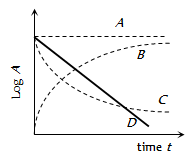
The graph which represents the correct variation of logarithm of activity $(\log\ A)$ versus time, in figure is
View full question & answer→MCQ 281 Mark
Which of the following atoms has the lowest ionization potential
AnswerCorrect option: C. ${ }_{55}^{133} \mathrm{Cs}$
${ }_{55}^{133} \mathrm{Cs}$
View full question & answer→MCQ 291 Mark
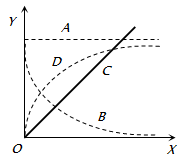
In Fig. $X$ represents time and $Y$ represent activity of a radioactive sample. Then the activity of sample, varies with time according to the curve
View full question & answer→MCQ 301 Mark
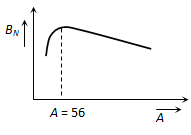
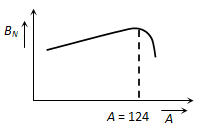
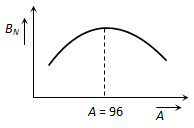
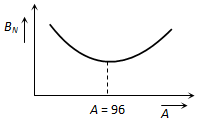
The dependence of binding energy per nucleon, $B_N$ on the mass number, $A,$ is represented by
View full question & answer→MCQ 311 Mark
A radioactive sample of $U^{238}$ decay to $Pb$ through a process for which half life is $4.5 \times 10^9$ years. The ratio of number of nuclei of $Pb$ to $U^{238}$ after a time of $1.5 \times 10^9$ years $($given $2^{1/3} = 1.26)$
- A
$0.12$
- ✓
$0.26$
- C
$1.2$
- D
$0.37$
AnswerCorrect option: B. $0.26$
$0.26$
View full question & answer→MCQ 321 Mark
When $90^{\mathrm{Th}^{228}}$ transforms to $83^{\mathrm{Bi}^{212}}$, then the number of the emitted $a-$ and $b-$particles is, respectively
- A
$8\alpha , 7\beta$
- B
$4\alpha , 7\beta$
- C
$4 \alpha , 4\beta$
- ✓
$4\alpha , 1\beta$
AnswerCorrect option: D. $4\alpha , 1\beta$
$4\alpha , 1\beta$
View full question & answer→MCQ 331 Mark
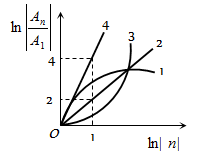
The figure shows a graph between ln$\left|\frac{A_n}{A_1}\right|$ and ln|n|, where $A_n$ is the area enclosed by the nth orbit in a hydrogen like atom. The correct curve is
View full question & answer→MCQ 341 Mark
In the disintegration series $\ce{{ }_{92}^{238} U \xrightarrow{\alpha} X \xrightarrow{\beta^{-}}{ }_{Z}^{A} Y}$ The value of $Z$ and $A$ respectively will be
- A
$92, 236$
- B
$88, 230$
- C
$90, 234$
- ✓
$91, 234$
AnswerCorrect option: D. $91, 234$
$91, 234$
View full question & answer→MCQ 351 Mark
he half-life of a radioactive substance is $48$ hours. How much time will it take to disintegrate to its $\frac{1}{16}$th part
- A
$12\ h$
- B
$16\ h$
- C
$48\ h$
- ✓
$192\ h$
AnswerCorrect option: D. $192\ h$
$192\ h$
View full question & answer→MCQ 361 Mark
An atomic nucleus $90^{Th^{232}}$ emits several $a$ and $b$ radiations and finally reduces to $82^{Pb^{208}}.$ It must have emitted
- A
$4a$ and $2b$
- ✓
$6a$ and $4b$
- C
$8a$ and $24b$
- D
$4a$ and $16b$
AnswerCorrect option: B. $6a$ and $4b$
$6a$ and $4b$
View full question & answer→MCQ 371 Mark
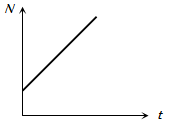
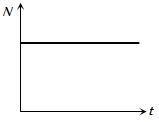
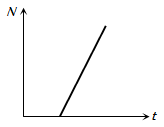
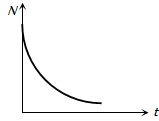
The graph between the instantaneous concentration $(N)$ of a radioactive element and time $(t)$ is
View full question & answer→MCQ 381 Mark
During mean life of a radioactive element, the fraction that disintegrates is
- A
$e$
- B
$\frac{1}{\mathrm{e}}$
- ✓
$\frac{e-1}{e}$
- D
$\frac{e}{e-1}$
AnswerCorrect option: C. $\frac{e-1}{e}$
$\frac{e-1}{e}$
View full question & answer→MCQ 391 Mark
$N$ atoms of a radioactive element emit $n$ alpha particles per second. The half life of the element is
- A
$\frac{\mathrm{n}}{\mathrm{N}} \mathrm{sec}$
- B
${ }^\frac{\mathrm{N}}{\mathrm{n}} \sec$
- ✓
$\frac{0.693}{\mathrm{n}} \mathrm{sec}$
- D
$\frac{0.693 \mathrm{n}}{\mathrm{N}} \mathrm{sec}$
AnswerCorrect option: C. $\frac{0.693}{\mathrm{n}} \mathrm{sec}$
$\frac{0.693}{\mathrm{n}} \mathrm{sec}$
View full question & answer→MCQ 401 Mark
The average life $T$ and the decay constant $\lambda$ of a radioactive nucleus are related as
AnswerCorrect option: A. $\mathrm{T} \lambda=1$
$\mathrm{T} \lambda=1$
View full question & answer→MCQ 411 Mark
Thermal neutrons can cause fission in
- ✓
$U^{235}$
- B
$U^{238}$
- C
$Pu^{238}$
- D
$Th^{232}$
AnswerCorrect option: A. $U^{235}$
$U^{235}$
View full question & answer→MCQ 421 Mark
The mass defect in a particular nuclear reaction is $0.3$ grams. The amount of energy liberated in kilowatt hours is $($Velocity of light $= 3\times 10^8 \mathrm{~m} / \mathrm{s})$
- A
$1.5 \times 10^6$
- B
$2.5 \times 10^6$
- C
$3 \times 10^6$
- ✓
$7.5 \times 10^6$
AnswerCorrect option: D. $7.5 \times 10^6$
$7.5 \times 10^6$
View full question & answer→MCQ 431 Mark
The diagram shows-the energy levels for an electron in a certain atom. Which transition shown represents the emission of a photon with the most energy
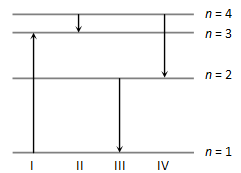
MCQ 441 Mark
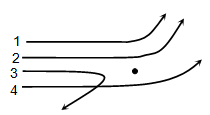
The diagram shows the path of four a-particles of the same energy being scattered by the nucleus of an atom simultaneously. Which of these are/is not physically possible
- A
$3$ and $4$
- B
$2$ and $3$
- C
$1$ and $4$
- ✓
$4$ only
AnswerCorrect option: D. $4$ only
$4$ only
View full question & answer→MCQ 451 Mark
The energy equivalent of $1$ kilogram of matter is about
- A
$10^{-15}J$
- B
$1 J$
- C
$10^{-12} J$
- ✓
$10^{17} J$
AnswerCorrect option: D. $10^{17} J$
$10^{17} J$
View full question & answer→MCQ 461 Mark
In the lowest energy level of hydrogen atom, the electron has the angular momentum
- A
$\pi/h$
- B
$h/\pi$
- ✓
$h/2\pi$
- D
$2\pi/h$
AnswerCorrect option: C. $h/2\pi$
$h/2\pi$
View full question & answer→MCQ 471 Mark
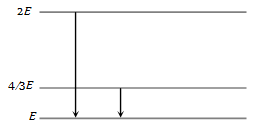
The following diagram indicates the energy levels of a certain atom when the system moves from $2E$ level to $E,$ a photon of wavelength $\lambda $ is emitted. The wavelength of photon produced during its transition from $\frac{4E}{3}$ level to $E$ is
- A
$\lambda /3$
- B
$3\ \lambda /4$
- C
$4\ \lambda /3$
- ✓
$3\ \lambda $
AnswerCorrect option: D. $3\ \lambda $
$3\ \lambda $
View full question & answer→MCQ 481 Mark
The angular momentum of electron in $n^{th}$ orbit is given by
- A
$nh$
- B
$\frac{h}{2 \pi n}$
- ✓
$n^{\frac{h}{2 \pi}}$
- D
$n^2 \frac{h}{2 \pi}$
AnswerCorrect option: C. $n^{\frac{h}{2 \pi}}$
$n^{\frac{h}{2 \pi}}$
View full question & answer→MCQ 491 Mark
Activity of radioactive element decreased to one third of original activity $R_o$ in $9$ years. After further $9$ years, its activity will be
AnswerCorrect option: C. $\mathrm{R}_{0 / 9}$
$\mathrm{R}_{0 / 9}$
View full question & answer→MCQ 501 Mark
Which of the following cannot cause fission in a heavy nucleus