MCQ
$1 \,atomic$ mass unit is equal to
  • A
    $\frac{1}{{25}}$ (mass of ${F_2}$ molecules)
  • B
    $\frac{1}{{14}}$ (mass of ${N_2}$ molecules)
  • $\frac{1}{{12}}$ (mass of one $C-$atom)
  • D
    $\frac{1}{{16}}$ (mass of ${O_2}$ molecules)

Answer

Correct option: C.
$\frac{1}{{12}}$ (mass of one $C-$atom)
c
(c)

Need a full question paper?

Generate a complete, print-ready paper with questions like this in minutes — across 16+ boards, with answer keys.
Start Generating Free

Similar questions

Which of the following cannot be emitted by radioactive substances during their decay
A long solenoid has $200$ turns per cm and carries a current of $2.5\, amps$. The magnetic field at its centre is $({\mu _0} = 4\pi \times {10^{ - 7}}\,weber/amp{\rm{ - }}m)$
The displacement $x$ (in metres) of a particle performing simple harmonic motion is related to time $t$ (in seconds) as $x = 0.05\cos \left( {4\,\pi \,t + \frac{\pi }{4}} \right)$. The frequency of the motion will be ..... $Hz$
What is the value of linear velocity, if $\vec \omega = 3\hat i - 4\hat j + \hat k$ and $\vec r = 5\hat i - 6\hat j + 6\hat k$
A metal sphere of radius $r$ and specific heat $S$ is rotated about an axis passing through its centre at a speed of $f$ rotations per second. It is suddenly stopped at $50\%$ of its energy is used in increasing its temperature. Then the rise in temperature of the sphere is
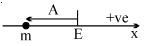
$A$ particle of mass m is constrained to move on $x$ -axis. $A$ force $F$ acts on the particle. $F$ always points toward the position labeled $E$. For example, when the particle is to the left of $E, F$ points to the right. The magnitude of $F$ is a constant $F$ except at point $E$ where it is zero. The system is horizontal. $F$ is the net force acting on the particle. The particle is displaced a distance $A$ towards left from the equilibrium position $E$ and released from rest at $t = 0.$  What is the period of the motion? 
A wheel initially at rest, is rotated with a uniform angular acceleration. The wheel rotates through an angle ${\theta _1}$ in first one second and through an additional angle ${\theta _2}$ in the next one second. The ratio $\frac{{{\theta _2}}}{{{\theta _1}}}$ is
Charge $Q$ is given a displacement $\vec r = a\hat i + b\hat j$ in an electric field $\vec E = E_1\hat i + E_2\hat j$ . The work done is
The maximum elongation of a steel wire of $1 \mathrm{~m}$ length if the elastic limit of steel and its Young's modulus, respectively, are $8 \times 10^8 \mathrm{~N} \mathrm{~m}^{-2}$ and $2 \times 10^{11} \mathrm{~N} \mathrm{~m}^{-2}$, is:
The angular magnification of a simple microscope can be increased by increasing