Question

1 Curie is equal to

(a) 3  disintegrations/sec

(b) 3.7   disintegrations/sec

(c) 5 disintegrations/sec

(d) 3.7  disintegrations/sec

Answer

(d) 3.7  disintegrations/sec

Need a full question paper?

Generate a complete, print-ready paper with questions like this in minutes — across 16+ boards, with answer keys.

Start Generating Free

Similar questions

Which one of the following phenomena is not explained by Huygen's construction of wavefront

(a) Refraction

(b) Reflection

(c) Diffraction

(d) Origin of spectra

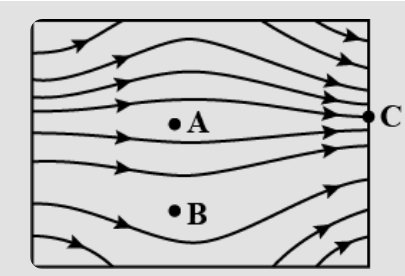
Figure shows the magnetic field lines in a magnetic field. A, B. and C are three points in this field. At what point is the magnetic field strong ?

Take the effect of bulging of earth and its rotation in account. Consider the following statements:
  1. There are points outside the earth where the value of g is equal to its value at the equator.
  2. There are points outside the earth where the value of g is equal to its value at the poles.
  1. Both A and B are correct.
  2. A is correct but B is wrong.
  3. B is correct but A is wrong.
  4. Both A and B are wrong.
Which is the frequency range of gamma rays from the following?
A bullet hits a block kept at rest on a smooth horizontal surface and gets embedded into it. Which of the following does not change?
  1. Linear momentum of the block.
  2. Kinetic energy of the block.
  3. Gravitational potential energy of the block.
  4. Temperature of the block.

Three light bulbs of 40 W, 60 W and 100 W are connected in series with 220 V source. Which one of the bulbs will glow brightest

(a) 40 W

(b) 60 W

(c) 100 W

(d) All with the same brightness

The band spectra (characteristic of molecular species) is due to emission of radiation

(a) Gaseous state

(b) Liquid state

(c) Solid state

(d) All of three states

To reduce the reasonant frequency in an LCR series circuit with a generator:
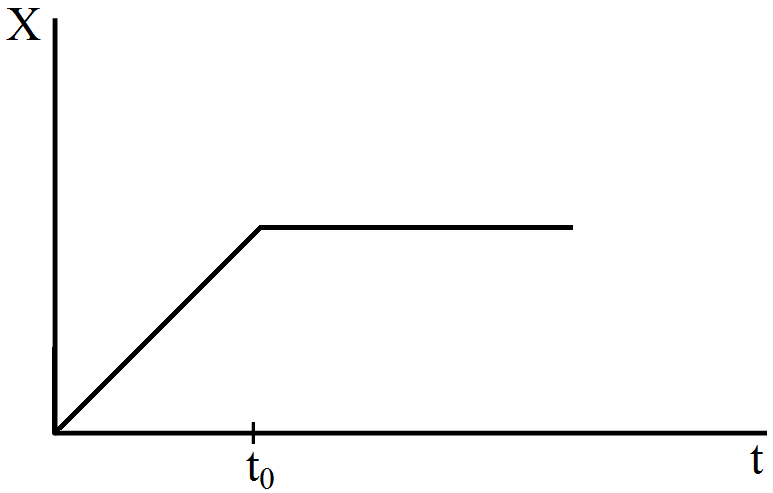
Figure shows the displacement-time graph of a particle moving on the X-axis.

  1. The particle is continuously going in positive x direction.
  2. The particle is at rest.
  3. The velocity increases up to a time to, and then becomes constant.
  4. The particle moves at a constant velocity up to a time to, and then stops.
The value of excitation energy required to bring an electron to the first excited state in hydrogen atom is :