Questions · Page 1 of 12

M.C.Q (1 Marks)

🎯

Test yourself on this topic

50 questions · timed · auto-graded

Question 11 Mark

Imagine an atom made up of a proton and a hypothetical particle of double the mass of the electron but having the same charge as the electron. Apply the Boh’r atom model and consider all possible transitions of this hypothetical particle to the first excited level. The longest wavelength photon that will be emitted has wavelength l (given in terms of the Rydberg constant R for the hydrogen atom) equal to

(a) 9/(5R)

(b) 36/(5R)

(c) 18/(5R)

(d) 4/R

Answer

(c) 18/(5R)

View full question & answer
Question 31 Mark

The mass defect in a particular nuclear reaction is 0.3 grams. The amount of energy liberated in kilowatt hours is (Velocity of light = 3)

(a) 1.5  

(b) 2.5  

(c) 3  

(d) 7.5  

Answer

(d) 7.5  

View full question & answer
Question 41 Mark

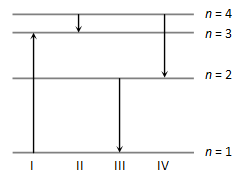
The diagram shows-the energy levels for an electron in a certain atom. Which transition shown represents the emission of a photon with the most energy

(a) I

(b) II

(c) III

(d) IV

Answer

(c) III

View full question & answer
Question 51 Mark

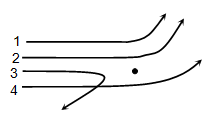
The diagram shows the path of four a-particles of the same energy being scattered by the nucleus of an atom simultaneously. Which of these are/is not physically possible

(a) 3 and 4

(b) 2 and 3

(c) 1 and 4

(d) 4 only

Answer

(d) 4 only

View full question & answer
Question 71 Mark

In the lowest energy level of hydrogen atom, the electron has the angular momentum

(a)  

(b) h/ 

(c) h/2  

(d)  

Answer

(c) h/2  

View full question & answer
Question 81 Mark

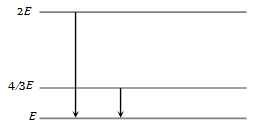
The following diagram indicates the energy levels of a certain atom when the system moves from 2E level to E, a photon of wavelength λ  is emitted. The wavelength of photon produced during its transition from   level to E is

 (a) λ/3

(b) 3 λ/4

(c) 4 λ/3  

(d) 3 λ

Answer

(d) 3 λ

View full question & answer
Question 101 Mark

The Rutherford a-particle experiment shows that most of the a-particles pass through almost unscattered while some are scattered through large angles. What information does it give about the structure of the atom

(a) Atom is hollow

(b) The whole mass of the atom is concentrated in a small centre called nucleus

(c) Nucleus is positively charged

(d) All the above

Answer

(d) All the above

View full question & answer
Question 111 Mark

Excitation energy of a hydrogen like ion in its first excitation state is 40.8 eV. Energy needed to remove the electron from the ion in ground state is

(a) 54.4 eV

(b) 13.6 eV

(c) 40.8 eV

(d) 27.2 eV

Answer

(a) 54.4 eV

View full question & answer
Question 121 Mark

After 280 days, the activity of a radioactive sample is 6000 dps. The activity reduces to 3000 dps after another 140 days. The initial activity of the sample in dps is

(a) 6000  

(b) 9000

(c) 3000  

(d) 24000

Answer

(d) 24000

View full question & answer
Question 131 Mark

The half-life of a radioactive substance is 40 years. How long will it take to reduce to one fourth of its original amount and what is the value of decay constant

(a) 40 year, 0.9173/year

(b) 90 year, 9.017/year

(c) 80 year, 0.0173 year

(d) None of these

Answer

(c) 80 year, 0.0173 year

View full question & answer
Question 151 Mark

In a fission reaction , the binding energy per nucleon of X and Y is 8.5 MeV whereas of  is 7.6 MeV. The total energy liberated will be about

(a) 200 KeV

(b) 2 MeV

(c) 200 MeV

(d) 2000 MeV

Answer

(c) 200 MeV

View full question & answer
Question 161 Mark

Atomic weight of boron is 10.81 and it has two isotopes  and  . Then ratio of  in nature would be

(a) 19 : 81

(b) 10 : 11

(c) 15 : 16

(d) 81 : 19

Answer

(a) 19 : 81

View full question & answer
Question 171 Mark

The ratio of the largest to shortest wavelengths in Lyman series of hydrogen spectra is

(a)  

(b)

(c)   

(d)  

Answer

(d)  

View full question & answer
Question 181 Mark

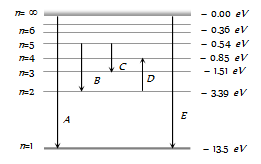
The energy levels of the hydrogen spectrum is shown in figure. There are some transitions A, B, C, D and E. Transition A, B and C respectively represent

(a) First member of Lyman series, third spectral line of Balmer series and the second spectral line of Paschen series

(b) Ionization potential of hydrogen, second spectral line of Balmer series and third spectral line of Paschen series

(c) Series limit of Lyman series, third spectral line of Balmer series and second spectral line of Paschen series

(d) Series limit of Lyman series, second spectral line of Balmer series and third spectral line of Paschen series

Answer

(c) Series limit of Lyman series, third spectral line of Balmer series and second spectral line of Paschen series

View full question & answer
Question 191 Mark

Radon (Ra) decays into Polonium ( by emitting an α - particle with half-life of 4 days. A sample contains 6.4  atoms of Rn. After 12 days, the number of atoms of  left in the sample will be

(a) 3.2  

(b) 0.53  

(c) 2.1  

(d) 0.8  

Answer

(d) 0.8  

View full question & answer
Question 201 Mark

The half life period of radium is 1600 years. The fraction of a sample of radium that would remain after 6400 years is

(a)  

(b)  

(c)   

(d) 

Answer

(d) 

View full question & answer
Question 211 Mark

Solar energy is mainly caused due to

(a) Fission of uranium present in the sun

(b) Fusion of protons during synthesis of heavier elements

(c) Gravitational contraction

(d) Burning of hydrogen in the oxygen

Answer

(b) Fusion of protons during synthesis of heavier elements

View full question & answer
Question 221 Mark

Light energy emitted by stars is due to

(a) Breaking of nuclei

(b) Joining of nuclei

(c) Burning of nuclei

(d) Reflection of solar light

Answer

(b) Joining of nuclei

View full question & answer
Question 231 Mark

Work of moderator is

(a) To control the velocity of neutrons

(b) Cooling

(c) As fuel

(d) It is used for safety

Answer

(a) To control the velocity of neutrons

View full question & answer
Question 241 Mark

The example of nuclear fusion is

(a) Formation of Ba and Kr from U235

(b) Formation of He from H

(c) Formation of Pu – 235 from U - 235

(d) Formation of water from hydrogen and oxygen

Answer

(b) Formation of He from H

View full question & answer
Question 251 Mark

Fission of nuclei is possible because the binding energy per nucleon in them

(a) Increases with mass number at high mass numbers

(b) Decreases with mass number at high mass numbers

(c) Increases with mass number at low mass numbers

(d) Decreases with mass number at low mass numbers

Answer

(b) Decreases with mass number at high mass numbers

View full question & answer
Question 261 Mark

If the mass number of an atom is A = 40 and its electron configuration is  , the number of neutrons and protons in its nucleus will be

(a) 22, 18

(b) 18, 22

(c) 20, 20

(d) 18, 18

Answer

(a) 22, 18

View full question & answer
Question 271 Mark

If in a nuclear fission, piece of uranium of mass 0.5 g is lost, the energy obtained in kWh is

(a) 1.25  

(b) 2.25  

(c) 3.25 

(d) 0.25 

Answer

(a) 1.25  

View full question & answer
Question 281 Mark

The curve of binding energy per nucleon as a function of atomic mass number has a sharp peak for helium nucleus. This implies that helium

(a) Can easily be broken up

(b) Is very stable

 (c) Can be used as fissionable material

(d) Is radioactive

Answer

(b) Is very stable

View full question & answer
Question 291 Mark

A nucleus is bombarded with a high speed neutron so that resulting nucleus is a radioactive one. This phenomenon is called

(a) Artificial radioactivity

(b) Fusion

(c) Fission

(d) Radioactivity

Answer

(c) Fission

View full question & answer
Question 301 Mark

What is used as a moderator in a nuclear reactor

(a) Water                                          

(b) Graphite

(c) Cadmium

(d) Steel

Answer

(b) Graphite

View full question & answer
Question 311 Mark

A nucleus of   originally at rest emits a particle with speed v. What will be the recoil speed of the daughter nucleus

(a) 4v/206

(b) 4v/214

(c) v/206

(d) v/214

Answer

(a) 4v/206

View full question & answer
Question 321 Mark

Nuclear fusion is common to the pair

(a) Thermonuclear reactor, uranium based nuclear reactor

(b) Energy production in sun, uranium based nuclear reactor

(c) Energy production in sun, hydrogen bomb

(d) Disintegration of heavy nuclei, hydrogen bomb

Answer

(c) Energy production in sun, hydrogen bomb

View full question & answer
Question 331 Mark

The principle of controlled chain reaction is used in

(a) Atomic energy reactor

(b) Atom bomb

(c) The core of sun

(d) Artificial radioactivity

Answer

(a) Atomic energy reactor

View full question & answer
Question 341 Mark

Heavy water is

(a) Water at 4

(b) Compound of deuterium and oxygen  

(c) Compound of heavy oxygen and heavy hydrogen

(d) Water, in which soap does not lather

Answer

(b) Compound of deuterium and oxygen  

View full question & answer
Question 351 Mark

Mark the correct statement

(a) Nuclei of different elements can have the same number of neutrons

(b) Every element has only two stable isotopes

(c) Only one isotope of each element is stable

(d) All isotopes of every element are radioactive

Answer

(a) Nuclei of different elements can have the same number of neutrons

View full question & answer
Question 361 Mark

The binding energy of nucleus is a measure of its

(a) Charge

(b) Mass

(c) Momentum

(d) Stability

Answer

(d) Stability

View full question & answer
Question 371 Mark

The kinetic energy of electron in the first Bohr orbit of the hydrogen atom is

(a) – 6.5 eV

(b) – 27.2 eV

(c) 13.6 eV

(d) – 13.6 eV

Answer

(c) 13.6 eV

View full question & answer
Question 381 Mark

Taking Rydberg’s constant  first and second wavelength of Balmer series in hydrogen spectrum is

(a) 2000 Å, 3000 Å

(b) 1575 Å, 2960 Å

(c) 6529 Å, 4280 Å

(d) 6552 Å, 4863 Å

Answer

(d) 6552 Å, 4863 Å

View full question & answer
Question 391 Mark

The kinetic energy of an electron revolving around a nucleus will be

(a) Four times of P.E.

(b) Double of P.E.

(c) Equal to P.E.

(d) Half of its P.E.

Answer

(d) Half of its P.E.

View full question & answer
Question 401 Mark

As the electron in Bohr orbit of Hydrogen atom passes from state n = 2 to n = 1, the kinetic energy K and potential energy U change as

(a) K two-fold, U four-fold

(b) K four-fold, U two-fold

(c) K four-fold, U also four-fold  

(d) K two-fold, U also two-fold

Answer

(c) K four-fold, U also four-fold       

View full question & answer
Question 411 Mark

The ground state energy of hydrogen atom is – 13.6 eV. What is the potential energy of the electron in this state

(a) 0 eV

(b) – 27.2 eV

(c) 1 eV   

(d) 2 eV

Answer

(b) – 27.2 eV

View full question & answer
Question 421 Mark

The energy of electron in the nth orbit of hydrogen atom is expressed as . The shortest and longest wavelength of Lyman series will be

(a) 910 Å, 1213 Å

(b) 5463 Å, 7858 Å

(c) 1315 Å, 1530 Å

(d) None of these

Answer

(a) 910 Å, 1213 Å

View full question & answer
Question 431 Mark

Which one of the relation is correct between time period and number of orbits while an electron is revolving in a orbit

(a)

(b)   

(c)  

(d)  

Answer
(c)  
View full question & answer
Question 441 Mark

In the spectrum of hydrogen atom, the ratio of the longest wavelength in Lyman series to the longest wavelength in the Balmer series is

(a) 5/27

(b) 1/93

(c) 4/9

(d) 3/2

Answer

(a) 5/27

View full question & answer
Question 451 Mark

The ratio of areas within the electron orbits for the first excited state to the ground state for hydrogen atom is

(a) 16 : 1 

(b) 18 : 1

(c) 4 : 1    

(d) 2 : 1

Answer

(d) 2 : 1

View full question & answer
Question 461 Mark

The colour of the second line of Balmer series is

(a) Blue

(b) Yellow

(c) Red

(d) Violet

Answer

(a) Blue

View full question & answer
Question 471 Mark

The Bohr model of atoms            

(a) Assumes that the angular momentum of electrons is quantized

(b) Uses Einstein’s photo-electric equation

(c) Predicts continuous emission spectra for atoms

(d) Predicts the same emission spectra for all types of atoms

Answer

(a) Assumes that the angular momentum of electrons is quantized

View full question & answer
Question 481 Mark

The shortest wavelength in the Lyman series of hydrogen spectrum is 912 Å corresponding to a photon energy of 13.6 eV. The shortest wavelength in the Balmer series is about

(a) 3648 Å

(b) 8208 Å

(c) 1228 Å

(d) 6566 Å

Answer

(a) 3648 Å

View full question & answer
Question 491 Mark

Which of the following is quantised according to Bohr’s theory of hydrogen atom

(a) Linear momentum of electron

(b) Angular momentum of electron

(c) Linear velocity of electron

(d) Angular velocity of electron

Answer

(b) Angular momentum of electron

View full question & answer
Question 501 Mark

Radius of first Bohr orbit is r. What is the radius of 2nd Bohr orbit?

(a) 8r

(b) 2r

(c) 4r

(d) 2 

Answer

(c) 4r

View full question & answer