Question
1. Explain hyperconjugation effect. How does hyperconjugation effect explain the stability of alkenes?
2. Draw the resonance structures of the following compounds:
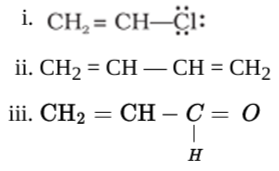
Image

Need a full question paper?

Generate a complete, print-ready paper with questions like this in minutes — across 16+ boards, with answer keys.

Start Generating Free

Similar questions

At 1127K and 1 atm pressure, a gaseous mixture of CO and $CO_2$ in equilibrium with soild carbon has 90.55% CO by mass
$\text{C (S) + CO}_2\text{ (g)}\rightleftharpoons2\text{CO (g)}$
Calculate $K_c​​​​​​​$​​​​​​​ for this reaction at the above temperature.
What are the common physical and chemical features of alkali metals?
What is Lewis point structure? Explain the rules of writing this with examples.
Explain different types of isomerism in alkenes with example.
Classify the elements on basis of electronic configuration.
How is heavy water prepared? Compare its physical properties with those of ordinary water.
Classify the following reactions in one of the reaction type studied in this unit.
i. $\mathrm{CH}_3 \mathrm{CH}_2 \mathrm{Br}+\mathrm{HS}^{-} \rightarrow \mathrm{CH}_3 \mathrm{CH}_2 \mathrm{SH}+\mathrm{Br}^{-}$
ii. $(\mathrm{CH})_2 2 \mathrm{C}=\mathrm{CH} 2+\mathrm{HCl} \rightarrow\left(\mathrm{CH}_3\right)_2 \mathrm{ClC}-\mathrm{CH}_3$
iii. $\mathrm{CH}_3 \mathrm{CH}_2 \mathrm{Br}+\mathrm{HO}^{-} \rightarrow \mathrm{CH}=\mathrm{CH}_2+\mathrm{H}_2 \mathrm{O}+\mathrm{Br}^{-}$
iv. $\left(\mathrm{CH}_3\right)_3 \mathrm{C}-\mathrm{CH}_3 \mathrm{OH}+\mathrm{HBr} \rightarrow\left(\mathrm{CH}_3\right)_2 \mathrm{CBrCH}_2 \mathrm{CH}_2 \mathrm{CH}+\mathrm{H}_2 \mathrm{O}$
Determine the solubilities of silver chromate, barium chromate, ferric hydroxide, lead chloride and mercurous iodide at 298 K from their solubility product constants.
1. $K _{ sp }\left( Ag _2 CrO _4\right)=1.1 \times 10^{-12}$,
2. $Ksp \left( BaCrO _4\right)=1.2 \times 10^{-10}$,
3. $K _{ sp }\left[ Fe ( OH )_3\right]=1.0 \times 10^{-3}$,
Determine also the molarities of individual ions.
What is Gibbs energy? How does this explain spontaneity?
Graphically show the total work done in an expansion when the state of an ideal gas is changed reversibly and isothermally from $\left(p_i, V_i\right)$ to $\left(p_f, V_f\right)$. With the help of a pV plot compare the work done in the above case with that carried out against a constant external pressure $p _{ f }$