Questions

5 Marks Questions

Take a timed test

5 questions · self-marked practice — reveal the answer and mark yourself.

Question 15 Marks
1. Explain hyperconjugation effect. How does hyperconjugation effect explain the stability of alkenes?
2. Draw the resonance structures of the following compounds:
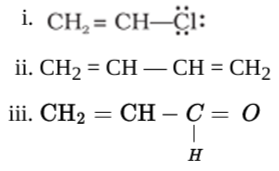
Image
View full question & answer
Question 25 Marks
1. What is the general molecular formula of saturated monohydric alcohols?
2. Write structural formulae for compounds named as-
a. 1-Bromoheptane
b. 5-Bromoheptanoic acid
View full question & answer
Question 35 Marks
A sample of pure $PCl _5$ was introduced into an evacuated vessel at 473 K . After equilibrium was attained, concentration of $PCl _5$ was found to be $0.5 \times 10^{-1} mol L ^{-1}$. If value of $K _{ C }$ is $8.3 \times 10^{-3}$, what are the concentrations of $PCl _3$ and $Cl _2$ at equilibrium?
$
PCl_5(g) \rightleftharpoons PCl_3(g)+Cl_2(g)
$
Answer
Let the initial molar concentration of $PCl _5$ per litre $= x mol$
Molar concentration of $PCl _5$ at equilibrium $=0.05 mol$
Moles of $PCl _5$ decomposed $=( x -0.05) mol$
Moles of $PCl _3$ formed $=( x -0.05) mol$
Moles of $Cl _2$ formed $=( x -0.05) mol$
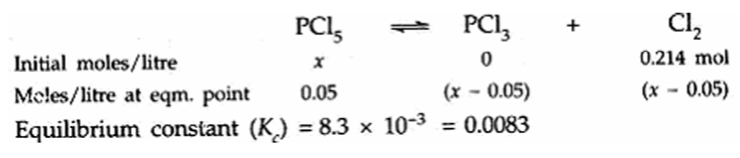
The molar concentration./ litre of reactants and products before the reaction and at the equilibrium point are:
Image

Applying Law of chemical equilibrium,
$
\begin{aligned}
& K_c=\frac{\left[P C l_3\right]\left[Cl_2\right]}{\left[P C l_5\right]} 0.0083=\frac{(x-0.05) \times(x-0.05)}{0.05} \\
& (x-0.05)^2=0.0083 \times 0.05=4.15 \times 10^{-4} \\
& (x-0.05)=\left(4.15 \times 10^{-4}\right)^{1 / 2}=2.037 \times 10^{-2}=0.02 moles \\
& x=0.05+0.02=0.07 mol
\end{aligned}
$
The molar concentration of $PCl _3$ at equilibrium. $= x -0.05=0.07-0.05=0.02 mol$
The molar concentration of $Cl _2$ at equilibrium. $= x -0.05=0.07-0.05=0.02 mol$
View full question & answer
Question 45 Marks
The pH of milk, black coffee, tomato juice, lemon juice, and egg white are $6.8,5.0,4.2,2.2$ and 7.8 respectively. Calculate corresponding hydrogen ion concentration in each.
Answer
We can calculate the hydrogen ion concentration by applying the formula, $pH =-\log [ H +]$
$
\begin{aligned}
& \text { i. } pH \text { of milk }=6.8 \\
& \text { Since, } pH=-\log \left[H^{+}\right] \\
& \Rightarrow 6.8=-\log \left[H^{+}\right] \\
& \Rightarrow \log \left[H^{+}\right]=-6.8
\end{aligned}
$
By taking antilog of both the sides, we get
$
\begin{aligned}
& \Rightarrow\left[H^{+}\right]=\operatorname{antilog}(-6.8) \\
& \Rightarrow\left[H^{+}\right]=1.5 \times 19-7 M
\end{aligned}
$
ii. pH of black coffee $=5.0$
$
\begin{aligned}
& \text { Since, } pH=-\log \left[H^{+}\right] \\
& \Rightarrow 5.0=-\log \left[H^{+}\right] \\
& \Rightarrow \log \left[H^{+}\right]=-5.0
\end{aligned}
$
By taking antilog of both the sides, we get
$
\begin{aligned}
& \Rightarrow\left[H^{+}\right]=\text {antilog }(-5.0) \\
& \Rightarrow\left[H^{+}\right]=10^{-5} M
\end{aligned}
$
iii. pH of tomato juice $=4.2$
$
\begin{aligned}
& \text { Since, } pH=-\log \left[H^{+}\right] \\
& \Rightarrow 4.2=-\log \left[H^{+}\right] \\
& \Rightarrow \log \left[H^{+}\right]=-4.2
\end{aligned}
$
By taking the antilog of both the sides, we get
$
\begin{aligned}
& \Rightarrow\left[H^{+}\right]=\operatorname{antilog}(-4.2) \\
& \Rightarrow\left[H^{+}\right]=6.31 \times 10^{-5} M
\end{aligned}
$
iv. pH of lemon juice $=2.2$
$
\begin{aligned}
& \text { Since, } pH=-\log \left[H^{+}\right] \\
& \Rightarrow 2.2=-\log \left[H^{+}\right] \\
& \Rightarrow \log [H+]=-2.2
\end{aligned}
$
By taking the antilog of both the sides, we get
$
\begin{aligned}
& \Rightarrow\left[H^{+}\right]=\operatorname{antilog}(-2.2) \\
& \Rightarrow\left[H^{+}\right]=6.31 \times 10^{-3} M
\end{aligned}
$
v. pH of egg white $=7.8$
Since, $pH =-\log \left[ H ^{+}\right]$
$
\begin{aligned}
& \Rightarrow 7.8=-\log \left[H^{+}\right] \\
& \Rightarrow \log \left[H^{+}\right]=-7.8
\end{aligned}
$
By taking the antilog of both the sides, we get
$
\begin{aligned}
& \Rightarrow\left[H^{+}\right]=\operatorname{antilog}(-7.8) \\
& \Rightarrow\left[H^{+}\right]=1.58 \times 10^{-8} M
\end{aligned}
$
View full question & answer
Question 55 Marks
Attempt any five of the following:
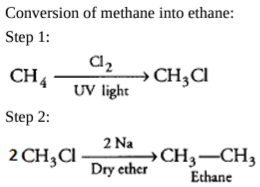
1. Convert methane into ethane.
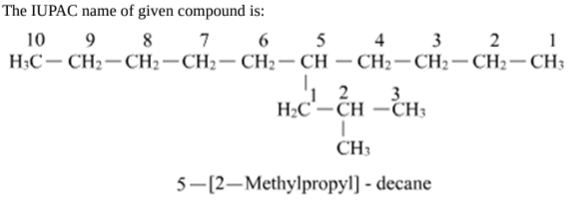
2. Write IUPAC name of the following: $CH _3\left( CH _2\right)_4 CH \left( CH _2\right)_3 CH _3 CH _2- CH \left( CH _3\right)_2$
3. To which category of compounds does cyclohexane belong?
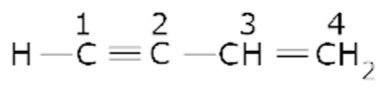
4. Name the type of hybridization in C (2) and C (3) in the following molecule
Image

5. What are Arenes?
6. n-propylmagnesium bromide on hydrolysis gives propane. Is there any other Grignard reagent which also gives propane? If so, give its name, structure and equation for the reaction.
7. How will you distinguish between acetylene and ethylene?
Answer
1.
Image
2.
Image
3. Cyclohexane belongs to saturated alicyclic hydrocarbons.
4.  ${ }^{ At , C (2)}$ two ${ }^\sigma$ and two ${ }^\pi$ - bonds are present. Therefore, $C (2)$ is sp-hybridized and at $C (3)$ three ${ }^\sigma$ and one ${ }^\pi$-bond are present. Therefore, (C3) is $sp ^2$ hybridized.
5.  Arenes are aromatic hydrocarbons
6. Iso-propylmagnesium bromide, $\left( CH _3\right)_2 CHMgBr$,
$
\left(CH_3\right)_2 CHMgBr+H_2 O \longrightarrow CH_3 CH_2 CH_3+Mg(OH) Br
$
7. Acetylene forms precipitate with ammoniacal silver nitrate solution, ethylene does not react with these reagents.
View full question & answer