Question
1. Explain hyperconjugation effect. How does hyperconjugation effect explain the stability of alkenes?
2. Draw the resonance structures of the following compounds:
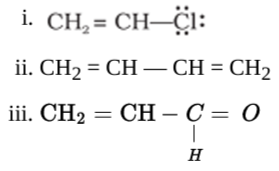
Image

Need a full question paper?

Generate a complete, print-ready paper with questions like this in minutes — across 16+ boards, with answer keys.

Start Generating Free

Similar questions

1. What is the general molecular formula of saturated monohydric alcohols?
2. Write structural formulae for compounds named as-
a. 1-Bromoheptane
b. 5-Bromoheptanoic acid
  1. What are two conditions for the formation of hydrogen bond?
  2. In which of the following compounds 'S' does not obey octet rule?

$\text{SF}_2,\text{SF}_4,\text{SF}_6,\text{SO}_2$

  1. Explain the term hybridisation taking $\text{CH}\equiv\text{CH}$ as an example.
Assign reason for the following:
  1. BaSO4 is insoluble although ionic in nature.
  2. ClF3 has only 90° bond angles.
  3. SO2 is angular but SO3 is planar.
  4. NH3 and PH3 have same hybridization but different bond angle.
  5. CuSO4.5H2O loses 4H2O on heating but not the fifth molecule.
Explain the following observations:
  1. CO2 and SO2 are not isostructural.
  2. BF3 and NF3 are not isostructural.
  3. $\text{BH}^-_4$ and $\text{NH}^+_4$ are isostructural.
  4. N2 has higher bond order than NO.
  5. In NO+ and N2, the bond order is same.
Calculate the equilibrium constant for the following equilibrium system at 1120K.

$\text{C}(\text{s})+\text{CO}_2(\text{g})+2\text{Cl}_2\stackrel{\text{K}_\text{p}}{\rightleftharpoons}2\text{COCl}_2(\text{g})$

Given the following equations and equilibrium constants:

$\text{CO}(\text{s})+\text{Cl}_2(\text{g})\rightleftharpoons\text{COCl}_2(\text{g})$

$\text{Kp}_1 = 6.0 \times 10-3 \dots(1)$

$\text{CO}(\text{s})+\text{Cl}_2(\text{g})\rightleftharpoons\text{CO}_2(\text{g})$

$\text{Kp}_2 = 1.3 \times 1014 \dots(2)$

Use the molecular orbital energy level diagram to show that N2 would be expected to have a triple bond, F2 a single bond and Ne2 no bond.
What is simple buffer? Give an example and also explain its mechanism.
$\Delta\text{G}$ is net energy available to do useful work and is thus a measure of “free energy”. Show mathematically that $\Delta\text{G}$ is a measure of free energy. Find the unit of $\Delta\text{G}$ . If a reaction has positive enthalpy change and positive entropy change, under what condition will the reaction be spontaneous?
How would you explain the fact that first ionisation enthalpy of sodium is lower than that of magnesium but its second ionisation enthalpy is higher than that of magnesium?
Calculate the wavelength for the emission transition if it starts from the orbit having radius 1.3225nm and ends at 211.6pm. Name the series to which this transition belongs and the region of the spectrum.