Question
Assign reason for the following:
  1. BaSO4 is insoluble although ionic in nature.
  2. ClF3 has only 90° bond angles.
  3. SO2 is angular but SO3 is planar.
  4. NH3 and PH3 have same hybridization but different bond angle.
  5. CuSO4.5H2O loses 4H2O on heating but not the fifth molecule.
Answer

  1. BaSO4 is insoluble in water because lattice energy is more than hydration energy (energy released when $\text{Ba}^{2+}$ and $\text{SO}^{2-}_4$ get attracted by water molecules)
  2. ClF3 has three bonded pair which are at 90° but lone pair of electrons are at equatorial position at angle 120° so as to minimize repulsion.
  3. SO2 has 1 lone pair, therefore, it is bent molecule, SO3 does not have lone pair.

$\therefore$ SO2 is planar.

  1. 'N' is smaller in size and more electronegative than 'P' therefore in NH3 bond angle is 107° but in PH3 it is 94.5°. As the size of central atom increases, bond angle decreases.

$[\text{Cu}(\text{H}_2\text{O})_4]\text{SO}_4\dots\text{H}_2\text{O}\xrightarrow{\ \ \text{heat}\ \ }\text{CuSO}_4\dots\text{H}_2\text{O}+4\text{H}_2\text{O}$

  1. CuSO4.5H2O loses 4 molecules of water which are forming coordinate bond with Cu2+ but does not lose H2O molecule, which is H-bonded.

Need a full question paper?

Generate a complete, print-ready paper with questions like this in minutes — across 16+ boards, with answer keys.

Start Generating Free

Similar questions

How is a covalent bond formed? Explain the rules of covalent bond formation with examples.
Calculate the pH of a 0.10 M ammonia solution. Calculate the pH after 50.0 mL of this solution is treated with 25.0 mL of 0.10 M HCl . The dissociation constant of ammonia, $K _{ b }=1.77 \times 10^{-5}$
  1. A sample of salt has the following percentage composition

Fe = 36.76%, S = 21.11 % and O = 42.14%

Calculate the empirical formula of the compound

  1. What happens if the compound is heated? Write the balanced chemical equation.
How the electrons was discovered? Explain
Attempt any five of the following:
1. What is electrophile in sulphonation?
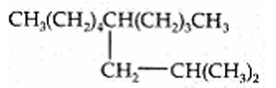
2. Write IUPAC name of following:
Image
3. Write IUPAC name: $CH _3 CH - C \left( CH _3\right)_2$
4. Methane does not react with chlorine in dark. Why?
5. How would you convert ethene to ethane molecule?
6. What is Huckel rule?
7. What is decarboxylation? Give an example.
Identify the substance oxidised reduced, oxidising agent and reducing agent for each of the following reactions:

  1. 2AgBr(s) + C6H6O2(aq) → 2Ag(s) + 2HBr(aq) + C6H4O2(aq)

  2. HCHO(l) + 2[Ag(NH3)2]+(aq) + 3OH-(aq) → 2Ag(s) + HCOO-(aq) + 4NH3(aq) + 2H2O(l)

  3. HCHO(l) + 2Cu2+(aq) + 5OH-(aq) → Cu2O(s) + HCOO-(aq) + 3H2O(l)

  4. N2H4(l) + 2H2O2(l) → N2(g) + 4H2O(l)

  5. Pb(s) + PbO2(s) + 2H2SO4(aq) → 2PbSO4(s) + 2H2O(l)

  1. Predict the sign of the entropy change for each of the following changes:
  1. Hg(l) → Hg(g)
  2. Steam → Water
  1.  
  1. Define Gibb's Energy. Give its mathematical expression. What is Gibb's energy criteria for spontaneity.
  2. Give a brief note on the following thermodynamic terms:
  • Standard enthalpy of combustion.
  • Standard enthalpy of formation.
What is resonance effect and it is of how many types? Explain with examples.
What is the minimum volume of water required to dissolve 1g of calcium sulphate at 298K? (For calcium sulphate, Ksp is 9.1 × 10⁻⁶).
Explain standard combustion enthalpy and atomisation enthalpy.