Question
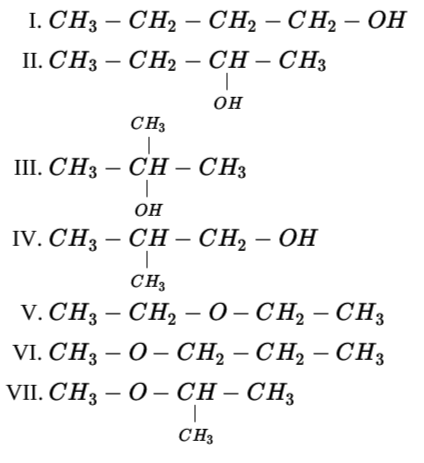
1. Identify the pairs of compounds which are functional group isomers.
Image
2. Explain, how is the electronegativity of carbon atoms related to their state of hybridization in an organic compound.

Answer

1. All the seven compounds given have the same molecular formula, so each alcohol is a functional group isomer of each ether given and visa-versa. Functional group isomers are a type of structural isomers having the same molecular formula but different functional groups. In the given structures, I, II, III, IV represent alcohols and V, VI, VII are ethers. Hence, I and V, I and VI, I and VII, II and V, II and VI, II and VII, III and V, III and VI, etc.
2. If C is sp hybridized then S character is $50 \%$.
If C is $sp ^2$ hybridized then S character is $33 \%$.
If C is $sp ^3$ hybridized then S character is $25 \%$.
Electronegativity of carbon is directly proportional to ' $s$ ' character.
Hence, sp hybridized carbon has strong S character.
We know that, s electrons are more strongly attracted by nucleus than p-electrons as they lie closer to nucleus.. Thus, electronegativity of carbon increases with increase in ' $s$ ' character.

Need a full question paper?

Generate a complete, print-ready paper with questions like this in minutes — across 16+ boards, with answer keys.

Start Generating Free

Similar questions

Extensive properties depend on the quantity of matter but intensive properties do not. Explain whether the following properties are extensive or intensive. Mass, internal energy, pressure, heat capacity, molar heat capacity, density, mole fraction, specific heat, temperature and molarity.
S. No
Column I
Column II
1.
Cl2O
+7
2.
Cl2O7
+4
3.
ClO2
+1
4.
Cl2O6
+6
Explain the effect of pressure, temperature, addition of catalyst and inert gas on the equilibrium of reversible reaction.
An alkene 'A' on ozonolysis gives a mixture of ethanal and pentan-3-one. Write structure and IUPAC name of 'A'.
The equilibrium constant for the following reaction is 1.6 ×10⁵ at 1024K $\text{H}_2\text{ (g) + Br (g)}\rightleftharpoons2\text{HBr (g)}$ Find the equilibrium pressure of all gases if 10.0 bar of HBr is introduced into a
sealed container at 1024K.
How would you explain the fact that the first ionization enthalpy of sodium is lower than that of magnesium but its second ionization enthalpy is higher than that of magnesium?
Calculate the wavenumber for the longest wavelength transition in the Balmer series of atomic hydrogen.
The ionization constant of HF, HCOOH and HCN at 298K are 6.8 × 10⁻⁴, 1.8 × 10⁻⁴ and 4.8 × 10⁻⁹ respectively. Calculate the ionization constants of the corresponding conjugate base.
Comment on following :
(i) Differential extraction
(ii) Estimation of sulphur by Carius process