Sample QuestionsModel Paper 8 questions
One sample from each question group in this chapter. Select any group above to see the full set with answer keys.
The number of alkynes possible with molecular formula $C _5 H _8$ is:
Answer: D.
View full solution →Cathode rays are deflected by:
- ✓
electric and magnetic fields
- B
- C
- D
Answer: A.
View full solution →Choose the correct explanation regarding half-reaction such as $Cr _2 O _7^{2-} \rightarrow Cr ^{3+}$ from the following.
Answer: C.
View full solution →The equilibrium constant for a reaction is 10 . What will be the value of $\Delta G^0$ ? $R =8.314 JK ^{-1}, T=300 K, T =$ 300 K ?
- ✓
$-5.744 kJ mol ^{-1}$
- B
$-5.456 kJ mol ^{-1}$
- C
$-6.132 kJ mol ^{-1}$
- D
$-5.978 kJ mol ^{-1}$
Answer: A.
View full solution →Choose one of the following in the order of increasing radii:
- A
$I ^{-}< I ^{+}< I$
- B
$I < I ^{+}< I ^{-}$
- C
$I ^{+}< I ^{-}< I$
- ✓
$I ^{-}> I > I ^{+}$
Answer: D.
View full solution →Write the electronic configuration of the following ions:
i. $H ^{-}$
ii. $Na ^{+}$
iii. $O ^{2-}$
iv. $F ^{-}$
View full solution →Alkynes on reduction with sodium in liquid ammonia form trans alkenes. Will the butene thus formed on the reduction of the 2-butyne show the geometrical isomerism?
Arrange the three isomers of pentane in increasing order of their boiling points.
How many seconds are there in 2 days?
Which of the elements $Na , Mg , Si$ and P would have the greatest difference between the first and second ionisation enthalpies. Briefly explain your answer.
View full solution →The density of 3 M solution of NaCl is $1.25 g mL ^{-1}$. Calculate the molality of the solution.
View full solution →Give the name and an atomic number of the inert gas atom in which the total number of d-electrons is equal to the difference in numbers of total p and s electrons.
Emission transitions in the Paschen series end at orbit $n =3$ and start from orbit n and can be represeted as $v =$ $3.29 \times 10^{15}(Hz)\left[1 / 3^2-1 / n ^2\right]$ Calculate the value of n if the transition is observed at 1285 nm . Find the region of the spectrum.
View full solution →Assuming the water vapor to be a perfect gas, calculate the internal energy change when 1 mol of water at $100^{\circ} C$ and 1 bar pressure is converted to the ice at $0^{\circ} C$. Given the enthalpy of fusion of ice is 6.00 kJ mol1 heat capacity of water is $4.2 J / g ^{\circ} C$.
View full solution →Consider the reactions :
a. $6 CO _2(g)+6 H _2 O ( I ) \longrightarrow C _6 H _{12} O _6( aq )+6 O _2(g)$
b. $O _3(g)+ H _2 O _2( I ) \longrightarrow H _2 O ( I )+2 O _2(g)$
Why it is more appropriate to write these reactions as :
a. $6 CO _2+12 H _2 O ( I ) \longrightarrow C _6 H _{12} O _6( aq )+6 H _2 O ( I )+6 O _2(g)$
b. $O _3(g)+ H _2 O _2( I ) \longrightarrow H _2 O ( I )+ O _2(g)+ O _2(g)$
Also suggest a technique to investigate the path of the above (a) and (b) redox reactions.
View full solution →1. Identify the pairs of compounds which are functional group isomers.
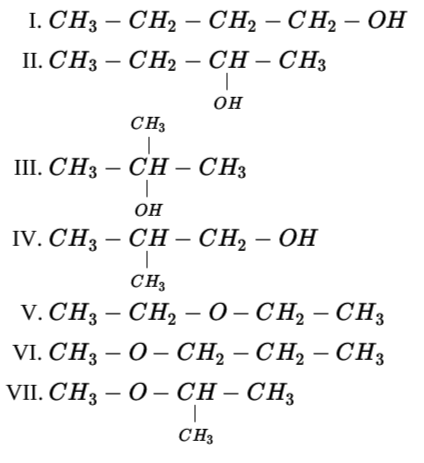
2. Explain, how is the electronegativity of carbon atoms related to their state of hybridization in an organic compound.
1. Give IUPAC names of the following structures.
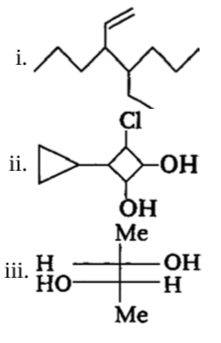
2. Benzoic acid is an organic compound. Its crude sample can be purified by crystallization from hot water. What characteristic differences in the properties of benzoic acid and the impurity make this process of purification suitable?
Write the expression for the equilibrium constant, $K _{ C }$ for each of the following reactions:
a. $2 NOCl ( g ) \rightleftharpoons 2 NO ( g )+ Cl _2(g)$
b. $2 Cu \left( NO _3\right)_2(s) \rightleftharpoons 2 CuO ( s )+4 NO _2(g)+ O _2(g)$
c. $CH _3 COOC _2 H _5( aq )+ H _2 O ( l ) \rightleftharpoons CH _3 COOH ( aq )+ C _2 H _5 OH ( aq )$
d. $Fe ^{3+}( aq )+3 OH ^{-}( aq ) \rightleftharpoons Fe ( OH )_3(s)$
e. $I _2(s)+5 F_2 \rightleftharpoons 2 IF _5$
View full solution →Attempt any five of the following:
1. What effect does branching of an alkene chain has on its boiling point?
2. What are Arenes?
3. Write IUPAC name of the following: $CH _3\left( CH _2\right)_4 CH \left( CH _2\right)_3 CH _3 CH _2- CH \left( CH _3\right)_2$
4. Why are alkanes called paraffins?
5. State Le chatelier's principle.
6. What is decarboxylation? Give an example.
7. Arrange the following: $HCl , HBr , Hl , HF$ in order of decreasing reactivity towards alkenes.
View full solution →1. Describe the effect of
a. addition of $H _2$
b. addition of $CH _3 OH$
c. removal of CO
d. removal of $CH _3 OH$ on the equilibrium of the reaction,
$
2 H_2(g)+CO(g) \rightleftharpoons CH_3 OH(g)
$
2. What happens to an equilibrium in a reversible reaction if a catalyst is added to it?
View full solution →Assertion (A): Molarity of a solution represents its concentration.
Reason (R): Molarity is the number of moles of solute per litre of solution.
- ✓
Both A and R are true and R is the correct explanation of A.
- B
Both A and R are true but R is not the correct explanation of A.
- C
A is true but R is false.
- D
A is false but R is true.
Answer: A.
View full solution →Assertion (A): Energy of radiation is large if its wavelength is large.
Reason (R): Energy $= h \nu\left(\nu=\right.$ frequency, $\left.\nu=\frac{c}{\lambda}\right)$
- A
Both A and R are true and R is the correct explanation of A.
- B
Both A and R are true but R is not the correct explanation of A.
- C
A is true but R is false.
- ✓
A is false but R is true.
Answer: D.
View full solution →Assertion (A): Electron deficient species that can accept lone pair of electrons known as an electrophile.
Reason (R): $\stackrel{\oplus}{N} H_4$ is an electrophile.
- A
Both A and R are true and R is the correct explanation of A.
- B
Both A and R are true but R is not the correct explanation of A.
- ✓
A is true but R is false.
- D
A is false but R is true.
Answer: C.
View full solution →Assertion (A): Ozonolysis of alkynes are faster than ozonolysis of alkenes.
Reason (R): Reaction proceed by cyclic transition state are faster on alkynes.
- ✓
Both A and R are true and R is the correct explanation of A.
- B
Both A and R are true but R is not the correct explanation of A.
- C
A is true but R is false.
- D
A is false but R is true.
Answer: A.
View full solution →When anions and cations approach each other, the valence shell of anions are pulled towards the cation nucleus and thus, the shape of the anion is deformed. The phenomenon of deformation of anion by a cation is known as polarization and the ability of the cation to polarize the anion is called as polarizing power of cation. Due to polarization, sharing of electrons occurs between two ions to some extent and the bond shows some covalent character.
The magnitude of polarization depends upon a number of factors.
1. Out of $AlCl _3$ and $AlI _3$ which halides show maximum polarization?
2. Out of $AlCl _3$ and $CaCl _2$ which one is more covalent in nature?
3. The non-aqueous solvent like ether is added to the mixture of $LiCl , NaCl$ and KCl . Which will be extracted into the ether?
OR
Out of $CaF _2$ and $CaI _2$ which one has a minimum melting point?
View full solution →The phenomenon of the existence of two or more compounds possessing the same molecular formula but different properties is known as isomerism. Such compounds are called isomers. Compounds having the same molecular formula but different structures (manners in which atoms are linked) are classified as structural isomers. Structural isomers are classified as chain isomer, position isomer, functional group isomer. Meristematic arises due to different alkyl chains on either side of the functional group in the molecule and stereoisomerism and can be classified as geometrical and optical isomerism. Hyperconjugation is a general stabilising interaction. It involves delocalisation of $\sigma$ electrons of the C-H bond of an alkyl group directly attached to an atom of an unsaturated system or to an atom with an unshared p orbital. This type of overlap stabilises the carbocation because electron density from the adjacent $\sigma$ bond helps in dispersing the positive charge.
1. Why Isopentane, pentane and Neopentane are chain isomers?
OR
Why hyperconjugation is a permanent effect?
2. The molecular formula $C _3 H _8 O$ represents which isomer?
3. What type of isomerism is shown by Methoxypropane and ethoxyethane?
View full solution →