Question
1 micro farad =

Answer

  1. 10-6

Need a full question paper?

Generate a complete, print-ready paper with questions like this in minutes — across 16+ boards, with answer keys.
Start Generating Free

Similar questions

The mass of an atomic nucleus is less than the sum of the masses of its constituents. This mass defect is converted into?
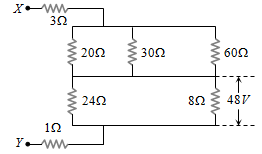
The potential difference across $8$ ohm resistance is $48$ volt as shown in the figure. The value of potential difference across $X$ and $Y$ points will be
What is the net electric field in the outer regions above the upper plate and below the lower plate in a parallel plate capacitor?
A circular loop carrying a current is replaced by an equivalent magnetic dipole. A point on the axis of the loop is(a) An end-on position(b) A broad side-on position(c) Both (a) and (b)(d) Neither (a) nor (b)
   
   
Which of these is unipolar transistor(a) Point contact transistor(b) Field effect transistor(c) PNP transistor(d) None of these
   
   
Consider the following statements A and B and identify the correct choice of the given answers
(A) A zener diode is always connected in reverse bias
(B) The potential barrier of a PN junction lies between 0.1 to 0.3 V approximately(a) A and B are correct (b) A and B are wrong(c) A is correct but B is wrong(d) A is wrong but B is correct
   
   
Resistance of a circuit is $12 \Omega$ and impedance is $15 \Omega$. The power factor of the circuit is :
The power rating of an electric motor which draws a current  of 3.75 amperes when operated at 200 V is about(a) 1 H.P.(b) 500 W(c) 54 W  (d) 750 H.P.
       
One farad (4F) is equal to :
A current of two amperes is flowing through a cell of e.m.f. 5 volts and internal resistance 0.5 ohm from negative to positive electrode. If the potential of negative electrode is 10V, the potential of positive electrode will be(a) 5 V(b) 14 V(c) 15 V(d) 16 V