Questions · Page 1 of 6

M.C.Q (1 Marks)

🎯

Test yourself on this topic

50 questions · timed · auto-graded

Question 11 Mark
A point charge is situated at an axial point of a small electric dipole at a large distance from it. The charge experiences a force F. If the distance of the charge is doubled, the force acting on the charge will become:
Answer
  1. $\frac{\text{F}}{8}$
Explanation:
The electric field due to dipole at distance r is $\text{E}\propto\frac{1}{\text{r}^3}.$
Thus force on charge is $\text{F}=\text{qE}$
$\Rightarrow\text{F}\propto\frac{1}{(2\text{r})^3}=\frac{\text{F}}{8}.$
View full question & answer
Question 21 Mark
An electric dipole consisting of charges +q and -q separated by a distance L is in stable equilibrium in a uniform electric field $\vec{\text{E}}.$ The electrostatic potential energy of the dipole is:
Answer
  1. –qLE
Explanation:
The electrostatic potential energy of the dipole is -qLE.
Given:
An electric dipole consisting of charges +q and -q.
Separation between these two charges is L.
We need to find the electrostatic potential energy of the dipole.
We know electrostatic potential energy of the dipole is given by:
P = -pE .....(1)
Here, p is electric dipole defined by product of charge and distance between them.
p = qL.
Putting value of p in equation 1,
We get, P = -qLE.
View full question & answer
Question 41 Mark
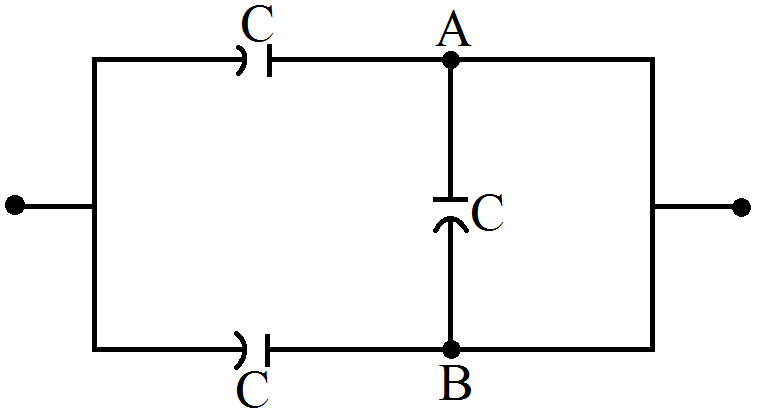
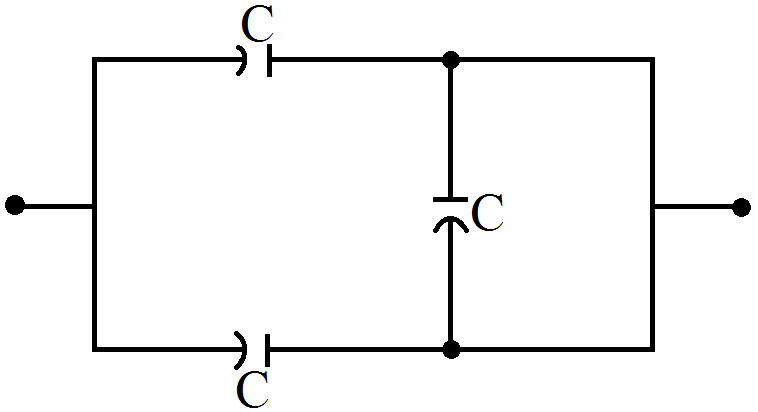
The equivalent capacitance of the combination shown in figure is:
Answer

Since the potential at point $A$ is equal to the potential at point $B,$ no current will flow along arm $AB.$
Hence, the capacitor on arm $AB$ will not contribute to the circuit.
Also, because the remaining two capacitors are connected in parallel, the net capacitance of the circuit is given by
$C_{eq} = C + C = 2C$
View full question & answer
Question 51 Mark
In a region, the potential is represented by V(x, y, z) = 6x - 8xy - 8y + 6yz, where V is in volts and x, y, z are in metres. The electric force experienced by a charge of 2 coulomb situated at point (1, 1, 1) is:
Answer
  1. $4\sqrt{35}\text{ N}$
View full question & answer
Question 61 Mark
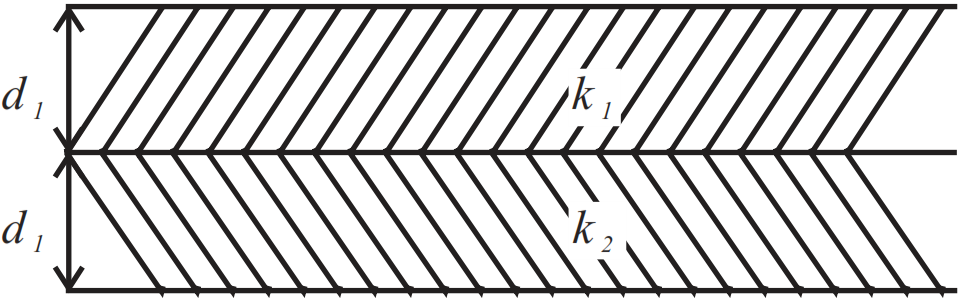
A parallel plate capacitor is made of two dielectric blocks in series. One of the blocks has thickness $d_1$ and dielectric constant $k_1$ and the other has thickness $d_2$ and dielectric constant $k_2$ as shown in Fig.

This arrangement can be thought as a dielectric slab of thickness $d (= d_1 + d_2)$ and effective dielectric constant $k$. The $k$ is
Answer
  1. $\frac{\text{k}_1\text{k}_2(\text{d}_1+\text{d}_2)}{(\text{k}_1\text{d}_1+\text{k}_2\text{d}_2)}$.
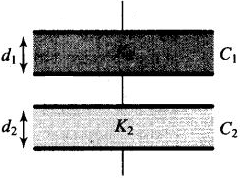
Here the system can be considered as two capacitors $C_1$ and $C_2$ connected in series as shown in figure.

The capacitance of parallel plate capacitor filled with dielectric block has thickness $d_1$ and dielectric constant $K_2$ is given by
$\frac{1}{\text{C}_\text{eq}}=\frac{1}{\text{C}_1}+\frac{1}{\text{C}_2}$
$\Rightarrow\ \text{C}_\text{eq}=\frac{\text{C}_1\text{C}_2}{\text{C}_1+\text{C}_2}$
$\text{C}_\text{eq}=\frac{\frac{\text{K}_1\epsilon_0\text{A}}{\text{d}_1}}{\frac{\text{K}_1\epsilon_0\text{A}}{\text{d}_1}}\frac{\frac{\text{K}_2\epsilon_0\text{A}}{\text{d}_2}}{\frac{\text{K}_2\epsilon_0\text{A}}{\text{d}_2}}=\frac{\text{K}_1\text{K}_2\epsilon_0\text{A}}{\text{K}_1\text{d}_2+\text{K}_2\text{d}_1}\ ...(\text{i})$
We can write the equivalent capacitance as
$\text{C}=\frac{\text{K}\epsilon_0\text{A}}{\text{d}_1+\text{d}_2}\ ...(\text{ii})$
On comparing $(i)$ and $(ii)$ we have
$\text{K}=\frac{\text{k}_1\text{k}_2(\text{d}_1+\text{d}_2)}{(\text{k}_1\text{d}_2+\text{k}_2\text{d}_1)}$.
View full question & answer
Question 71 Mark
The electrostatic potential due to an electric dipole is directly proportional to:
Answer
  1. $\frac{1}{\text{r}^2}$
View full question & answer
Question 81 Mark
Two capacitors each having capacitance $C$ and breakdown voltage $V$ are joined in series. The capacitance and the breakdown voltage of the combination will be:
Answer
Since the voltage gets added up when the capacitors are connected in series, the voltage of the combination is $2V.$
Also, the capacitance of a series combination is given by
$\frac{1}{\text{C}_{\text{net}}}=\frac{1}{\text{C}_1}+\frac{1}{\text{C}_2}$
Here,
$C_{​net}​ =$ Net capacitance of the combination
$\text{C}_1=\text{C}_2=\text{C}$
$\therefore\text{C}_{\text{net}}=\frac{\text{C}}{2}$
View full question & answer
Question 91 Mark
The electrostatic potential due to a point charge is directly proportional to:
Answer
  1. $\frac{1}{\text{r}}$
View full question & answer
Question 101 Mark
The energy density in the electric field created by a point charge falls off with the distance from the point charge as:
Answer
  1. $\frac{1}{\text{r}^4}$
Explanation:
Energy density U is given by
$\text{U}=\frac{1}{2}\epsilon_0\text{E}^2\ \dots(1)$
The electric field created by a point charge at a distance r is given by
$\text{E}=\frac{\text{q}}{4\pi\epsilon_0\text{r}^2}$
On putting the above form of E in eq. 1, we get
$\text{U}=\frac{1}{2}\epsilon_0\Big(\frac{\text{q}}{4\pi\epsilon_0\text{r}^2}\Big)^2$
Thus, U is directly proportional to $\frac{1}{\text{r}^4}.$
View full question & answer
Question 111 Mark
The electric field and the electric potential at a point are E and V respectively.
Answer
  1. If V = 0, E must be zero.
Explantion:
Electric field is negative gradient of electric potential.
$\text{E}=-\text{grad}(\text{V})$
$\text{E}=-\frac{\text{dV}}{\text{dr}}$
If $\text{E}=0$
$-\frac{\text{dV}}{\text{dr}}=0$
This implies
V = constant.
A constant can be zero or a quantifiable number.
View full question & answer
Question 121 Mark
The electrostatic potential due to an electric dipole is inversely proportional to:
Answer
  1. $\text{r}^2$
View full question & answer
Question 131 Mark

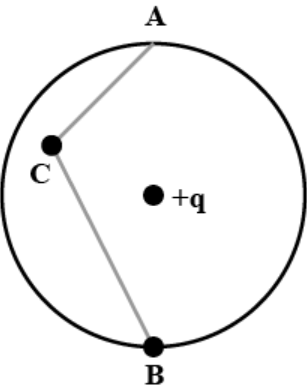
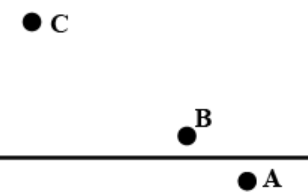
A charge q is placed at the center of a circle and B, C are the points on the circle. Another charge q is moved from A to B and from A to C. Which of them is correct?
Image
Answer
  1. Work done in both cases are the same.
Explanation:
B and C points are situated on the circle, so they are on the equipotential surface. To bring a point charge from A to B and from A to C requires the same amount of work done as the initial and final points have the same potential energy in both the cases.
View full question & answer
Question 141 Mark

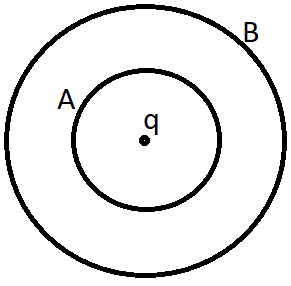
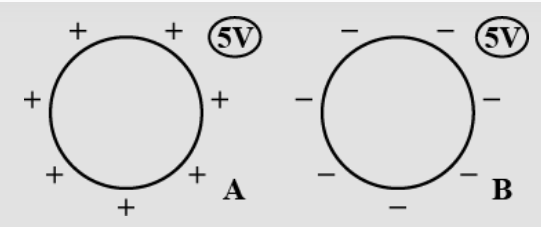
If A and B are two equipotential surfaces around a positive point charge q, what will happen if we place another point charge +Q between A and B?
Image
Answer
  1. It will move from A to B
Explanation:
A charge always tries to move from a point of higher potential to a point of lower potential. The potential at A is greater than the potential at B because of electric potential decreases with distance from the charge. It can also be explained by the fact that a positive charge is always repelled by another positive charge.
View full question & answer
Question 151 Mark

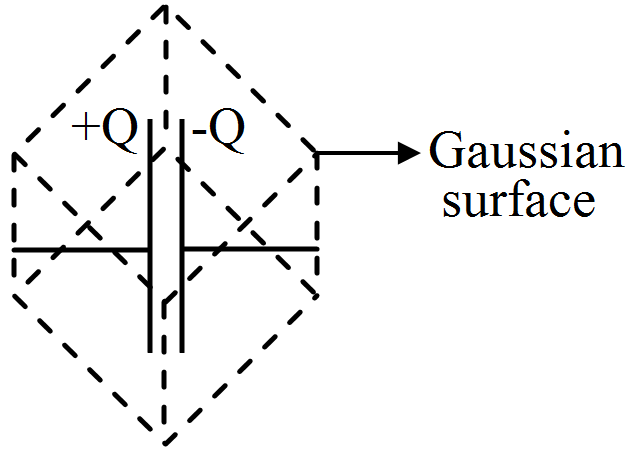
What is the total charge on the parallel plate capacitor shown?
Image
Answer
  1. 0
Explanation:
Since the total charge on a capacitor is given by sum of the charges on the two parallel plates, here charge on each plate is equal and opposite, hence –Q + Q = 0. Therefore, the total charge on the capacitor is 0.
View full question & answer
Question 171 Mark
At the surface of a charged conductor electrostatic field must be _____ to the surface at every point.
Answer
  1. Both a and b.
View full question & answer
Question 181 Mark
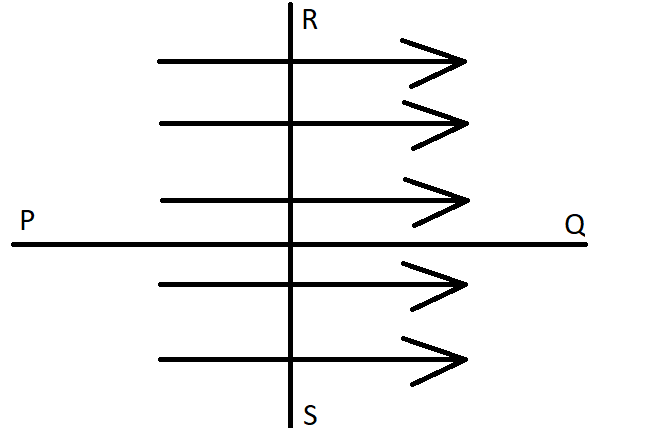
According to the diagram, the equipotential points are _____. The arrows are the direction of the electric field.
Image
Answer
  1. S and R
Explanation:
The equipotential surface is always perpendicular to the electric field lines. In the diagram, the electric field lines are horizontal and parallel to each other. Therefore, the equipotential lines must be vertical and the points that have equal potential should be on the vertical line. Therefore, R and S have equal potential.
View full question & answer
Question 191 Mark
Name the unit of electrical potential:
Answer
  1. Volt
Explanation:
Electrical potential is a type of potential energy, and refers to the energy that could be released if electric current is allowed to flow.
View full question & answer
Question 201 Mark
Mark the correct options:
Answer
  1. A diode valve can be used as a rectifier.
  2. A triode valve can be used as a rectifier.
  1. A triode valve can be used as an amplifier.
Explanation:
A diode valve and a triode valve allow current to flow only in one direction. Since a rectifier is a device that converts alternating current (bi-directional) into direct current (uni-directional), a diode valve and a triode valve can be used as rectifiers. A triode valve can control its output in proportion to the input signal. That is, it can act as an amplifier, whereas a diode valve cannot control its output in proportion to the input signal. So, it cannot be use as an amplifier.
View full question & answer
Question 211 Mark
A capacitor of capacitance C is charged to a potential V. The flux of the electric field through a closed surface enclosing the capacitor is:
Answer
  1. $\text{Zero}.$
Explanation:

Since the net charge enclosed by the Gaussian surface is zero, the total flux of the electric field through the closed Gaussian surface enclosing the capacitor is zero.
$\phi=\oint\text{E.ds}=\frac{\text{q}}{\epsilon_0}=0$
Here,
$\phi=$ Electric flux
q = Total charge enclosed by the Gaussian surface.
View full question & answer
Question 221 Mark
Equipotential surfaces of a single point charge are _____ surfaces centred at the charge.
Answer
  1. Concentric spherical.
View full question & answer
Question 231 Mark
Which of the following about potential at a point due to a given point charge is true?
The potential at a point P due to a given point charge.
Answer
  1. Is a function of distance from the point charge.
View full question & answer
Question 251 Mark
Electric conduction takes place in a discharge tube due to the movement of:
Answer
  1. Positive ions.
  2. Negative ions.
  3. Electrons.
Explanation:
Some ions are always present in gases due to cosmic rays and other factors. When we apply potential difference  across a discharge tube, the ions get accelerated due to the electric field. If the potential difference is large, then the ions get enough energy to ionise the molecules on collision. Thus, a large number of ions are produced and conduction starts. Generally, an electron gets detached from a molecule to make the molecule a positive ion. At low pressure, this electron moves through a large distance and gets attached to another molecule and forms a negative ion. Thus, electric conduction takes place in a discharge tube due to the movement of positive ions, negative ions and electrons.
View full question & answer
Question 261 Mark
When the separation between two charges is increased the electric potential energy of the charges.
Answer
  1. May increase or decrease.
Explanation:
When the separation between two charges is increased, the electric potential Energy of charge may incease or decrease.
If Both charge are like charge then electric potential energy of charge decreases.
$\text{U}=\frac{\text{k}\text{q}_1\text{q}_2}{\text{r}}$
If Both charge are unlike charge then electric potential energy of charge increases.
$\text{U}=\frac{-\text{kq}_1\text{q}_2}{\text{r}}$
View full question & answer
Question 271 Mark
The positive terminal of 12V battery is connected to the ground. Then the negative terminal will be at:
Answer
  1. - 12V
View full question & answer
Question 281 Mark
Which of the following statement is not true?
Answer
  1. Electrostatic force is non-conservative.
Explanation:
Work done by the electrostatic force is independent of the path followed by it, and it depends only on the initial and final positions. For example, work done in moving a unit positive charge in a closed loop of an electric field is zero. So,electrostatic force is a conservative force.
View full question & answer
Question 291 Mark
 Dielectrics are _____________?
Answer
  1. Non-conducting substances.
Explanation:
Dielectrics are non-conducting substances.
View full question & answer
Question 321 Mark
From a supply of identical capacitors rated 8 μF, 250 V, the minimum number of capacitors required to form a composite 16 μF, 1000 V capacitor is:
Answer
  1. 32
Explanation:
The required voltage is 1000v and the capacitors are parallel as 250v.
So number of capacitors required will be 4  i.e250 × 4 = 1000 in series.
Now example of four capacitor in series will be equal 2μf (micro farade) but the equivalent capacitance required is given as 16μf so there must be 8 series of parallel arrange capacitors each of capacitor 2 micro farad hence total number of capacitor = 4 × 8 = 32
View full question & answer
Question 331 Mark
The amount of energy that a unitary point electric charge would have, if located at any point in space, is defined its:
Answer
  1. Electric potential.
Explanation:
The electric potential is the electric potential energy per unit charge.
View full question & answer
Question 341 Mark
ECG is a method of diagnosis used to check the functioning of heart, it is based on the principle that there is:
Answer
  1. An electrical impulse associated with the functioning of organs and tissues of human body.
Explanation:
The heart generates by itself an electrical activity which is transmitted through all the organ and produces its contraction. The Electrocardiogram is no other than the graphical representation of this electrical activity.
View full question & answer
Question 361 Mark
The total capacitance of capacitors connected in parallel is given by $........$  ?
Answer
Sum of all the individual capacitors in parallel.
The equivalent capacitance of the capacitors connected in parallel is given by sum of their individual capacitances, that is if there are $n$ capacitors in parallel the total capacitance is given by $, \ce{C = C_{1 }+ C_{2 }+ C_{3 }+ C_{4 }+ ….. + C_n}.$
View full question & answer
Question 371 Mark
What is the maximum energy that can be stored in a capacitor?
Answer
  1. Depends on the maximum electric field.
Explanation:
The maximum energy that can be desirably stored in a capacitor is depends on the maximum electric field that the dielectric can withstand without breaking down. Therefore, capacitors of the same type have about the same maximum energy density, i.e. joules of energy per cubic meter.
View full question & answer
Question 381 Mark
A capacitor is charged by a battery and then the battery is disconnected. A dielectric slab is introduced between the plates. The result is:
Answer
  1. P.d between the plates decreases, charge remains same.
Explanation:
As dielectric slab does not affect charges:
$\text{V}=\frac{\text{Q}}{\text{C}}=\frac{\text{Qd}}{\text{K}\epsilon_0\text{A}}$
View full question & answer
Question 391 Mark
Identify the correct statement from below:
Answer
  1. A will be at higher potential.
Explanation:
Point A have positive charge.
More is the positive charge, more will be the potential. So, A will be at higher potential.
View full question & answer
Question 401 Mark
The electrostatic potential on the surface of a charged conducting sphere is $100V.$ Two statements are made in this regard $S_1$ at any point inside the sphere, electric intensity is zero. $S_2$ at any point inside the sphere, the electrostatic potential is $100V.$ Which of the following is a correct statement?
Answer
$S_1$ is true, $S_2$ is also true and $S_1$ is the cause of $S_{2.}$​​​​​​​
View full question & answer
Question 411 Mark
An arrangement which consists of two conductors separated by a dielectric medium is called:
Answer
  1. Capacitor.
View full question & answer
Question 441 Mark
How does the potential difference change with the effect of the dielectric when the battery remains connected across the capacitor?
Answer
Remains constant
As the battery remains connected across the capacitor, so the potential difference remains constant at $V_0$ even after the introduction of the dielectric slab.
In this way, dielectric has an effect on potential difference.
View full question & answer
Question 451 Mark
A charge is brought from a point on the equatorial plane of a dipole to its mid-point. Which of the following quantities remains constant?
Answer
  1. Electric potential.
View full question & answer
Question 461 Mark
When a thin mica sheet is placed between the plates of a condenser then the amount of charge, so compared to its previous value, on its plates will become:
Answer
  1. unchanged
Explanation:
As no cell is connected to the capacitor, the charge will remain constant.
View full question & answer
Question 471 Mark
What is the value of capacitance of a capacitor if it has a charge of 9C and voltage of 5V?
Answer
  1. 1.8F
Explanation:
Since we know that capacitance$=\frac{\text{charge}}{\text{voltage}}$
Therefore capacitance$=\frac{9}{5}=1.8\text{f.}$
View full question & answer
Question 481 Mark
In the circuit shown in Fig. initially key $K_1$ is closed and key $K_2$ is open. Then $K_1$ is opened and $K_2$ is closed $($order is important$). [$Take $Q_1' $and $Q_2'$ as charges on $C_1$ and $C_2$ and $V_1$ and $V_2$ as voltage respectively.$]$ Then
Answer
  1. Charge on $C_1$ gets redistributed such that $V_1 = V_2.$
  1. Charge on $C_1$ gets redistributed such that $Q_1' + Q_2' = Q.$
Initially key $K_1$ is closed and key $K_2$ is open, the capacitor $C_1$ is charged by battery and capacitor $C_2$ is still uncharged. Now $K_1$ is opened and $K_2$ is closed, the capacitors $C_1$ and $C_2$ both are connected in parallel.
The charge stored by capacitor $C_1,$ gets redistributed between $C_1$ and $C_2$ till their potentials become same, $i.e., V_2 = V_1.$
By law of conservation of charge, the charge stored in capacitor $Cx$ is equal to sum of charges on capacitors $C_1$ and $C_2$ when $K_1$ is opened and $K_2$ is closed, $i.e., Q'_1 + Q'_2 = Q.$
View full question & answer
Question 501 Mark
Some charge is being given to a conductor. Then its potential:
Answer
  1. remains same throughout the conductor.
Explanation:
Given that some charge is given to a conductor then the whole charge is distributed over its surface only. Inside of conductor, electric field is zero whereas potential is same as on the surface. Hence, throughout the conductor, potential is same i.e, the whole conductor is equipotential.
View full question & answer
M.C.Q (1 Marks) - Physics STD 12 Science Questions - Vidyadip