MCQ
$1$ mole of $H_2$ gas is contained in a box of volume $V = 1.00m^3$ at $T = 300K.$ The gas is heated to a temperature of $T = 3000K$ and the gas gets converted to a gas of hydrogen atoms. The final pressure would be $($considering all gases to be ideal$).$
  • Same as the pressure initially.
  • B
    $2$ times the pressure initially.
  • C
    $10$ times the pressure initially.
  • D
    $20$ times the pressure initially.

Answer

Correct option: A.
Same as the pressure initially.
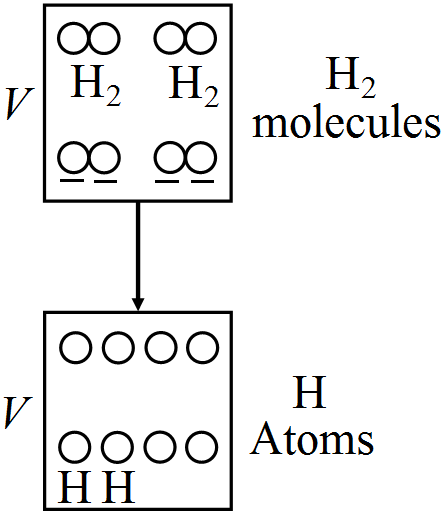
The situation is shown in the diagram, $H_2$ gas is contained in a box is heated and gets converted to a gas of hydrogen atoms. Then the number of moles would become twice.
According to gas equation,
$\text{PV = nRT}$

$P =$ Pressure of gas, $n =$ Number of moles
$R =$ Gas constant, $T =$ Temperature $\text{PV = nRT}$
As volume $(V) $of the container is constant.
Hence, when temperature $(T)$ becomes $10$ times, $($from $300K$ to $3000K)$ pressure $(P)$ also becomes $10$ times, as $P\ \alpha\ T.$
Pressure is due to the bombardment of particles and as gases break, the number of moles becomes twice of initial, so $n_2 = 2n_1$
So $P\ \alpha\ nT$
$\Rightarrow\frac{\text{P}_2}{\text{P}_1}=\frac{\text{n}_2\text{T}_2}{\text{n}_1\text{T}_1}=\frac{(2\text{n}_1)(3000)}{\text{n}_1(300)}=20$
$\Rightarrow\text{P}_2=20\text{P}_1$
Hence, final pressure of the gas would be $20$ times the pressure initially.

Need a full question paper?

Generate a complete, print-ready paper with questions like this in minutes — across 16+ boards, with answer keys.

Start Generating Free

Similar questions

The velocity of a particle executing SHM varies with displacement $( x )$ as $4 v ^2=50- x ^2$. The time period of oscillations is $\frac{x}{7} s$. The value of $x$ is $............$ $\left(\right.$ Take $\left.\pi=\frac{22}{7}\right)$
A tube is attached as shown in closed vessel containing water. The velocity of water coming out from a small hole is :
The two opposite faces of a cubical piece of iron (thermal conductivity $= 0.2\, CGS$ units) are at ${100^o}C$ and ${0^o}C$ in ice. If the area of a surface is $4c{m^2}$, then the mass of ice melted in $10$ minutes will be ...... $gm$
Which of the following statement is correct?
The maximum percentage errors in the measurement of mass (M), radius (R) and angular velocity $(\omega)$ of a ring are $2 \%, 1 \%$ and $1 \%$ respectively, then find the maximum percenta? error in the measurement of its moment of inertia $\left(I=\frac{1}{2} M R^{2}\right)$ about its geometric axis.
The diagram shows a cup of tea seen from above. The tea has been stirred and is now rotating without turbulence. A graph showing the speed $ v$ with which the liquid is crossing points at a distance $ X$  from $O $ along a radius $XO$  would look like
A unit mass of solid converted to liquid at its melting point. Heat is required for this process is:
The equation of the progressive wave, where $t$ is the time in second, $x$ is the distance in metre is $y=A \cos 240\left(t-\frac{x}{12}\right)$. The phase difference (in $SI$ units) between two positions $0.5 \,m$ apart is ...........
A cylinder of fixed capacity $44.8$ litre. contains a monatomic gas at standard temperature and pressure. The amount of heat required to cylinder by $10^o C$ will be. ($R=$ universal gas constant)
A metallic body of material with density of $8000\  kg/m^3$ has a cavity inside. A spring balance shows its mass to be $10.0\  kg$ in air and $7.5\  kg$ when immersed in water. The ratio of the volume of the cavity to the volume of the material of the body must be