MCQ 11 Mark
According to atomic hypothesis:
- A
Atoms attract each other when they are little distance apart.
- B
Atoms repel if they being squeezed into one another.
- ✓
Both $(a)$ and $(b).$
- D
Neither $(a)$ nor $(b).$
AnswerCorrect option: C. Both $(a)$ and $(b).$
Atoms attracts when they are little distance apart and repel, if they being squeezed into one another.
View full question & answer→MCQ 21 Mark
In a diatomic molecule, the rotational energy at a given temperature.
AnswerCorrect option: D. Both $A$ and $C$
Consider a diatomic molecule along $z-$axis so its rotational energy about $z-$axis is zero.
So energy of diatomic molecule,
$\text{E}=\frac{1}{2}\text{mv}_\text{x}^2+\frac{1}{2}\text{mv}_\text{y}^2+\frac{1}{2}\text{mv}_\text{z}^2+\frac{1}{2}\text{I}_\text{x}\omega_\text{x}^2+\frac{1}{2}\text{I}_\text{y}\omega_\text{y}^2 ($as moment of inertia along $z$ axis is zero$)$
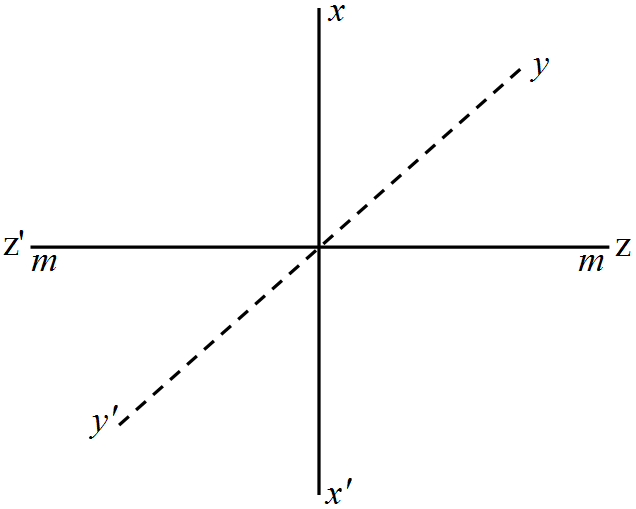
The independent terms in the above expression is $5.$
As we can predict velocities of molecules by Maxwell’s distribution.
Hence the above expression also obeys Maxwell’s distribution.
As $2$ rotational and $3$ translational energies are associated with each molecule.
So the rotational energy at given temperature is $2/3$ of its translational Kinetic energy of each molecule. View full question & answer→MCQ 31 Mark
The monoatomic molecules have only three degrees of freedom because they can possess:
- ✓
- B
- C
Both translatory and rotatory motion.
- D
Translatory, rotatory and vibratory motion.
View full question & answer→MCQ 41 Mark
The temperature of the mixture of one mole of helium and one mole of hydrogen is increased from $0^\circ C$ to $100^\circ C$ at constant pressure. The amount of heat delivered will be:
- A
$600\ \text{cal}$
- ✓
$1200\ \text{cal}$
- C
$1800\ \text{cal}$
- D
$3600\ \text{cal}$
AnswerCorrect option: B. $1200\ \text{cal}$
View full question & answer→MCQ 51 Mark
The energy of a given sample of an ideal gas depends only on its:
AnswerTemperature of a gas is directly proportional to its kinetic energy.
Thus, energy of an ideal gas depends only on its temperature.
View full question & answer→MCQ 61 Mark
The $\text{r.m.s.}$ velocity of a gas is:
- A
Directly proportional to the density of the gas.
- B
Inversely proportional to the density of the gas.
- C
Directly proportional to the square of density.
- ✓
Inversely proportional to the square root of the density of the gas.
AnswerCorrect option: D. Inversely proportional to the square root of the density of the gas.
View full question & answer→MCQ 71 Mark
During an adiabatic process, the pressure of a gas is found to be proportional to the cube of its temperature. The ratio of $\frac{\text{C}_{\text{P}}}{\text{C}_{\text{V}}}$ for the gas is:
- A
$\frac{4}{3}$
- B
$2$
- C
$\frac{5}{3}$
- ✓
$\frac{3}{2}$
AnswerCorrect option: D. $\frac{3}{2}$
View full question & answer→MCQ 81 Mark
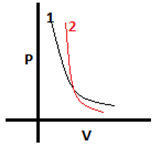
In the given diagram, one graph is of an ideal gas and another is of a real gas. Select the correct option.
- A
$1-$real gas, $2-$ideal gas
- ✓
$1-$ideal gas, $2-$real gas
- C
Both are for an ideal gas at different temperatures
- D
Their graphs cannot intersect
AnswerCorrect option: B. $1-$ideal gas, $2-$real gas
Real gases, unlike ideal gases, consider volume taken up by molecules because of which mean free path decreases or collisions increase and hence pressure increases.
So, at low volumes this factor will play a big role and thus for a particular volume in the low volume range, pressure of real gases will be higher.
To see which graph belongs to whom we can draw a line parallel to the pressure axis at very low volume. The one having higher pressure will be that of real gases.
Therefore, $2-$real gas $\&\ 1-$ideal gas.
View full question & answer→MCQ 91 Mark
In kinetic theory’ of gases, it is assumed that:
- A
The collisions are not perfectly elastic.
- B
The molecular collisions change the density of the gas.
- C
The molecules don’t collide with each other on the well.
- ✓
Between two collisions the molecules travel with uniform velocity.
AnswerCorrect option: D. Between two collisions the molecules travel with uniform velocity.
View full question & answer→MCQ 101 Mark
Average kinetic energy of molecules is:
- A
Independent of absolute temperature.
- B
Inversely proportional to absolute temperature.
- ✓
Directly proportional to absolute temperature.
- D
Directly proportional to score root of temperature.
AnswerCorrect option: C. Directly proportional to absolute temperature.
The measure of average kinetic energy of molecules is called temperature.
View full question & answer→MCQ 111 Mark
A hotter gas implies higher average value of:
AnswerCorrect option: B. $K.E.$
View full question & answer→MCQ 121 Mark
Moon has no atmosphere because:
- A
It is far away form the surface of the earth.
- B
Its surface temperature is $10^\circ C.$
- ✓
The $\text{r.m.s.}$ velocity of all the gas molecules is more then the escape velocity of the moons surface.
- D
The escape velocity of the moons surface is more than the $\text{r.m.s}$ velocity of all molecules.
AnswerCorrect option: C. The $\text{r.m.s.}$ velocity of all the gas molecules is more then the escape velocity of the moons surface.
View full question & answer→MCQ 131 Mark
The total energy of water molecule is given by:
MCQ 141 Mark
The correct statement of the law of equipartition of energy is:
AnswerCorrect option: B. The gas possess equal energies in all the three directions $x, y$ and $z-$axis.
View full question & answer→MCQ 151 Mark
A rigid container of negligible heat capacity contains one mole of an ideal gas. The temperature of the gas increases by $1^\circ C$ if $3.0\ \text{cal}$ of heat is added to it. The gas may be:
AnswerCorrect option: D. Both $B$ and $C$
The temperature of one mole of a gas kept in a container of fixed volume is increased by $1$ degree Celsius if $3$ calories,
i.e. $12.54J$ of heat is added to it.
So, its molar heat capacity, $C_v=12.54 \mathrm{~J}^{-} \mathrm{JK}^{-1} \mathrm{~mol}^{-1}$, as molar heat capacity at fixed volume is the heat supplied to a mole of gas to increase its temperature by a degree. For a monatomic gas, $\text{C}_\text{v}\simeq\frac{3}{2}\text{R}=1.5\times8.314=12.54\text{JK}^{-1}\text{mol}^{-1}.$
Among the given gases, only helium and argon are inert and hence, monoatomic.
Therefore, the gas may be helium or argon.
View full question & answer→MCQ 161 Mark
$K.E.$ of gas molecules is zero at:
- A
$0^\circ C$
- B
$273^\circ t$
- ✓
$-273^\circ C$
- D
AnswerCorrect option: C. $-273^\circ C$
View full question & answer→MCQ 171 Mark
One mole of ideal gas required $207J$ heat to rise the temperature by $10^\circ K$ when heated at constant pressure. If the same gas is heated at constant volume to raise the temperature by the same $10^\circ K$ the heat required is $(R = 8/ 3J/ \text{mole}^\circ \text{K})$
- A
$1987J$
- B
$29J$
- C
$215.3J$
- ✓
$124J$
AnswerCorrect option: D. $124J$
View full question & answer→MCQ 181 Mark
The $\text{rms}$ speed of oxygen at room temperature is about $500\ m/ s.$ The rms speed of hydrogen at the same temperature is about:
- A
$125\ ms^{-1}$
- ✓
$2000\ ms^{-1}$
- C
$8000\ ms^{-1}$
- D
$31\ ms^{-1}$
AnswerCorrect option: B. $2000\ ms^{-1}$
Given,
Molecular mass of hydrogen, $M_H = 2$
Molecular mass of oxygen, $M_O = 32$
$\text{RMS}$ speed is given by,
$\text{v}_\text{rms}=\sqrt{\frac{3\text{RT}}{\text{M}}}$
$\Rightarrow\sqrt{\frac{3\text{RT}}{\text{M}_\text{O}}}=500$
Now,
$\Rightarrow\frac{\text{v}_\text{Orms}}{\text{v}_\text{Hrms}}=\frac{\sqrt{\frac{3\text{RT}}{\text{M}_\text{O}}}}{\sqrt{\frac{3\text{RT}}{\text{M}_\text{H}}}}$
$\Rightarrow\frac{\text{v}_\text{Orms}}{\text{v}_\text{Hrms}}=\frac{\sqrt{\frac{3\text{RT}}{32}}}{\sqrt{\frac{3\text{RT}}{2}}}$
$\Rightarrow\frac{\text{v}_\text{Orms}}{\text{v}_\text{Hrms}}=\frac{1}{4}$
$\Rightarrow\frac{500}{\text{v}_\text{Hrms}}=\frac{1}{4}$
$\Rightarrow\text{v}_\text{Hrms}=4\times500=2000\ \text{ms}^{-1}$
View full question & answer→MCQ 191 Mark
According to the kinetic theory of gases, the temperature of a gas is a measure of average:
- A
Velocities of its molecules.
- B
Linear momenta of its molecules.
- ✓
Kinetic energies of its molecules.
- D
Angular momenta of its molecules.
AnswerCorrect option: C. Kinetic energies of its molecules.
View full question & answer→MCQ 201 Mark
Which of the following is the unit of specific:
- A
$Jkg/^\circ c$
- ✓
$J/kg^\circ c$
- C
$kg^\circ c/J$
- D
$Jkg/^\circ c^2$
AnswerCorrect option: B. $J/kg^\circ c$
View full question & answer→MCQ 211 Mark
The $\text{rms}$ speed of oxygen molecules in a gas is $v.$ If the temperature is doubled and the oxygen molecules dissociate into oxygen atoms, the rms speed will become:
- A
$\text{v}$
- B
$\text{v}\sqrt{2}$
- ✓
$2\text{v}$
- D
$4\text{v}$
AnswerCorrect option: C. $2\text{v}$
Given, $\text{v}=\sqrt{\frac{3\text{RT}}{32}}$
Let the new rms speed be $v'.$
Molecule dissociate, $M = 16$
$\text{v}'=\sqrt{\frac{3\text{R}(2\text{T})}{16}}$
$=\sqrt{\frac{3\text{R}(4\text{T})}{32}}$
$=2\sqrt{\frac{3\text{R}\text{T}}{32}}$
$=2\text{v}$
View full question & answer→MCQ 221 Mark
An ideal gas is that which can:
AnswerThe term ideal gas refers to a hypothetical gas composed of molecules which follow a few rules:
Ideal gas molecules do not attract or repel each other.
View full question & answer→MCQ 231 Mark
Four cylinders contain equal number of moles of argon, hydrogen, nitrogen and carbon dioxide at the same temperature. The energy is minimum in:
AnswerThe energy of a gas is measured as $C_vT$. All the four cylinders are at the same temperature but the gases in them have different values of $C_v$, such that it is least for the monatomic gas and keeps on increasing as we go from monatomic to tri$-$atomic. Among the above gases, argon is monatomic, hydrogen and nitrogen are diatomic and carbon dioxide is tri$-$atomic. Therefore, the energy is minimum in argon.
View full question & answer→MCQ 241 Mark
Which of the following parameters is the same for molecules of all gases at a given temperature?
AnswerTemperature is defined as the average kinetic energy of the molecules in a gas sample. Average is same for all the molecules of the sample. So, kinetic energy is the same for all.
View full question & answer→MCQ 251 Mark
There is some liquid in a closed bottle. The amount of liquid remains constant as time passes. The vapour in the remaining part:
AnswerSince the amount of liquid is constant, there is no vapourisation of the liquid inside the bottle. Also, since there cannot be a liquid with no vapours at all and vapourisation cannot take place in the remaining saturated part, the remaining part must be saturated with the vapours of the liquid.
View full question & answer→MCQ 261 Mark
The diatomic molecule is treated as:
MCQ 271 Mark
The molar specific heat at constant pressure of an ideal gas is $\Big(\frac{7}{2}\text{R}\Big).$ The ratio of specific heat at constant pressure to that at constant volume is:
- A
$\frac{9}{7}$
- ✓
$\frac{7}{5}$
- C
$\frac{5}{7}$
- D
$\frac{8}{7}$
AnswerCorrect option: B. $\frac{7}{5}$
$\text{C}_{\text{P}}=\frac{7}{2}\text{R}$
$\text{C}_{\text{V}}=\text{C}_{\text{P}}-\text{R}=\frac{7}{2}\text{R}-\text{R}=\frac{5}{2}\text{R}$
$\gamma=\frac{\text{C}_{\text{P}}}{\text{C}_{\text{V}}}=\frac{\frac{7}{2}\text{P}}{\frac{5}{2}\text{R}}=\frac{7}{5}$
View full question & answer→MCQ 281 Mark
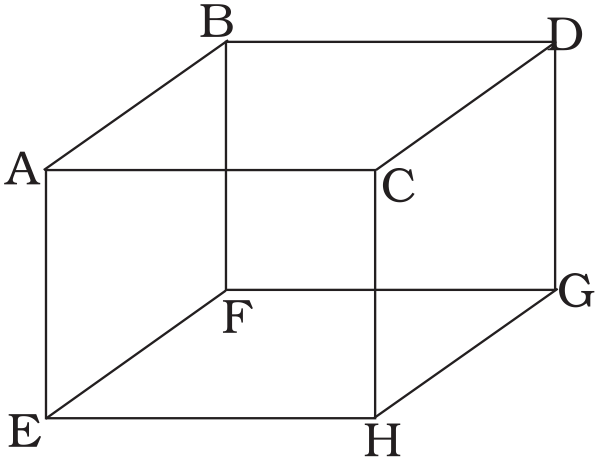
$1$ mole of an ideal gas is contained in a cubical volume $\text{V, ABCDEFGH}$ at $300K ($figure$)$. One face of the cube $\text{(EFGH)}$ is made up of a material which totally absorbs any gas molecule incident on it. At any given time,
- A
The pressure on $\text{EFGH}$ would be zero.
- B
The pressure on all the faces will be equal.
- C
The pressure of $\text{EFGH}$ would be double the pressure on $\text{ABCD.}$
- ✓
The pressure on $\text{EFGH}$ would be half that on $\text{ABCD.}$
AnswerCorrect option: D. The pressure on $\text{EFGH}$ would be half that on $\text{ABCD.}$
Pressure on the wall due to force exerted by molecule on walls due to its rate of transfer of momentum to the wall. The molecule bounces back due to elastic collision and magnitude of momentum transferred to wall by each molecule is $\text{2mv}$ but wall $\text{EFGH}$ absorbs those molecule which strikes to it. Therefore rate of change in momentum to it become only mv so the pressure of $\text{EFGH}$ would be half of $\text{ABCD}.$
View full question & answer→MCQ 291 Mark
How many degrees of freedom are there in a monatomic gas?
AnswerA monatomic gas has $3$ translational degrees of freedom.
View full question & answer→MCQ 301 Mark
What is the mass of $22.4L$ of $CO_2$ at $\text{STP}?$
- A
$1g$
- ✓
$44g$
- C
$44\ kg$
- D
$1\ kg$
Answer$22.4L$ of a gas at $\text{STP}$ has a weight equal to its molar mass.
So, the weight of $CO_2$ will be $12 + 16 + 16$
$= 44g.$
View full question & answer→MCQ 311 Mark
When $20\ \text{cal}$ of heat is supplied to a system, the increase in internal energy is $50J$. If the external work done is $35J$, the mechanical equivalent of heat is:
- ✓
$4.25\ \text{J/ cal}$
- B
$1.26\ \text{J/ cal}$
- C
$4.92\ \text{J/ cal}$
- D
$2.1\ \text{J/ cal}$
AnswerCorrect option: A. $4.25\ \text{J/ cal}$
According to first law of thermodynamics $\text{J}\triangle\text{Q}=\triangle\text{W}+\triangle\text{U},$
where $J$ is the mechanical equivalent of heat.
$J \times 20 = 50 + 35$
$J = 4.25\ \text{J/ cal}$
View full question & answer→MCQ 321 Mark
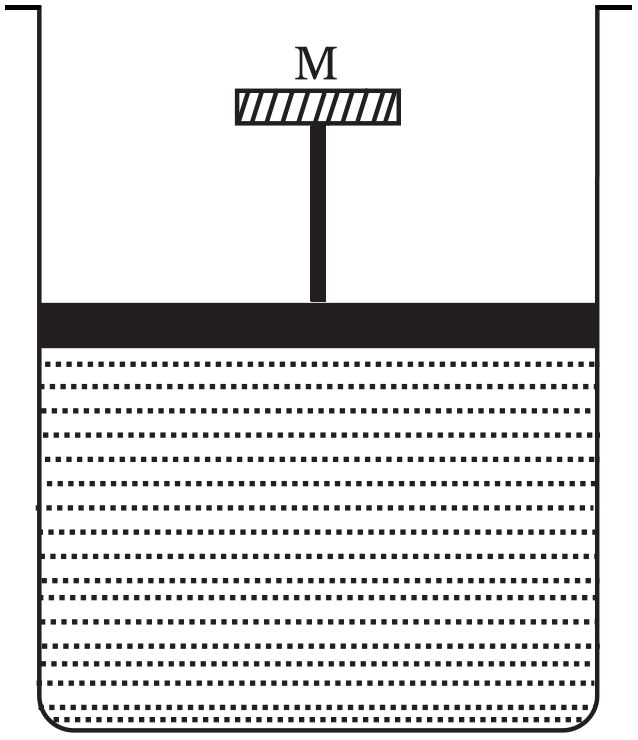
A cylinder containing an ideal gas is in vertical position and has a piston of mass M that is able to move up or down without friction ( figure). If the temperature is increased.
- A
Both P and V of the gas will change.
- B
Only P will increase according to Charles’ law.
- ✓
- D
Answerc. V will change but not P.
Explanation:
The pressure on the ideal gas does not changes from initial to final position. According to the given arrangement P = Mg/ A which shows that pressure is constant. As piston and cylinder is frictionless so by ideal gas equation, PV = nRT.
View full question & answer→MCQ 331 Mark
The deviation of gases from the behaviour of ideal gas is due to:
- ✓
- B
- C
Covalent bonding of molecules
- D
View full question & answer→MCQ 341 Mark
In a diatomic molecules, the rotational energy at a given temperature:
- ✓
Obeys Maxwell’s distribution
- B
Have the same volue for all molecules
- C
Equals the translational kinetic energy for each molecule
- D
AnswerCorrect option: A. Obeys Maxwell’s distribution
View full question & answer→MCQ 351 Mark
- A
- B
Variable shape and volume.
- ✓
Variable shape but fixed volume.
- D
Fixed shape but variable volume.
AnswerCorrect option: C. Variable shape but fixed volume.
View full question & answer→MCQ 361 Mark
We took two separate gases with the same number densities for both. If the ratio of the diameters of their molecules is $4 : 1,$ then ratio of their mean free paths is:
- A
$1 : 4$
- B
$4 : 1$
- C
$2 : 1$
- ✓
$1 : 16$
AnswerCorrect option: D. $1 : 16$
View full question & answer→MCQ 371 Mark
Law of equipartition of energy is used to:
- A
Predict the specific heats of gases.
- B
Predict the specific heats of solids.
- ✓
Both $(a)$ and $(b).$
- D
Neither $(a)$ nor $(b).$
AnswerCorrect option: C. Both $(a)$ and $(b).$
Law of equipartition of energy is used to predict the specific heat of gases and solids.
View full question & answer→MCQ 381 Mark
Real gases show mark able deviation from that of ideal gas behavior at:
- A
Low temperature and high pressure.
- ✓
High temperature and high pressure.
- C
Low temperature and high pressure.
- D
Low temperature and low pressure.
AnswerCorrect option: B. High temperature and high pressure.
At low temperature or high$-$pressure, gases deviate from ideal behavior. This is because at low temperature the gases molecules come close to each other and their kinetic energy decreases.
View full question & answer→MCQ 391 Mark
The velocity of the molecules of a gas at temperature $120K$ is $v.$ At what temperature will the velocity be $2v\ ?$
- A
$120K$
- B
$240K$
- ✓
$480K$
- D
$1120K$
AnswerCorrect option: C. $480K$
View full question & answer→MCQ 401 Mark
If $C_P, C_V$ are molar specific heats of a solid and $R$ is universal gas constant, then:
- A
$C_P-C_V=R$
- B
$C_P-C_V=0$
- C
$C_P - C_V$ is negative
- ✓
$(C_P-C_V)<< R$
AnswerCorrect option: D. $(C_P-C_V)<< R$
In case of solides, $C_P=C_V$
$\therefore C_P-C_V<< R$
View full question & answer→MCQ 411 Mark
The value of $C_V$ for solids is:
- ✓
$3R$
- B
$2$
- C
$4R$
- D
$\frac{3}{2}\text{R}$
View full question & answer→MCQ 421 Mark
The three states of matter depend on:
MCQ 431 Mark
A man is climbing up a spiral type of staircase. His degrees of freedom are:
- A
$1$
- B
$2$
- ✓
$3$
- D
More than $3$
View full question & answer→MCQ 441 Mark
What is meant by mean free path?
AnswerCorrect option: A. It is the average distance a molecule travels without colliding.
Mean free path of a molecule is defined as the average distance travelled by molecules before colliding.
View full question & answer→MCQ 451 Mark
What is the number of molecules in $2.24L$ of $SO_2$ at $\text{STP}\ ?$
- A
$6.023 \times 10^{23}$
- ✓
$6.023 \times 10^{22}$
- C
$6.023 \times 10^{20}$
- D
$6.023 \times 10^{21}$
AnswerCorrect option: B. $6.023 \times 10^{22}$
According to Avogadro’s law $22.4L$ of any gas at $\text{STP}$ is $6.023 \times 10^{23}$.
So, in $2.24L$ there will be $\frac{6.023\times10^{23}}{10}$
$= 6.023 \times 10^{22}$.
View full question & answer→MCQ 461 Mark
The molar heat capacity of oxygen gas at $\text{STP}$ is nearly $2.5R.$ As the temperature is increased, it gradually increases and approaches $3.5R.$ The most appropriate reason for this behaviour is that at high temperatures:
- A
Oxygen does not behave as an ideal gas.
- B
Oxygen molecules dissociate in atoms.
- C
The molecules collide more frequently.
- ✓
Molecular vibrations gradually become effective.
AnswerCorrect option: D. Molecular vibrations gradually become effective.
Molar specific heat capacity has direct dependence on the degree of freedom of gas molecules. As temperature is increased, the gas molecules start vibrating about their mean position, leading to change $($increase$)$ in the degree of freedom and hence, increasing molar heat capacity.
View full question & answer→MCQ 471 Mark
The average energy associated with each translational degree of freedom is:
- A
$\frac{3}{2}\text{k}_{\text{B}}\text{T}$
- B
$\text{k}_{\text{B}}\text{T}$
- ✓
$\frac{1}{2}\text{k}_{\text{B}}\text{T}$
- D
$2\text{k}_{\text{B}}\text{T}$
AnswerCorrect option: C. $\frac{1}{2}\text{k}_{\text{B}}\text{T}$
View full question & answer→MCQ 481 Mark
According to Kinetic theory of gases, molecules are:
- A
Perfectly inelastic particles in random motion.
- ✓
Perfectly elastic particles in random motion.
- C
Perfectly inelastic particles at rest.
- D
Perfectly elastic particles at rest.
AnswerCorrect option: B. Perfectly elastic particles in random motion.
Assumptions of Kinetic Theory of Gases All gases are made up of molecules which are constantly and persistently moving in random directions.
The separation between the molecules is much greater than the size of molecules.
When a gas sample is kept in a container, the molecules of the sample do not exert any force on the walls of the container during the collision.
The time interval of collision between two molecules, and between a molecule and the wall is considered to be very small.
All the collisions between molecules and even between molecules and wall are considered to be elastic.
All the molecules in a certain gas sample obey Newton’s laws of motion.
If a gas sample is left for a sufficient time, it eventually comes to a steady state.
The density of molecules and the distribution of molecules are independent of position, distance and time.
View full question & answer→MCQ 491 Mark
Temperature remaining constant, the pressure of gas is decreased by $20\%$. The percentage change in volume:
- A
Increases by $20\%$
- B
Decreases by $20\%$
- ✓
Increases by $25\%$
- D
Decreases by $25\%$
AnswerCorrect option: C. Increases by $25\%$
View full question & answer→MCQ 501 Mark
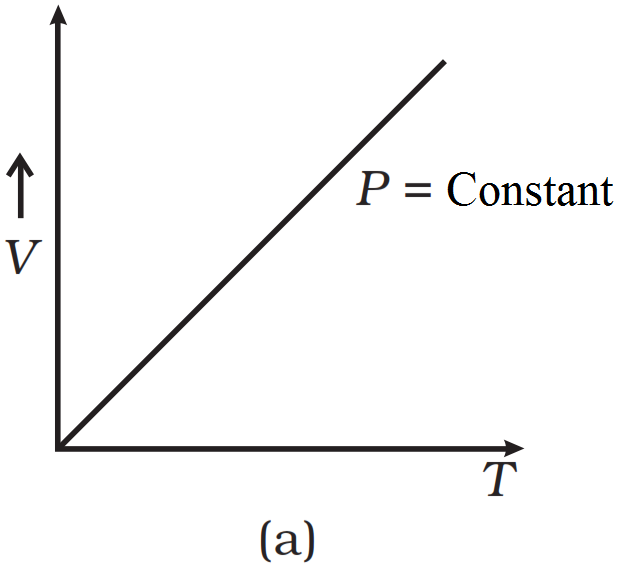
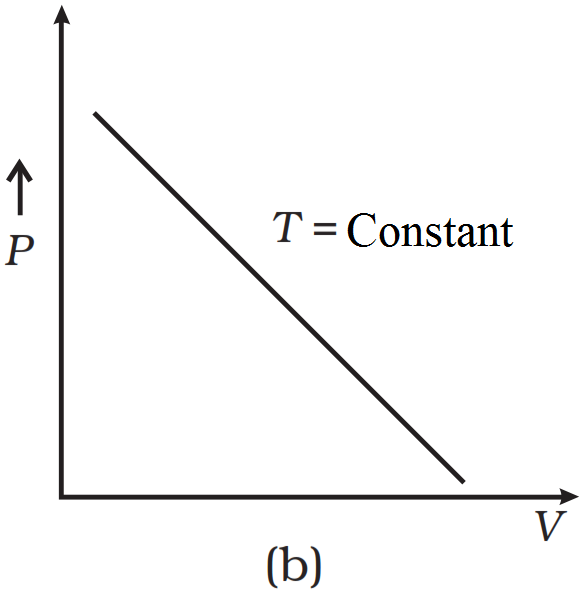
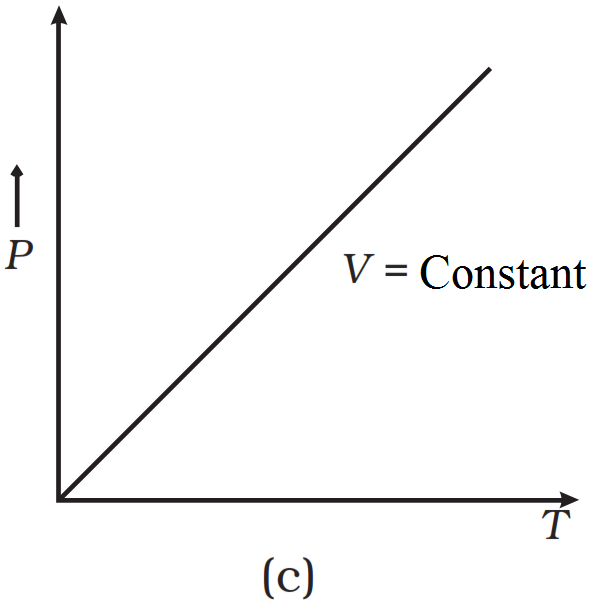
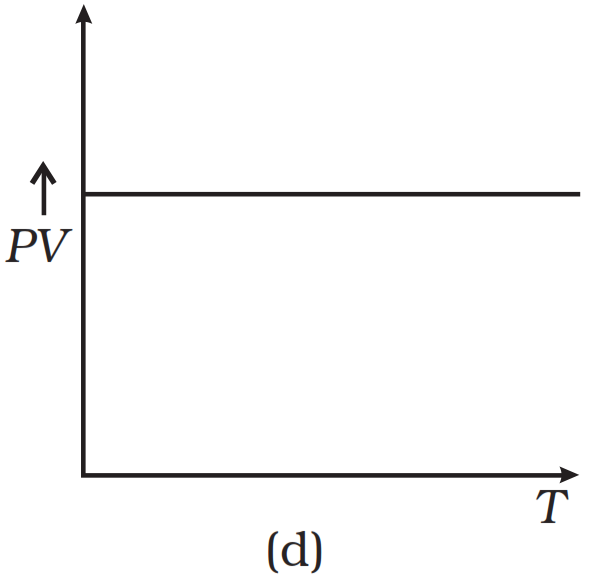
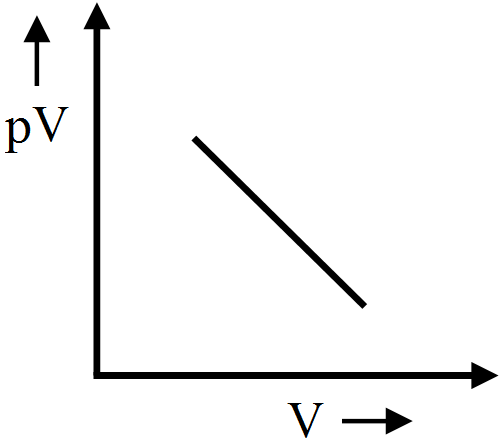
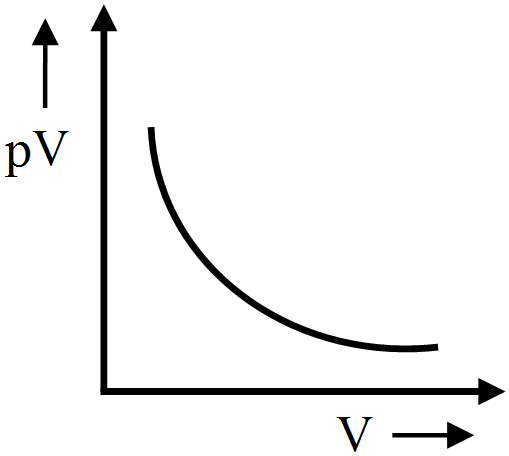
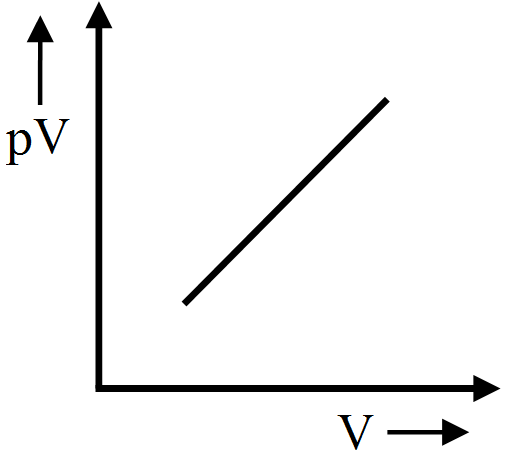
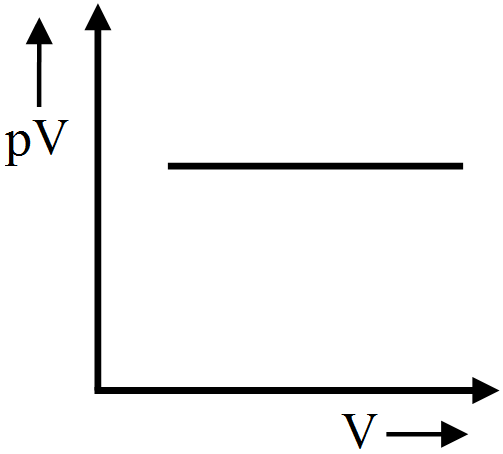
Which of the following diagrams $($figure$)$ depicts ideal gas behaviour?
Answer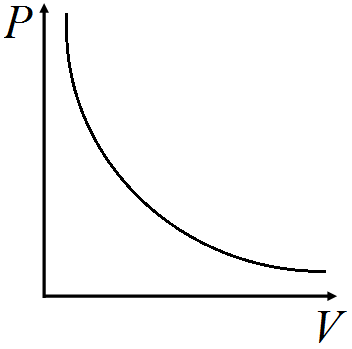
For ideal gas behaviour,
$\text{PV = nRT}$
- When pressure, $P =$ constant.
From $(i)$ Volume $V \propto$ Temperature $T$
Graph of $V$ versus $T$ will be straight line.
- When $T =$ constant.
So, graph of $P$ versus $V$ will be a rectangular hyperbola.
Hence this graph is wrong.
The correct graph is shown below:
- When $V=$ constant.
From $(i) \text{P}\propto\text{T}$
So, graph is a straight line passing throught the origin.
- From $(i) \text{PV}\propto\text{T}$
$\Rightarrow\frac{\text{PV}}{\text{T}} =$ constant
So, graph of $PV$ versus $T$ will be a straight line parallel to the temperature axis $(x-$axis$).$
i.e., slope of this graph will be zero.
So, $(d)$ is not correct. View full question & answer→MCQ 511 Mark
Which of the following states of matter has the maximum value of mean free path?
AnswerThe atoms of gas have the most interatomic space and can therefore travel freely. This is why they travel longer distances without colliding and are therefore said to have the maximum mean free path.
View full question & answer→MCQ 521 Mark
The energy of a given sample of an ideal gas depends only on its:
AnswerThe energy of a given sample of an ideal gas depends only on temperature as average energy/ molecule/ degree of freedom $=\frac{1}{2}\text{k}_{\text{B}}\text{T}$
View full question & answer→MCQ 531 Mark
The number of molecules per unit volume in the sample is $20.$ The mass of each molecule is $10-20\ kg.$ The mean of speed squared is $4\ m^2/s^2$. What is the value of internal energy of the gas? Assume volume of container is $0.02m^3$.
- ✓
$0.8 \times 10^{-20} \mathrm{~J}$
- B
$0.53 \times 10^{-20} \mathrm{~J}$
- C
$0.01 \times 10^{-20} \mathrm{~J}$
- D
$0.45 \times 10^{-20} \mathrm{~J}$
AnswerCorrect option: A. $0.8 \times 10^{-20} \mathrm{~J}$
Internal energy is given by: $E = \Big(\frac{1}{2}\Big)Nmv^2$,
where $N$ is the total number of molecules $= nV.$
$E =0.5 \times 20 \times 0.02 \times 10^{-20} \times 4$
$= 0.8 \times 10^{-20} \mathrm{~J}$.
View full question & answer→MCQ 541 Mark
In a mixture of gases at a fixed temperature:
- ✓
Heavier molecule has lower average speed
- B
Lighter molecule has lower average speed
- C
Heavier molecule has higher average speed
- D
AnswerCorrect option: A. Heavier molecule has lower average speed
View full question & answer→MCQ 551 Mark
Consider a mixture of oxygen and hydrogen kept at room temperature. $AB$ compared to a hydrogen molecule an oxygen molecule hits the wall:
- A
With greater average speed.
- ✓
With smaller average speed.
- C
With greater average kinetic energy.
- D
With smaller average kinetic energy.
AnswerCorrect option: B. With smaller average speed.
The average speed of molecules is given by $\sqrt{\frac{8\text{kT}}{\pi\text{m}}}.$
We observe that greater the mass, lesser is the average speed of the molecule. Since an oxygen molecule is heavier than a hydrogen molecule, the oxygen molecule will hit the wall with smaller average speed.
View full question & answer→MCQ 561 Mark
For Boyle’s law to hold, the gas should be:
- ✓
Perfect and of constant mass and temperature.
- B
Real and of constant mass and temperature.
- C
Perfect and constant temperature but variable mass.
- D
Real and constant temperature but variable mass.
AnswerCorrect option: A. Perfect and of constant mass and temperature.
View full question & answer→MCQ 571 Mark
AnswerCorrect option: D. All $(a), (b)$ and $(c).$
Interatomic forces are attractive in long range and repulsive in short range and negligible in gases.
View full question & answer→MCQ 581 Mark
The temperature at which the $\text{r.m.s.}$ velocity of $H^2$ becomes escape velocity from the earth is,
- A
$10059^\circ C$
- ✓
$10059K$
- C
$10332^\circ C$
- D
$10332K$
AnswerCorrect option: B. $10059K$
View full question & answer→MCQ 591 Mark
The total energy for one mole of solid is:
- A
$2RT$
- ✓
$3RT$
- C
$4RT$
- D
$\frac{3}{2}\text{RT}$
View full question & answer→MCQ 601 Mark
- A
Less than external latent heat of fusion.
- B
More than external latent heat of fusion.
- C
Twice the external latent heat of fusion.
- ✓
Equal to external latent heat of fusion.
AnswerCorrect option: D. Equal to external latent heat of fusion.
Latent heat of ice is more than external latent heat of fusion.
View full question & answer→MCQ 611 Mark
The behavior of real gases approaches that of ideal gas in which of these following conditions?
- A
Low pressure $\&$ low temperature
- B
High Pressure $\&$ high temperature
- ✓
Low pressure $\&$ high temperature
- D
High pressure $\&$ low temperature
AnswerCorrect option: C. Low pressure $\&$ high temperature
Ideal gas is based on the assumptions of kinetic theory of gases$\text{(KTG).}$
At low pressure and high temperature the intermolecular forces become less significant and the size of molecules becomes less as compared to separation between them.
These are two postulates of $\text{KTG}$ and hence in these conditions real gas behavior is similar to that of ideal gases.
View full question & answer→MCQ 621 Mark
Boyls law is applicable in:
MCQ 631 Mark
What is the ratio of specific heats for a monatomic gas?
- ✓
$\frac{5}{3}$
- B
$\frac{5}{2}$
- C
$\frac{7}{5}$
- D
$\frac{9}{5}$
AnswerCorrect option: A. $\frac{5}{3}$
The value of $Cv$ for a monatomic gas is $\frac{3}{2} R$ and
$C_P$ is $\frac{5}{2} R.$
Thus the value of $γ$ is:
$\frac{\text{C}_\text{p}}{\text{C}_\text{V}}=\frac{5}{3}$
View full question & answer→MCQ 641 Mark
Which one of the following graphs represents the behavior of an ideal gas?
MCQ 651 Mark
Why are liquids and gases termed as fluids? Because:
- A
They have irregular shape
- B
They have randomly moving particles
- C
- ✓
View full question & answer→MCQ 661 Mark
A gas behaves more closely as an ideal gas at:
- A
Low pressure and low temperature.
- ✓
Low pressure and high temperature.
- C
High pressure and low temperature.
- D
High pressure and high temperature.
AnswerCorrect option: B. Low pressure and high temperature.
At low pressure, the concentration of gas molecules is very low. Hence, the kinetic assumption that the size of the molecules can be neglected compared to the volume of the container applies. At high temperature, molecules move very fast. So, they tend to collide elastically and forces of interaction between the molecules minimise. This is the required idea condition.
View full question & answer→MCQ 671 Mark
If $\text{r.m.s.}$ speed of a gas increases, then its pressure:
View full question & answer→MCQ 681 Mark
In equilibrium, the total energy is equally distributed in all possible energy modes having an energy equal to $\text{1/2KB T,}$ this is called as:
- A
- B
- ✓
Law of equipartition of energy
- D
AnswerCorrect option: C. Law of equipartition of energy
View full question & answer→MCQ 691 Mark
When we cool a gas below its condensation point, the $K.E.$ of its molecules:
- A
- ✓
- C
- D
First decreases then increases
AnswerAs we know kinetic energy of molecules of a gas is a function of Temperature
So, As we decrease its temperature or say cool it, its kinetic energy gradually decrease.
At a certain point which decreasing kinetic energy it starts bonding up whit molecules and thus condensation starts.
View full question & answer→MCQ 701 Mark
Cooking gas containers are kept in a lorry moving with uniform speed. The temperature of the gas molecules inside will.
- ✓
- B
Decrease for some and increase for others
- C
- D
View full question & answer→MCQ 711 Mark
At constant pressure, the volume of the gas is proportional to the absolute temperature is called as:
- A
- B
- ✓
Zeroth law of thermodynamics
- D
Second law of thermodynamics
AnswerCorrect option: C. Zeroth law of thermodynamics
View full question & answer→MCQ 721 Mark
The diatomic gas molecule has total $............$ degrees of freedom.
View full question & answer→MCQ 731 Mark
Which of the following quantities is zero on an average for the molecules of an ideal gas in equilibrium?
AnswerThe molecules move in all possible directions in an ideal gas at equilibrium.
Since momentum is a vector quantity for every direction of motion of the molecules, there exists an opposite direction of motion of the other.
Hence, the average momentum is zero for an ideal gas at equilibrium.
View full question & answer→MCQ 741 Mark
An inflated rubber balloon contains one mole of an ideal gas, has a pressure $P.$ volume $V$ and temperature $T.$ If the temperature rises to $1.1 T,$ and the volume is increased to $1.05V,$ the final pressure will be:
- A
$1.1 P$
- B
$P$
- C
Less than $P$
- ✓
Between $P$ and $1.1$
AnswerCorrect option: D. Between $P$ and $1.1$
$\text{PV = nRT n}$ and $R$ are constant for the system here
$\frac{\text{PV}}{\text{T}} =$ constant
or
$\frac{\text{P}_1\text{V}_1}{\text{T}_1}=\frac{\text{P}_2\text{V}_2}{\text{T}_2}$
$\text{P}_2=\frac{\text{P}_1\text{V}_1}{\text{T}_1}\times\frac{\text{T}_2}{\text{V}_2}$
$=\frac{\text{p}\text{V1.1T}}{\text{T1.05V}}=\frac{1.1}{1.05}\text{p}$
$=(1.0476)\text{p}$
i.e. $P_2$ is between $P$ and $1.1p.$
So option $(d)$ verifies.
View full question & answer→MCQ 751 Mark
Which of the following quantities is the same for all ideal gases at the same temperature?
- A
The kinetic energy of $1$ mole.
- B
The kinetic energy of $1g.$
- C
The number of molecules in $1$ mole.
- ✓
Both $A$ and $C$
AnswerCorrect option: D. Both $A$ and $C$
Kinetic energy per mole of an ideal gas is directly proportional to $T.$
So, it will be the same for all ideal gases.
Number of molecules in $1$ mole of an ideal is the same for all ideal gases because ideal gases obey Avogadro's law.
View full question & answer→MCQ 761 Mark
The temperature to which a gas must be cooled before it can't be liquefied by pressure alone is called its:
AnswerIn this $P-V$ curve the isotherm having $T_c$ is that critical temperature and corresponding to that there is critical pressure $P_c$.
Critical temperature is the temperature of a gas in its critical state, above which it cannot be liquefied by pressure alone.
Critical pressure is the pressure of a gas or vapour in its critical state.
Critical temperature amd pressure $-$ Thermodynamics $-$ Engineering Reference with Worked Examples
View full question & answer→MCQ 771 Mark
The internal energy of one mole of an ideal gas depend upon:
MCQ 781 Mark
The volume of $5$ moles of a gas at $\text{N.T.P.}$ in litres is:
- ✓
$112$
- B
$11.2$
- C
$1.12$
- D
$1120$
View full question & answer→MCQ 791 Mark
What is number of degrees of freedom of an ideal diatomic molecule at ordinary temperature?
AnswerThe degrees of freedom of an ideal diatomic molecule at ordinary temperature is $5.$
View full question & answer→MCQ 801 Mark
On a particular day, the relative humidity is $100\%$ and the room temperature is $30^\circ C,$ then the dew point is:
- A
$70^\circ C$
- ✓
$30^\circ C$
- C
$100^\circ C$
- D
$0^\circ C$
AnswerCorrect option: B. $30^\circ C$
View full question & answer→MCQ 811 Mark
The average kinetic energy of the molecules of a gas at $27^\circ C$ is $9 10-20J.$ what is its average $K.E.$ at $227^\circ C\ ?$
- A
$5 10-20J$
- B
$10 10-20J$
- ✓
$15 10-20J$
- D
$20 10-20J$
AnswerCorrect option: C. $15 10-20J$
View full question & answer→MCQ 821 Mark
According to kinetic theory of gases the $\text{r.m.s}.$ velocity of the gas molecules is directly proportional to:
- A
$\sqrt{\text{T}}$
- B
$T^4$
- ✓
$T$
- D
$T^2$
View full question & answer→MCQ 831 Mark
Pressure exerted by a gas is:
- ✓
Directly proportional to the density of the gas.
- B
Directly proportional to the square of the density of the gas.
- C
Inversely proportional to the density of the gas.
- D
Independent of density of the gas.
AnswerCorrect option: A. Directly proportional to the density of the gas.
View full question & answer→MCQ 841 Mark
At a given temperature the force between molecules of a gas as a function of intermolecular distance is:
- ✓
First decreases and then increases
- B
- C
- D
AnswerCorrect option: A. First decreases and then increases
View full question & answer→MCQ 851 Mark
If masses of all molecule of a gas are halved and their speed doubled then the ratio of initial and final pressure will be:
- A
$2 : 1$
- ✓
$1 : 2$
- C
$4 : 1$
- D
$1 : 4$
AnswerCorrect option: B. $1 : 2$
View full question & answer→MCQ 861 Mark
The $\text{r.m.s}$ velocity of oxygen molecules at $27^\circ C$ is $318\ m/ s.$ the $\text{r.m.s}$ velocity of hydrogen molecules at $127^\circ C$ is:
- ✓
$1470\ m/ s$
- B
$1603\ m/ s$
- C
$1869\ m/ s$
- D
$2240\ m/ s$
AnswerCorrect option: A. $1470\ m/ s$
View full question & answer→MCQ 871 Mark
The average kinetic energy of gas molecules depends upon which of the following factor?
MCQ 881 Mark
At change of state the kinetic energy of the molecules of a substances increases greatly.
AnswerIf heat is coming into a substance during a phase change, then this energy is used to break the bonds between the molecules of the substance.
An example we will use here is ice melting into water.
View full question & answer→MCQ 891 Mark
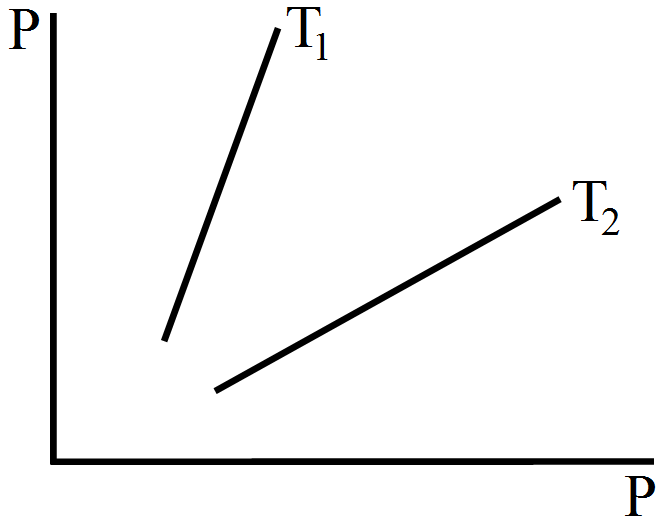
Figure. shows graphs of pressure vs density for an ideal gas at two temperatures $T_1$ and $T_2$.
- ✓
$T_1>T_2$
- B
$T_1=T_2$
- C
$T_1 < T_2$
- D
Any of the three is possible.
AnswerCorrect option: A. $T_1>T_2$
The straight line $T_1$ has greater slope than $T_2$. This means $\frac{\text{P}}{\rho}$ ratio is greater for $T_1$ than $T_2$. Now, rms velocity of a gas is given by $\sqrt{\frac{3\text{P}}{\rho}}.$ This means rms velocity of gas with $T_1$ molecules is greater than $T_2$ molecules. Again, gas with higher temperature has higher rms velocity.
View full question & answer→MCQ 901 Mark
Two bodies at different temperatures are mixed in a calorimeter. Which of the following quantities remains conserved?
- A
Sum of the temperatures of the two bodies.
- B
Total heat of the two bodies.
- ✓
Total internal energy of the two bodies.
- D
Internal energy of each body.
AnswerCorrect option: C. Total internal energy of the two bodies.
When two bodies at different temperatures are mixed in the calorimeter, heat flows from one body to the other due to the temperature difference. This results in change in the internal energy of the individual bodies. There is no exchange of heat with the surrounding in the calorimeter. Thus, the total internal energy of the bodies remain conserved as no external work is done on them.
View full question & answer→MCQ 911 Mark
A product from a chemical industry passes through three states $-$ gas, liquid, solid. The product is initially formed in gaseous state which is then liquefied and finally solidified. For same mass $($say $5g)$ which state has maximum internal energy?
- A
- B
- ✓
- D
All have equal internal energy
AnswerInternal energy is dependent on the freedom of movement of particles.
Since in gaseous state, particles are most free to move, this state has maximum internal energy.
View full question & answer→MCQ 921 Mark
Oxygen and hydrogen gases are at same temperature and pressure. And the oxygen molecule has 16 times the mass of hydrogen molecule. Then the ratio of their r.m.s. speed is:
- A
$2$
- ✓
$\frac{1}{4}$
- C
$4$
- D
$16$
AnswerCorrect option: B. $\frac{1}{4}$
$\frac{\text{C}_{\text{oxy}}}{\text{C}_{\text{H}}}=\sqrt{\frac{\text{m}_{\text{H}}}{\text{m}_{\text{oxy}}}}=\sqrt{\frac{1}{16}}=\frac{1}{4}$
View full question & answer→MCQ 931 Mark
According to kinetic theory of gases, at absolute zero temperature:
MCQ 941 Mark
Real gases show markable deviation from that of ideal gas behavior at:
- ✓
High temperature and low pressure.
- B
Low temperature and high pressure.
- C
High temperature and high pressure.
- D
Low temperature and low pressure.
AnswerCorrect option: A. High temperature and low pressure.
Real gases approach ideal gas behaviour at high temperature and low pressure because at high pressures and low temperature, molecules of gases are very close to each other.
View full question & answer→MCQ 951 Mark
The internal energy of $2$ moles of a mono atomic gas is:
- A
$\frac{3}{2}\text{RT}$
- ✓
$3\text{RT}$
- C
$2\text{RT}$
- D
$5\text{RT}$
AnswerCorrect option: B. $3\text{RT}$
lnternal energy, $\text{U}=\Big(\frac{3}{2}\text{k}_{\text{B}}\text{T}\Big)2\text{N}_{\text{A}}$
$=3(\text{k}_{\text{B}}\times\text{N}_{\text{A}})\text{T = 3RT}$
View full question & answer→MCQ 961 Mark
Equal volumes of two gases at the same temperature and pressure have the same:
MCQ 971 Mark
When a gas is in thermal equilibrium, its molecules:
- ✓
Have the same average kinetic energy of molecules.
- B
Have different energies which remain constant.
- C
Have a certain constant energy.
- D
Do not collide with one another.
AnswerCorrect option: A. Have the same average kinetic energy of molecules.
View full question & answer→MCQ 981 Mark
The number of degrees of freedom for translatory motion are:
- A
Dependent on the nature of translatory motion.
- ✓
Same for all types of molecules.
- C
Less for multiatomic molecules.
- D
More for multiatomic molecules.
AnswerCorrect option: B. Same for all types of molecules.
View full question & answer→MCQ 991 Mark
A molecule moving along a straight line possess $............$ degree of freedom.
View full question & answer→MCQ 1001 Mark
Energy supplied to convert unit of substance from solid to liquid state at its melting point is called:
AnswerThe heat energy supplied per unit mass of a substance at its melting point to convert the state of the substance from solid to liquid is known as Latent heat of Fusion.
View full question & answer→MCQ 1011 Mark
The pressure of a gas kept in an isothermal container is $200\ \text{kPa.}$ If half the gas is removed from it, the pressure will be:
- ✓
$100\ \text{kPa.}$
- B
$200\ \text{kPa.}$
- C
$400\ \text{kPa.}$
- D
$800\ \text{kPa.}$
AnswerCorrect option: A. $100\ \text{kPa.}$
Let the number of moles in the gas be $n.$
Applying equation of state, we get,
$\text{PV}=\text{nRT}$
$\Rightarrow\text{P}=\frac{\text{nRT}}{\text{V}}$
$\Rightarrow2\times10^5=\frac{\text{nRT}}{\text{V}}\ ...(1)$
When half of the gas is removed, number of moles left behind $=\frac{\text{n}}{2}$
Let the pressure be $P'.$
$\text{P}'=\frac{\text{n}}{2}\frac{\text{RT}}{\text{V}}$
Now,
$\text{P}'=\frac{1}{2}\times2\times10^5=10^5 [$From eq. $(1)]$
$=100\text{kPa}$
View full question & answer→MCQ 1021 Mark
Gases deviate from perfect gas behaviour because their molecules:
- A
- B
- C
Don’t attract each other.
- ✓
Interact with each other through intermolecular forces.
AnswerCorrect option: D. Interact with each other through intermolecular forces.
View full question & answer→MCQ 1031 Mark
The absolute zero is that temperature at which:
- ✓
All molecular linear velocities are zero.
- B
Most of the molecular linear velocities are zero.
- C
Most of the molecular linear velocities are not zero.
- D
The weight of the gas is zero.
AnswerCorrect option: A. All molecular linear velocities are zero.
View full question & answer→MCQ 1041 Mark
Oxygen and hydrogen gases are at the same temperature $T.$ The kinetic energy of an oxygen molecule will be equal to:
- A
$16$ times the kinetic energy of a hydrogen molecule.
- B
$5$ times the kinetic energy of a hydrogen molecule.
- ✓
The kinetic energy of a hydrogen molecule.
- D
One$-$fourth the kinetic energy of a hydrogen molecule.
AnswerCorrect option: C. The kinetic energy of a hydrogen molecule.
View full question & answer→MCQ 1051 Mark
The pressure $P$ of a gas and its mean $K.E.$ per unit volume are related as:
- A
$\text{P}=\frac{1}{2}\text{E}$
- B
$\text{P = E}$
- C
$\text{P}=\frac{3}{2}\text{E}$
- ✓
$\text{P}=\frac{2}{3}\text{E}$
AnswerCorrect option: D. $\text{P}=\frac{2}{3}\text{E}$
$\text{P}=\frac{1}{3}\rho\text{C}^2$
Mean $K.E$./ volume $=\text{E}=\frac{1}{2}\rho\text{C}^2$
$\therefore\text{P}=\frac{1}{3}\rho\text{C}^2=\frac{2}{3}\Big(\frac{1}{2}\rho\text{C}^2\Big)=\frac{2}{3}\text{E}$
View full question & answer→MCQ 1061 Mark
The molar specific heat at constant pressure for monoatomic gas molecule is given by:
- A
$\frac{3}{2}\text{R}$
- B
$\frac{1}{2}\text{R}$
- ✓
$\frac{5}{2}\text{R}$
- D
$\text{R}$
AnswerCorrect option: C. $\frac{5}{2}\text{R}$
View full question & answer→MCQ 1071 Mark
Which of the following can be the basis of sesparating a mixture of gases?
- ✓
Graham’s law of diffusion
- B
- C
- D
AnswerCorrect option: A. Graham’s law of diffusion
View full question & answer→MCQ 1081 Mark
The phenomenon of Browninan movement may be taken as evidence of:
- ✓
- B
Electromagnetic theory of radiation
- C
Corpuscular theory of light
- D
View full question & answer→MCQ 1091 Mark
What is the ratio of specific heats for a diatomic gas?
- ✓
$\frac{7}{5}$
- B
$\frac{5}{3}$
- C
$\frac{9}{7}$
- D
$\frac{7}{2}$
AnswerCorrect option: A. $\frac{7}{5}$
The value of $CV$ for a diatomic gas is $\frac{7}{2} R$ and
CP is$\frac{9}{2} R.$
Thus the value of $γ$ is:
$\frac{\text{C}_\text{P}}{\text{C}_\text{V}}=\frac{7}{5}$
View full question & answer→MCQ 1101 Mark
Diatomic molecules like hydrogen have energies due to both translational as well as rotational motion. From the equation in kinetic theory $\text{PV} = \frac{2}{3} E,E$ is:
- A
The total energy per unit volume.
- B
Only the translational part of energy because rotational energy is very small compared to the translational energy.
- ✓
Only the translational part of the energy because during collisions with the wall pressure relates to change in linear momentum.
- D
The translational part of the energy because rotational energies of molecules can be of either sign and its average over all the molecules is zero.
AnswerCorrect option: C. Only the translational part of the energy because during collisions with the wall pressure relates to change in linear momentum.
According to kinetic theory equation, $\text{PV} = \frac{2}{3} E [$where $P=$ Pressure $V =$ volume$]$
$E$ is representing only translational part of energy.
Internal energy contains all types of energies like translational, rotational, vibrational etc.
But the molecules of an ideal gas is treated as point masses in kinetic theory, so its kinetic energy is only due to translational motion.
Point mass does not have rotational or vibrational motion.
Here, we assumed that the walls only exert perpendicular forces on molecules.
They do not exert any parallel force, hence there will not be any type of rotation present.
The wall produces only change in translational motion.
View full question & answer→MCQ 1111 Mark
According to kinetic theory of gases, at absolute zero of temperature:
AnswerThis model is described for an ideal gas and assumes that the particles does not interact in any other way.
It is known that the root mean square velocity of a particle is proportional to the absolute temperature Also for zero absolute temperature, the velocity is also zero.
View full question & answer→MCQ 1121 Mark
The ratio of principal molar heat capacities of a gas is maximum for:
MCQ 1131 Mark
Which of the following quantities is zero on an average for the molecules of an ideal gas in equilibrium?
AnswerIn case of ideal gases the average velocity is always zero. Hence the average momentum is zero.
Whereas average speed is non$-$zero so the kinetic energy also non$-$zero, as these two are scalar quantities.
View full question & answer→MCQ 1141 Mark
The process on an ideal gas, shown in figure. is:
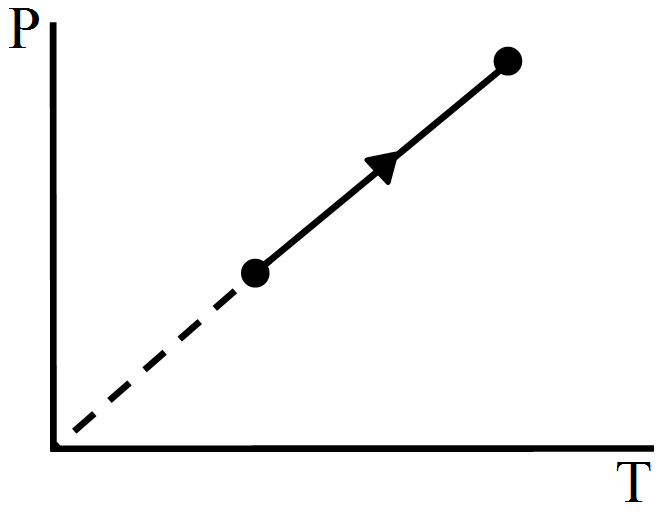
AnswerAccording to the graph, $P$ is directly proportional to $T.$
Applying the equation of state, we get,
$\text{PV = nRT}$
$=\frac{\text{nR}}{\text{V}}\text{T}$
Given: $\text{P}\propto\text{T}$
This means $\frac{\text{nR}}{\text{V}}$ is a constant.
So, $V$ is also a constant.
Constant $V$ implies the process is isochoric.
View full question & answer→MCQ 1151 Mark
Which of the following is not a postulate of kinetic theory of gases:
- ✓
The molecules of a gas are always at rest.
- B
The molecules of a gas are point masses.
- C
The molecules of a gas are perfectly elastic spheres.
- D
The molecules of a gas are identical.
AnswerCorrect option: A. The molecules of a gas are always at rest.
View full question & answer→MCQ 1161 Mark
When do real gases approach the ideal gas behaviour?
- ✓
At low pressure and high temperature
- B
At high pressure and high temperature
- C
At high pressure and low temperature
- D
At low pressure and low temperature
AnswerCorrect option: A. At low pressure and high temperature
View full question & answer→MCQ 1171 Mark
Keeping the number of moles, volume and temperature the same, which of the following are the same for all ideal gases?
AnswerPressure of an ideal gas is given by $\text{PV}=\frac{1}{3}\text{mnu}^2.$
We know that pressure depends on volume, number of molecules and root mean square velocity.
Also, root mean square velocity depends on the temperature of the gas.
Since the number of molecules, volume and temperature are constant, pressure of the gas will not change.
View full question & answer→MCQ 1181 Mark
Which of the following options is correct about the flow of a liquid?
- ✓
In liquids the atoms are not as rigidly fixed as in solid.
- B
In liquids the atoms are more rigidly fixed as in gas.
- C
In liquid the separation between atoms are spaced about.
- D
AnswerCorrect option: A. In liquids the atoms are not as rigidly fixed as in solid.
View full question & answer→MCQ 1191 Mark
A cubic vessel $($with face horizontal $+$ vertical$)$ contains an ideal gas at $\text{NTP.}$ The vessel is being carried by a rocket which is moving at a speed of $500\ ms^{-1}$ in vertical direction. The pressure of the gas inside the vessel as observed by us on the ground:
- A
Remains the same because $500\ ms^{-1}$ is very much smaller than $v_{rms}$ of the gas.
- ✓
Remains the same because motion of the vessel as a whole does not affect the relative motion of the gas molecules and the walls.
- C
Will increase by a factor equal to $\left(\mathrm{v}_{\mathrm{rms}}^2+(500)^2\right) / \mathrm{v}^2_{rms}$ where $v_{rms}$ was the original mean square velocity of the gas.
- D
Will be different on the top wall and bottom wall of the vessel.
AnswerCorrect option: B. Remains the same because motion of the vessel as a whole does not affect the relative motion of the gas molecules and the walls.
As the relative velocity of molecules with respect to the walls of container does not change in rocket, due to the mass of a molecule is negligible with respect to the mass of whole system and system of gas moves as a whole and $g = 0$ on molecule everywhere. The acceleration of rocket is also zero because rocket is moving with constant speed. Hence the pressure inside the vessel of gas as observed by us on the ground remains same.
View full question & answer→MCQ 1201 Mark
What is the number of molecules in $3$ cubic metre of a gas at $3\ \text{atm}\ 27^\circ C?$
- ✓
$2.17\times 10^{-20}$
- B
$6.38\times 10^{-20}$
- C
$3.86\times 10^{-20}$
- D
$4.58\times 10^{-20}$
AnswerCorrect option: A. $2.17\times 10^{-20}$
Using, $\text{PV = NkT}$
we get : $\text{N}=\frac{\text{PV}}{\text{KT}}$
$= \frac{(3\times3\times105)}{(1.38\times10^{-23}\times300)}$
$= 2.17\times 10^{-20}$
View full question & answer→MCQ 1211 Mark
For a gas, $\frac{\text{R}}{\text{C}_{\text{V}}}=0.67$ The gas is made up of molecules, which are:
Answer$\frac{\text{R}}{\text{C}_{\text{V}}}=0.67=\frac{2}{3}$
$\text{C}_{\text{V}}=\frac{3}{2}\text{R}$
View full question & answer→MCQ 1221 Mark
A vessel of volume $V$ contains a mixture of $1$ mole of hydrogen and $1$ mole of oxygen $($both considered as ideal$).$ Let $f_1\text{(v)dv}$ denotes the fraction of molecules with speed between $v$ and $(v + dv)$ with $f_2\text{(v)dv}$, similarly for oxygen. Then,
- A
$f_1(v) + f_2(v) = f (v)$ obeys the Maxwell’s distribution law.
- ✓
$f_1(v), f_2(v)$ will obey the Maxwell’s distribution law separately.
- C
Neither $f_1(v)$ nor $f_2(v)$ will obey the Maxwell’s distribution law.
- D
$f_2(v)$ and $f_1(v)$ will be the same.
AnswerCorrect option: B. $f_1(v), f_2(v)$ will obey the Maxwell’s distribution law separately.
Key concept: Maxwell’s Law $($or the Distribution of Molecular Speeds$):$
- The $v_{rms}$ gives us a general idea of molecular speeds in a gas at a given temperature.
This doesn’t mean that the speed of each molecule is $v_{rms}$. Many of the molecules have speed less than $v_{rms}$ and many have speeds greater than $v_{rms}$.
- Maxwell derived equation gives the distribution of molecules in different speeds as follows:
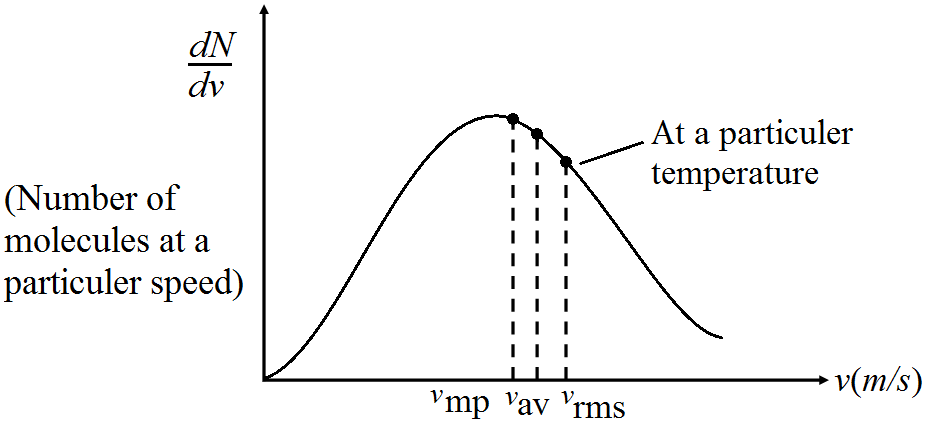
The masses of hydrogen and oxygen molecules are different.
For a function $f(v),$ the number of molecules $dn = f[v),$ which are having speeds between $v$ and $v + dv.$ The Maxwell$-$Boltzmann speed distribution function $(N_v = dn/ dv)$ depends on the mass of the gas molecules.
For each function $f_1(v)$ and $f_2(v), n$ will be different, hence each function $f_1(v)$ and $f_2(v)$ will obey the Maxwell’s distribution law separately. View full question & answer→MCQ 1231 Mark
Specific heat capacity of water is given by:
MCQ 1241 Mark
The state of greatest potential energy is:
MCQ 1251 Mark
The internal energy of a gram-molecule of an ideal gas depends on:
- A
- B
- ✓
- D
Both on pressure as well as temperature
View full question & answer→MCQ 1261 Mark
The pressure of an ideal gas is written as $\text{p}=\frac{2\text{E}}{3\text{v}}.$ Here $E$ refers to:
- ✓
Translational kinetic energy.
- B
Rotational kinetic energy.
- C
Vibrational kinetic energy.
- D
AnswerCorrect option: A. Translational kinetic energy.
According to the kinetic theory, molecules show straight line in motion $($translational$)$. So, the kinetic energy is essentially transitional.
View full question & answer→MCQ 1271 Mark
According to the kinetic theory of gases, the pressure exerted by a gas on the wall of the container is measured as:
- ✓
Rate of change of momentum imparted to the walls per second per unit area.
- B
Momentum imparted to the walls per unit area.
- C
Change of momentum imparted to the walls per unit area.
- D
Change in momentum per unit volume.
AnswerCorrect option: A. Rate of change of momentum imparted to the walls per second per unit area.
View full question & answer→MCQ 1281 Mark
Molecules of a ideal gas behave like:
AnswerCorrect option: A. Perfectly elastic rigid sphere
View full question & answer→MCQ 1291 Mark
Following gases are kept at the same temperature. Which gas possesses maximum r.m.s. speed?
AnswerOut of all gases, hydrogen gas has the minimum molecular mass, therefore hydrogen gas will have the highest $\text{r.m.s}$ speed.
View full question & answer→MCQ 1301 Mark
At what temperature the kinetic energy of gas molecule is half of the value at $27^\circ C\ ?$
- A
$13.5^\circ C$
- B
$150^\circ C$
- C
$75K$
- ✓
$-123^\circ C$
AnswerCorrect option: D. $-123^\circ C$
View full question & answer→MCQ 1311 Mark
At constant volume temperature is increased then:
- A
Collision on walls will be less
- ✓
Collision frequency will be increases
- C
Collision will be in straight line
- D
Collision will not change
AnswerCorrect option: B. Collision frequency will be increases
View full question & answer→MCQ 1321 Mark
The two gases with the ratio $3 : 2$ of their masses in a container are at a temperature $T.$ The ratio of the kinetic energies of the molecule of two gases is:
- A
$3 : 2$
- B
$9 : 4$
- ✓
$1 : 1$
- D
$4 : 9$
AnswerCorrect option: C. $1 : 1$
View full question & answer→MCQ 1331 Mark
During an adiabatic process, the pressure of a gas is proportional to the cube of its absolute temperature. The value of $\frac{\text{C}_{\text{p}}}{\text{C}_\text{v}}$ for that gas is:
- A
$\frac{3}{5}$
- ✓
$\frac{4}{3}$
- C
$\frac{5}{3}$
- D
$\frac{3}{2}$
AnswerCorrect option: B. $\frac{4}{3}$
View full question & answer→MCQ 1341 Mark
For hydrogen gas, $C_p-C_v=b$. The relation between $a$ and $b$ is:
- A
$a = 16b$
- B
$b = 16$
- ✓
$a = b$
- D
$a = 4b$
AnswerCorrect option: C. $a = b$
For any gas $C_P - C_V = R$
$\therefore a = b$
View full question & answer→MCQ 1351 Mark
According to law of equipartition of energy, in equilibrium the tot energy is equally distributed in all possible energy modes having an energy equal to:
- A
$\frac{3}{2}\text{KBT}$
- ✓
$\frac{1}{2}\text{KBT}$
- C
$\text{KBT}$
- D
$\frac{5}{2}\text{KBT}$
AnswerCorrect option: B. $\frac{1}{2}\text{KBT}$
View full question & answer→MCQ 1361 Mark
A room temperature the $\text{r.m.s.}$ velocity of the molecules of a certain diatomic gas is found to be $1930\ m/\sec$. the gas is:
- ✓
$H^2$
- B
$F^2$
- C
$O^2$
- D
$Cl^2$
View full question & answer→MCQ 1371 Mark
Consider the quantity $\frac{\text{MkT}}{\text{pV}}$ of an ideal gas where $M$ is the mass of the gas. It depends on the,
AnswerIn an ideal gas, the equation of state is given by
$\text{PV}=\text{nRT}$
$\Rightarrow\text{PV}=\text{nN}_\text{A}\frac{\text{R}}{\text{N}_\text{A}}\text{T}$
$\Rightarrow\text{PV}=\text{nN}_\text{A}\text{kT}$
$\Rightarrow\frac{1}{\text{nN}_\text{A}}=\frac{\text{kT}}{\text{PV}}$
Multiplying both sides by mass of the gas $M,$ we get
$\frac{\text{M}}{\text{nN}_\text{A}}=\frac{\text{MkT}}{\text{PV}}$
Now, $nN_A$ gives the total number of molecules of the gas.
Also, $\frac{\text{M}}{\text{nN}_\text{A}}$ gives the mass of a single molecule.
Hence, $\frac{\text{MkT}}{\text{PV}}$ is the mass of a single molecule of the gas,
Molecular mass is a property of the gas.
View full question & answer→MCQ 1381 Mark
A vessel $A$ volume $V$ and a vessel $B$ has volume $2V.$ Both contain some water which has a constant volume. The pressure in the space above water is $p_a$ for veesel $A$ and $p_b$ for vessel $B.$
- ✓
$\mathrm{p}_{\mathrm{a}}=\mathrm{p}_{\mathrm{b}}$
- B
$\mathrm{p}_{\mathrm{a}}=2\mathrm{p}_{\mathrm{b}}$
- C
$\mathrm{p}_{\mathrm{b}}=2 \mathrm{p}_{\mathrm{a}}$
- D
$\mathrm{p}_{\mathrm{b}}=4 \mathrm{p}_{\mathrm{a}}$
AnswerCorrect option: A. $\mathrm{p}_{\mathrm{a}}=\mathrm{p}_{\mathrm{b}}$
The maximum pressure attainable above the water will be saturated vapour pressure at that temperature. Since saturated vapour pressure does not depend upon volume, both the vessels will have same pressure.
View full question & answer→MCQ 1391 Mark
A container has $3$ gases whose mass ratio is $1:3:5.$ What is the ratio of mean square speed of the molecules of two gases? Their atomic masses are $20u, 30u\ \&\ 40u$ corresponding to the order in which the ratios are given.
- A
$2:3:4$
- ✓
$4:3:2$
- C
$2:\sqrt{3}:\sqrt{2}$
- D
$\sqrt{2}:\sqrt{3}:2$
AnswerCorrect option: B. $4:3:2$
Their average kinetic energies will be the same.
Thus, $\frac{1}{2}mv^2$ will be the same.
$\text{v}_1^2:\text{v}_2^2:\text{v}_3^2$
$= m_3:m_2:m_1$
$= 40:30:20$
$= 4:3:2.$
View full question & answer→MCQ 1401 Mark
Real gases obey ideal gas laws more closely at:
- A
Low pressure and low temperature.
- ✓
Low pressure and high temperature.
- C
High pressure and low temperature.
- D
High pressure and high temperature.
AnswerCorrect option: B. Low pressure and high temperature.
Real gases obey ideal gas laws at low pressure and high temperature because at low pressure the number of molecules per unit volume is less so attractive force between them is negligible.
At high temperature the speed of the molecules is very high so collisions becomes elastic.
View full question & answer→MCQ 1411 Mark
A sealed container with negligible thermal coefficient of expansion contains helium $($a monoatomic gas$).$ When it is heated from $300$ to $600K,$ the average kinetic energy of the helium atom is:
View full question & answer→MCQ 1421 Mark
The molecule of monoatomic gas has:
- A
Three rotational degrees of freedom.
- ✓
Three translational degrees of freedom.
- C
Two rotational degrees of freedom.
- D
Both $a$ and $b.$
AnswerCorrect option: B. Three translational degrees of freedom.
View full question & answer→MCQ 1431 Mark
Kinetic theory of gases provide a base for:
- ✓
Both Charle’s law and Boyle’s law
- B
- C
- D
AnswerCorrect option: A. Both Charle’s law and Boyle’s law
View full question & answer→MCQ 1441 Mark
In the gas equation $\text{PV = RT, V}$ is the volume of:
- ✓
$1$ mol of gas
- B
$1g$ of gas
- C
- D
$1$ litre of gas
AnswerCorrect option: A. $1$ mol of gas
For an Ideal Gas, $\text{PV = nRT}$
Here $V$ is the volume of $n$ moles of gas.
Thus for $\text{PV = (1)RT, V}$ is the volume of $1$ mol of gas.
View full question & answer→MCQ 1451 Mark
The specific heat capacity of solids is given by:
MCQ 1461 Mark
A perfect gas at $27^\circ C$ is heated at constant pressure so as to double its volume. The temperature of the gas will be:
- A
$300^\circ C$
- B
$54^\circ C$
- C
$600^\circ C$
- ✓
$327^\circ C$
AnswerCorrect option: D. $327^\circ C$
According to Charle's law, when $P$ is constant, $\text{T}\propto\text{V}$ As $V$ is doubled, $T$ becomes twice i.e.,
$T = 2 \times (17 + 273)K$
$= 600K$
$= 600 - 273$
$= 327^\circ C$
View full question & answer→MCQ 1471 Mark
Diatomic molecule $($rigid rotator$)$ has:
AnswerCorrect option: C. Both $(a)$ and $(b).$
The diatomic molecules $($without vibration mode$)$ like $O_2$ and $N_2$ has three translational degrees of freedom and two rotational degrees of freedom.
View full question & answer→MCQ 1481 Mark
The molecular kinetic energy of a liquid is:
- ✓
More than molecular kinetic energy of solids.
- B
More than molecular kinetic energy of gases.
- C
Less than molecular kinetic energy of solids.
- D
AnswerCorrect option: A. More than molecular kinetic energy of solids.
The inter$-$molecular attractions in liquids are lesser compared to solids. As, liquids can move freely due to less inter molecular attraction they have more molecular kinetic energy compared to solids.
View full question & answer→MCQ 1491 Mark
As temperature tends to zero i.e., $T \rightarrow 0$
- ✓
Specific heat of all substances approaches zero.
- B
Specific heat of all substances approaches infinity.
- C
Specific heat of all substances may be zero or infinity.
- D
AnswerCorrect option: A. Specific heat of all substances approaches zero.
View full question & answer→MCQ 1501 Mark
The gas which satisfies the equation $\text{PV = nRT}$ at all pressure and temperature is called as:
View full question & answer→MCQ 1511 Mark
Avogadro's number is the number of molecules in:
MCQ 1521 Mark
The total internal energy of a mole of diatomic gas is given by:
- A
$\frac{5}{3}\text{RT}$
- B
$\frac{5}{2}\text{R}$
- ✓
$\frac{5}{2}\text{RT}$
- D
$\frac{3}{2}\text{RT}$
AnswerCorrect option: C. $\frac{5}{2}\text{RT}$
View full question & answer→MCQ 1531 Mark
In the equation, $\text{PV = RT,}$ the $V$ refers to the volume of:
- A
$1 g$ of a gas
- ✓
$1$ mole of a gas
- C
$1 \ kg$ of gas
- D
AnswerCorrect option: B. $1$ mole of a gas
View full question & answer→MCQ 1541 Mark
What is the number of degrees of freedom of an ideal diatomic molecule at ordinary temperature?
MCQ 1551 Mark
The specific heat of a gas:
AnswerCorrect option: D. Can have any value between o and infinity.
The specific heat of a gas at constant pressure is the amount of heat required to raise the temperature of one mole of a gas by unit temperature at constant pressure.
View full question & answer→MCQ 1561 Mark
The mean free path for air molecule with average speed $18.5 \mathrm{~ms}^{-1}$ at $\text{STP}$ is $($Take, $\mathrm{d}=2 \times 10^{-10} \mathrm{~m}$ and $\mathrm{n}=2.7 \times 10^{25} \mathrm{~m}^{-3} )$
- A
$3.5 \times 10^{-7} \mathrm{~m}$
- B
$4 \times 10^{-7} \mathrm{~m}$
- ✓
$2.9 \times 10^{-7} \mathrm{~m}$
- D
$5 \times 10^{-7} \mathrm{~m}$
AnswerCorrect option: C. $2.9 \times 10^{-7} \mathrm{~m}$
For air at $\text{STP}, \mathrm{n}=2.7 \times 10^{25} \mathrm{~m}^{-3}$
$d=2 \times 10^{-10} \mathrm{~m}$
$\Rightarrow\text{l}=\frac{1}{\sqrt{2}\text{n}\pi\text{d}^2}$
On putting values, $\mathrm{I}=2.9 \times 10^{-7} \mathrm{~m}$
View full question & answer→MCQ 1571 Mark
Atom of an element is electrically:
AnswerAccording to Thomson's model of an atom, Atom as a whole is electrically neutral because the negatively charged electrons and positively charged protons are equal in magnitude and, thus, atom as a whole is electrically neutral.
View full question & answer→MCQ 1581 Mark
The internal energy of an ideal gas is in the form of:
- ✓
Kinetic energy of molecules.
- B
Potential energy of molecules.
- C
Both kinetic and potential energy of molecules.
- D
Gravitational potential energy of molecules.
AnswerCorrect option: A. Kinetic energy of molecules.
View full question & answer→MCQ 1591 Mark
The total internal energy of the monoatomic gas molecule is given by:
- A
$\frac{1}{2}\text{RT}$
- B
$\frac{5}{2}\text{RT}$
- ✓
$\frac{3}{2}\text{RT}$
- D
$\text{RT}$
AnswerCorrect option: C. $\frac{3}{2}\text{RT}$
View full question & answer→MCQ 1601 Mark
What is the ratio of densities of $2$ gases, $O_2\ \&\ N_2$, having partial pressures in the ratio $2:3\ ?$
- ✓
$\frac{16}{21}$
- B
$\frac{12}{7}$
- C
$\frac{21}{16}$
- D
$\frac{7}{12}$
AnswerCorrect option: A. $\frac{16}{21}$
The ratio of moles is the same as the ratio of partial pressures.
The ratio of densities:
$\frac{\text{d}_1}{\text{d}_2}= \frac{\Big(\frac{\text{m}_1}{\text{V}}\Big)}{\Big(\frac{\text{m}_2}{\text{V}}\Big)}$
$=\frac{\text{m}_1}{\text{m}_2}= \frac{\Big(\frac{\text{n}_1}{\text{M}_1}\Big)}{\Big(\frac{\text{n}_1}{\text{M}_2}\Big)}$
where $n$ is the number of moles and $M$ is the molecular mass.
$\frac{\text{d}_1}{\text{d}_2}=\Big(\frac{2}{3}\Big)\times\Big(\frac{16}{14}\Big)$
$= \frac{16}{21}$
View full question & answer→MCQ 1611 Mark
Consider a collision between an oxygen molecule and a hydrogen molecule in a mixture of oxygen and hydrogen kept at room temperature. Which of the following are pcssible?
- A
The kinetic energies of both the molecules increase.
- B
The kinetic energy of the hydrogen molecule increases and that of the oxygen molecule decreases.
- C
The Kinetic energy of the oxygen molecule increases and that of the hydrogen molecule decreases.
- ✓
Both $B$ and $C$
AnswerCorrect option: D. Both $B$ and $C$
According to Kinetic theory, postulates collision between molecules are elastic. This means that kinetic energy after any collision is conserved because while one gains kinetic energy, another loses it. Both options, $(c)$ and $(d)$ consider the conservation of kinetic energy in the collision.
View full question & answer→MCQ 1621 Mark
Two vessels having equal volume contain molecular hydrogen at one atmosphere and helium at two atmosphere pressure respectively. If both samples are at the same temperature the mean velocity of hydrogen molecule is:
AnswerCorrect option: D. $\sqrt{2}$ times that of helium.
View full question & answer→MCQ 1631 Mark
There is some liquid in a closed bottle. The amount of liquid is continuously decreasing. The vapour in the remaining part:
AnswerAs the liquid is decreasing, the liquid is vapourised.
We know that vapourisation cannot occur in saturated air and there cannot be any liquid with no vapour at all.
So, the vapour in the remaining part is unsaturated.
View full question & answer→MCQ 1641 Mark
In the isothermal expansion of $10g$ of gas from volume $V$ to $2V$ the work done by the gas is $575J.$ What is the root mean square speed of the molecules of the gas at that temperature?
- ✓
$499\ m/s$
- B
$532\ m/s$
- C
$520\ m/s$
- D
$398\ m/s$
AnswerCorrect option: A. $499\ m/s$
View full question & answer→MCQ 1651 Mark
A gas mixture consists of $2.0$ moles of oxygen and $4.0$ moles of neon at temperature $T.$ Neglecting all vibrational modes, calculate the total internal energy of the system. $($Oxygen has two rotational modes.$)$
- ✓
$11RT$
- B
$13RT$
- C
$15RT$
- D
$19RT$
AnswerCorrect option: A. $11RT$
View full question & answer→MCQ 1661 Mark
The energy density of an ideal gas is related to its pressure $P$ as:
- A
$\frac{\text{u}}{\text{V}}=3\text{P}$
- ✓
$\frac{\text{u}}{\text{V}}=\frac{3}{2}\text{P}$
- C
$\frac{\text{u}}{\text{V}}=\frac{1}{3}\text{P}$
- D
$\frac{\text{u}}{\text{V}}=\frac{2}{3}\text{P}$
AnswerCorrect option: B. $\frac{\text{u}}{\text{V}}=\frac{3}{2}\text{P}$
View full question & answer→MCQ 1671 Mark
Oxygen and hydrogen are at the same temperature $T.$ The ratio of the mean kinetic energy of oxygen molecules to that of the hydrogen molecules will be:
- A
$16 : 1$
- ✓
$1 : 1$
- C
$4 : 1$
- D
$1 : 4$
AnswerCorrect option: B. $1 : 1$
View full question & answer→MCQ 1681 Mark
Which one of the following molecules does not possess vibrational energy?
MCQ 1691 Mark
A gas is taken in a sealed container at $300K$. it is heated at constant volume to a temperature $600K.$ the mean $K.E.$ of its molecules is:
View full question & answer→MCQ 1701 Mark
The law of equipartition of energy is applicable to the system whose constituents are:
- A
- B
- ✓
- D
Moving with constant speed
View full question & answer→MCQ 1711 Mark
The average momentum of a molecule in a sample of an ideal gas depends on:
AnswerAverage momentum of a gas sample is zero, so it does not depend upon any of these parameters.
View full question & answer→MCQ 1721 Mark
Vapour is injected at a uniform rate in a closed veseel which was initially evacuated. The pressure in the vessel:
- A
- B
- C
First increases and then decreases.
- ✓
First increases and then becomes constant.
AnswerCorrect option: D. First increases and then becomes constant.
As the vapour is injected, the pressure of the chamber increases. But when the pressure becomes equal to the saturated vapour pressure, it condenses. So, if more vapour is injected beyond the saturated vapour pressure, the vapour will condense and thus the vapour pressure will be constant.
View full question & answer→MCQ 1731 Mark
The pressure $P$ and density $p$ of a gas are related as:
- ✓
$\text{P}\propto\text{p}$
- B
$\text{P}\propto\frac{1}{\text{p}}$
- C
$\text{P}\propto\text{p}^2$
- D
$\text{P}\propto\frac{1}{\text{p}^2}$
AnswerCorrect option: A. $\text{P}\propto\text{p}$
View full question & answer→MCQ 1741 Mark
A unit mass of solid converted to liquid at its melting point. Heat is required for this process is:
- A
- B
Latent heat of vaporization
- ✓
- D
View full question & answer→MCQ 1751 Mark
In kinetic theory of gases, it is assumed that molecules:
- A
Have same mass but negligible volume.
- B
Have different mass as well as volume.
- C
Have same volume but mass can be different.
- ✓
Have same mass but can have different volume.
AnswerCorrect option: D. Have same mass but can have different volume.
View full question & answer→MCQ 1761 Mark
The speed of sound in a gas is $v$. The $\text{rms}$ speed of molecules of this gas is $C.$ If $\gamma=\frac{\text{C}_{\text{p}}}{\text{C}_{\text{v}}},$ then the ratio of $v$ and $C$ is:
AnswerCorrect option: D. $\sqrt{\frac{\gamma}{3}}$
View full question & answer→MCQ 1771 Mark
The random motion of smoke or gas particles in the air is termed as:
MCQ 1781 Mark
Suppose a container ia evacuated to leave just one molecule of a gas in it. Let $V_a$ and $v_{rms}$ represent the average speed and the $\text{rms}$ speed of the gas.
- A
$v_a > v_{rms}$
- B
$v_a < v_{rms}$
- ✓
$v_a = v_{rms}$
- D
$v_{rms}$ is undefined
AnswerCorrect option: C. $v_a = v_{rms}$
Speed is constant and same for a single molecule. Thus, $\text{rms}$ speed will be equal to its average speed.
View full question & answer→MCQ 1791 Mark
Which of the following is not the correct definition of frame of reference.
- A
Frame of reference is frame in which all the Newton's laws are valid.
- ✓
Frame of reference is a point of intersection of the axis of a rectangular coordinate system.
- C
Frame of reference is a frame in which the speed of light is constant.
- D
All the frame of reference are parallel to each other and move with the constant velocity.
AnswerCorrect option: B. Frame of reference is a point of intersection of the axis of a rectangular coordinate system.
The frame of reference is a system of geometric axis to which measurement of size, position or motion can be made. The frame of reference has falling properties.
The speed of light is constant in the frame of reference.
All the laws of Newton are valid in the frame of reference.
All the frame of reference move with constant velocity with respect to one another.
View full question & answer→MCQ 1801 Mark
Volume versus temperature graphs for a given mass of an ideal gas are shown in figure. At two different values of constant pressure. What can be inferred about relation between $P_1$ and $P_2$?
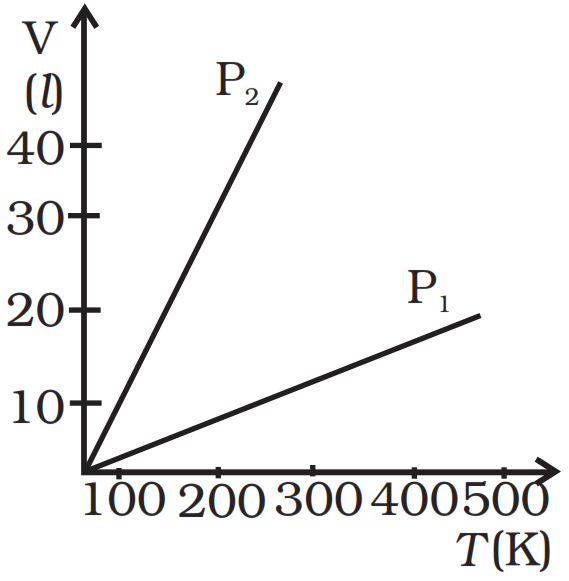
- ✓
$P_1 > P_2$
- B
$P_1 = P_2$
- C
$P_1 < P_2$
- D
AnswerCorrect option: A. $P_1 > P_2$
$\text{V}\propto\text{T}$ as $n, R$ and $P$ are constant
$\frac{\text{V}_1}{\text{T}_1}=$ constant or slope of graph is constant
$\text{V}=\frac{\text{nRT}}{\text{P}}$
$\frac{\text{dv}}{\text{dt}}=\frac{\text{nR}}{\text{P}}$ so $\frac{\text{dV}}{\text{dT}}$ increase when $P$ decreases
$\frac{\text{dV}}{\text{dT}}\alpha\frac{1}{\text{P}}$ as slope of $P_1$ is smaller than $P_2$.
Hence, $P_1 > P_2$ verifies option $(a).$
View full question & answer→MCQ 1811 Mark
The average $K.E.$ of a gas molecule at $25^\circ C$ is $6.21 \times 10^{-21}J$. Its average $K.E$. at $227^\circ$ will be:
- A
$52.2 \times 10^{-21}J$
- B
$5.21 \times 10^{-21}J$
- ✓
$10.35 \times 10^{-21}J$
- D
$11.35 \times 10^{-21}J$
AnswerCorrect option: C. $10.35 \times 10^{-21}J$
$\text{E}_2=\text{E}_1\sqrt{\frac{\text{T}_2}{\text{T}_1}}$
$=6.21\times10^{-21}\frac{(263+227)}{(273+27)}$
$=10.35\times10^{-21}\text{J}$
View full question & answer→MCQ 1821 Mark
The ratio of the molar heat capacities of a diatomic gas at constant pressure to that at constant volume is:
- A
$\frac{7}{2}$
- B
$\frac{3}{2}$
- C
$\frac{3}{5}$
- ✓
$\frac{7}{5}$
AnswerCorrect option: D. $\frac{7}{5}$
View full question & answer→MCQ 1831 Mark
$K.E.$ of molecular motion appears as:
AnswerIn the kinetic theory of gasses, increasing the temperature of a gas increases the average kinetic energy of the molecules, causing increased motion. This increased motion increases the outward pressure of the gas, an expected result from the ideal gas equation $\text{PV = NkT}$
Hence, the kinetic energy of the molecular motion appears as temperature since it varies with change in temperature.
View full question & answer→MCQ 1841 Mark
The total kinetic energy of $8$ litres of helium molecules at $5$ atmosphere pressure will be:
- A
$6078\ erg$
- ✓
$6078$ Joule
- C
$607\ erg$
- D
$607$ Joule
AnswerCorrect option: B. $6078$ Joule
View full question & answer→MCQ 1851 Mark
What is the average velocity of the molecules of an ideal gas?
MCQ 1861 Mark
Mean free path of a gas molecule is:
- ✓
Inversely proportional to number of molecules per unit volume.
- B
Inversely proportional to diameter of the molecule.
- C
Directly proportional to the square root of the absolute temperature.
- D
Directly proportional to the molecular mass.
AnswerCorrect option: A. Inversely proportional to number of molecules per unit volume.
View full question & answer→MCQ 1871 Mark
The collisions of the molecules of an ideal gas are:
AnswerAccording to kinetic theory of gases the collision among molecules and the collision of molecule with the walls of container are elastic.
View full question & answer→MCQ 1881 Mark
A closed vessel contains some gas at a given temperature and pressure. If the vessel is given a very high velocity, the temperature of the gas:
- A
- B
- C
May increase or decrease depending upon the nature of the gas.
- ✓
AnswerPressure and Temperature are two thermodynamic parameters which are controlled by microscopic parameters of the system i.e speed of the molecules, their collision with the boundary and other molecules.
At a given temperature molecules move in a random fashion due to thermal energy. so when we move the container in a certain fashion that does mean random motion becomes a systematic motion i.e molecules are still moving in a random fashion and there is no change in motion of molecules with respect to each other and the container, hence no change in Temperature of the Gas.
View full question & answer→MCQ 1891 Mark
Boyle' law is applicable for an:
MCQ 1901 Mark
Who gave the law of equipartition of energy?
MCQ 1911 Mark
How many degrees of freedom are there in a diatomic gas?
AnswerA diatomic gas has $3$ translational degrees of freedom and $2$ rotational degrees of freedom. Thus, the total number of degrees of freedom is $5.$
View full question & answer→MCQ 1921 Mark
$1$ mole of $H_2$ gas is contained in a box of volume $V = 1.00m^3$ at $T = 300K.$ The gas is heated to a temperature of $T = 3000K$ and the gas gets converted to a gas of hydrogen atoms. The final pressure would be $($considering all gases to be ideal$).$
- ✓
Same as the pressure initially.
- B
$2$ times the pressure initially.
- C
$10$ times the pressure initially.
- D
$20$ times the pressure initially.
AnswerCorrect option: A. Same as the pressure initially.
The situation is shown in the diagram, $H_2$ gas is contained in a box is heated and gets converted to a gas of hydrogen atoms. Then the number of moles would become twice.
According to gas equation,
$\text{PV = nRT}$
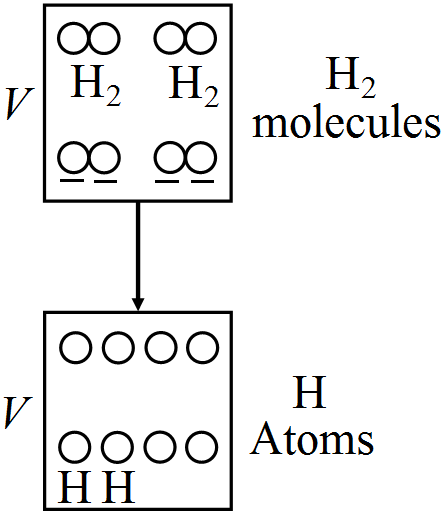
$P =$ Pressure of gas, $n =$ Number of moles
$R =$ Gas constant, $T =$ Temperature $\text{PV = nRT}$
As volume $(V) $of the container is constant.
Hence, when temperature $(T)$ becomes $10$ times, $($from $300K$ to $3000K)$ pressure $(P)$ also becomes $10$ times, as $P\ \alpha\ T.$
Pressure is due to the bombardment of particles and as gases break, the number of moles becomes twice of initial, so $n_2 = 2n_1$
So $P\ \alpha\ nT$
$\Rightarrow\frac{\text{P}_2}{\text{P}_1}=\frac{\text{n}_2\text{T}_2}{\text{n}_1\text{T}_1}=\frac{(2\text{n}_1)(3000)}{\text{n}_1(300)}=20$
$\Rightarrow\text{P}_2=20\text{P}_1$
Hence, final pressure of the gas would be $20$ times the pressure initially. View full question & answer→MCQ 1931 Mark
The mass of $22.4L$ of any gas is equal to its molecular weight in grams at:
- A
$270K$ and $1$ atm.
- ✓
$273K$ and $1$ atm.
- C
$273K$ and $10$ atm.
- D
$270K$ and $10$ atm.
AnswerCorrect option: B. $273K$ and $1$ atm.
View full question & answer→MCQ 1941 Mark
The mean square speed of the molecules of a gas at absolute temperature $T$ is proportional to:
- A
$\frac{1}{\text{T}}$
- B
$\sqrt{\text{T}}$
- ✓
$\text{T}$
- D
$\text{T}^2$
AnswerCorrect option: C. $\text{T}$
Root mean squared velocity is given by,
$\text{v}_\text{rms}=\sqrt{\frac{3\text{RT}}{\text{M}}}$
$\Rightarrow(\text{v}_\text{rms})^2=\frac{3\text{RT}}{\text{M}}$
$\Rightarrow(\text{v}_\text{rms})^2\alpha\text{T}$
View full question & answer→MCQ 1951 Mark
The diatomic gas molecule has $...........$ degrees of freedom.
- A
$3$ translational
- B
$2$ rotational
- ✓
Both $a$ and $b$
- D
AnswerCorrect option: C. Both $a$ and $b$
View full question & answer→MCQ 1961 Mark
What happens when the temperature of a gas contained in a vessel is raised?
- ✓
The molecules of gas move faster and pressure increases.
- B
The molecules of gas move faster and the pressure decreases
- C
The molecules of the gas move slower and the pressure, increases.
- D
The gas molecules move slower and the pressure decreases.
AnswerCorrect option: A. The molecules of gas move faster and pressure increases.
View full question & answer→MCQ 1971 Mark
The value of $\gamma$ for a diatomic molecule $($vibrational mode$)$ is:
- ✓
$\frac{9}{7}$
- B
$\frac{7}{9}$
- C
$\frac{7}{5}$
- D
$\frac{5}{7}$
AnswerCorrect option: A. $\frac{9}{7}$
View full question & answer→MCQ 1981 Mark
Which of the following is not an assumption of $\text{KTG}\ ?$
- A
Time spent during collision is negligibly small.
- B
All gases are made up of molecules moving randomly in all directions.
- ✓
Molecules do not collide with each other.
- D
Molecules collide elastically with the wall.
AnswerCorrect option: C. Molecules do not collide with each other.
According to $\text{KTG,}$ molecules collide elastically with each other and with the walls of the container. The other given assumptions are true. These assumptions help to develop a model of molecular behavior of an ideal gas.
View full question & answer→MCQ 1991 Mark
The average distance a molecule can travel without colliding is called as:
MCQ 2001 Mark
Which of the following gases has maximum rms speed at a given temperature?
AnswerThe rms speed of a gas is given by $\sqrt{\frac{3\text{RT}}{\text{M}_\text{O}}}.$
Since hydrogen has the lowest $M_O$ compared to other molecules, it will have the highest rms speed.
View full question & answer→MCQ 2011 Mark
The $\text{r.m.s}$ velocity of the molecules of an ideal gas is $C$ at a temperature of $100K.$ at what temperature is $\text{r.m.s.}$ velocity will be doubted?
- A
$200K$
- ✓
$400K$
- C
$300K$
- D
$50K$
AnswerCorrect option: B. $400K$
View full question & answer→MCQ 2021 Mark
One mole of an ideal gas requires $207J$ heat to raise the temperature by $10K,$ when heated at constant pressure. If the same gas is heated at constant volume to raise the temperature by $10K,$ then heat required is:
- A
$96.6J$
- ✓
$124J$
- C
$198.8J$
- D
$215.4J$
AnswerCorrect option: B. $124J$
Using $\text{CP − CV = R,}$
$CP$ is heat needed for raising by $10 K.$
$\therefore \text{CP = 20.7J/ moleK}$
Given $\text{R = 8.3 J/ mole K}$
$\therefore \text{CV = 20.7 − 8.3 = 12.4J/ moleK}$
$\therefore$ For raising by $10 K. = 124 J$
View full question & answer→MCQ 2031 Mark
When an ideal gas is compressed adiabatically, its temperature rises the molecules on the average have more kinetic energy than before. The kinetic energy increases,
- ✓
Because of collisions with moving parts of the wall only.
- B
Because of collisions with the entire wall.
- C
Because the molecules gets accelerated in their motion inside the volume.
- D
Because of redistribution of energy amongst the molecules.
AnswerCorrect option: A. Because of collisions with moving parts of the wall only.
As the ideal gas compress, then the mean free path becomes smaller so the number of collisions per second between the molecules and walls increases which increase the temperature of gas in turn Kinetic energy of gas molecule increases. Kinetic energy depends on temperature.
View full question & answer→MCQ 2041 Mark
Boyle’s law is applicable for an:
AnswerBoyle’s law is applicable at constant temperature, and temperature remains constant in isothermal process,
$\text{PV = nRT (n, R}$ and $T$ are constant$)$
$\therefore \text{PV} =$ constant
$\text{P}\alpha\frac{1}{\text{V}}$ (where constant $\text{= nRT})$
View full question & answer→MCQ 2051 Mark
Energy supplied to convert unit mass of substance from solid to liquid state at its melting point is called:
AnswerThe heat energy supplied per unit mass of a substance at its melting point to convert the state of the substance from solid to liquid is known as Latent heat of Fusion.
View full question & answer→MCQ 2061 Mark
At constant temperature, pressure is inversely proportional to volume is called as:
- A
- ✓
- C
Zeroth law of thermodynamics
- D
First law of thermodynamics
View full question & answer→MCQ 2071 Mark
The specific heat of a gas in isothermal process is:
MCQ 2081 Mark
Consider a gas enclosed in a box. A molecule of mass $m,$ having a velocity $-2i +3j +4k$ collides with a wall parallel to the $xz$ plane. What will be its velocity after collision and its change in momentum$?\ i, j\ \&\ k$ are unit vectors along the $x, y\ \&\ z$ axis.
- ✓
$-2i -3j +4k, -6mj$
- B
$2i +3j -4k, -6mj$
- C
$-2i -3j +4k, 6mj$
- D
$2i +3j -4k, 6mj$
AnswerCorrect option: A. $-2i -3j +4k, -6mj$
On collision with a wall parallel to the $xz$ plane, only the $y-$component will change.
Thus, new velocity will be $-2i -3j +4k.$
The change in momentum will be $-3mj -3mj = -6mj.$
View full question & answer→MCQ 2091 Mark
Two mole of oxygen is mixed with eight mole of helium. The effective specific heat of the mixture at constant volume is:
- A
$1.3R$
- B
$1.4R$
- ✓
$1.7R$
- D
$1.9R$
AnswerCorrect option: C. $1.7R$
View full question & answer→MCQ 2101 Mark
A gaseous mixture consists of $16g$ of helium and $16g$ of oxygen. The ratio $\text{CP/ CV}$ of the mixture is:
- A
$1.4$
- B
$1.54$
- C
$1.59$
- ✓
$1.62$
AnswerCorrect option: D. $1.62$
View full question & answer→MCQ 2111 Mark
Calculate the $\text{RMS}$ velocity of molecules of a gas of which the ratio of two specific heats is $1.42$ and velocity of sound in the gas is $500\ m/ s:$
- ✓
$727\ m/ s$
- B
$527\ m/ s$
- C
$927\ m/ s$
- D
$750\ m/ s$
AnswerCorrect option: A. $727\ m/ s$
View full question & answer→MCQ 2121 Mark
The quantity $\frac{\text{PV}}{\text{kT}}$ represents:
- A
- B
Kinetic energy of the gas.
- C
Number of moles of the gas.
- ✓
Number of molecules in the gas.
AnswerCorrect option: D. Number of molecules in the gas.
Here,
$\text{PV = nRT ...(1)}$
Also,
$\text{k}=\frac{\text{R}}{\text{N}}$
$\Rightarrow\text{R}=\text{kN}\ ...(2)$
Now,
$\text{PV = nkNT} [$From eq. $(1)$ and eq. $(2)]$
$\Rightarrow\text{nN}=\frac{\text{PV}}{\text{kT}}$
$nN =$ Number of molecules
$\frac{\text{PV}}{\text{kT}} =$ Number of molecules.
View full question & answer→MCQ 2131 Mark
Which of the following is an assumption of Kinetic theory of matter?
- A
Molecules are in a state of continuous motion and possess kinetic energy.
- B
The kinetic energy of molecules increases with increase in temperature.
- C
The molecules of matter always attract each other due to forces of cohesion and adhesion.
- ✓
AnswerThe following are the assumptions made regarding the motion of molecules in matter:
$-$Molecules are in a state of continuous motion and possess kinetic energy.
$-$The kinetic energy of molecules increases with an increase in temperature and decreases with a decreases in temperature.
$-$The molecules of matter always attract each other due to the intermolecular force of attraction.
$-$Molecules of matter have space in between them.
$-$If the intermolecular space is small, intermolecular force of attraction increases.
View full question & answer→MCQ 2141 Mark
A diatomic molecule has how many degrees of freedom:
AnswerNumber of degree of freedom.
$d = 3N - 1$
where $N$ is the number of atoms in a molecules
In diatomic molecules, $N = 2$
$\Longrightarrow d = 3(2) - 1$
$= 5$
Hence diatomic molecule has $5$ degrees of freedom $(3$ translational and $2$ rotational$).$
View full question & answer→MCQ 2151 Mark
There are $3$ non$-$interacting ideal gases in a container. The moles of gases $1, 2\ \&\ 3$ are in the ratio $1:3:5.$ If the total pressure is $54Pa,$ find the value of partial pressure of gas $1.$
- ✓
$6Pa$
- B
$12Pa$
- C
$18Pa$
- D
$28Pa$
AnswerThe ratio of partial pressures will be in the same ratio as that of moles,
i.e: $1:3:5.$
Let the partial pressure of gas $1$ be $'x\ '.$
Thus, $x + 3x + 5x = 54.$
$x = 6Pa.$
View full question & answer→MCQ 2161 Mark
The Brownian Motion was discovered by the scientist:
MCQ 2171 Mark
$\text{ABCDEFGH}$ is a hollow cube made of an insulator $($figure$)$ face $\text{ABCD}$ has positive charge on it. Inside the cube, we have ionised hydrogen. The usual kinetic theory expression for pressure.
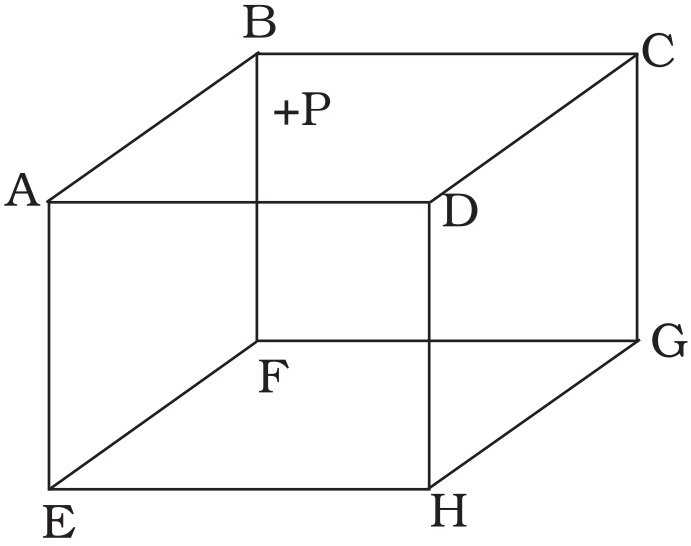
- A
- B
Will not be valid, since the ions would experience forces other than due to collisions with the walls.
- C
Will not be valid because isotropy is lost.
- ✓
Both $B$ and $C$
AnswerCorrect option: D. Both $B$ and $C$
Due to the presence of hydrogen ions and $+ve$ charged wall $\text{ABCD}$ there will be electrostatic force which acts apart of collision, so Kinetic theory of gas will not be valid. Due to the presence of ions in place of hydrogen molecules the isotropy is also lost.
View full question & answer→MCQ 2181 Mark
For a mole of solid the total energy is:
MCQ 2191 Mark
The gases carbon monoxide $(CO)$ and nitrogen $(N_2)$ at the same temperature have kinetic energies $E_1$ and $E_2Z,$ respectively. Then,
AnswerCorrect option: A. $E_1=E_2$
View full question & answer→