Question
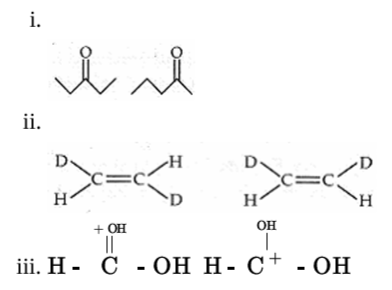
1. What is the relationship between the members of following pairs of structures? Are they structural or geometrical isomers or resonance contributors?
Image
2. A sample of 0.50 g of an organic compound was treated according to Kjeldahl's method. The ammonia evolved was absorbed in 50 mL of $0.5 M H _2 SO _4$. The residual acid required 60 mL of 0.5 M solution of NaOH for neutralisation. Find the percentage composition of nitrogen in the compound.

Answer

1. i. Structural isomers (actually position isomers as well as metamers)
ii. Geometrical isomers
iii. Resonance contributors because they differ in the position of electrons but not atoms
$\begin{aligned} & \text { 2. Volume of the acid taken }=50 mL \text { of } 0.5 M H _2 SO _4 \\ & =25 mL \text { of } 1.0 M H _2 SO _4 \\ & \text { Volume of alkali used for neutralisation of excess acid } \\ & =60 mL \text { of } 0.5 M NaOH \\ & =30 mL \text { of } 1.0 M NaOH \\ & H _2 SO _4+2 NaOH \longrightarrow Na _2 SO _4+2 H _2 O \\ & 1 \text { mole of } H _2 SO _4=2 moles \text { of } NaOH \\ & \text { Hence, } 30 mL \text { of } 1.0 M NaOH =15 mL \text { of } 1.0 M H _2 SO _4 \\ & \therefore \text { Volume of acid used by ammonia }=25-15=10 mL \\ & \% \text { of nitrogen }=\frac{1.4 \times N_1 \times \text { vol. of acidused }}{w} \\ & \text { (where, } N _1=\text { normally of acid and w }=\text { mass of the organic compound taken) } \\ & \% \text { of nitrogen }=\frac{1.4 \times 2 \times 10}{0.5}=56.0\end{aligned}$

Need a full question paper?

Generate a complete, print-ready paper with questions like this in minutes — across 16+ boards, with answer keys.

Start Generating Free

Similar questions

  1. A cylinder of gas supplied by a company is assumed to contain 14kg of butane. If a normal family requires 20000kJ of energy per day for cooking, how long will the cylinder last?
  2. If the air supplied to the burner is insufficient, a portion of gas escapes without combustion. Assuming that 25% of the gas is wasted due to this inefficiency, how long will the cylinder last (Heat of combustion of butane $= 2658kJ/ mol.)?$
i. A vessel of $1.00 dm ^3$ capacity contains $16.00$ g of oxygen and $8.00$ g of hydrogen at $17^{\circ} C$. Calculate the partial
ii. According to kinetic molecular theory, explain why gases exert pressure?
iii. How is isotherm at critical temperature of a gas different from those at lower temperatures?
How do atomic radius vary in a period and in a group? How do you explain the variation?
How do you account for the formation of ethane during chlorination of methane?
Define hydrogen bond. Is it weaker or stronger than the van der Waals forces?
How many neutrons and protons are there in the following nuclei?
$\text{ }^{13}_{06}\text{C},\text{ }^{16}_{08}\text{O},\text{ }^{24}_{12}\text{Mg},\text{ }^{56}_{26}\text{Fe},\text{ }^{88}_{38}\text{Sr}$
Match the species in Column I with the type of hybrid orbitals in Column II.
 
Column I
 
Column II
i.
$H_3O^+$
a.
Linear
ii.
$HC = CH$
b.
Angular
iii.
$\text{ClO}^{-}_{2}$
c.
Tetrahedral
iv.
$\text{NH}^{+}_{4}$
d.
Trigonal bipyramidal
 
 
e.
Pyramidal
What are the major differences between metals and non-metals?
A sample of pure $PCl _5$ was introduced into an evacuated vessel at 473 K . After equilibrium was attained, concentration of $PCl _5$ was found to be $0.5 \times 10^{-1} mol L ^{-1}$. If value of $K _{ C }$ is $8.3 \times 10^{-3}$, what are the concentrations of $PCl _3$ and $Cl _2$ at equilibrium?
$
PCl_5(g) \rightleftharpoons PCl_3(g)+Cl_2(g)
$
Explain briefly about the electrochemical series and give its main uses.