Question
Define hydrogen bond. Is it weaker or stronger than the van der Waals forces?
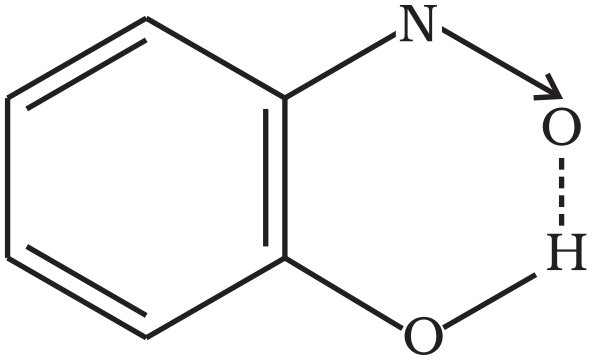
Answer


A hydrogen bond is defined as an attractive force acting between the hydrogen attached to an electronegative atom of one molecule and an electronegative atom of a different molecule (may be of the same kind).
Due to a difference between electronegativities, the bond pair between hydrogen and the electronegative atom gets drifted far away from the hydrogen atom. As a result, a hydrogen atom becomes electropositive with respect to the other atom and acquires a positive charge. a positive charge.
$4^\delta-\text{X}^{\delta-}.......\text{H}^{\delta+}-\text{X}^{\delta-}.......\text{H}^{\delta+}-\text{X}^\delta$
The magnitude of H-bonding is maximum in the solid state and minimum in the gaseous state.
There are two types of H-bonds:
  1. Intermolecular H-bond e.g., $\mathrm{HF}, \mathrm{H}_2 \mathrm{O}$ etc.
  2. Intramolecular H-bond e.g., o-nitrophenol.
  1. Hydrogen bonds are stronger than Van der Walls forces since hydrogen bonds are regarded as an extreme form of dipole-dipole interaction.

Need a full question paper?

Generate a complete, print-ready paper with questions like this in minutes — across 16+ boards, with answer keys.

Start Generating Free

Similar questions

State the industrial uses of common ion effect and solubility product.
  1. Why is HF liquid but HCl, HBr, Hl are gases?
  2. Why is o-nitrophenol steam volatile whereas p-nitrophenol is not steam volatile?
  1. Arrange the following in decreasing order of their bond angle: $H_2O, NH_3, H_2S$
  2. Sketch the bond moments and resultant dipole moment of the following molecule:
$H_2O, NH_3, NF_3$ and $PCl_5$​​​​​​​
  1. Draw shape of the following molecules on the basis of VSEPR theory:
$XeF_4$ and $SF_4$​​​​​​​. (At. No. of Xe = 54, At. No. of S = 16)
Explain the oxidation number method to balance the redox reaction with explain.
Calculate the pH of a solution formed by mixing equal volumes of two solutions A and B of a strong acid having pH = 6 and pH = 4 respectively.
Perform the following calculations and express the results to proper number of significant figures.
  1. $144.3 m^2 + (2.54 m \times 8.4 m)$.
  2. $(4.05 \times 10^2mL) - (0.0225 \times 10^2mL)$.
  3. $(3.50 \times 10^2cm) (4.00 \times 10^6cm)$.
Write down the reactions involved during the formation of photochemical smog.
Match the correct atomic radius with the element.
 
Element
 
Atomic radius
i.
Be
A.
74
ii.
C
B.
88
iii.
O
C.
111
iv.
B
D.
77
v.
N
E.
66
If the position of the electron is measured within an accuracy of $\pm0.002\text{nm},$ calculate the uncertainty in the momentum of the electron. Suppose the momentum of the electron is $\frac{\text{h}}{4\pi_{\text{m}}}\times0.05\text{nm},$ is there any problem in defining this value.
Write chemical reactions to justify that hydrogen peroxide can function as an oxidising as well as reducing agent.
The solubility product of $Al ( OH )_3$ is $2.7 \times 10^{-11}$. Calculate its solubility in $gL ^{-1}$ and also find out pH of this solution. (Atomic mass of $Al =27 u$ ).