MCQ

Image
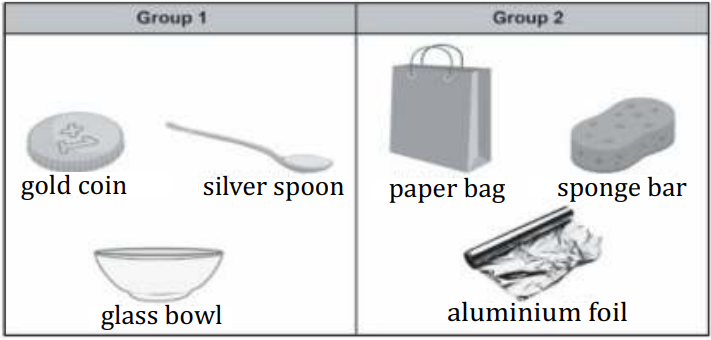
$1.$ Which property was used to sort the objects in two groups?
  •  Hard/Soft
  • B
     Shiny/Dull
  • C
    Transparent/Opaque
  • D
     Water soluble/Water insoluble

Answer

Correct option: A.
 Hard/Soft
 Hard/Soft

Need a full question paper?

Generate a complete, print-ready paper with questions like this in minutes — across 16+ boards, with answer keys.

Start Generating Free

Similar questions

Idhant wanted to ind out which type of food his rabbit likes the most.
He offered different kinds of food to his rabbit for ive days.
Idhant noted the food item that his rabbit chose to eat every day.
Day Food given to the rabbit Food item chosen by the rabbit
Day $1$ Spinach and carrot Carrot
Day $2$ Grass and carrot Grass
Day $3$ Carrot and pineapple Carrot
Day $4$ Grass and carrot Grass
Day $5$ Pineapple and strawberry Pineapple
$10$.Which food item did the rabbit like the most?
Sumit wants to find out if burning takes place only in the presence of air.
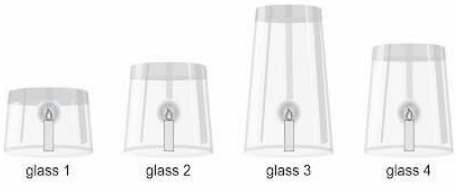
He places a burning candle inside each of the four inverted glasses.
Image
$1.$ Inside which glass will the candle stop burning last?
$A.$ Glass $1$
$B.$ Glass $2$
$C.$ Glass $3$
$D.$ Glass $4$
$2.$ What should Sumit keep the same for the activity?
Circle $‘Yes’$ or $‘No’$ for the correct response.
Should this be kept the same? $Yes$ or $No$
Size of the candles $Yes/No$
Thickness of the glass walls $Yes/No$
$3.$ Which of these shows that air contains water vapour?
$A.$ Steam is produced when water is heated.
$B.$ Road surfaces shine on hot summer days.
$C.$ Dew appears on plant leaves on winter nights.
$D.$ Tiny particles shine in a narrow beam of sunlight.
Which of these adaptations helps to keep animals cool?
Which device needs an electric cell to work?
 
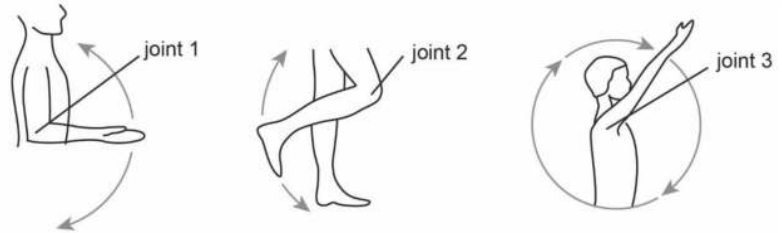
Joints are the locations in the human body where two bones are connected.
The picture shows three types of joints.
The arrows show the movement of the bones in each joint.Image
$3.$ In which joint can the pair of bones move in all directions?
$4.$ Which two joints shown in the picture are of the same type?
Mention the name for that type of joint.
$5.$ Some bone joints are ixed and the bones at those joints cannot move.
Which of these are ixed joints?
$A.$ Joints in the toe
$B.$ Joints in the neck
$C.$ Joints in the wrist
$D.$ Joints in the skull

 
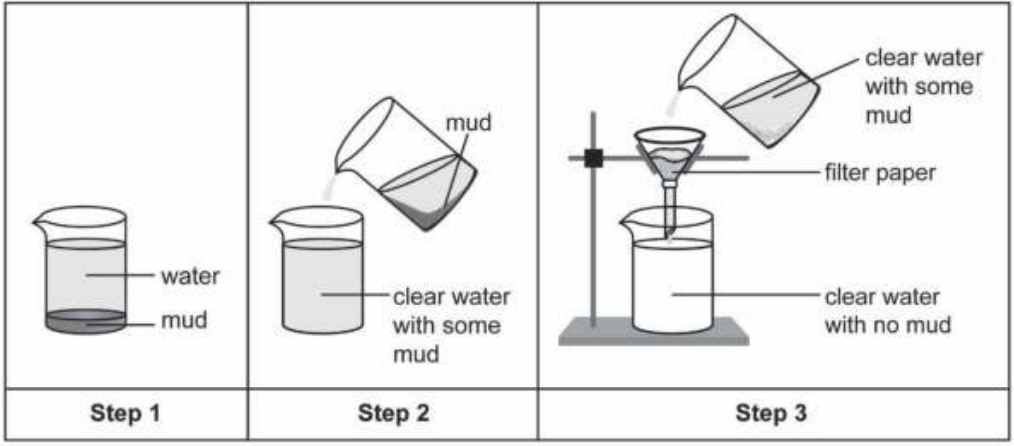
Saroj collected muddy water from a pond.
He separated the water from the mud in three steps as shown in the pictures below.
Image
$1.$ Which separation method did Saroj use at each step?
Select the correct row.
  Step $1$ Step $2$ Step $3$
$A.$ Evaporation Sedimentation Decantation
$B.$ Sedimentation Decantation Filtration
$C.$ Decantation Sedimentation Condensation
$D.$ Sedimentation Filtration Decantation
$2.$ Did Which of these properties did Saroj use to separate mud from water?
$A.$ Mud loats on water.
$B.$ Mud dissolves in water.
$C.$ Mud turns water cloudy.
$D.$ Mud is heavier than water.
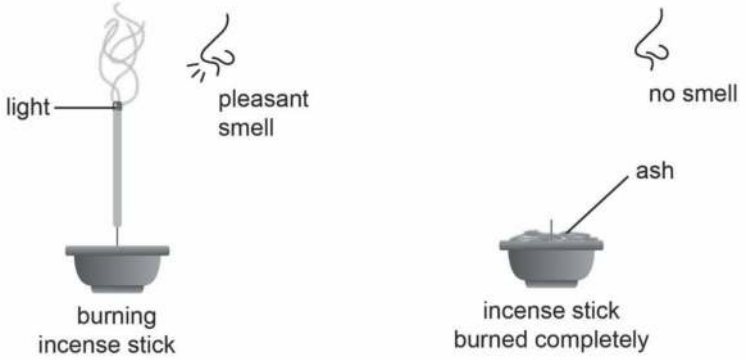
Mary lit an incense stick.
She sensed a pleasant smell for as long as the stick was burning.
The incense stick burned up completely, leaving some ash behind.Image
$3.$ What can be concluded from Mary’s activity?
Circle $‘Yes’$ or $‘No’$ to mark your response.
Can this be concluded from the activity? $Yes$ or $No$
Incense sticks contain chemicals that produce smell when burnt Yes/No
Burning of incense sticks produces light. Yes/No
A new substance is formed by the burning of incense sticks. Yes/No
$4.$ Which of these changes can be reversed?
$A.$ Boiling of egg
$B.$ Burning of wood
$D.$ Making curd from milk
$C.$ Melting of ice cream
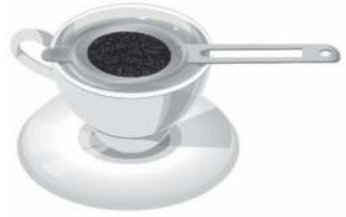
Tea leaves are separated with a strainer while pouring tea.
Image
$7.$ What property of tea leaves is used to separate them from the tea?
 
Image
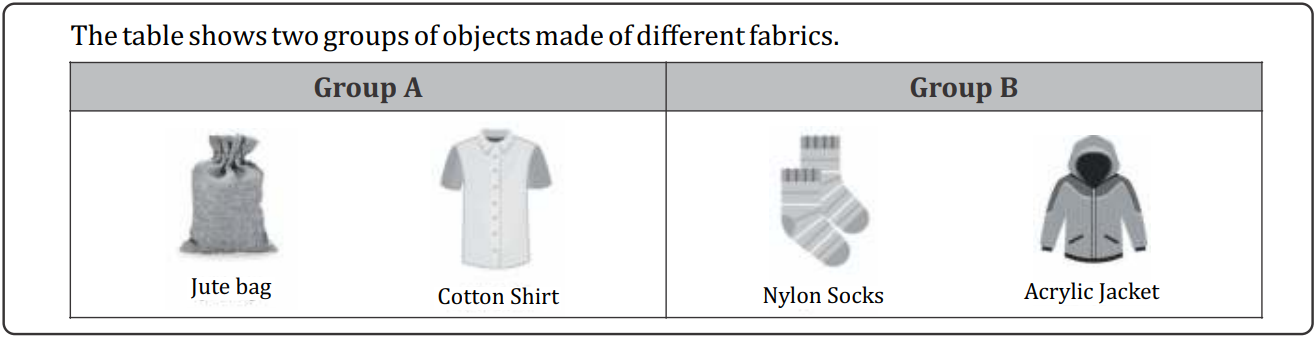
$3.$Which feature was used to group the fabrics?
$A.$ Shiny/Dull
$B.$ Rough/Smooth
$C.$ Natural/Synthetic
$D.$ Animal ibre/Plant ibre
$4.$What is the correct sequence for making cotton shirt from cotton balls?
$A.$ Fabric spun into fibres $\rightarrow $Fibres woven into yarn
$B.$ Fibres spun into yarn $\rightarrow $Yarn woven into fabric
$C.$ Yarn woven into fabric $\rightarrow $ Fabric spun into fibres
$D.$ Yarn knitted into fibres$ \rightarrow $ Fibres woven into fabric
$5.$Which part of a cotton plant is used to obtain cotton balls?
$A.$ Fruit
$B.$ Stem
$D.$ Leaves
$C.$ Flowers
The table describes the body shape of four animals.
Animal Shape of the body
Animal $P$ Large body with pillar-shaped legs
Animal $Q$ Slim body tapered at both ends
Animal $R$ Round body with large claws
Animal $S$ Star-shaped body with tiny legs
$9.$ Which animal is likely to swim the fastest in water?
$A.$ Animal $P$
$B.$ Animal $Q$
$C.$ Animal $R$
$D.$ Animal $S$
$10.$Which of these statements is true about yoga?
Circle $‘Yes’$ or $‘No’$ to mark your responses.
Is the statement true about yoga? $Yes$ or $No$
Yoga helps to make the backbone lexible. $Yes/No$
Yoga helps adults grow taller. $Yes/No$
Yoga helps in treating breathing problems. $Yes/No$