MCQ
$10 \,\,gm$ of ice at $0^o C$ is kept in a calorimeter of water equivalent $10 \,\,gm$. ....... $cal$ heat should be supplied to the apparatus to evaporate the water thus formed? (Neglect loss of heat)
  • A
    $6200 $
  • B
    $7200$
  • C
    $13600$
  • $8200 $

Answer

Correct option: D.
$8200 $
d
Heat supplied to ice to change from $0^{\circ} \mathrm{C}$ ice to $100^{\circ} \mathrm{C}$ vapour is

$M L_{f u s i o n}+M C \Delta T+M L_{v a p}$

$Q_{1}=10 \times 336+10 \times 4.2 \times 100+10 \times 2260$

$Q_{1}=30160 \mathrm{J}$ or $7200 \mathrm{cal}$

Heat for calorimeter $Q_{2}=10 \times 1 \times 100=1000 \mathrm{cal}$

$Q=Q_{1}+Q_{2}=8200 \mathrm{cal}$

Need a full question paper?

Generate a complete, print-ready paper with questions like this in minutes — across 16+ boards, with answer keys.
Start Generating Free

Similar questions

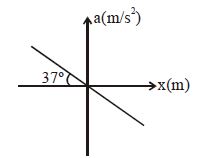
The acceleration displacement graph of a particle executing $SHM$  is shown in figure. The time period of simple harmonic motion is
A perfect gas at $27^\circ C$ is heated at constant pressure so as to double its volume. The temperature of the gas will be:
The escape velocity of a sphere of mass $m$ is given by $(G=$ Universal gravitational constant; $M_e=$ Mass of the earth and $R_e=$ Radius of the earth)
A gas behaves more closely as an ideal gas at:
Two masses $m_1$ and $m_2$ ($m_1$ > $m_2$) are connected by massless flexible and inextensible string passed over massless and frictionless pulley. The acceleration of center of mass is
An inclined plane makes an angle of $30^o$ with the horizontal. $A$ solid sphere rolling  down this inclined plane from rest without slipping has a linear acceleration equal to
The stream of a river is flowing with a speed of $2\,km/h.$ A swimmer can swim at a speed of $4\,km/h.$ ....... $^o$ should be the direction of the swimmer with respect to the flow of the river to cross the river straight .
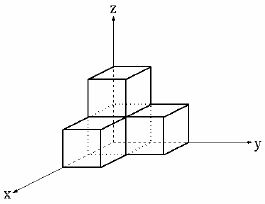
Find the center of mass $(x,y,z)$ of the following structure of four identical cubes if the length of each side of a cube is $1$ unit.
Two particles are projected from the same point with the same speed $u$ such that they have the same range $R$, but different maximum heights, $h_1$ and $h_2$. Which of the following is correct ?
A tuning fork produces $4\text{beats/ sec}$ with another fork of frequency $288\ \text{c.p.s}$. A little wax is placed on the unknown fork and it then produces $2\text{beats/ sec.}$ The unknown frequency is: