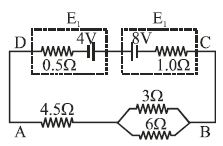
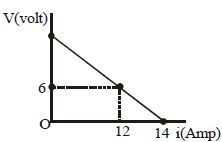
$10\,Cells$, each of emf $'E'$ and internal resistance $'r'$, are connected in series to a variable external resistance. Figure shows the variation of terminal potential difference of their combination with the current drawn from the combination.$Emf$ of each cell is ............. $V$
Medium
Download our app for free and get started
From similar triangle method
$\frac{6-0}{14-12}=\frac{E-0}{14-0}$
$\frac{6}{2}=\frac{E}{14} \quad \Rightarrow E=42$ $\mathrm{volt}$
$\mathrm{E}_{\mathrm{eq}}=42=10 \mathrm{\,E} \quad \Rightarrow \mathrm{E}=4.2 \mathrm{\,volt}$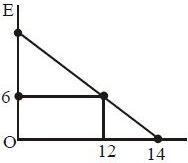

Download our appand get started for free
Experience the future of education. Simply download our apps or reach out to us for more information. Let's shape the future of learning together!No signup needed.*
Similar Questions
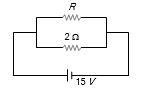
- 1If in the circuit, power dissipation is $150\, W$, then $R$ is ............... $\Omega$View Solution
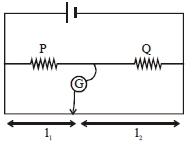
- 2The meter bridge shown is in balanced position with $\frac{\mathrm{P}}{\mathrm{Q}}=\frac{\mathrm{l}_{1}}{\mathrm{l}_{2}}$. If we now litterchange the positions of gavanometer and cell, will the bridge work? If yes, what will be balance condition?View Solution
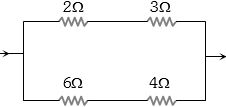
- 3In the circuit as shown in the figure, the heat produced by $6\, ohm$ resistance due to current flowing in it is $60$ calorie per second. The heat generated across $3\, ohm$ resistance per second will be ................. $calorie$View Solution
- 4A battery having $e.m.f.$ $5\,\,V$ and internal resistance $0.5$ $\Omega$ is connected with a resistance of $4.5 \,\Omega$ then the voltage at the terminals of battery is ............. $V$View Solution
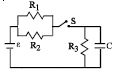
- 5The circuit shown in the figure consists of a battery of $emf$ $\varepsilon = 10 \,V$ ; a capacitor of capacitance $C = 1.0$ $ \mu F$ and three resistor of values $R_1 = 2$ $\Omega$ , $R_2 = 2$ $\Omega$ and $R_3 = 1$ $\Omega$ . Initially the capacitor is completely uncharged and the switch $S$ is open. The switch $S$ is closed at $t = 0.$View Solution
- 6The balancing length for a cell is $560 \;\mathrm{cm}$ in a potentiometer experiment. When an external resistance of $10 \;\Omega$ is connected in parallel to the cell, the balancing length changes by $60\; \mathrm{cm} .$ If the internal resistance of the cell is $\frac{\mathrm{N}}{10} \;\Omega,$ where $\mathrm{N}$ is an integer then value of $\mathrm{N}$ isView Solution
- 7When the current $i$ is flowing through a conductor, the drift velocity is $v$. If $2i$ current is flowed through the same metal but having double the area of cross-section, then the drift velocity will beView Solution
- 8A current of $1\, mA$ is flowing through a copper wire. How many electrons will pass a given point in one secondView Solution
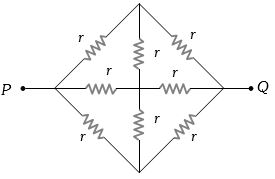
- 9The equivalent resistance between the points $P$ and $Q$ in the network given here is equal to ................ $\Omega$ (given $r = \frac{3}{2}\Omega $)View Solution
- 10In the given circuit, calculate the value of current in $4.5\,\Omega $ resistor .............. $\mathrm{A}$View Solution